
You are currently browsing the tag archive for the ‘Google’ tag.

–
This is mind-boggling. But perhaps not surprising. It’s another very large leap in AI/robotics/super-computing.
At Google, Tobias Weyand and his team have trained a deep-learning machine to work out the location of almost any photo using only the photo; only the pixels it contains.
They fed the neural network–which they’ve named PlaNet–126 million images along with their accompanying Exif location data. Based upon that info, when fed a new image, PlaNet analyses visual clues (buildings, topography, vegetation, weather, etc) to determine the most probable location.
“PlaNet is able to localize 3.6% of the images at street-level accuracy and 10.1% at city-level accuracy,” say Weyand and co. What’s more, the machine determines the country of origin in a further 28.4% of the photos and the continent in 48% of them.
So that’s 3 in every 100 PlaNet puts right at the front door. 1 in 10, it knows the city, and in over a quarter the neural network correctly identifies the country. Impressive.
–
What’s the future looking like? For the first time, I’m really fretting over the strength of the global human community to make the right–and ever-recurring–decisions on the ethics and control of AI. After a computer beat the world’s best Go player this month, the making of AlphaGo (another Google project) warned against hasty application of AI technologies. Stephen Hawking has been erring caution for decades. AI is still is a long way from applying learning from one system to another so we needn’t worry about self-driving cars learning to control markets or journalism robots changing careers and taking the reigns of power.
But who’s to say that in a few decades, you won’t be able to connect the automated detection of news events in, say, social media, to trigger the dispatch of drones pre-programmed to make photos (behind police tape/above breaking stories/inside toxic environs)? Then the images are sent images to the systems of robot journalists which in turn publish a story in a template. Possible? Maybe. Fine-tune the identifying capacity of PlaNet and you’ve accurate captioning info enough to furnish a news agency … and dispose of the photojournalist!?!
Such a scenario would take care of breaking news, but I’ll still wager on humans, not robots, to fashion the long-form documentary projects. Hell, by then, documentary photography stories might be one of the few things left connecting us!
–
Thanks Robert Gumpert for the tip off

All I want for Christmas is more weird images.
Twelve months ago, I posted To You, Happy Christmas, From Google Image Search. I guess now that I’m revisiting the format, it’s now a holiday tradition? I don’t know if this years selection tops last. I’ll let you be the judges.
Merry seasonal cheer to one and all.

















It’s pretty cool that if you punch in ‘Broomberg and Chanarin‘ on Google, after their website, my commentary is next up.
I have great respect for Broomberg and Chanarin’s work.
Don’t worry, it won’t go on my resume or anything but it shows at least Google notices what I’m doing.
What would be the phrase for this faceless recognition? Googlelove > G-Love > Glove? I’m wittering.
Image: From Afterlife, an investigation and de-construction of iconic images taken in 1979 that came to define a moment in both Iranian and photographic history. (Source)
Danny Lyon spoke out last week about Google books’ disregard for rights, artistic craft and common respect. In Google vs. The Bikeriders he lays out a short and no nonsense argument.
Lyon doesn’t oppose digital distribution of his work – he just doesn’t want it scanned en masse. He wants publishers, software programmers and artists to do the work.
On the existence of books, Lyon warned, “I’d be real careful about messing with this stuff. I’m not sure I would want to live without them.”
FULL STATEMENT
The Bikeriders 1968, The Destruction of Lower Manhattan 1969, and Conversations with the Dead 1971, were all out of print within two years of their publications. They had all been remaindered by their publishers and would remain out of print for at least twenty years each.
“Conversations” is still out of print. Under Google’s new rules, Conversations with the Dead could be scanned and put on line by Google without even contacting me. Many photo book makers are torn between standing up for their rights, and “being left out” by the Ruler of the Internet.
So what is wrong with having Goggle (sic) bring my out of print work to the world wide web?
1) It is theft. Ownership of out of print work reverts to the author (me). Copyright has worked well in America for centuries and is part of the foundation of our Democracy and the Ist Amendment. I own my writing and my work. They really do have to ask.
2) Picture books are different. You cannot scan them and put them on the internet. Scanning a printed image destroys the beauty of the work which is embedded in the work itself. That is why authors make picture books. They are making a thing of beauty. That is why printers, ink, paper, and publishers and production managers are all so important. They all work to create a thing of beauty, a book. In this case, as picture book.
There is nothing wrong with putting a picture book on the internet. But that can only be done the way a book is printed, which is to scan the individual images. It is the difference between “the real thing” and a bad xerox of it.
If they want “Conversations with the Dead” on the internet they have to work with publishers, who employ the people to make the prints and make the scans and recreate the book for internet use, just the way a person makes a good website.
That’s a lot of work that will create a lot of jobs, and it should.
Publishers are the people to do this, as they are in the book business. Google seems intent on destroying the book business and its just possible, that they will.
Books, the printed smelly kind you hold in your hand, have been part of and have helped advance civilization for five hundred years. The Greeks and Ancient Jews used papyrus rolls, which they also held to write on, and to read, 2,500 years ago. I’d be real careful about messing with this stuff. I’m not sure I would want to live without them.
I am amazed that Lyon even needs to fight a corner on this. He surely is more valuable to us than scanned copies of his books.
How to tell Google to lay off Lyon’s publications?
__________________________________________________
Danny Lyon’s website is Bleak Beauty.
Here for everything else:
http://www.americansuburbx.com/2009/08/theory-end-of-age-of-photography-by.html
http://5b4.blogspot.com/2007/10/like-thiefs-dream-by-danny-lyon.html
http://www.luminous-lint.com/app/photographer/Danny__Lyon/C/
http://www.scottnicholsgallery.com/artists/danny-lyon/23.html
http://www.geh.org/ne/mismi2/lyon_sld00001.html
http://www.americansuburbx.com/2008/01/theory-doing-life-interview-with-danny.html
http://www.nytimes.com/2009/04/26/arts/design/26kenn.html
http://www.mocp.org/collections/permanent/lyon_danny.php

US Soldiers in a Mosul Internet Cafe. Photo Credit: Andy HoboTraveler.com World Travels. http://www.hobotraveler.com/120mosul03.shtml
Last week, BLDGBLOG published How The Other Half Writes: In Defence of Twitter. It slammed Margaret Dowd’s “brain-dead editorial” in which she pouted like an adolescent instead of actually interviewing Twitter founders, Stone and Williams.
In Defense of Twitter was vitriolic and robust in its argument. Geoff usually sticks to urban-tectonics, mobile architecture and Los Angeles, so it was unusual to see him drop down to the base debate over whether Twitter is good or not. Alas, he dropped in and closed the debate.
Geoff’s argument was that Twitter is essentially a note taking application, and we shouldn’t crap ourselves just because the post-its are seen by the world.
Paul Carr’s article in the Guardian today suggested Twitter can take care of itself anyway. Twitter and other webomediasphere-folk have been brought in to consult on the loose ends and cable ends of a frayed Iraq. Carr exhorts
“I am not making this up. The department has just airlifted Twitter’s Jack Dorsey along with representatives from WordPress, Meetup.com, YouTube and Google into Baghdad to discuss how social media can help build Iraq 2.0″
Carr’s article runs at the same time the New York Times picks up on the story.
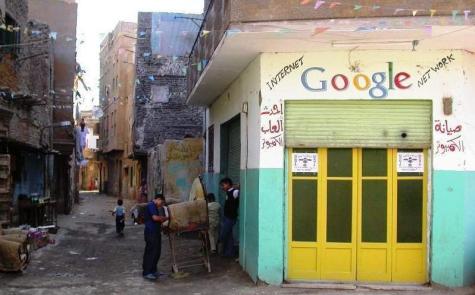
Internet Cafe in Baghdad. Photo Credit: BlogIraq (died April 2008). http://www.blogiraq.info/2007/02/22/at-last-google-opens-and-office-in-baghdad/
The US military’s partnership with non-military groups/corporations takes me back to a presentation made in 2005 (the pre-Obama era). Thomas Barnett bleated about the failings of the Iraq (mainly the “six months of dicking around” after Saddam was toppled). He relates all of this to the US military’s ongoing deficiencies since the end of the cold war. The American army can annihilate any chosen subject but it has not paid much attention to post-major-operations rebuilding. Iraq is a sorry testament to that fact. Barnett suggested a flood of 250,000 “administrators” into Iraq in April 2003 would have stabilised the country a lot quicker.
It seems the US military is now calling upon Twitter and others as “post-war administrators” infrastructure builders, vacuum fillers – whatever you want to call them – as described by Barnett. What should one make of this? Why shouldn’t Twitter et al. be working to improve the long term prospects of Iraq? The US military is great at shock, awe, power and might, but not building community. Barnett prefers his soldiers “young, male, unmarried and slightly pissed off”. But he insists the military personnel be followed up by a flood of partners who facilitate the the rebuilding of infrastructure. A 19 year old marine cannot carry out both distinct functions/philosophies of war.
I don’t like Barnett’s tone. I like his honesty about the realities of military combat, but not his pompous humour. Barnett takes on many groups; multiple government agencies, the UN, TSA, and not least liberals who squirm uncomfortably to pussy jokes. But just because he takes on the military – just because we share opposition to the Iraq war – does not makes us allies in thought. Barnett wants to make military better and ultimately a more efficient killing machine.
Military Icons for PC
It is perhaps this quote by Barnett describing the relationship of military and non-military responsibilities through hypothetical steps of entering, winning and closing warfare, that positions Twitter best. Twitter is part of the second group.
“The first group takes down networks, the second group puts them up. You’ve got to wage war here, in such a way to facilitate that [second group reconstruction activities]. “
Again, what should one make of this? Everyone knows about Halliburton, because of Cheney’s associations. Are Twitter and its do-no-evil web 2.0 pioneers any different to the tens of thousands of other corporate interests in Iraq?
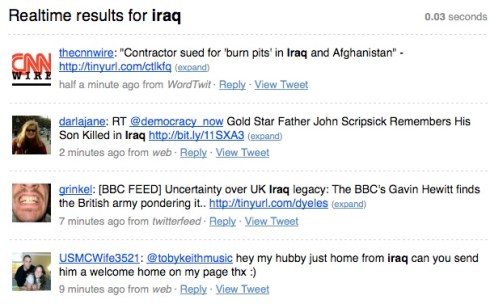
Screenshot of "Iraq" Search on Twitter. April 28th 2009
Kevin Van Aelst for The New York Times
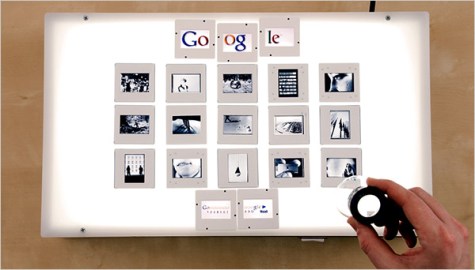
I posted about Google’s collaboration with LIFE Magazine a few months ago. I – like many folk – were excited to dig in, ferret about and generally enjoy the visual culture of decades past. It seems the novelty has worn off for some. An excellent diatribe, Photo Negative, in the New York Times last week made the point succinctly.
“When Google first announced on its blog that the Life archive was up, it seemed like another Google good deed: rescuing the name of Life magazine and the glorious 20th-century tradition of still photojournalism. But Google has failed to recognize that it can’t publish content under its imprint without also creating content of some kind: smart, reported captions; new and good-looking slide-show software; interstitial material that connects disparate photos; robust thematic and topical organization. All this stuff is content, and it requires writers, reporters, designers and curators. Instead, the company’s curatorial imperative, as usual, is merely ‘make it available’.”
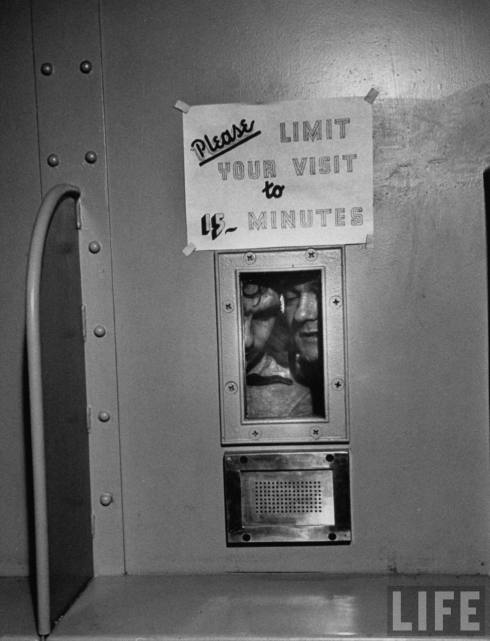
Prisoners watching baptism of repentant killer, in Harris County jail, TX, US. March 1954. Credit: John Dominis. ©2008 Google
With little in the platform or functionality to inspire users, Google could find visitors’ perusal time shrinking. Users might face unavoidable limits to their search time and patience. 15 minutes?
Google announced today that it has come to an arrangement with TimeInc to host the LIFE Archive. The archive is one of the largest collections in the world comprised of over 10 million images. This is an incredible new resource for photophiles worldwide. Twenty percent of the images went live today.

Carl Mydans. American flag draped over balcony of building as American and Filipino civilians cheer their release from the Japanese prison camp at Santo Tomas University folllowing Allied liberation of the city. Manila, Luzon, Philippines. February 05, 1945
A very preliminary search using the keyword “Prison” returned twelve pages of 200 images. I was struck by the strength of the handful of images from the Santo Tomas Prison Liberation Series (Manila, Philippines). The Carl Mydans photographs were captured in the days following the camp’s liberation by allied forces. It was one of four camps liberated in the space of a month in January/February 1945.
Rest assured, I will return to this archive in time to source material and discuss more widely the politics of power partially described by the photographic collection. “Mexico Prison“, with over 150 images, certainly looks like interesting material.

Carl Mydans. Freed American and Filipino prisoners outside main entrance of Santo Tomas University which was used as a Japanese prison camp before Allied liberation forces entered the city. Manila, Luzon, Philippines. February 05, 1945
I would like to make clear that this is a hastily put together post and its main function is to draw attention to this fantastic whale-sized new archive – I might go as far to say our archive – I might even go as far to say its bigger than a whale. I do not condone personal whale ownership.
I would also like to clarify that while the LIFE Archive refers to the Santo Tomas Complex as a prison, it was in fact an internment camp – not that naming conventions matter to those who were subject to its walls and discipline. Still, we must always bear in mind the different types of sites of incarceration; what they purported to do; what, in truth, they did; from what context they arose and operated; and how they fit into our general understanding of humans detaining other humans.

Carl Mydans. Emaciated father feeding Army rations to his son after he and his family were freed from a Japanese prison camp following the Allied liberation of the city. Manila, Luzon, Philippines. February 05, 1945
Personally, I encountered a strange coincidence over this matter. Internment camps are low on my list of primary interest. I am not an expert on internment camps. But, only yesterday I received a fantastic email from a Berkeley art history undergraduate who is focusing on the work of Ansel Adams, Toyo Miyatake and Patrick Nagatani at Manzanar War Relocation Center, California. From the internet monolith that is Google to the academic interests of aspiring students, the histories, memories and powerful images of Second World War internment push themselves to the fore of thought.

Carl Mydans. Two emaciated American civilians, Lee Rogers (L) & John C. Todd, sit outside gym which had been used as a Japanese prison camp following their release by Allied forces liberating the city. Manila, Luzon, Philippines, February 05, 1945
It is conventional wisdom that World War II had two sides. Unfortunately, the military definitions of ‘ally’ and ‘enemy’ spilled into civic life with catastrophic consequences. The US internment of Japanese nationals and Japanese Americans has since been proved to be based not on national security but state-sanctioned discrimination. As testimonies and images attest, where stories are concerned, there are more than two sides.
Click here for the LIFE Archive on Google. Here is an obituary for Carl Mydans, the photographer at Santo Tomas. Try here and here for first-hand account of detention and to find audio and visual resources about Santo Tomas Internment Camp.

 Prison Photography