“Prison companies had a plan — a new business model to lock up illegal immigrants. And the plan became Arizona’s immigration law.”

Remember AZ SB1070? Laura Sullivan shows us the greedy plotting behind it.

In the first of two reports, Sullivan exposes the murky connections between Arizona’s legislators and the private prison companies, and how they manufactured a legal landscape to profit form locking up immigrants.

Basically, there is a secretive group called the American Legislative Exchange Council. Insiders call it ALEC. It is “a membership organization of state legislators and powerful corporations and associations, such as the tobacco company Reynolds American Inc., ExxonMobil and the National Rifle Association. Another member is the billion-dollar Corrections Corporation of America — the largest private prison company in the country.”

In December 2009, ALEC convened in Washington D.C. and in cahoots with Arizona state Sen. Russell Pearce, wrote a piece of model legislation that four months later was adopted almost unmodified as an Arizona SB1070.

“As soon as Pearce’s bill hit the Arizona statehouse floor in January, there were signs of ALEC’s influence. Thirty-six co-sponsors jumped on, a number almost unheard of in the capitol.  According to records obtained by NPR, two-thirds of them either went to that December meeting or are ALEC members.”

“That same week, the Corrections Corporation of America hired a powerful new lobbyist to work the capitol. […] At the state Capitol, campaign donations started to appear.”

“Thirty of the 36 co-sponsors received donations over the next six months, from prison lobbyists or prison companies — Corrections Corporation of America, Management and Training Corporation and The Geo Group.”

An absolute scandal.

LAURA SULLIVAN

I have celebrated Sullivan’s reporting before.

Her three-parter on the inequalities and injustices of the bail system is heroic:

Part One: Bail Burden Keeps U.S. Jails Stuffed With Inmates
Part Two: Inmates Who Can’t Make Bail Face Stark Options
Part Three: Bondsman Lobby Targets Pretrial Release Programs

NPR

Reporting such as Sullivan’s is, in simple terms, essential. Which brings the illogic and limelight-obsessions of these idiots’ calling for the defunding of NPR into sharp focus.

Golf Five Zero watchtower. Crossmaglen, South Armagh, Northern Ireland, UK.  © Jonathan Olley.

Last month, I had a jolly nice chat with a jolly nice chap about what all this means at Prison Photography. Where’s this open journal taking me?

I said if I took this whole thing to the academy, it could be as simple as a historic survey: The Uses of Photography to Represent, Control and Surveil Prison, Prisoners and Publics in the United States (1945 – 2010).

I was encouraged to ditch the historical view and engage the modern. Ask myself, why should anyone care about prisons? Only a small minority care now and that status quo has remained for many reasons tied up in the antagonisms of capitalism. Would a historical survey change minds and attitudes or just lay out on paper the distinctions most people have already made between themselves and those in prison?

Perhaps people would care more if the abuse of human rights that exists within the criminal justice system of America were shown to impinge on everyone, not only on those caught in its cogs?*

What if we consider the methods and philosophies of management used by prisons and identify where they overlap with management of citizens in the “free” society. Think corporate parks, protest policing, anti-photography laws, stop and search, street surveillance, wire taps, CCTV.

My contention has always been that there was no moral division or severance of social contract over and through prison walls. For me it’s never been us & them; it is us & others among us put in a particular institution we call prison.

But, now I am seeing also, there is an ever decreasing division of tactics either side of prison walls. Strategies of management and technologies of discipline perfected in prisons have crept into daily routine.

What has this emphasis on containment and of monitoring – at the expense of education and social justice – done to our society and to our expectations of society?

SURVEILLANCE/CCTV IN PHOTOGRAPHY

And now for the tie in with photography…

Thinking about surveillance, obviously we have the big show at Tate from this Summer, Exposed: Voyeurism, Surveillance & the Camera with its devoted section to CCTV. (Jonathan Olley‘s work from Northern Ireland is the standout.)

But I always think back to Tom Wichelow‘s series Whitehawk CCTV (1999), possibly because he insists it is not a criticism of CCTV just a look at the politicisation of the human subject viewed through its lens.

Most remarkable in the series is the trio of images of the tragic site of a murder. They reveal to us that looking and bearing witness can be an act of respect as much as that of curiosity as much as an act of control. We are all compelled to look, but some observers are recording the feed and have a disciplinary apparatus to back it up.

Untitled (CCTV footage). Young family visits murder site. Brighton 1999. © Tom Wichelow

Untitled. Friends of murdered boy visit the site. Brighton 1999. © Tom Wichelow

Untitled. Resident reveals murder site outside her bungalow window. Brighton 1999. © Tom Wichelow

– – –

*There’s a simple argument that we all suffer because our tax dollars support a broken system that makes us no safer.

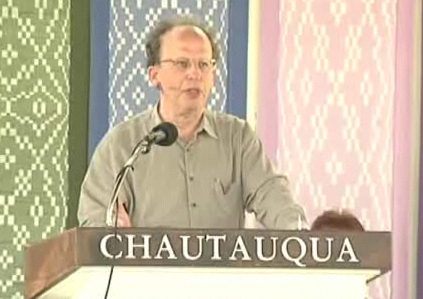
Fred Ritchin’s talk from the Chautauqua Institution is a must watch. It is over an hour, but if you don’t make it through you might just prove his point!

He lays out how digital universe allows us to reorder content as and when we please (a contact sheet has an order; digital files can be swapped about, deleted). He posits that along with the demise of analogue technologies, analogue thinking has disappeared. Today, to read is not to follow a book front to back, to listen to music is not to listen to an album. We take in bits, bytes, single tracks and isolated comments.

Ritchin isn’t moaning, he just wants us to see our current universe for what it is and respond accordingly. Ritchin wants us to use digital [photo] technologies not make models thinner, the pyramids closer or to run algorithms removing unwanted objects from caches of images; he wants us to use digital tools for positive ends. Instead of changing the past and present, why not the future envisioned? Ritchin wants us to present, to image and imagine futures so striking they might alter our behaviours – Earth without animals … or people. If we see the horrifying aftermath of climate change or war maybe we won’t go down that path? Think activist/photo-manipulation hybridism.

Ritchin questions Flickr. Rightly so. The mere upload of imagery is inadequate. After a trip to New Orleans’ Ninth Ward, Ritchin searched Flickr for imagery of “New Orleans”. The first 400 images were of young people partying on their stoops.

Our obsessive production and distribution of images (usually through socially networking) devalues meaning in, and of, photography. In photography we can increasingly find ourselves, but can we find each other? See each other? In a meaningful way?

Photography, as in life, is becoming less about them and us and more about me and I. This is a point Ritchin makes in his recent blog post too:

“I have written elsewhere about the assertion by Paul Stookey (of the singing group Peter, Paul and Mary), about the progression of values in the United States as seen through the popularity of certain magazines. During a 1980s concert he recounted how once the popular magazine in the United States was called Life (about life), then it was People (not about life, but just about people), then it was Us (not even about all people, but just about us), then it was Self (not even about us), and now – to add on to what he had said – it becomes the Daily Me of Nicholas Negroponte, where one’s dentist appointment or Facebook status supersedes the report of the declaration of a new war or healthcare initiative on the “front page” of one’s nearly ubiquitous screen.”

Of course, there is no obligation to use photography always in a means to connect with others.

There is however, an obligation to be honest. As it stands, the predominantly shallow use of image is far less of an insult as that of people obsessed with the past, with the idea of “the power of photography” and with the continued lip service to a dead idea and a false reality.

The prison officials had given us a room where we could talk to the women and I could take their pictures. […] I photographed each woman in a slightly different setting. When it was Williams’ turn, I photographed her next to a calendar showing the date: May 1987.

I told the warden that I wanted to see the women in more of a typical prison setting. After much discussion, I was allowed to photograph Williams in her room, as long as I didn’t show any other prisoners or the barbed wire fences surrounding the prison.

– J.B. Forbes

May, 1987 Chillicothe, Missouri Vicky Williams was 30 years old in 1987 when she posed for a photo in the Chillicothe Correctional Center where she was serving a 50-year sentence for killing her husband. © J.B. Forbes

Here’s a nice human interest piece in the St. Louis Daily by photographer J.B. Forbes.

“I was not interested in judging Vicky Williams’ guilt or innocence,” says Forbes. “This was a woman whose life was dramatically different from mine, someone for whom time had stood still.”

Forbes:

“After a decade-long fight by lawyers who took the cause of several women convicted of murdering their husbands, the state Board of Probation and Parole granted Williams an early release. The lawyers pointed to claims of abuse, the fact that domestic violence was poorly understood years ago, and a new state law that said abuse victims could be granted early release under certain conditions. The move infuriated prosecutors and relatives of Gilbert Williams.”

“By the time Williams walked out of the prison, she had been behind bars for 32 years. She was now 55.”

Forbes was with Williams during her first few hours of freedom following early release. Quite intriguing, to me at least, are Williams’ first requests upon leaving prison:

“One of her first requests was to see the town of Chillicothe. She’d been there all this time, but she had no idea what the town was like. She wanted to see a local Catholic church because she had watched from prison as a crane installed a new steeple there. She wanted to pray there because a priest had prayed in the sanctuary for her during her appeals process.”

“And she wanted to visit the grave of one of the prison guards who had befriended her. When the guard died in 2004, Williams was not allowed to attend the funeral. I watched as she poured a vanilla Coke on the ground next to the grave. It was the guard’s favorite drink.”

[My bolding]

‘I never talk to them… I don’t ask their permission. I don’t pay them… And eventually…I got into trouble’

– Philip-Lorca DiCorcia

I’ve been thinking about surveillance a lot recently.

Philip-Lorca DiCorcia leans on the ubiquity of CCTV to exempt him of guilt for taking portraits without the subjects’ knowledge. It’s a fair point; he worked in public space. Below he talks about his Heads series.

Interesting stuff on DiCorcia here and here.

FOR A HANDLE ON THE US MILITARY’S COMPLICITY IN WIDESPREAD TORTURE IN SAMARRA, IRAQ, WATCH THIS.

FRAGO 242

FRAGO 242 is the US military’s abbreviation of a “fragmentary order” given to US military operatives.

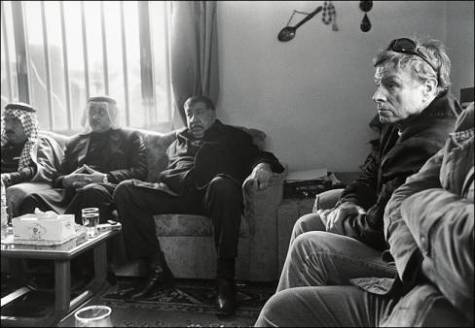
When US military became aware of Iraqi torture of other Iraqis, to quote The Guardian‘s David Leigh, “FRAGO 242 meant that no further investigation was necessary.” When in the custody of Iraqi security forces, detainees were subjected to horrendous abuse. The US turned a blind-eye. The information about this is brilliantly presented in this seven minute video.

Iraqi commandos securing the area after a car chase resulted in the arrest of foreign terrorists. Gilles Peress/Magnum, for The New York Times. (Cropped from original)

Included in the seven minute video are Gilles Peress’ images from a New York Times assignment in 2005. (You can find 23 of Peress’ image from the assignment by searching “Peress Iraq Counterterrorism Commandos” on the Magnum website.)

The writer for that assignment was Peter Maass. He was reporting on the elite Iraq Ministry of Interior Commando Force, known as the Wolf Brigade. For the assignment, Maass shadowed Col. James Steele who he describes as “Petraeus’ man.”

At the invite of Steele, Maas visited a Samarra interrogation center. In this same video, Maass describes the sights and sounds of torture from within. During the interview incredibly loud screams of pain could be heard throughout the building. According to Maass, Steele left the room, the screams fell silent, Steele returned and Maass continued his interview with a Saudi prisoner.

Steele has not yet commented on Maass’ account of that day in Samarra.

General Abul Waleed, Head of Command for the Wolf Brigade, and Col. James Steele, Samarra, Iraq. Gilles Peress/Magnum, for The New York Times.

WHAT JOHN MOORE DIDN’T PHOTOGRAPH

All of this is a very interesting counterpoint to John Moore’s In American Custody.

Moore’s compilation of images from embedded positions at Abu Ghraib and Camp Cropper (2003-2007) have been roundly celebrated since their publication on the 22nd Oct. I don’t see it. The collection is a politically safe edit of images from a war we are technically out of; they are the product of US military deceit. Moore was their pawn.

Moore’s images are benign in comparison to the descriptions set forth by Maass, the Wikileaks files and the thousands of Iraqis whose stories of torture have fallen on deaf ears for the past six plus years.

I know the drill, Got cells to burn,
I’m dressed to kill, A mortal coil,
And time is still, On secret soil.

Yeah pay the bills, Cells to burn, Mouths to fill
On Boeing jets, In the sunset make glowing threats.

Yes shall we take a spin again in business,
This time is fixed lets sweeten our facilities,
It took all the man in me.

Lyrics from Massive Attack’s Atlas Air

The animated video for Massive Attack’s Atlas Air, directed by Edouard Salier is a tour de force.

Rampaging and amorphous, what can only be described as a Donnie Darkoesque were-bunny, rips it way through and across blackened territories of prismatic violence. Against and allied, it runs with commercial jets into explosions. Apparently, this is a second appearance for the satanic leporid; it previously romped around Massive Attack’s last video Splitting the Atom.

The randomness of it all, sometimes seen through a gun-sight, recalls the Wikileaks Apache Attack video. But other things are going on too – burning oil fields (the first Gulf War); shattering buildings (9/11); Prestwick airport gets a mention (not the most well known airport but it was the site of a botched car-bomb attack in 2007).

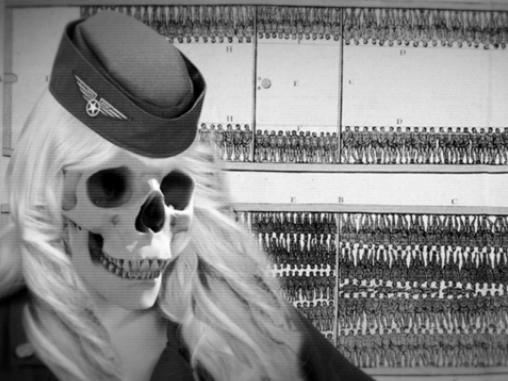
Ultimately, this is a video about extrajudicial rendition flights, the absence of law and the suspension of human rights. The screen grab above – which flashes by so quickly you’ll be forgiven for missing it – deals quite clearly with the involuntary movement of humans, only in this case that of slavery.

Just as the 9/11 plotters usurped commercial airliners for their ideology, the US military adopted commercial jets for its murky logistics. Salier doesn’t miss the opportunity to point out the hypocrisy in the visuals. 737’s get a mention in Atlas Air‘s lyrics.

Salier shows us the negation of order and, perversely, the power-distorted dominance and slick allure of disorder.

By strangling any reason out the compressed annihilation, the Atlas Air video is, for me, one of the finest visualisations of REAL terror. Massive Attack and Salier are not describing anything that relates to the rhetorical usage of the word ‘terror’ pushed on us by war-mongering politicians; they are dealing with pure destructive force as and when it is sent out against an equal force.

This is not a narrative of us against them or of us against them and their allies, or even us and our allies against them and their allies, it is about how fucked it all is … and about the terrifying, beyond-human-scale to which violence escalates. By relying on images of man made cities and theatres of war, Salier reminds us that these crushing vortexes are of our own creation and our own instigation.

I’ve admired Massive Attack’s intelligent use of video before.

*GWOT = Global War on Terror

Private Residence (Owners Deceased). South Philadelphia. November 4, 2008. Copyright © 2010 Ryan Donnell. All Rights Reserved.

Ryan Donnell‘s ‘Behind The Curtain‘ is just fantastic and surprising.

There is a long interview about the series on Eat The Darkness blog.

“When the 2008 election came around I was feeling a little weird since I wasn’t doing anything of importance photographically or journalistically, and it was such an IMPORTANT election (remember that feeling?). So I felt I should participate somehow. I started researching some of the more unusual sounding polling places in the city. The Philadelphia Elections Board actually posts a list of all the polling stations and every place has a small description next to the address, such as “Residence” or “Storefront” or “Water Department Laboratory.” So I made a list of the weirdest sounding places, packed-up my Hassy, tripod and film in my car and basically just drove all over the city of Philadelphia for about 10 hours on Election Day. I’ve done that every election since Nov. 2008.”

EMAIL

prisonphotography [at] gmail [dot] com

Prison Photography Archives

Post Categories