
Wild thanks to Brendan over at Anxiety Neurosis for publishing on the world wide web my recent heartfelt plea to close friends. My words are now world wide … and webby. Seriously, I’d encourage you to read his analysis as he said, with some degree of wit and intelligence, what I had relied on the New York Times Opinion Page to say for me.

David Alan Harvey, Title Unknown, from Living Proof 1 series
I’d advise that you don’t read on after Brendan’s discussion of the propositions regarding criminal justice, as the tone changes to one of outrage and profanity. Do, however, consider Brendan’s intriguing solution to our failed social experiment and financial black hole we know as the prison-industrial-complex.
My daydreams might seem a little strange to you. I envision a system of work-camps spread throughout California. Low-level offenders (obviously non-violent) would be siphoned away from the concrete and steel onto various prison farms. They would become, possibly for the first time, acquainted with the world of plants, dirt, sky. They would be required to till the soil, sow the seed, reap the harvest and above all else participate in a cycle of life greater than their own. The crops (organic, obviously) would be distributed throughout state agencies providing food for the convicts, prisons, schools and state hospitals. Imagine school-children eating something that hadn’t be processed and purchased from a profit-driven third party with no regard for the kids’ health or well-being. At night the inmates of my farms would take various classes both academic and trade-oriented. They could see therapists, take workshops or paint the distant mountains in watercolor. Whatever they need to show them something outside of the life they’ve known. They would have free range of the property in question, requiring a couple fences and a small staff of guards. Where are they going to run to?
Knowing Brendan as I do, he hides here a vulnerable idealism that we would all like to embrace but the bottom-line mentality of modern life has disappointed us too often. We keep our arms folded. Brendan’s main points are uncontestable though – remove non-violent offenders from prisons; engage them in more than wall-staring for 23 hours a day; provide meaningful, even plentiful, opportunities for rehabilitation, education and therapy. Unfortunately, all this costs money and when CDCR struggles to cover the cost of inhumane lock-up the chance of seeing an individual-oriented rehabilitation is less than zero.
Work-camps do exist in California and they specialise in training for fire-abatement. This is a far cry from Brendan’s organic farming initiative, but probably skills in bio-diverse agriculture are as handy as skills in fire suppression. As we continue to burn fossil fuels and globally-warm our summers, growing local crops and putting pay to the 3,000 mile caesar salad, will be as relevant as beating annual forest fires.
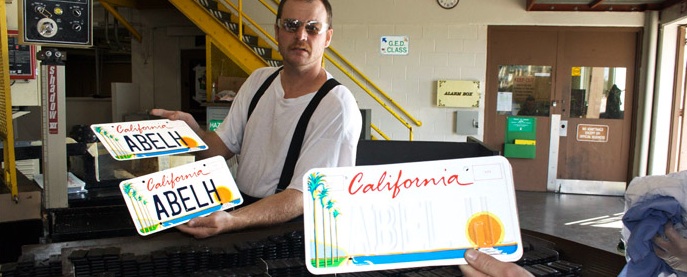
Photographer Unknown
But if we are talking about productive inmates it is worth noting that the CDCR runs the Prison Industry Authority paying inmates anywhere between 30 cents and 95 cents before deductions. This is a body that provides state departments with furniture, uniforms and California drivers with their license plates. Many have described this system as “Modern Day Slave Labor”. If it seems that way, it’s because it is.
CDCR runs the PIA because the state profits from it. Engaging the inmate in daily activity is essential, but we should try to move away from repetitive factory production, or at the very least break it up with other outlets of energy (and ideally even creativity). What other administered programs could occupy inmates’ time? We must consider here programs that do not turn an immediate product or profit – but secure long term savings for society as the inmate is provided with skills and self esteem. The PIA uses 5,900 CDCR inmates. What do the remaining 312,511 men, women and children under CDCR jurisdiction do?
These are general questions (and admittedly subjective gripes) for which there are no correct answers. Nevertheless, with so many systemic problems we should only focus on the problems we can affect and the most timely problems of the CDCR. Californians’ priorities now must be to prevent the motion to change the criminal-justice system into a “victim-vengeance system” (Prop. 9) and the motion to broaden the state’s definition of crime, subjecting thousands more citizens to the abuses of a failed system (Prop. 6).
In the meantime, we can all focus on the watercolour opportunities available to inmates at Wasco State Prison.

Wasco State Prison's new solar field
Note on Images: David Alan Harvey’s image here is included purely for aesthetic reasons. The author confesses no background knowledge of the image, only an intrigue in the juxtaposition between uniform-pressed youth and caricatured-inmates subjected to the humility of stripes and trucker hats. Even if these young men grew up and/or went to the same schools together, there is no relationship between them now. All this is neatly summarised by the wielding of the gun. The guard pays attention to the camera almost unaware of his responsibilities over his shoulder. The rifle makes the guard’s close personal observation of inmates unnecessary; the guard has a back-up. With the use of weaponry, any misdemeanour can be remedied/snuffed out within an instant.
I do not know David Alan Harvey’s views on the prison industrial complex. If I ever acquire that knowledge I will be sure to share it. As well as his website he also has a solid blog.
Disclaimer: This post, while making use of photographic imagery is a non-objective commentary. It has more to do with the author’s politic than an academic look at the photographic medium.

 Prison Photography
3 comments
Comments feed for this article
October 30, 2008 at 1:11 pm
blaark
You’ve drawn attention to the portion of my writing I feel least secure about but I’m glad my wildly delusional hippie dream found a sympathetic ear. I’ll agree that the restructuring of incarceration in America is a pipe-dream but I’m not sure that it’s strictly a matter of lackluster finances and overwhelming set-up costs. If we can have private companies running for-profit prisons via contract agreements there’s no reason we can’t have non-profit alternative prisons.
My cynicism whispers in my ear that the majority of people, particularly the movers and shakers responsible for policy in this country, are hardly inclined to support any project which might lessen the perceived harshness of retribution as dictated by long-standing laws or expose their upright families to the people currently locked away. It benefits the economic health of a country to have more people available for producing and consuming widgets as you’ve noted; the long-term payoff of rehabilitation can’t really be argued against. But when you start bridging the gap between those most likely to be imprisoned (poor) and the lower echelons of the middle class then the upper economic class finds their power in danger of depleting.
December 21, 2008 at 11:55 am
Three Bills
I appreciated the opinion piece about a future incarceration system that allowed those willing and able to seek out a more meaningful reform to do so. Having worked in the system I see more than a few men that, given the chance, would make something of their lives and probably contribute greatly to society. The number of talented artisans, thinkers, and highly intelligent people locked up is alarming to a first time observer.
The first thought I had as I was reading was that many of these individuals don’t come to this understanding of their potential until after many years of incarceration and/or cycling in and out of prisons. Many of the most “enlightened” of them, in my experience, are older and have been through the paces of criminality that has shown them the true foolishness of their behavior. Now, I would argue that a great many of the lower security offenders are just too young and pig headed to see the gift of an enriching and therapeutic program. Also, many of the lesser offenders are diverted out of the prison system, in California at least, a good number (and growing) are largely made up of serious, violent, gang members with little regard for right, wrong or conscience.
As I type this out I come to a conclusion that the money a government would spend on the system described would be better off spent in the communities that generate these individuals. While there will always be crime and criminals, I whole-heartily believe that many of the people can be saved as youths. The truly sociopathic criminal will not be helped, and he/she must be secluded from society, in a humane and safe environment. This type of expenditure would not only revive blight in urban areas but also prevent a great number of the residents of those areas from ending up as victims or guests of the State.
This is only the humble opinion of a “prison guard”.
Thanks for the interesting blog, I will try to read as much as I can, soon. In the meantime, I am going to bed, have to go back to work tonight. Take care. 3bills
December 21, 2008 at 7:34 pm
petebrook
3Bills. Thanks for stopping by and leaving a comment. I agree with you for the most part. I was encouraged to see you begin with acknowledgement of inmates’ talents and potential. I believe many inmates have the ability to realise self-sufficiency and lives not involving serious crime. Unfortunately, this potential relies on many factors including pride, decision-making and fulfilling personal goals that the state cannot affect nor should it attempt to. The state (and other NGOs) should provide opportunities for non-criminal life and individuals must meet these efforts half way.
Sadly, half way is easier for some people to reach than others. It is not a slight change for a prisoner to reform. It is a U-Turn. As you said, age and reflection can affect how readily an inmate welcomes change. We must avoid envisioning a perfect scenario and face disappointment when it does not materialise. I cannot petition individuals to turn away from serious crime and that is why my energies are focused on the operations of the state and namely the CDCR. Every prison in the state is overcrowded. I personally believe many of the facilities are inhumane. This is the first step at which the state falters. The CDCR at its current capacity is in no position to claim it can rehabilitate. It is stretched too thin.
Most people now acknowledge that the prison expansion experiment of the 80s and 90s brought an economic and humanitarian time-bomb. The question is how do we reverse the terrible, even malevolent political decisions of that time in order to restore credibility to California’s prisons? First priority is to fund schools, neighbourhood programs and education and outreach programs. As you said, intervene early, build community. Vernell Crittendon with Real Choices is doing a great job of dispelling the abstract glamour of gang life and criminal choices. He is trying to nip it in the bud.
At this point, trust has waned, moral is low and many folks are still bitter about hard line ‘tough on crime’ rhetoric that never effected crime rates, only ruined lives of new prisoners and their families. There is much work to be done.
The young are always pig-headed – it is just that those inside are sticking to their life choices so far. The obstinacy, arrogance, naivety of other youths is no less troubling, its just that it hasn’t got wrapped up with criminal activity. But age alone doesn’t guarantee wisdom, and the provision of rehabilitation programs to bring forth that wisdom would help most inmates. Do you agree?
Caifornia’s Supermaxes were a direct strategic response to gang activity. I don’t know if Pelican Bay and others have isolated the violence or whether they have removed violence from communities only for it to be replaced again? I have no suggestions for tackling gangs – the problem is so endemic – I am at a loss. I am thoroughly depressed by the psycholgies at use in gang life. That said, I would suggest again an emphasis on early interventions. Children needs mentors and if their parents nor guardians can help, then others must try … but what does this look like?
If I have used the term “prison guard”, do not be offended. I understand many prefer Correctional Officer but I interchange the two. Prison guard does not hold outdated or pejorative meanings for me; correctional officer seems to be a title that side steps the harsh realities of the job, as if prison is an uncomfortable word for some. You are proud of your work and I respect that. I know I could not do what you do having seen the inside of CDCR facilities. I began reading some of Pacovilla’s blog back in 2004, and I find I agree with half of it and put off by the other half that tends toward grandstanding. That said, he is a wonderful contribution to the online community discussing prison issues and I am glad that you too can share your work experiences. Previously, there has been animosity and opposition. Much of this has been based on misunderstanding. Blogs can put out that personal message required often to avoid misunderstanding. I suppose as I type this I wonder, where is the prisoners voice?