
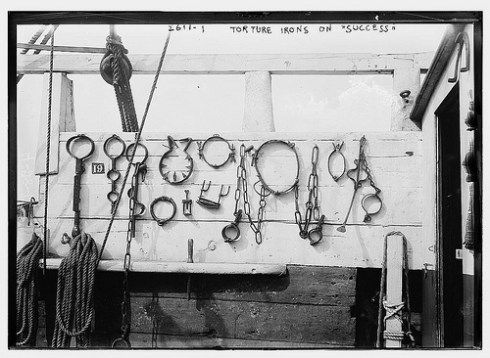
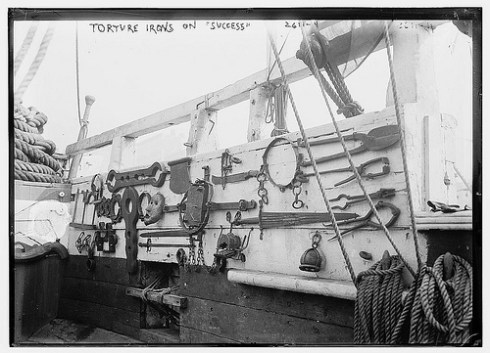
A couple of months ago, I wrote about the prison convict ship Success and its repurposing as a museum ship in the early 19th century. At that time, I featured a couple of images of the ship docked in Seattle and Tacoma. To continue from that visual anchor (pun intended), I’d like to share these few close up images of this unique and long-gone “Museum Ship of Colonial Horrors” (as I like to refer to it).
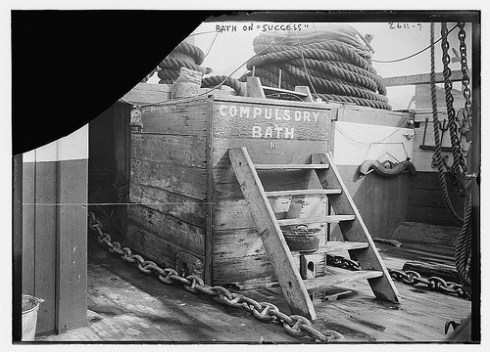
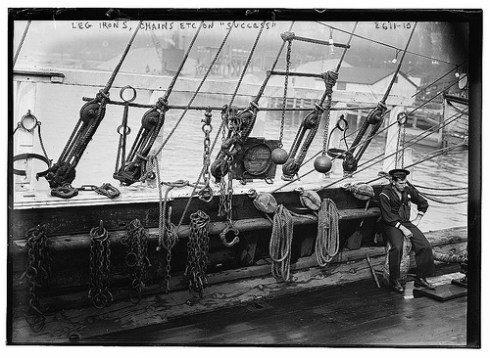 The accoutrements of abuse on display are chilling. The international seafaring exhibit was an old British and latterly Australian ship used for deportation of ‘criminals’ during Victorian times and for non-human commodities thereafter.
I wonder what sort of museological interpretation of Success was given to American audiences? Would this have been kept in a separate narrative to the slavery ships of the Atlantic or would all histories be foisted into one macabre reductive appreciation of the ‘Other’?
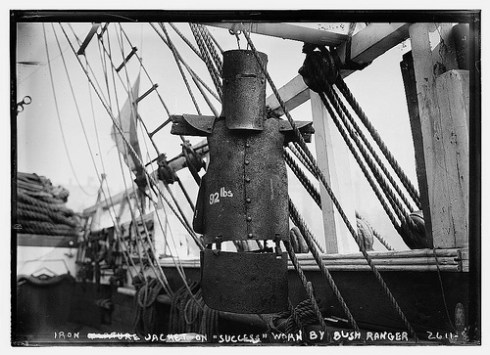
 When I saw the iron jacket I was terrified, but then I read Wystan‘s description of the Wooden Maiden:
If you were very naughty, you might be asked to remove your clothing and climb inside this vertical coffin, where of course it was pitch dark, there was no water, and fresh air was scarce. Then the box (which was clad in sheet iron) would stand in the hot sun until you got nice and warm. But you wouldn’t want to slump or faint, because then your bare flesh might get snagged on the ends of the long nails that had been pounded into it from random directions . . .
All images from the Library of Congress on Flickr,
and searched out through Flickr Commons.

 Prison Photography
7 comments
Comments feed for this article
April 29, 2009 at 3:34 pm
Sven
Yikes! Reminds me of the museum in Rothenburg, Germany, where all the medieval torture devices are on display. Ironic too that they call it the “Crime Museum” nowadays, used to be called the “Torture Museum” when I grew up. Like the evolution from torture to “enhanced interrogation.”
http://www.kriminalmuseum.rothenburg.de/Englisch/whatframe.htm
April 29, 2009 at 5:18 pm
jamblichus
There’s something so banal about pics 1 and 3; as if what is on display were only a toolshed or part of the rigging. Incidentally, have you seen James Nachtwey’s pictures of Crime and Punishment? http://www.jamesnachtwey.com/ you may be interested..
April 29, 2009 at 5:30 pm
petebrook
jamblichus and sven. thanks for the links. the criminal museum looks proper old school. i am aware of nachtwey’s work. there’s not a lot of stuff out there on his crime and punishment stuff. i’ve seen some of his photos from siberian prisons as part of his XDR-TB awareness campaign. i am sure there’s a spot of research and contact to be done with the photographer there….
June 4, 2009 at 10:55 pm
Alex
Regarding the “iron jacket”, there is a very well known Australian bushranger called Ned Kelly (http://www.slv.vic.gov.au/collections/treasures/kelly_armour/kellyarmour1.html) who wore an armoured suit very similar to that one pictured.
I’m not entirely sure it is an torture device as you believe.
June 4, 2009 at 11:24 pm
petebrook
Alex. You are right. Thanks for the information. My presumption that no one would voluntarily wear a 92lb full upper body sheath was my key mistake. The “Success” was a museum at this time – makes me wonder what else they had in the collection?
Iron Jacket: Definitely not a torture device despite looking like it’d be a bit off a struggle wearing.
July 27, 2009 at 6:04 pm
Ralph
I believe it was around 1944 that a prison ship, maybe it was the success came to Cleveland Ohioat lake Erie. I remember seeing the torture devices and one sticks in my mind to this day. I was told it was called the iron maiden, but your photos call it the wooden coffin. Although i saw it as a child the memory stays with me to this day.
December 4, 2010 at 7:25 pm
Richard
You are correct, Ralph. This device was known as the Iron Maiden. It was never used on the ship but was acquired somewhere along the way for use as an exhibit. The Success was in Cleveland from 1939 until the fall of 1942 when she was towed to Sandusky, remaining there until she was taken to Port Clinton in August of 1945. She was destroyed by fire the following year, on July 4th, 1946.