
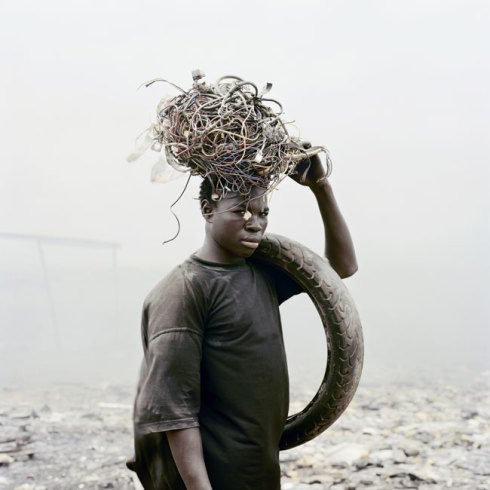
Yakubu Al Hasan, Agbogbloshie Market, Accra, Ghana 2009
Pieter Hugo’s series Permanent Error appeared in last weeks New York Magazine under the title A Global Graveyard for Dead Computers in Ghana.
The style is not too distant from Nollywood or The Hyena & Other Men, the former of which dusted up a small (and in my opinion, unnecessary) brouhaha last year about neo-colonialism/exploitation in photography.
Hugo’s case, in this instance, is not helped by the fact that the NY Times magazine piece is purely a gallery with no journalist elaborations, save the captions.
The merits and shortcomings of Hugo’s photographic approach is only half the issue; our denial of the extent of racial and economic inequality colours our response.
Hugo graduated in 1994. In this interview (which I think I came across amongst James’ youtube feast) Hugo gives an interesting perspective on how his work fits historically in the South African tradition.
“The photography in South Africa comes from a very political background. Pre-1994, it was an extreme situation here. And if one had the skill you had a certain responsibility to inform the world what was happening here. It was very much all black and white. This is wrong and this is right. There are good guys and there are bad guys.
That’s all changed now. Guys that were good are now bad and the lines aren’t as distinct as they were. […] Things are more complex […] One of the things I hope people get when they look at my pictures is that things are complex.”
This still might not excuse an aesthetic that aggressively depicts African subjects as “the other”, but then, what split second act of opening the shutter is not a machine-mediated differentiation between user and subject?
AFTER THOUGHT
The overtly-political nature of South African (photojournalism) photography is something David Goldblatt, as an art-documentarian, had to negotiate himself away from. And yet, as Fred Ritchin remarks, “during Goldblatt’s career, which began in the early 1960s, nearly everything that he saw was contextualized by the distorting prism of apartheid.”
This makes me wonder if there’s been an adequate survey of ‘South African photography from the second half of the 20th century’ toured on an international stage. If there has been, please let me know.

 Prison Photography
1 comment
Comments feed for this article
August 13, 2010 at 11:45 pm
Dan
We just saw this exhibition at Michael Stevenson, in Cape Town, and the impact of the exhibition, as distinct perhaps from the New York magazine version, is a bit different. The issues of race, ethne, gender, disability, age oppression and exploitation are both on the surface of the large format photos as well as nuanced throughout, and the conversation among the pieces is critical, engaged, as suggested by comments of those walking through and lingering to discuss after. The exhibition was impeccably curated, which speaks to that aspect of your inquiry as well, ie the `translation’ of curated exhibitions into magazine and journal venues, and vice versa. Thanks as ever for this!