
You are currently browsing the category archive for the ‘Photojournalism’ category.
Democracy Now! reports:
Journalists from the investigative team in Iceland that released the now-infamous US military video on WikiLeaks traveled to Baghdad recently to meet with the family members of some of the twelve people killed in the 2007 attack.
Ahlam Abdelhussain, the widow of Saleh Mutashar who was killed when the gunship opened fire on a van, asks, “Why was he shot with his children in the car? They did nothing wrong. He was helping a journalist. What was his crime? What was the crime of our children who are left with no father and no support?”

Democracy Now! introduces the piece with footage from the attack on the van. Material about Mutashar begins at 15.27
Saleh Mutashar was taking his 6 and 9 year old children to school when he passed the aftermath of the attack and choose to help a wounded man.
– – –
Also from Democracy Now! “This is How These Soldiers Were Trained to Act”
PART FIFTEEN IN A SERIES OF POSTS DISCUSSING PHOTOGRAPHERS’ ACTIONS AND RESPONSES TO THE KILLING OF FABIENNE CHERISMA IN PORT-AU-PRINCE, HAITI ON THE 19TH JANUARY 2010.
The aftermath of the Haiti earthquake was zealously covered by the media and American networks particularly.
Several factors likely fed the saturation of disaster over the wires – Haiti’s geographic proximity; Haiti’s diaspora and cultural ties within the US; fresh memories of the controversial, US-backed coup and removal of Jean-Bertrand Aristide; and collective guilt over (or, alternatively, the collective amnesia of) the US’ corporate involvement in Haiti.
The US was going in full-yield again.

The lifeless body of fifteen-year-old Fabienne Cherisma lies on the roof of a fallen building in downtown Port-au-Prince while looters file down the street on January 19, 2010. The young girl was carrying three ornamental mirrors when she was hit by a random shot from Haitian police as she walked with looters on the street. Photo by Lucas Oleniuk / Toronto Star.
WHY ONE IMAGE?
The still Fabienne Cherisma surrounded by the bustle of opportunists jolted me from my image-stupor for long enough to realise it was time to voluntarily step off the media-photo-treadmill and pay attention to a single image, a single person, a single story.
It occurred to me that this was barely a risk. If the majority of the imagery had stopped informing then I really had nothing to lose by redirecting my energies and time elsewhere.
(Please, don’t misunderstand me: I appreciate the purpose for a lot of media images, and I believe that they deliver immediate messages which catalyse reaction, donations and aid. That said, emoting a response in an audience is a distinct function to that of informing an audience.)
WHY FABIENNE?
In all honesty, I may have never have seen that image and with that in mind, I may have paid particular attention to another single victim of the earthquake. Chance? Compulsion? My “small contribution”? I don’t know. I don’t want to minimise my analysis of Fabeinne Cherisma’s death in photographs, but nor do I know exactly what it is yet …
Now, after some time, two unique things about the image of the dead Fabienne Cherisma still stand out.
In other pictures bodies were either buried, dusted, pulverised or piled high with other corpses. If they lay in the streets they were circled by onlookers. Fabienne’s body was isolated. Secondly, unlike 230,000 of her compatriots, it wasn’t the violent instability of concrete in the physical environment that killed Fabienne, it was the violent fallibility of human decision making that killed her; a bullet, from a gun, in a hand.
MAN-MADE NATURAL DISASTER
It has been said that no natural disaster is simply that, but that every disaster comprises natural and man-made factors. Man-made corruption, political instability and resultant poverty led to inadequate (if any) building codes. Just as human decisions prior to the quake cost lives, so they would after the quake.
The rainy season is about to begin in Haiti and the quality of aid, community solidarity, flood and disease abatement measures will determine how many people succumb to this second wave of elemental assault.
Fabienne, to me, was one of the first victims to fall to poor human decision-making following the earthquake. Others have perished since and unfortunately, thousands more are likely to die. (I read an estimated 5,000 people may die in the predicted mudslides, but I don’t know on which this is based – the cold calculation makes me quite uncomfortable).
Fabienne’s death was not in the earthquake but in its aftermath.
VISUAL FORENSICS
The day after seeing Garcia Rawlin‘s photograph for Reuters, I found a virtually identical image by Jan Grarup, except Fabienne’s body was positioned differently. Suddenly, time and timing was brought to bear upon Fabienne’s demise. Two photographers. Soon after, I saw the work of Olivier Laban-Mattei, whose photographs followed the family down the street as they carried the body. Three photographers.
Once I had launched my inquiry, the full picture developed quickly. An interview with Michael Mullady. Four photographers. Shortly after, Edward Linsmier discussed his experiences at the same locations. He was with Nathan Weber. Six photographers.
At this point I was already in contact with Grarup and Mullady. Garcia-Rawlins and Laban-Mattei did not respond to inquiries and have not until this day (I cannot be certain they received my inquiries). Grarup’s response mentioned Paul Hansen and Jan Dago. Eight photographers.
( Jan Dago did not respond to my inquiries. His images of Fabienne are here and this slideshow references looting in its title but actually has little of visual evidence to contribute to my inquiry.)
Hansen was also accompanied by Michael Winarski, US correspondent for Dagens Nyheter. Eight photographers, one reporter.
The next photojournalist to surface was James Oatway. Ten journalists – nine photographers, one reporter. Oatway mentioned Alon Skuy, who in turn mentioned the delayed arrival of Felix Dlangamandla upon the scene. Eleven photographers.
Meanwhile, I stumbled upon Nick Kozak‘s work and upon contacting him learnt of two other Canadian photographers present – Lucas Oleniuk and Matt Levitch (Tranbleman De Te). Fourteen photographers.
Soon thereafter, a reader alerted me to Frederic Sautereau‘s portfolio containing graphic images of disorder, skirmishes, police and Fabienne’s corpse. Fifteen photographers.
CONCLUSIONS
1.) There may well have been more photographers on the scene. It wouldn’t surprise me to learn so.
2.) A couple of photographers mentioned giving others space and trying not to get in others’ shots and avoiding getting photographers in their frames. Why? If a situation is chaotic and journalists are part of that chaos, what does it matter if photographers or journalists are in the scene?

Jan Grarup photographs police beating a looter in downtown Port-au-Prince Tuesday afternoon. © Lucas Oleniuk/Toronto Star.

Tuesday, January 19th. Photo: Jan Grarup/NOOR Images
As a small step, this mutual refusal to depict fellow professionals in the field, can be understood as the first step toward a manipulated in front of a distant audience.
The erasure of fellow media from a scene is a paradox. Journalists are required to record events as they are, but if a photographer depicts them as if he or she is working in isolation – as if from a unique one-off viewpoint – then what is delivered is not an objective, neutral description but a construction.
3.) I am not criticising the photographers who have kindly given their time, thoughts and (often) emotions to this inquiry, but I am questioning the decisions at the photodesks of mass media. I usually only see images that implicate media/photographers when the story becomes about them, when they get injured or kidnapped. Photojournalists are either the directors of a scene or the embattled hero of a scene; they are never bit-part players.
4.) I am convinced, CONVINCED, that enough evidence exists in the digital files of these fifteen photographers to identify and prosecute the policeman who fired the fatal shot.

© Alon Skuy
– – –
ALSO IN THE ‘PHOTOGRAPHING FABIENNE’ SERIES
Part One: Fabienne Cherisma (Initial inquiries, Jan Grarup, Olivier Laban Mattei)
Part Two: More on Fabienne Cherisma (Carlos Garcia Rawlins)
Part Three: Furthermore on Fabienne Cherisma (Michael Mullady)
Part Four: Yet more on Fabienne Cherisma (Linsmier, Nathan Weber)
Part Five: Interview with Edward Linsmier
Part Six: Interview with Jan Grarup
Part Seven: Interview with Paul Hansen
Part Eight: Interview with Michael Winiarski
Part Nine: Interview with Nathan Weber
Part Ten: Interview with James Oatway
Part Eleven: Interview with Nick Kozak
Part Twelve: Two Months On (Winiarski/Hansen)
Reporter Rory Carroll Clarifies Some Details
Part Fourteen: Interview with Alon Skuy
Part Sixteen: Fabienne Cherisma’s Corpse Features at Perpignan (Frederic Sautereau)
Part Seventeen: Brouhaha in Sweden following Award to Paul Hansen for his Image of Fabienne Cherisma (Paul Hansen, Olivier Laban Mattei, James Oatway)
Part Eighteen: A Photo of Fabienne Cherisma by Another Photographer Wins Another Award (Lucas Oleniuk)
PART FOURTEEN IN A SERIES OF POSTS DISCUSSING PHOTOGRAPHERS’ ACTIONS AND RESPONSES TO THE KILLING OF FABIENNE CHERISMA IN PORT-AU-PRINCE, HAITI ON THE 19TH JANUARY 2010.
Alon Skuy, photographer for The Times in South Africa, was in Haiti from 17th – 22nd January.
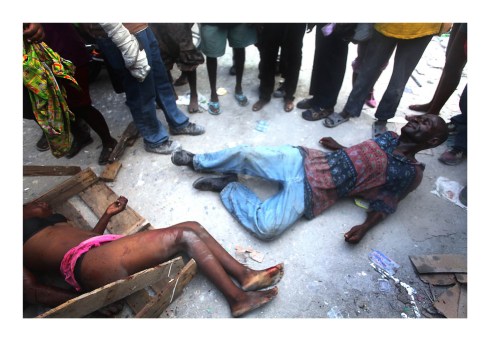
Fabienne was shot at approximately 4pm. What had you photographed earlier that day?
General looting and destruction in the downtown area of Port-Au-Prince.
How many other photographers did you see at the scene? Do you know the photographers’ names?
Contrary to another article on this site, there were three South African Photographers on the scene: myself, Felix Dlangamandla and James Oatway.
How was the atmosphere? How did others behave?
The atmosphere was very tense and thick with emotion. It was quite a chaotic scene. Photographers were jostling for images. On the whole, I feel that the photographers behaved
respectfully on the scene.
Did you discuss the tragedy with other photographers?
Yes, briefly on the scene with the two other South African photographers, we were all aware of each others presence.
How long was it until her family and father arrived to carry away Fabienne’s corpse?
About 30 minutes.
How long did you follow the group as they carried her away?
For about three kilometers down the main road.
Where was their destination? How far away was that?
Their destination seemed to be a market where Fabienne’s mother, as well as other relatives may have been.

How does Fabienne’s death fit in with the visual narratives of Haiti’s earthquake aftermath?
An important event to cover, imperative to show the desperation due to lack of aid getting through, and the inhumane fashion in which the law enforcement behaved at times. The family were obviously really distraught.
– – –
Both images © Alon Skuy. From top, Osam Cherisma mourns the death of his daughter Fabienne; Amante Kelcy, Fabienne’s mother (in white), mourns the loss of her daughter.
– – –
ALSO IN THE ‘PHOTOGRAPHING FABIENNE’ SERIES
Part One: Fabienne Cherisma (Initial inquiries, Jan Grarup, Olivier Laban Mattei)
Part Two: More on Fabienne Cherisma (Carlos Garcia Rawlins)
Part Three: Furthermore on Fabienne Cherisma (Michael Mullady)
Part Four: Yet more on Fabienne Cherisma (Linsmier, Nathan Weber)
Part Five: Interview with Edward Linsmier
Part Six: Interview with Jan Grarup
Part Seven: Interview with Paul Hansen
Part Eight: Interview with Michael Winiarski
Part Nine: Interview with Nathan Weber
Part Ten: Interview with James Oatway
Part Eleven: Interview with Nick Kozak
Part Twelve: Two Months On (Winiarski/Hansen)
Reporter Rory Carroll Clarifies Some Details
WAR
In many ways I am surprised it has taken so long for a reel of film to make such an immediate impact on American audiences. The wikileaked military footage Collateral Murder shows us exactly what war is; war is the erasure of doubt, benefit of doubt in the face of procedure. The procedure of war is to kill.

Photographer Namir Noor-Eldeen runs for his life in the midst of a US 30mm machine-gun assault
Following the helicopter gunman’s requests to engage, the wait for the permission is one of the most haunting silences I’ve heard. And then, murder. Is it any wonder PTSD follows such carnage?
PRISONS
Ever since Change.org published With 140,000 Veterans in Prison, We Can Do Better last Veteran’s Day I have been aware of stories about the links between violence and suffering abroad with violence and suffering within US communities.
This week two stories surfaced – one from either side of the Atlantic – which illustrate two common scenarios for returning service men and women. The first is clinical depression in the from of Post-Traumatic Stress Disorder, and the second is clinical depression in the form of addiction and aggressive behaviours.

At the Mid-Orange Correctional Facility in Warwick, N.Y., service dogs share a room with the prisoners who help train them. Photo: Stephen Crowley/The New York Times
PTSD
Stephen Crowley visited Mid-Orange Correctional Facility in Warwick, N.Y. to document the Puppies Behind Bars program. (I have mentioned this initiative before at a NY womens prison).
The program at Mid-Orange serves as rehabilitation in the form of responsibility, “softening up” and purpose in the direct service to outside communities. One of the growing communities to benefit from personally trained service dogs are America’s war veterans.
Staff Sgt. Aaron Ellis, suffering from PTSD had not been to the supermarket in three years until his prison-trained service dog gave him the confidence to step into the stimulating environment.
Watch the New York Times’ slideshow A Canine Treatment for PTSD.
CRIME
The Times Newspaper (UK) published From Hero to Zero reporting the fortunes of three ex-soldiers who’ve done time. Their addiction and aggression is often the result of either undiagnosed or untreated PTSD. The Times:
There is a widespread belief that post-traumatic stress disorder, occasioned by Britain’s engagement in two brutal wars, is behind the large numbers of veterans who offend. The truth is muddier. PTSD normally takes several years after the traumatic event to set in.
The Howard League for Penal Reform has launched an independent inquiry to bring this to public attention in the UK.

Former UK soldier, Michael Clohessy sleeps with a sword under his pillow. Photo TIMES Newspaper, UK
One of the biggest stumbling blocks for understanding and working to improve the prospects of the veteran/prisoner population is that the exact figures are not known and estimates vary wildly. The Times:
We send too many ex-servicemen to prison. How many, nobody is sure. A recent study by the National Association of Probation Officers (Napo) estimated that there may be as many as 8,500 ex-servicemen in prison out of a total prison population of 92,000. Harry Fletcher, assistant general secretary of the organisation, believes that around 8% of Britons in jail are from the forces. The vast majority of these offenders are from the army, and a large majority of the ex-army are from the infantry. But other groups have taken issue with Napo’s findings. The Ministry of Justice and the Ministry of Defence conducted their own survey, which they published in January, concluding that only 3% of the prison population were former members of the military — around 2,500 veterans in total.
I think the title of the Times piece suggests it all – From Hero to Zero.We freely project the character of a man based upon our knowledge of his or her publicly performed actions. This is okay, but it mustn’t be only form part of our assessment. Heroes are never heroes, and zeroes are never zeroes; they are stereotypes. Stereotypes are often benign but sometimes damaging and paralysing to good judgement.
WHAT TO THINK?
Our prisons are filled with a wide variety of people with a wide variety of faults, competencies, potential and histories. For the most part, the authorities are aware of this, but I am not always convinced the public is.
Is it in our interest to think of these diverse populations in prison? Does this affect how we consider prisons and prison reform?
What do we need to see (photography?) – as well as read – to think of prisons in more reflexive ways?
“No, it was not a random shooting. There was a group of three police officers. One officer took aim and shot Fabienne in the head.”
Fabienne’s father, Osama Cherisma, March 2010
Michael Winiarski and Paul Hansen recently returned to Port-au-Prince with the specific intention of following up on the fortunes of the Cherisma family.

Fabienne's family (left to right): Father, Osama Cherisma, brother Jeff, 18 years, his sister Amanda, 13 years, and mother Amante Kelcy. Photo: Paul Hansen
Following my interview with Winiarski, I had asked rhetorically what the Cherismas may feel about the international coverage of their daughter’s death. I was raising the issue of media and journalists’ responsibilities toward the subjects of their stories, and more specifically I was wondering if the Cherismas would ever be interviewed at length to elaborate on their experiences since that terrible day.
Well, a part answer can be provided in the actions and article of Winiarski and Hansen who published this story on the 13th March. (Swedish original / English translation):
– Osama says he knows the identity of the killer – a high ranking police officer from their own neighbourhood.
– The family have not filed a police report because they are too scared. They say the police are watching them daily.
– They have not talked to local media and only talk to Winiarski and Hansen of Dagens Nyheter because they are foreign journalists.
– Osama dealt with the body directly because he didn’t trust he’d see his daughter again if he handed her corpse over the police and authorities.
– Although their house still stands, it is so destabilised they live in a tent city.
– The schools of Jeff and Amanda, Fabienne’s brother and sister, were both destroyed during the earthquake.
– Jeff, Amanda and their mother Amante all – understandably – still feel extreme pain and emotion. Osama cannot sleep.
– Fabienne is buried in Zorange, north of Port-au-Prince. It is the village of Fabienne’s grandmother.
– – –
ALSO IN THE ‘PHOTOGRAPHING FABIENNE’ SERIES
Part One: Fabienne Cherisma (Initial inquiries, Jan Grarup, Olivier Laban Mattei)
Part Two: More on Fabienne Cherisma (Carlos Garcia Rawlins)
Part Three: Furthermore on Fabienne Cherisma (Michael Mullady)
Part Four: Yet more on Fabienne Cherisma (Linsmier, Nathan Weber)
Part Five: Interview with Edward Linsmier
Part Six: Interview with Jan Grarup
Part Seven: Interview with Paul Hansen
Part Eight: Interview with Michael Winiarski
Part Nine: Interview with Nathan Weber
Part Ten: Interview with James Oatway
Part Eleven: Interview with Nick Kozak
Reporter Rory Carroll Clarifies Some Details
Part Fourteen: Interview with Alon Skuy
Part Fifteen: Conclusions
PART EIGHT IN A SERIES OF POSTS DISCUSSING PHOTOGRAPHERS’ ACTIONS AND RESPONSES TO THE KILLING OF FABIENNE CHERISMA IN PORT-AU-PRINCE, HAITI ON THE 19TH JANUARY 2010.
Michael Winiarski is the US correspondent for Swedish newspaper Dagens Nyheter and colleague of photographer Paul Hansen (interviewed in part seven).

Osama Cherisma carries Fabienne's body down Boulevard Jean Jacques Dessaline, followed by his son, Jeff (18) and his daughter, Amanda (13). Photo: Paul Hansen
What were the dates of your stay in Haiti?
I arrived to Port-au-Prince in the morning of January 14th. I flew in from Washington (where I’m posted as correspondent for the newspaper Dagens Nyheter) through Santo Domingo. I left Haiti late on January 21st, by car to Dominican Republic.
Fabienne was shot at approximately 4pm. What had you reported on earlier that day?
Actually about the deteriorating security situation and looting in central Port-au-Prince.
Did you see Fabienne get shot?
No, I was by the car at Boulevard Jean-Jacques Dessalines when our driver came and told me that a girl had been shot. When I saw her she lay in the street.
How long was it until her family and father arrived to carry away Fabienne’s corpse?
When I saw her, the father was already there. I checked my watch which was exactly 16.00pm, so I assume she was shot at least 10-15 minutes earlier.
How many other journalists/photographers did you see at the scene? Do you know the names of these other media people?
Apart from Paul Hansen from Dagens Nyheter, I saw the Danish photographer Jan Grarup and the Reuters and AFP guys. I think I was the only foreign writer/reporter, and there also was a Haitian man who volunteered with translating some things the father said.
How was the atmosphere? How did others behave?
It was of course tense, with lot of crying, screaming and lamenting as we followed the crowd to the house of the Cherisma family. But the immediate threat of more shootings had subsided – no police were to be seen around us.
Did you discuss the tragedy with Paul or other journalists?
At that point only with Paul, and we did not hesitate that we should report the story.
Any other thoughts?
In Sweden, there were ethics discussions about Fabienne [and the photographs] by magazines and bloggers.
SWEDISH MEDIA DISCUSS THE ETHICS OF PUBLISHING PAUL HANSEN’S IMAGE OF FABIENNE
So upsetting is the photograph of a dead young girl, that Swedish magazines and bloggers responded to and questioned it’s use for Winiarski’s article (Swedish original / English translation).
The article humanised Fabienne and communicated the injustice and immediate devastation her death caused. It ends with a description of the family’s grief:
Fabienne’s little sister, Samantha, runs adjacent to [her father who carries Fabienne’s dead body] and roars in grief. It is only later Osama Cherisma will completely absorb what has happened. Then he will sit down and stare blankly ahead. But now he cries curses at the police who he believes took aim at his daughter.
We follow the weeping and despaired small group down the street, through the business district, to Fabienne’s home. It is only here when Fabienne’s mother Amante Kelcy hear what has happened to her girl. She falls apart in a crying, “Why? “Why? Why?”
Ever since the shot, the police are not to be seen. No police dare to enter these streets after a member of its rank and file killed one of the neighborhood children. No ambulance will be summoned. There is still no one to send. And Fabienne is already dead. Unnecessarily.
Osama Cherisma curses the police. “They are like animals, they are animals, “he says. “Why should my daughter pulled away in the prime of their youth?”

Fabienne's younger sister, Amanda Cherisma (13) and older brother, Jeff Cherisma (18) over the body of their sister. Photo: Paul Hansen
Dagens Nyheter, to its credit, acknowledged the concerns and answered them directly in an editorial. I paraphrase due to the vagaries of translation:
We are obviously very reluctant to publish pictures of the deceased. A reader emailed and questioned how we would handle the issue if the image depicted a fifteen year old girl in Sweden. The answer is that the situation in Sweden is not comparable – if Sweden were affected by a disaster of equal scale of that in Haiti, then publication discussions would be based on the circumstances of that event.
How families are affected by publication is another important issue to consider in the decision.
DN’s mission is to take the world closer to readers, even when reporting can bring discomfort. Michael Winiarski’s and Paul Hansen’s reporting in connection with this individual tragedy is strong and worthy – and not at all speculative. In our view, it’s publication was important.
The statement above can be construed as a standard media response – that while Dagens Nyheter is aware of the distress Hansen’s photographs may cause it readers AND the deceased’s family, it goes ahead with publication in the interests of information.
Respect is given in that the need for respect is articulated. Is this enough?
I remain a little uneasy. The photographers I’ve interviewed for this series have given their opinions, but still I wonder what Fabienne’s family actually think – especially eight weeks later – of the international coverage of Fabienne’s death.
– – –
ALSO IN THE ‘PHOTOGRAPHING FABIENNE’ SERIES
Part One: Fabienne Cherisma (Initial inquiries, Jan Grarup, Olivier Laban Mattei)
Part Two: More on Fabienne Cherisma (Carlos Garcia Rawlins)
Part Three: Furthermore on Fabienne Cherisma (Michael Mullady)
Part Four: Yet more on Fabienne Cherisma (Linsmier, Nathan Weber)
Part Five: Interview with Edward Linsmier
Part Six: Interview with Jan Grarup
Part Seven: Interview with Paul Hansen
Part Nine: Interview with Nathan Weber
Part Ten: Interview with James Oatway
Part Eleven: Interview with Nick Kozak
Part Twelve: Two Months On (Winiarski/Hansen)
Reporter Rory Carroll Clarifies Some Details
Part Fourteen: Interview with Alon Skuy
Part Fifteen: Conclusions

War wounds: Don McCullin on photography. The acclaimed frontline photojournalist speaks about the horrors of conflict, struggling with ‘this terrible name, war photographer’, and why shooting landscapes instead of battle zones has finally granted him a sense of peace.
WELL SAID MR McCULLIN
My post, Staring at Death, Photographing Haiti got a lot of attention. It was a simple format – an extensive collection of links to online photography coverage of Haiti. It was posted a week after the earthquake and very soon after was out of date.
It may have been apparent from my other posts on Haiti [1, 2, 3, 4, 5] that I appreciated words alongside images.
I was grateful for the interviews by the New York Times of Damon Winter, Maggie Steber and Daniel Morel.
Well, add Lynsey Addario to that list.

Even Orphanages Spawn Orphans in Haiti is the type of approach and reflexivity I admire in journalism. It is a great salve to the overly-anxious who worry that photojournalism has lost it’s soul.
Of course, I have a few buddies who’d insist that Haitian voices be heard also, so I don’t want to suggest that PJ audio interviews are the crowning point of crisis reporting – they obviously aren’t but they are a necessary component.
To hear the photojournalist’s voice and responses to their subject reminds us that photographers are not camera-wielding automatons operating in vacuums.

 Prison Photography