
You are currently browsing the category archive for the ‘Uncategorized’ category.
Okay, okay, I know DAH is a good photographer and a greater promoter of work.
Seriously, what he does for youngsters in the industry is incredible and he was doing it a long time before the internets allowed him to share his support and passion via burn.
So, I’ll probably take a lot of heat for what I am about to say … like that time I was invited around to a friends house and ended up pissing on the kids’ Christmas presents.
It’s just that, this seems like quite an essay for a time of emergency.
“This calls for immediate action!”

After publishing a few posts about prison tattoos (here, here and here) Klaus Pichler emailed me to tell me about his project ‘Inked for Life: The World of Prison Tattoos‘:
I am a landscape architect and I am currently researching the exercise yards of Austrian prisons, in both spatial and sociological approaches. I am also a photographer.
‘Inked for Life: The World of Prison Tattoos‘ deals with the art of tattooing in the prisons of Central Europe, from the 1950s through to the 1980s.
I am surely not the first one who has done a project about this topic, but the Central European tradition of prison tattooing is genuinely different from the North American, the Latin American and also the Russian/Eastern European style of tattooing.
I have worked more than seven years on this project, and it will be published as a book in late 2010. The project consists of pictures and excerpts of interviews with (mostly) ex-inmates, about tattooing, prison life and prison culture.
I am assuming it is because the book is imminent that Klaus did not provide me jpegs from the Inked for Life series. Klaus did, however, send over these four images from Skeletons in the Closet.
Skeletons in the Closet goes into the long list of photo-projects adopting a distancing view of stores/archives/displays/dioramas of natural history museums, albeit one of the better projects of that ilk … of that trend.
Klaus Pichler‘s entire portfolio is worth a look but I think his studies of people, nay characters, in his Odessa series are particularly good … very good.
So please look at those people shortly after looking at these dead animals!

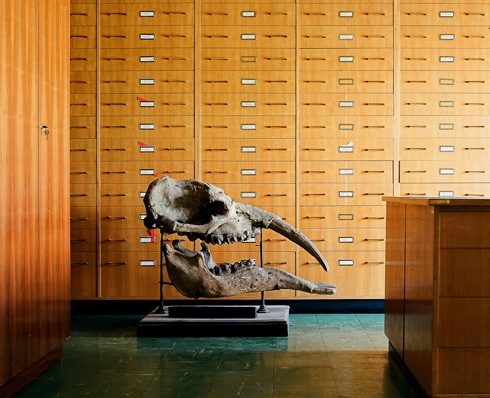


Photo: Andy Duback / AP. An inmate shows off the nutraloaf prepared by the cafeteria of the Chittenden Regional Correctional Facility in South Burlington, Vt. To prison officials, it’s a complete meal. To inmates, it’s a food so awful, they’d rather go hungry than eat it.
Prison food is notoriously bad, but is it unconstitutional? Prisoners have sued saying the forced menu of Nutraloaf, served to inmates accused of alleged infractions, is cruel and unusual punishment.
This from Slate:
Nutraloaf (sometimes called Nutri-loaf, sometimes just “the loaf”) is served in state prisons around the country. It’s not part of the regular menu but is prescribed for inmates who have misbehaved in various ways—usually by proving untrustworthy with their utensils. The loaf provides a full day’s nutrients, and it’s finger food—no fork necessary.
Nutraloaf is cubed whole wheat bread, nondairy cheese, raw carrots, spinach, seedless raisins, beans, vegetable oil, tomato paste, powdered milk and dehydrated potato flakes.
The larger issue here is one of economics. State prisons look to cost-saving in every part of its operations (that’s what happens when an unsustainable prison-system is created by voters and punitive laws). Nutritional considerations were abandoned long ago across the US prison industrial complex. Ideally, the “better food” discussion should be eclipsed by the “better non-custodial alternatives in US criminal justice” discussion.

Yesterday, I still didn’t know the blogger’s identity, now at least I know his or her initials are A.S.H.
If you’re aren’t reading Iconic Photos you should be. It is excellent. A.S.H. has just posted on his/her first 500 days of blogging.
Everything from love for commenters (Iconic Photos get a lot), to dubious search criteria, to accusations of very specific Americocentric partisanship despite the bloggers non-US citizenship.
A.S.H. sounds like he/she is having a blast, and despite A.S.H’s insistence he/she is not a good writer, I beg to differ.

I was sorry to hear that, after 6-and-a-half years, Big RED & Shiny has decided to close up shop. It’s 135th issue will be its last. It’s not ending operations due to money but because its just arrived at that time.
BR&S’s self-defined scope was the New England Arts scene, but in reality its reach and applied knowledge was national.
In my past writing I have leant on some of the great photography articles at BR&S – Larry Sultan, William Christenberry, Harold Feinstein and Stephen Tourlentes.
BR&S has had over 170 contributors down the years and the sites development stands out as a true community; the writing has been considered and committed – Matthew Gamber was editor-in-chief for 126 issues; writers turned editors, Micah Malone and Christian Holland, started with the first issue; James Nadeau first wrote an article in issue #19 and remained as editor.
Matthew Nash, publisher of BR&S said this:
If Big RED & Shiny were a human, our six-and-a-half years would put them in the first grade. Yet, online we are old. Very old. We have been online a full third of the life of the Internet. There was no Facebook when we started. No Blogger. No MySpace. The iPhone was over 3 years in the future.
If Nash is suggesting that BR&S has less of a place in the rapidly changing internet (which I’d currently characterise as an idea-economy, link-economy, micro-blogging, shuffling-content internet) then he is surely wrong. He observes that perhaps people have less need for editorial framing and more an appetite for primary content. Nash could be right, but I don’t know if that means editorial writing is pushed out. I hope that there’s room for both – I mean, a tweet (which is essential a quick-fire bulletin board) does not compete with a full length article (which is substantive content, ideas).
Whatever. The debate on the web is a distraction really from an announcement that means our arts coverage online just got a little thinner. Thankfully, the archive lives!
BR&S – Sad to see you go. Good luck with future endeavours!
Even prisons that incarcerate children are violent.
In the UK, following a five year legal battle families have successfully (under Freedom of Information Act) had released a document titled ‘Physical Control in Care’. It is a manual for private prisons, authorising staff to:
– “Use an inverted knuckle into the trainee’s sternum and drive inward and upward.”
– “Continue to carry alternate elbow strikes to the young person’s ribs until a release is achieved.”
– “Drive straight fingers into the young person’s face, and then quickly drive the straightened fingers of the same hand downwards into the young person’s groin area.”
Or in other words, authorised child abuse. (Story)

As a foil to the non-committal position of my last post, Jim Johnson has posted a very important statement about the label – and according judgement – that should fall upon America’s homegrown terrorists.
What’s the difference between a terrorist and an “apocalyptic Christian militant”? A must read.

© Pavel Maria Smejkal. From the 'Stars' series
For some, my deliberations about Bruce Gilden/Haitians might seem tepid compared to Pavel Maria Smejkal‘s use of people-as-props for his photographic art.
Smejkal’s Stars series is potentially about the reversal of fates, wasted potential, chance events and turns of fortune. It is also potentially insulting.
The question for me is whether digital composites of Auschwitz inmates and the faces of silver-screen stars is a good way to communicate an actually important philosophical position. Mrs. Deane (Beierle or Keijser) can’t say that Smejkal’s work is a success or not because they stumble at its first requirement to recognise the faces of inserted celebrities! Which is a nice side-step.
I too intend to hang up my judgement on this and simply pass on notice of the project for you to decide. My editor said a few months ago that Western culture – and photography in particular – had no sacred cows left to slaughter. In the manner in which sentiment and controversy whirl past without touching the sides these days, right now, I am inclined to agree.
– – –

 Prison Photography