
You are currently browsing the tag archive for the ‘Virginia’ tag.

Quick post & a request. We all know about the relentless Shorpy and the site’s daily dose of long gone photo ephemera. It is indeed a treat.
Today, two images from the 1920s went up. Shorpy’s keen to focus on the visual narratives that arrest the attention. Consider it a human interest archive if you will. It is my guess is he/she/it chose these two photographs relating to crime and punishment because they deal with women and children. If there is still one thing true today as was back then, these two groups are distinguished from, sometimes condescended to, and likely protected and abused in equal measure by, prevailing patriarchies.

Washington, D.C., circa 1920. “Jail, Women’s School.” Alternate title: “Complete this sentence.” National Photo Co. Collection glass negative.

Washington, D.C., circa 1922. “House of Detention, Ohio Avenue N.W.” Equipped with a nice playground. National Photo Company glass negative.
These came at an opportune moment because I’ve been wondering what to do with the following four images from the American Civil War. It is not an area I am well read up on. I guess the make-shift nature of jails and prisons in the vicinity of battlefields and front lines attests to the constant flux and shroud of unpredictability across a bloodied young nation.
Prison Photography blog is often concerned with inflexibility and pursuant damage it can cause as applied to institutions. But the modern prison is merely a permanent abstraction of earlier jails. ‘Transitory’ sites of incarceration, especially in times of war, are even more contested as sites than the Supermax prisons of the 21st century.
It’s got me thinking how Castle Thunder and Belle Isle relate to the the GWOT prisons – namely the early incarnation of Abu Ghraib prison, Bagram Airbase and other as yet unknown ‘Black Sites’ of detention and interrogation.

Richmond, 1865. “Castle Thunder, Cary Street. Converted tobacco warehouse for political prisoners.” Main Eastern theater of war, fallen Richmond, April-June 1865. Wet plate glass negative, photographer unknown.

Spring 1865. Belle Isle railroad bridge from the south bank of the James River after the fall of Richmond. Glass plate negative from the Civil War collection compiled by Hirst D. Milhollen and Donald H. Mugridge.
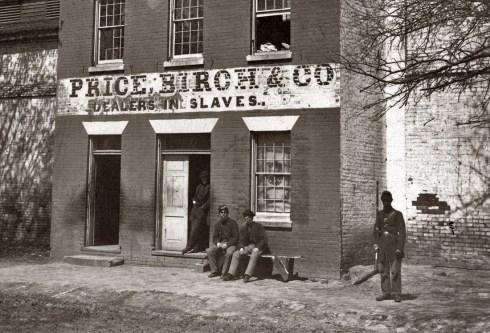
And finally, this site is described as a “slave pen”. This document of slave incarceration is gut-thumping and, however agonising the means, justifies the Civil War and its righteous ends.
Request: I am keen to know more about prisons and jails of the Civil War era. If you’ve any resources I should absolutely be aware of please drop me a note. Thanks
Morgan Spurlock is a decent guy. I’d like to have a beer with him. He lays it out straight. Prisons & jails are boring and hopeless. He knows this because he spent 30 days in a county jail just outside of Richmond, Virginia.
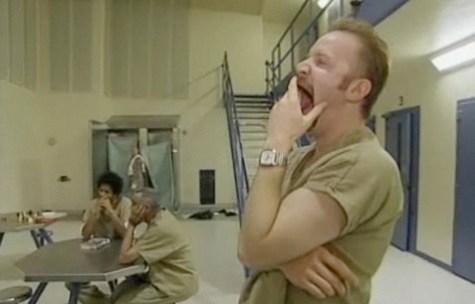
Spurlock nails it. “One of the most surprising things about prison is that you are pretty much left on your own. all you can do is kinda suck it up and fall into a pattern. I’m gonna get up, gonna eat, gonna play cards, gonna watch TV, gonna do some push ups, do some sits ups, write a letter, read a book….”
He continues, “People will be in their rooms or down here – just hanging out, you know, on the phones. The punishment is the monotony. This is it. You don’t have to think. You’re in jail. There is no thinking involved. And you’re feeding the machine. And you feel like that … you don’t feel like a person in a lot of ways.”
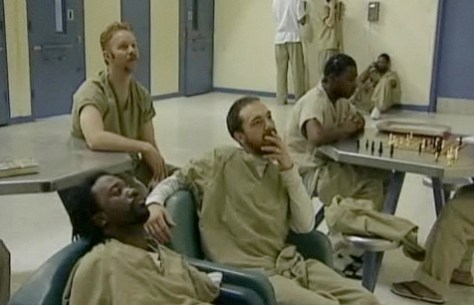

Spurlock elaborates “I haven’t seen a tree in over two week;, I haven’t seen one blade of grass; I haven’t breathed fresh air. It gets to you being in here … it really does. I see people like George and Randy who keep making the same mistakes over and over and over again. What is the system doing for these guys? They’re stuck! I see this cycle that were putting people in and punishing people for problems we could be helping them with. And the prisons and jails are just becoming a dumping ground. It really is a place that feels hopeless.”

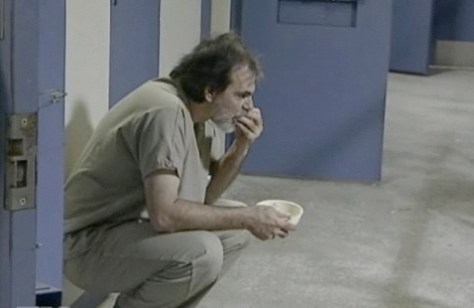
Spurlock even challenged his sanity by agreeing to a 72 hours stretch in solitary confinement. Spurlock couldn’t comprehend how Randy (mentioned earlier) spent a year in solitary.
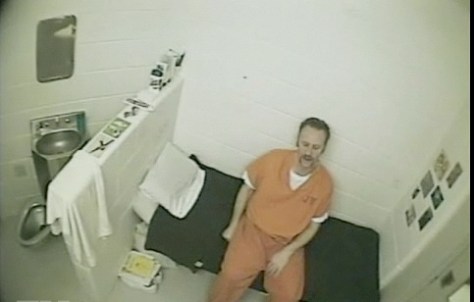
Great series. Great episode. Sobering reality. Spend 45 minutes of your life and witness the monotonous and expensive warehousing of society’s misfits.

 Prison Photography