
You are currently browsing the tag archive for the ‘Washington Post’ tag.
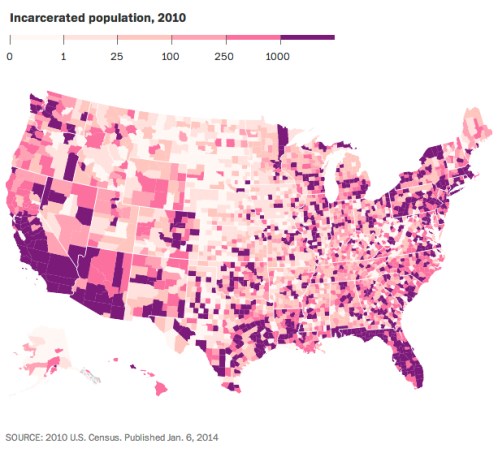
More prisons than colleges? Are we surprised? It seems that ever depressing metric one turns to, shows the prison industrial complex out of control, tumorous and beyond expensive. Just when you think you’ve seen all the maps and data points, another emerges to hammer home our sad reality with “corrections” in this country.
Charlie Ingraham at the Washington Post’s Wonk Blog points out that when we trot out the U.S.’s incredibly high incarceration rates, we tend to focus less on where we’re putting all those people. If we do that, we see that large swathes of California, Florida and Arizona have the biggest prison populations per capita. Southern states are not shy to lock people up. Rural counties’ demographics are skewed — up to 20 or 30% of their population being imprisoned individuals.
“To put these figures in context, we have slightly more jails and prisons in the U.S. — 5,000 plus — than we do degree-granting colleges and universities. In many parts of America, particularly the South, there are more people living in prisons than on college campuses. Cumberland County, Pa. — population 235,000 — is home to 41 correctional facilities and 7 colleges. Prisons outnumber colleges 15-to-1 in Lexington County, SC,” says Ingraham.
One conclusion of many? Prisons and jails have infected nearly every corner of the land of the free. “Nearly 85% of U.S. counties are home to some number of incarcerated individuals,” says Ingraham.

Michael S. WIlliamson for the Washington Post was inside Deerfield Correctional Center earlier this month and photographed the aging and sick prison population.
From The Washington Post:
“We’re left trying to be both a nursing home and a prison,” said warden Keith Davis

SOURCE: Virginia Department of Corrections, The Washington Post – Sept. 8, 2010
Since the General Assembly abolished parole in 1995, Virginia has been forced to care for more and more elderly prisoners. In 2008, 12 percent of Virginia’s prison population was age 50 or older, up from less than 5 percent in 1990.

 Prison Photography