

© Paolo Patrizi, from the series Migration
This week, I wrote two pieces for Wired on Google Street View. The first was a gallery of the various projects spawned by GSV, and the second was a piece about authorship and the repetition of nine scenes in two of the most well known GSV projects (Jon Rafman’s Nine Eyes and Michael Wolf’s A Series of Unfortunate Events and FY.)
Anecdotally, the photo-thinkers out there are converging on Doug Rickard’s A New American Picture as the most robust work. A close contender though is the relatively new No Man’s Land by Mishka Henner.
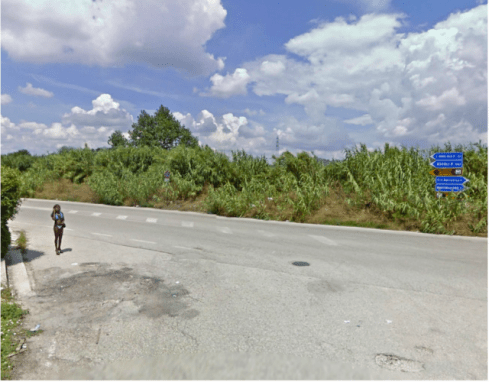
© Mishka Henner
No Man’s Land (more images here) is a disturbingly large selection of GSV screen-grabs of (presumably) prostitutes awaiting customers on the back roads of Italy. Henner says:
I came across communities using Street View to trade information on where to find sex workers. I thought that was the subject to work with. Much of my work is really about photography and this subject tapped into so many aspects of it; The fact the women’s faces are blurred by the software, that they look at the car with the same curiosity that we have when looking at them, and finally, that the liminal spaces they occupy are in the countryside or on the edge of our cities – it all has such great symbolism for our time. And that’s aside from the fact these women have occupied a central place in the history of documentary photography.
But for traditionalists, No Man’s Land is a long way from the spirit of documentary photography. Of Henner’s work and of all GSV series generally, the ever-outspoken Alan Chin says:
“Google Street Views is a navigational tool, an educational resource, and sure, it can reveal a lot about a place and a scene at a given moment in time. But if you, the artist, are really so interested, then go there and take some pictures yourself. This is about as interesting as cutting out adverts from magazines that have some connection and then presenting your edit as a work of art. Post-modern post-structuralist post-whatever denizens of of the art world and academia love this shit. Which is well and good for the university-press industry. But it has little to do with actual reporting and actual documentary work in the field.”
Well, just last week, I came across Paolo Patrizi documentary photographer that actually took himself to those byways.
For Migration, Patrizi has keenly researched where these women have come from and where, if anywhere, they may be going. From the project statement:
“The phenomenon of foreign women, who line the roadsides of Italy, has become a notorious fact of Italian life. These women work in sub-human conditions; they are sent out without any hope of regularizing their legal status and can be easily transferred into criminal networks. […] For nearly twenty years the women of Benin City, a town in the state of Edo in the south-central part of Nigeria, have been going to Italy to work in the sex trade and every year successful ones have been recruiting younger girls to follow them. […] Most migrant women, including those who end up in the sex industry, have made a clear decision to leave home and take their chances overseas. […] Working abroad is therefore often seen as the best strategy for escaping poverty. The success of many Italos, as these women are called, is evident in Edo. For many girls prostitution in Italy has become an entirely acceptable trade and the legend of their success makes the fight against sex traffickers all the more difficult.”
Patrizi is interviewed on the Dead Porcupine blog and talks about the unchanging situation, the pain experienced by the women, their reactions to him, and the destruction of woodland by authorities in attempts to literally expose the illicit encounters. It’s a must read.
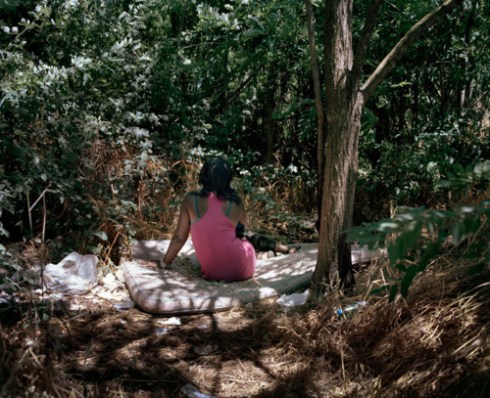
The images in Migrations are inescapably bleak; therein lies their power.
© Paolo Patrizi

© Paolo Patrizi

© Paolo Patrizi

© Paolo Patrizi
Patrizi’s Migration induces a visceral shock; images of the littered make-shift sex-camps turn the stomach. When human fluids are dumped, it is not usual that humans continue to function in and around them. These workstead pits of dirt, tarps and abuse are shrines to the shortcomings of globalisation and the social safety net.
By contrast, Henner’s work allows us to keep a safe distance. He even saves us the trouble of finding these scenes on our own computer screens; we’re detached one step beyond. We are cheap consumers.
Patrizi’s photography with its clear evidence of his boots on the ground don’t allow us to share Henner and Google’s amoral and disinterested eye.
On Henner’s virtual tour, we cruise, at 50mph. We don’t stop, we don’t get out the car and we don’t get too close. We might as well be in another country … which of course we are. Patrizi’s work walks us by hand to the edge of the soiled mattresses and piles of discarded condoms.
Patrizi’s images counter the washed out colours, the flattening effect of wide-angle lenses, and the perpendicular viewpoint of GSV. Instead, they involve texture, depth, legitimate colour, details and different focal points along different sight-lines. In other words, Patrizi’s Migration engages the senses and the basics of human experience. Patrizi’s photographs return us to the shocking fact that that these women are human and not just bit-parts in the difficult social narratives of contemporary society. Works full of threat, fear, flesh and blood.
By comparison, Henner’s screen-grabs are anaemic.
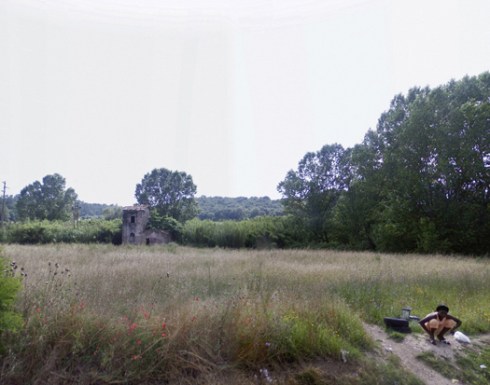
Via del Ponte Pisano, Rome, Italy. © Mishka Henner
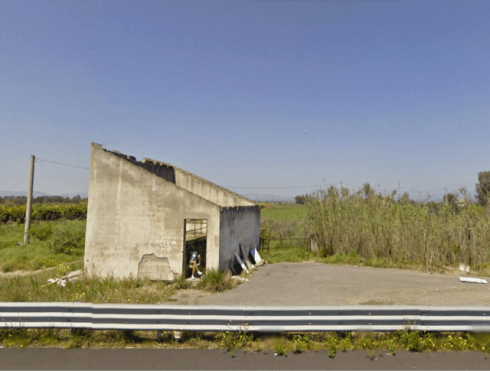
© Mishka Henner

Carretera de Ganda, Oliva, Spain. © Mishka Henner


 Prison Photography
17 comments
Comments feed for this article
August 19, 2011 at 9:24 pm
Noah Huber
THANK YOU.
Amy Stein pointed out this work (Henner’s) on G+ a week or two ago and I knee-jerked to disliking it. It is very weak in terms of “photography” and what I expect it to deliver aesthetically, and, or so my auto-immune response affirmed, immoral, slanderous, chauvinist, dehumanizing, and just served to remind me of the power differences between those in the first world and those in the second or third world (Henner is in a position of privilege 1st world citizens are so used to taking for granted that it infrequently crosses our minds that so much of the world still lacks access to the internet, et al.).
I eventually came to acknowledge that there were some margins on which the work touches that merit the accolade “interesting”, but … it just hasn’t sat well with me since then.
I know this is all dross, but here’s the rub – I used to feel that “interesting” was about as good as it got in a show of appreciation. I liked that it meant “my mind was stimulated”, and to me – aspiring to the circles of art that hold intellect as being the only true virtue – that was the goal.
What I’ve felt in these last two weeks is this persistent quiet discomfort with any sort of approval for No Man’s Land. That experience, coupled with seeing the work by Patrizi you’ve posted above, really helps cement what No Man’s Land fails to do both photographically and intellectually by contrast with Migration – demonstrating so well what photography CAN do.
I’m not going to spill a lot of virtual ink trying to characterize the above paragraph, it should be enough for the viewer to look at both works and have the experience for themselves.
Thanks for the post – it helped me get rid of a bit of a loose end on my part, and introduced me to Patrizi’s images to boot!
On a not so distant tangent: http://www.txemasalvans.com/eng/index.html – at the top click “Spanish Roads”. Salvans also photographed prostitutes on rural roads.
August 22, 2011 at 3:58 pm
>Re: PHOTO » Blog Archive » Street View Photography
[…] on his own Prison Photography blog, in Photographing the Prostitutes of Italy’s Backroads: Google Street View vs. Boots on the Ground Brook looks at two contrasting approaches to the same subject matter, one by photographer Paolo […]
August 22, 2011 at 9:53 pm
‘Spanish Roads’ by Txema Salvans « Prison Photography
[…] on from my comparative analysis of Mishka Henner and Paolo Patrizi’s documenting of Italian roadside prostitutes, a reader […]
October 20, 2011 at 4:55 am
Dead End Street | SIP
[…] A photographic series by the Italian photographer Paolo Patrizi, recently highlighted in an article by my blogger colleague Pete Brooke, suggests that the sex trade not only thrives on the exploitation of women in general, more […]
October 26, 2011 at 10:22 am
We Are All Monkeys Now | Robert Gumpert - photographer
[…] screen grabs of Google Maps now art, and artists arguing that their screen grabs of the exact same Google Map frame are somehow […]
December 5, 2011 at 8:54 pm
Top Photography Websites of 2011 | LPV Magazine
[…] Recommended: Photographing the Prostitutes of Italy’s Backroads: Google Street View vs. Boots on the Ground […]
April 23, 2012 at 12:00 am
A Conversation with Mishka Henner « Prison Photography
[…] year, in the article Photographing the Prostitutes of Italy’s Backroads: Google Street View vs. Boots on the Ground, I compared the work of artists Mishka Henner and Paolo Patrizi both of whom were making images of […]
April 24, 2012 at 4:01 am
Tom Waugh
Just a query: how can these images be credited “© Mishka Henner” when surely they were taken by GSV?
January 6, 2014 at 1:52 pm
Christmas task. | Natasha Hancock photography.
[…] analysing this book, I began to link some of the book with an article called Photographing the prostitutes of Italy’s Backroads: Google Street View vs. Boots on the Ground… There is a piece of text which really stood out to […]
January 6, 2014 at 4:56 pm
tarenbilkhu
Reblogged this on Taren Bilkhu Photography and commented:
An interesting concept by Henner, but it keeps us away from the depth of the reality. Details are lost within Google Street View, which Patrizi brings forth in his exploration. From first seeing Henner’s work, I was surprised, but the shock wasn’t as evident as when viewing Patrizi’s work. The reason being, because he went directly to the source and placed himself in the scene, documenting the details and harsh reality of the women’s lives. The distanced approach of Henner would work better for the media, for example, however to show the gritty, disturbing truth, Patrizi succeeds in a much more hard-hitting way, forcing us to pay attention to these women and their lifestyles. It makes use question more about the women, the men, their emotions and thoughts, their way of living, their location, their lives. It feels much more personal and creates that personal immediacy, rather than with distant figures and blurred out faces on GSV. While Henner picked up on a good concept for a project, I would say Patrizi developed it, documenting the reality and telling more of their story.
February 15, 2014 at 11:17 am
Christmas Task – Paolo Patrizi vs. Mishka Henner | Buhai Andra Photography
[…] * https://prisonphotography.org/2011/08/19/photographing-the-prostitutes-of-italys-backroads-google-str… […]
January 2, 2015 at 8:58 am
The Digital World | Chloe Parker
[…] the Prostitutes of Italy’s Backroads: Google Street View vs. Boots on the Ground [online] https://prisonphotography.org/2011/08/19/photographing-the-prostitutes-of-italys-backroads-google-str… [visited on […]
February 10, 2015 at 2:44 pm
Google Street View Vs. Boots on the Ground | Bethany Crisp Photography
[…] christmas we were asked to look at this article, it compared similar projects of prostitutes on the backroads of Italy however Mishka […]
February 11, 2015 at 6:44 am
151MC Christmas Task | hayleyfearnley
[…] the different approaches to a similar concept/subject in this article, what questions are posed? What are your […]
November 29, 2015 at 12:43 am
Kristin Wilson | Google Street View and Documentary Photography: New Technology, New Approaches? New Connections?
[…] distance is an issue raised by Pete Brook when he compared Henner’s No Man’s Land to Paolo Patrizi’s Migration. Like […]
March 13, 2017 at 9:01 am
Kelly Bryan
I have no connections with Henner, nor have I valued his work over others in the past, yet this article has outraged me to say the least. As a passionate student at University studying photography, I am appalled at your utter disregard for Henner’s style of documentary (yes I would absolutely class this as a style of documentary photography). Whilst you and others like Chin remain in your ‘nostalgic’ ways, the world moves on, rather than disregarding the inevitable, accepting and using what the new digital age has to offer us, which is exemplified by Henner’s work.
In short, you conclude that Patricia’s form of documentary photography on the same issue of prostitution is more skilled, requires more effort and portrays a much more powerful message than Henner’s. Without criticising Patricia’s work, I feel this is not the case. You have been illogical to compare such different formats of work. Henner’s work sparks a whole different thought process on the issue; why, if these images can be seen worldwide and are in the public domain, is the issue not particularly covered by the media?; what are the ethical concerns regarding these images being placed on the internet? And so on.
I feel your critique of both works has been narrow and hollow. The follow up conversation with Henner was applaudable however, as your inadequate evaluation of his work was made to appear even more idiotic with his logical and though-provoking responses.
Get with the new era.
July 21, 2018 at 12:57 pm
Google Street View: New Technology, New Approaches? New Connections? | kristin wilson
[…] distance is an issue raised by Pete Brook when he compared Henner’s No Man’s Land to Paolo Patrizi’s Migration. Like […]