
I came across this image on a ‘free media web hosting site’ where I lazily put in the term “Prison” to the search. I am unwilling to name the site as I do not wish you to suffer the same banner ads and unedited content.
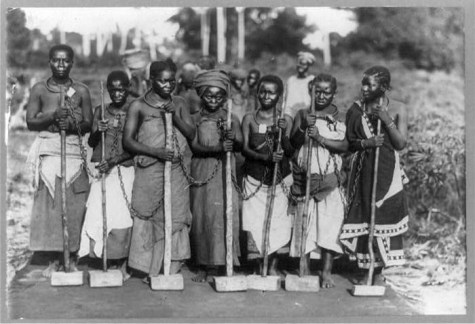
Women prisoners working on road, Tanzania. circa 1901. Source: Unknown
The search returned the usual images of pets in crates (1st-person caption optional), macro-shots of rusting locks and/or bars, stock images of barb wire, and photos from Eastern State Penitentiary (which does many photography workshops). There were three images that were worth a second glance – the other two being images WWII prisoners of war.
Despite having no means to confirm its authenticity or the accuracy of the caption, I thought the image worthy of a quick reflection. The image is contrary to the usual representation of incarcerated peoples – the era; the gender of the subjects; the continent; the anonymity of the photographer. De facto, this becomes a visual source in its most naive understanding; all we have to go on are the women depicted. The photograph wriggles away from all the contextual information one needs to assess its political purpose.
The responses of the women to the camera (pride, defiance, awkwardness, subjection – and even laughter from a lady in the background) compel me to presume nothing of this picture. I question the authority to which they are subject, I question the legitimacy of the charge by which they are held prisoner, I certainly can’t reconcile hard labour with a mode of justice for grown women. This is a depiction of slavery more than it is of criminal justice.
If the date in the caption is accurate, Tanzania (then Tanganyika) was under German rule. “Tanzania as it exists today consists of the union of what was once Tanganyika and the islands of Zanzibar. Formerly a German colony from the 1880s through 1919, the post-World War I accords and the League of Nations charter designated the area a British Mandate (except for a small area in the northwest, which was ceded to Belgium and later became Rwanda and Burundi). British rule came to an end and Tanganyika became officially independent in 1961.”
I rarely harp on about “the power of photography” because it is a subjective assessment, but I will vouch for that personal reaction to imagery that can stop you in your tracks and get you thinking.


5 comments
Comments feed for this article
February 3, 2009 at 8:12 am
silvester
I don’t blame anyone about this – it was a long time go when organizations about human rights were not set up. I have never seen this world. Whenever I look at this picture I can see small droplets of my tears are falling on my chicks [sic] because that was more than brutality. But surprisingly, up to date government still practices this kind of punishments to female prisoners in Tanzania. I wish they could allow us to picture what happens in the prisons.
February 3, 2009 at 2:48 pm
petebrook
Thanks for the comment Silvester. It was necessary for me to edit it a little. I could not include your comment about German people as it was a slightly negative generalization. Were you trying to say that German colonisers back in the early 20th century were secretive and authoritative? I also presume the use of the word “chicks” is a literal translation of a commonly used term-of-familiarity? Your assertion that the government today still treats it prisoners (as) harshly is frightening. I agree it would be of critical interest to see photography inside contemporary Tanzanian prisons in order to assess conditions there. I have several written pieces in draft form about prisons in other African nations but not Tanzania. If you see any photo essays of this nature, please notify me.
April 13, 2009 at 10:12 pm
jxn
She intends to use the word “cheeks” as it is where her tears fall. And to suggest that the German East Africa “Protectorate” concessionaires and their Swahili-Arab proxies were anything less than brutal would be outright revisionism. Only the Belgians in the Congo basin, and possibly the Südwesafrika perpetrators of the Herero Genocide, were worse than the Tanganyika bunch at the time. Of course that was a different era and a very different Germany, but many people forget that reality in light of horrors much closer to (in) Europe.
I can say from personal experience that almost no African state permits photography in its prisons. South Africa was an exception from 1994 until about 2004, but even then, only in certain areas and under observation. Prison administration is utterly corrupt and thus virtually lawless in much of the continent.
April 20, 2009 at 5:27 pm
Jim
Why would you presume they were innocent people, “enslaved” for no good reason. For all we know, they may have been the six most ruthless criminals in Tanzanian history. Do you assume that Tanzanians are incapable of meting out fair punishment? Why? Because they’re African? Do you presume the women innocent because they are women? What if they were white? What if they were men? Are men always perpetrators and women always victims?
April 20, 2009 at 5:44 pm
petebrook
Jim, I am not sure if you are addressing me or other comment-makers with your inquiry, but i will attempt to respond nonetheless. I would still question the authority and the charges to which these women are held, but that is because it is responsible to question all visual cues, I believe. I don’t presume they are innocent, as you said, I don’t know – will never know – their charge.
I think the difficulty here is that 1901 is so long ago and it is fool-hardy to makes assertions based on contemporary modes of thought. That is why I raised more questions in the piece and ultimately concluded that the image was powerful and left it at that.
I think Tanzanians are quite capable of finding their own cultural modes of punishment, but as we know Tanzanians weren’t solely in charge at this time. I think East Africa is a wonderful place and it could teach the West a thing or two about community, life for living, forgiveness to name a few. I have thoroughly enjoyed time spent in Tanzania, Kenya, Uganda and I expect I’d enjoy other African nations too if I am fortunate to visit or live there in the future.
I don’t presume. You presume I presume. Regardless of gender or colour I would think any image of a chain gang would be more representative of slavery than criminal justice. I’d even apply that to the chain gangs of Southern (and other) states of modern America. Work can be purposeful and rewarding for rehabilitative purposes, but it can also masquerade as abuse and cheap labour. I’d take each instance on a case by case basis.