
You are currently browsing the monthly archive for March 2010.
PART NINE IN A SERIES OF POSTS DISCUSSING PHOTOGRAPHERS’ ACTIONS AND RESPONSES TO THE KILLING OF FABIENNE CHERISMA IN PORT-AU-PRINCE, HAITI ON THE 19TH JANUARY 2010.
Nathan Weber was in Haiti from January 14th to January 21st.
Fabienne was shot at approximately 4pm. What had you photographed earlier that day?
Prior to being in the area where Fabienne was shot we had been searching for the mass graves and visiting the port area. We walked from the port area through one of the markets to investigate looting. It was there on the street Rue Marthely Seiee that everything went down.
Once we made it down the streets we came to this area (a ghetto, as it was explained to me) where a large number of people were coming down the street at a fast pace. At that point we heard gun shots and proceeded 1.5 blocks in the direction of the gun fire where several police were standing at an intersection. From that intersection, I could see more police trying to disperse looters and we headed to a destroyed structure.
The structure’s roof acted as a ramp that people used to gain access to other rooftops in order to scavenge and take anything they could carry. After a few minutes we decided to climb up and onto that collapsed building to make pictures from a different angel and see just what was up there. Roughly 15 to 20 minutes passed and when most of the police headed away from the collapsed building used to access rooftops to arrest some people around the corner. For whatever reason I didn’t follow and stayed put on the roof.
Did you see Fabienne get shot?
I remember looking down on the street and there was a lone officer pointing his pistol up into the air in my general direction. I don’t remember hearing a gun shot but out of the corner of my eye probably 15 to 20 feet away I saw a girl fall. The roof I was standing on was somewhat steep, slippery and was covered with small granular pieces of concrete. At first I thought she had slipped and knocked herself unconscious as I had seen others fall and didn’t think much about it until I went over to check on her. To my disbelief I realized she wasn’t breathing and I discovered a large head wound. At that point my fixer was yelling for me come down from the roof as things were heating up down the street. I looked and him, gave a hand signal indicating that something very bad had just happened and stayed put. Within a couple of minutes several photographers were upon the rooftop and shooting the scene of Fabienne’s body.
How long was it until her family and father arrived to carry away Fabienne’s corpse?
It wasn’t very long maybe 20 minutes at the most before word spread to Fabienne’s family and her father arrived on scene.
How many other photographers did you see at the scene? Do you know the photographers’ names?
The picture below shows that scene where all the photographers in the area ascended. The only photographers I know in this picture are Ed Linsmier and Michael Mullady. I think there was only one other American journalist there and everyone else was from Norway, Mexico, France, etc.

© Nathan Weber
How was the atmosphere?
The atmosphere was pretty intense. This is the most high emotion environment I have ever been in. At one point I felt that we all needed to back off and stop shooting. I thought that the pictures have been made and stepping away from the scene was in order. I also gave thought to heading back to the hotel and transmitting my images. Until this point there hadn’t been a youth death involved in looting and I knew that I would be an important news story. I am so glad I didn’t leave and I waited to see what would happen.
How did others behave?
Everyone of the photographers on the scene were very professional. We all worked together to document the situation and did our best not to add or take away from the environment. Basically, we all acted within the Society of Professional Journalists (SP&J) ethics and guidelines.
Did you discuss the tragedy with other photographers?
I didn’t really discuss the tragedy with any of the photographers at the time, or at a later date. I know that for myself being focused on the scene and doing my best to capture what was going there kept me somewhat removed. It wasn’t until being back in the States that I broke down to my girlfriend about Fabienne’s death. It was extremely senseless and there was absolutely no reason for her to have been killed. As I understand this is a common thing in Haiti, and there is very little recourse if any for this type of incident.
How does Fabienne’s death fit in with the visual narratives of Haiti’s earthquake aftermath?
I think Fabienne’s death shows when there are environments that have total chaos, the only thing you can count on is uncertainty. The visual representation here is a snapshot of what people in Haiti are dealing with.
I’m not sure what will become of the images, where they will be used or their legacy. If nothing else maybe our coverage of what happened to Fabienne will show her actions of survival were not in vain.
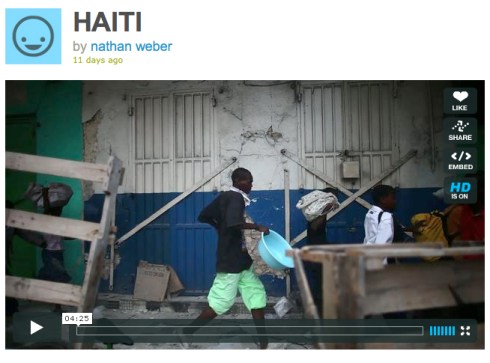
WEBER’S VIDEO
Nathan Weber has put together footage from before, during and after Fabienne’s shooting. (Content warning) Fabienne’s death is put in the context of the disorder of Port-au-Prince at the time.
Click on the frame below to be taken to Weber’s footage.
NOTE: Weber’s footage includes images of Fabienne’s dead body upon the roof, her father carrying her down the street away from the scene and the beginning of her family’s mourning. The footage is extremely descriptive. It is graphic in the sense that it shows a dead body. It is not bloody. It is very emotive.
I know that some people won’t want to see the footage and others will question its distribution. I am providing a link because it was provided to me. It is a accurate indicator of the atmosphere in LaVille on the 19th January, and in that regard a needed piece of evidence in the reconstruction of events.
– – –
ALSO IN THE ‘PHOTOGRAPHING FABIENNE’ SERIES
Part One: Fabienne Cherisma (Initial inquiries, Jan Grarup, Olivier Laban Mattei)
Part Two: More on Fabienne Cherisma (Carlos Garcia Rawlins)
Part Three: Furthermore on Fabienne Cherisma (Michael Mullady)
Part Four: Yet more on Fabienne Cherisma (Linsmier, Nathan Weber)
Part Five: Interview with Edward Linsmier
Part Six: Interview with Jan Grarup
Part Seven: Interview with Paul Hansen
Part Eight: Interview with Michael Winiarski
Part Ten: Interview with James Oatway
Part Eleven: Interview with Nick Kozak
Part Twelve: Two Months On (Winiarski/Hansen)
Reporter Rory Carroll Clarifies Some Details
Part Fourteen: Interview with Alon Skuy
Part Fifteen: Conclusions
PART EIGHT IN A SERIES OF POSTS DISCUSSING PHOTOGRAPHERS’ ACTIONS AND RESPONSES TO THE KILLING OF FABIENNE CHERISMA IN PORT-AU-PRINCE, HAITI ON THE 19TH JANUARY 2010.
Michael Winiarski is the US correspondent for Swedish newspaper Dagens Nyheter and colleague of photographer Paul Hansen (interviewed in part seven).

Osama Cherisma carries Fabienne's body down Boulevard Jean Jacques Dessaline, followed by his son, Jeff (18) and his daughter, Amanda (13). Photo: Paul Hansen
What were the dates of your stay in Haiti?
I arrived to Port-au-Prince in the morning of January 14th. I flew in from Washington (where I’m posted as correspondent for the newspaper Dagens Nyheter) through Santo Domingo. I left Haiti late on January 21st, by car to Dominican Republic.
Fabienne was shot at approximately 4pm. What had you reported on earlier that day?
Actually about the deteriorating security situation and looting in central Port-au-Prince.
Did you see Fabienne get shot?
No, I was by the car at Boulevard Jean-Jacques Dessalines when our driver came and told me that a girl had been shot. When I saw her she lay in the street.
How long was it until her family and father arrived to carry away Fabienne’s corpse?
When I saw her, the father was already there. I checked my watch which was exactly 16.00pm, so I assume she was shot at least 10-15 minutes earlier.
How many other journalists/photographers did you see at the scene? Do you know the names of these other media people?
Apart from Paul Hansen from Dagens Nyheter, I saw the Danish photographer Jan Grarup and the Reuters and AFP guys. I think I was the only foreign writer/reporter, and there also was a Haitian man who volunteered with translating some things the father said.
How was the atmosphere? How did others behave?
It was of course tense, with lot of crying, screaming and lamenting as we followed the crowd to the house of the Cherisma family. But the immediate threat of more shootings had subsided – no police were to be seen around us.
Did you discuss the tragedy with Paul or other journalists?
At that point only with Paul, and we did not hesitate that we should report the story.
Any other thoughts?
In Sweden, there were ethics discussions about Fabienne [and the photographs] by magazines and bloggers.
SWEDISH MEDIA DISCUSS THE ETHICS OF PUBLISHING PAUL HANSEN’S IMAGE OF FABIENNE
So upsetting is the photograph of a dead young girl, that Swedish magazines and bloggers responded to and questioned it’s use for Winiarski’s article (Swedish original / English translation).
The article humanised Fabienne and communicated the injustice and immediate devastation her death caused. It ends with a description of the family’s grief:
Fabienne’s little sister, Samantha, runs adjacent to [her father who carries Fabienne’s dead body] and roars in grief. It is only later Osama Cherisma will completely absorb what has happened. Then he will sit down and stare blankly ahead. But now he cries curses at the police who he believes took aim at his daughter.
We follow the weeping and despaired small group down the street, through the business district, to Fabienne’s home. It is only here when Fabienne’s mother Amante Kelcy hear what has happened to her girl. She falls apart in a crying, “Why? “Why? Why?”
Ever since the shot, the police are not to be seen. No police dare to enter these streets after a member of its rank and file killed one of the neighborhood children. No ambulance will be summoned. There is still no one to send. And Fabienne is already dead. Unnecessarily.
Osama Cherisma curses the police. “They are like animals, they are animals, “he says. “Why should my daughter pulled away in the prime of their youth?”

Fabienne's younger sister, Amanda Cherisma (13) and older brother, Jeff Cherisma (18) over the body of their sister. Photo: Paul Hansen
Dagens Nyheter, to its credit, acknowledged the concerns and answered them directly in an editorial. I paraphrase due to the vagaries of translation:
We are obviously very reluctant to publish pictures of the deceased. A reader emailed and questioned how we would handle the issue if the image depicted a fifteen year old girl in Sweden. The answer is that the situation in Sweden is not comparable – if Sweden were affected by a disaster of equal scale of that in Haiti, then publication discussions would be based on the circumstances of that event.
How families are affected by publication is another important issue to consider in the decision.
DN’s mission is to take the world closer to readers, even when reporting can bring discomfort. Michael Winiarski’s and Paul Hansen’s reporting in connection with this individual tragedy is strong and worthy – and not at all speculative. In our view, it’s publication was important.
The statement above can be construed as a standard media response – that while Dagens Nyheter is aware of the distress Hansen’s photographs may cause it readers AND the deceased’s family, it goes ahead with publication in the interests of information.
Respect is given in that the need for respect is articulated. Is this enough?
I remain a little uneasy. The photographers I’ve interviewed for this series have given their opinions, but still I wonder what Fabienne’s family actually think – especially eight weeks later – of the international coverage of Fabienne’s death.
– – –
ALSO IN THE ‘PHOTOGRAPHING FABIENNE’ SERIES
Part One: Fabienne Cherisma (Initial inquiries, Jan Grarup, Olivier Laban Mattei)
Part Two: More on Fabienne Cherisma (Carlos Garcia Rawlins)
Part Three: Furthermore on Fabienne Cherisma (Michael Mullady)
Part Four: Yet more on Fabienne Cherisma (Linsmier, Nathan Weber)
Part Five: Interview with Edward Linsmier
Part Six: Interview with Jan Grarup
Part Seven: Interview with Paul Hansen
Part Nine: Interview with Nathan Weber
Part Ten: Interview with James Oatway
Part Eleven: Interview with Nick Kozak
Part Twelve: Two Months On (Winiarski/Hansen)
Reporter Rory Carroll Clarifies Some Details
Part Fourteen: Interview with Alon Skuy
Part Fifteen: Conclusions
PART SEVEN IN A SERIES OF POSTS DISCUSSING PHOTOGRAPHERS’ ACTIONS AND RESPONSES TO THE KILLING OF FABIENNE CHERISMA IN PORT-AU-PRINCE, HAITI ON THE 19TH JANUARY 2010.
Last month, Swedish photographer Paul Hansen was named POYi Newspaper Photographer of the Year. The month before – from Jan 16th until Jan 28th – Hansen was in Haiti .
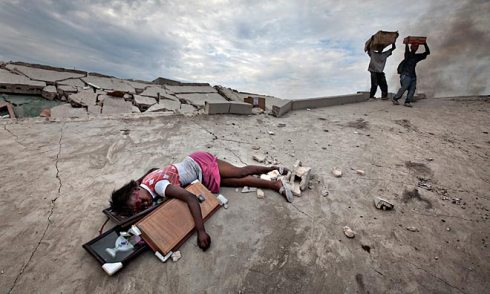
Photo: Paul Hansen
Fabienne was shot at approximately 4pm. What had you photographed earlier that day?
I was in the city of Leogane earlier that day to cover the destruction. Later in the afternoon I covered the ongoing looting in central Port-au-Prince
Did you see Fabienne get shot?
No.
How long was it until her family and father arrived to carry away Fabienne’s corpse?
I don´t really remember, and I don’t know exactly when she got shot – but from the time I got up on the roof until her father arrived I estimate it took around half an hour. But, the stress and trauma of the situation makes that estimate shaky.
How many other photographers did you see at the scene? Do you know the photographers’ names?
I saw five or six, but perhaps there was more. It was a very fluid situation. I know two of them – Jan Grarup and Jan Dagö, both Danish.
Did you discuss the tragedy with other journalists?
I discussed it mostly with my Swedish colleagues at the time, and I still discuss it today.
How was the atmosphere? How did others behave?
The atmosphere was very fluid and potentially dangerous, a young girl had just been shot in the head by somebody, and we were standing in the same spot. What baffles me is that the looting continued around this poor girl and that some of the other looters stole money from her hand and poked the body so that she started to slide/roll down towards us (photographers) – it was a very tragic thing to witness. How traumatized and desperate must these people be to act in this manner?
How does Fabienne’s death fit in with the visual narratives of Haiti’s earthquake aftermath?
I don´t really understand the question. If there is there something that “fits with the visual narrative of a disaster” in general I do not know what that would be. However, having said that, I think it is extremely tragic that a young girl had to die like that. For me, Fabienne’s death and her story is an poignant reminder of the need for a society to have basic security – with or without a disaster.
Anything else?
The more attention Haiti gets, the better. Fabienne’s death is to me an unnecessary tragedy – on top of the larger tragedy.
If the security would have been in place, an earthquake survivor like Fabienne and many more would be alive. I photographed several people killed by the mob/police/security personnel. The death of this little girl, killed over some decorative trinkets, saddens me deeply and affects me to this day. I frequently talk about her with readers, colleagues and friends.
I will never forget that horrible day.

Fabienne's mother, Amante Kelcy, after seeing Fabienne's dead body. Photo Paul Hansen
– – –
ALSO IN THE ‘PHOTOGRAPHING FABIENNE’ SERIES
Part One: Fabienne Cherisma (Initial inquiries, Jan Grarup, Olivier Laban Mattei)
Part Two: More on Fabienne Cherisma (Carlos Garcia Rawlins)
Part Three: Furthermore on Fabienne Cherisma (Michael Mullady)
Part Four: Yet more on Fabienne Cherisma (Linsmier, Nathan Weber)
Part Five: Interview with Edward Linsmier
Part Six: Interview with Jan Grarup
Part Eight: Interview with Michael Winiarski
Part Nine: Interview with Nathan Weber
Part Ten: Interview with James Oatway
Part Eleven: Interview with Nick Kozak
Part Twelve: Two Months On (Winiarski/Hansen)
Reporter Rory Carroll Clarifies Some Details
Part Fourteen: Interview with Alon Skuy
Part Fifteen: Conclusions
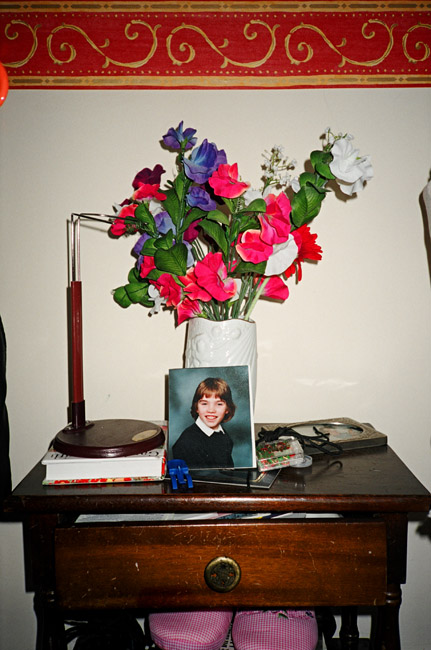
Anna Fox
Tomorrow, the 17th March, the Deutsche Borse Prize is announced.
Two artists up for this year’s prize can fill us with humour and optimism, two others serve the cold reality of human’s strategic antagonism and ability to destroy. It depends on which worldview you prefer.
THE COLOUR OF FOX AND LEONARD
Anna Fox’s bright works are full of love and wonder but they aren’t winners … not yet. Fox has too many ongoing projects that it would be counter intuitive to make her the Deutsche Boss.
The appeal of Fox’s work is obvious part Richard Billingham, part Cindy Sherman, large part Martin Parr. Fox observes congested cupboards, Mothers Day flowers, plastic dolls and emphatic interior details with awe but without irony. All her work is colourful and her later photography staged (Country Girls). Fox’s work is a celebration of that British penchant for chintz and pattern that is rarely brought into focus. While it is distancing, Fox’s work is not distant. Necessarily the ugly brocade of a parents’ generation is balanced by the crayons of the kids’ generation, Fox’s work is unifying. It’s a winner but a winner in its mid-development, so not a winner for now.
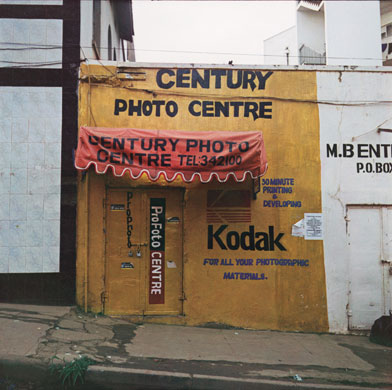
Zoe Leonard
Zoe Leonard has a keen omnicultural view that picks out the additions and modifications that humans make to their world. Surely, it is Leonard’s wandering eye which casts wonderment upon all nations that is the attraction of her work?
Like Fox, Leonard is interested in human ingenuity. Both artists are optimistic about the utility and purpose of things. For Fox and Leonard things, as curious and benign as they may be, are material objects that budded elements of creativity and graft.
Leonard’s worldly view is generous and progressive but is it a fair reflection of our world?
THE DARKNESS OF WYLIE AND RISTELHUEBER
On the other side of the equation, Wylie and Ristelhueber – with restrained palettes – throw down their documents of strife and its aftermath with dominating conscience.
The choice you must make between the two is simple. Do you go for Wylie’s final phase ‘Troubles’ of Northern Ireland or do you go for Ristelhueber’s sprawling and ongoing multinational survey of carnage?
Do you prefer your battles contained or dispersed? Can violence be enclosed, bright-burning and abated between walls, or is conflict slower – continually popping and maiming in every country and on any old road?

Donovan Wylie
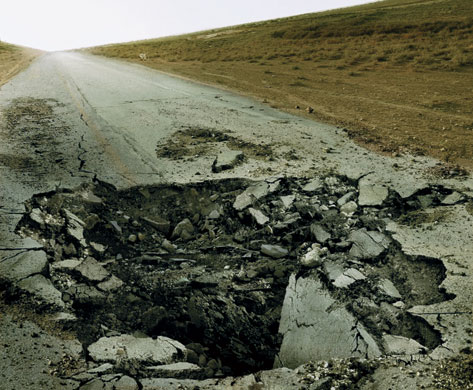
Sophie Ristelhueber
As Ristelhueber opens up space Wylie closes it down. As Wylie describes literal containment Ristelhueber prowls the unnerving territory of psychological containment. Ristelhueber’s Blowups series of craters after IED and car bomb explosions are chilling and very effective.
The ultimate difference between these two artists is that Wylie offers reprieve. Wylie recently declared his image of the Maze’s last wall to be demolished his “Best Shot”. Everyone is aware of Wylie’s Northern Irish heritage and H.M.P. Maze carries more meaning for him personally than it may for us. Wylie documented the prison’s decommission and demolition over a period of eight years. He hopes that the work be simultaneously a record of the site and a “metaphor for the peace process”.
Ristelheuber’s document of violence seemingly has no limits or borders, a notion of violence that is depressing but accurate for today’s globalised military engagement. Where do we find a peace process here? Which road or road-map do we follow here?
If Wylie’s work references the remnants of a political battle, Ristelhueber’s is record of ongoing skirmish. Ristelhueber’s photographs of blockades and bomb-craters are images not unlike those of the Northern Irish Troubles so we can identify a lineage there. However, hers are not photographs from 35 or even 15 years ago; Ristelhueber’s work shows us the violence of the 21st century.
Some might favour the distant and deadpan of Wylie’s aesthetic, but for me, for its immediacy and for its relevance, Ristelhueber should take the prize.
PART SIX IN A SERIES OF POSTS DISCUSSING PHOTOGRAPHERS’ ACTIONS AND RESPONSES TO THE KILLING OF FABIENNE CHERISMA IN PORT-AU-PRINCE, HAITI ON THE 19TH JANUARY 2010.
Jan Grarup was in Haiti from January 14th to 26th January.

In the central part of Port au Prince, looting is getting worse. Desperate people rob the stores and warehouses. Police try maintain law and order but can not control the increasing crowds. Tuesday, January 19th. Photo: Jan Grarup/NOOR Images
Fabienne was shot at approximately 4pm. What had you photographed earlier that day?
Mainly looting, things were going crazy in the center of Port-au-Prince.
Did you see Fabienne get shot?
Yes. I even think I photographed the police officer who shoot her.
How long was it until her family and father arrived to carry away Fabienne’s corpse?
Approximately, 30 to 40 minutes.

Osama Cherisma, Fabienne's father carries her away after followed by his son, Jeff (18) and his daughter, Amanda (13). Photo: Jan Grarup/NOOR Images
How many other photographers did you see at the scene? Do you know the photographers’ names?
I would guess about eight photographers. I know of at least five of them – Paul Hansen from Sweden, Jan Dago from Jyllands Posten … I’ll have to check the others.
How was the atmosphere? How did others behave?
Looting continued without stopping even when she was lying dead on the rooftop.
Did you discuss the tragedy with other photographers?
No, not really, it was a bad and very sad thing.
How does Fabienne’s death fit in with the visual narratives of Haiti’s earthquake aftermath?
It showed how desperate people were in order to survive.

Photo: Jan Grarup / NOOR Images
– – –
Jan Grarup is a photographer for NOOR Images. His portfolio of images from Haiti can be viewed here (Content warning). Images of and around the time of Fabienne’s shooting are on pages 1, 2 and 3.
Jan is working on a larger body of work about Fabienne but is not willing yet to offer any details.
– – –
The mentioned Jan Dago, Jyllands Posten photojournalist, could not be reached for interview. His dispatch can be viewed here (Content warning).
– – –
ALSO IN THE ‘PHOTOGRAPHING FABIENNE’ SERIES
Part One: Fabienne Cherisma (Initial inquiries, Jan Grarup, Olivier Laban Mattei)
Part Two: More on Fabienne Cherisma (Carlos Garcia Rawlins)
Part Three: Furthermore on Fabienne Cherisma (Michael Mullady)
Part Four: Yet more on Fabienne Cherisma (Linsmier, Nathan Weber)
Part Five: Interview with Edward Linsmier
Part Seven: Interview with Paul Hansen
Part Eight: Interview with Michael Winiarski
Part Nine: Interview with Nathan Weber
Part Ten: Interview with James Oatway
Part Eleven: Interview with Nick Kozak
Part Twelve: Two Months On (Winiarski/Hansen)
Reporter Rory Carroll Clarifies Some Details
Part Fourteen: Interview with Alon Skuy
Part Fifteen: Conclusions
PART FIVE IN A SERIES OF POSTS DISCUSSING PHOTOGRAPHERS’ ACTIONS AND RESPONSES TO THE KILLING OF FABIENNE CHERISMA IN PORT-AU-PRINCE, HAITI ON THE 19TH JANUARY 2010.
Edward Linsmier was in Haiti from January 15th to January 20th.
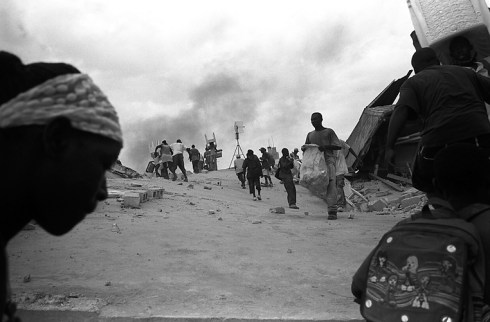
Members of the public on a collapsed roof moments prior to Fabienne's fatal shooting. Photo: Edward Linsmier
Fabienne was shot at approximately 4pm. What had you photographed earlier that day?
Michael Mullady, Nathan Weber and I were all traveling around together while in Haiti. Earlier that day we had made our way to the airport, hired a fixer and driver, been to the mass graves, fired our fixer and driver, met up with our old fixer and made our way downtown. We photographed at the General Hospital (it’s also worth noting that Eric Beecroft at the Foundry Workshops donated about $350 worth of badly needed medical supplies to the General Hospital, which we were able to deliver in person), the port and we were making our way back through LaVille (where the Iron Market is) towards the Presidential Palace when we walked into the crowds looting and heard the gunshots.
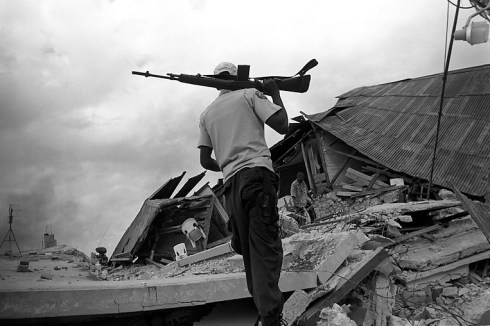
Policemen had been instructed to fire high into the air to disperse members of the public. Photo: Edward Linsmier
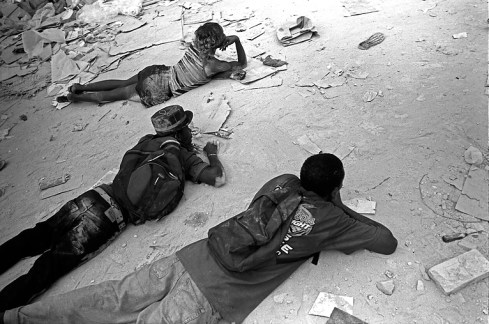
Three members of the public take cover presumably from shots fired on a collapsed roof. Photo: Edward Linsmier
Edward describes the lead up to Fabienne’s death on the Adjustment Layer blog:
Soon lines of people began gathering goods seized from the bowels of the destroyed buildings. We followed the line up onto a downed roof top that led to the exposed insides of several shops filled with the scavenging and excited crowd. We were making pictures. Some people briefly yelled at us not to take their picture but hesitated to stay around long enough to enforce their requests. More gunshots filled the air. We couldn’t tell where they were coming from but they seemed close.
There was a commotion from not far down the street. The fixer motioned for me to come because the police had caught a man and had him down on the ground. I, in turn, motioned for my friend and fellow photographer, Nathan Weber, who was still on the slanting concrete rooftop to follow me to the commotion down the road. I yelled his name and he looked at me with a blank stare. Nathan is someone who is on point in a situation such as this. He communicates quickly, clearly and with authority when needed. He is no stranger to photographing in similar situations but something of this magnitude was new to both of us. I knew he heard me and figured he would be right behind me as I headed down to the commotion.
I began photographing a man on the ground and the fixer stood near us and began translating what the police were saying into English, all the while keeping a keen eye on our surroundings. Then someone ran past our fixer and said something in Creole. Our fixer then yelled to us that someone had been shot where we had just been. We ran maybe 50 yards back and climbed back up on the roof to see Nathan in almost the exact same spot where I last saw him, except he was looking at a girl who was lying face down on the slanting concrete roof. As best as I can recall, Nathan spoke in short sentences, “I saw her fall. I thought she tripped and knocked herself out. She’s dead. Fuck. She got shot. I was right here.”
The decision to continue making photographs was instinctual. More photographers showed up and we were all making pictures, composing the dead girl in the foreground as the looters continued to walk past her, almost over her, carrying whatever they could. Several men stopped to turn her over, seemingly to identify the body. They gently took her arms and almost had to twist her just a little to face her upward. They looked at her with little emotion and left. She had been shot in the head. From what I could tell, the bullet entered her cheek and exited from the back of her head. The blood had been pooling in some picture frames she was carrying when she fell. After the men moved her, the blood began to run down the slanting concrete roof towards us. We all were still making pictures. To anybody else, it must have looked sick, a crowd of photographers vying for the best position to tell the story of the death of a girl.
Edward recalls a detail he had forgotten for the Adjustment Layer interview:
I had almost forgotten completely about the individual that came up and literally took the money out of Fabienne’s lifeless grip. Upon looking back through my digital take, I have a sequence of a teenage boy coming up and taking the money.

Member of the public peers at Fabienne's body. Photo: Edward Linsmier
Did you discuss the tragedy with other photographers?
During a lull in photographing Fabienne, I spoke briefly with a photographer from Canada, perhaps the Toronto paper, and asked him how he was doing. It was a hot day and all of the photographers had been working hard as it was a decently fast-paced situation even before the shooting. We were both kneeling, facing away from the body and he said that he was a little shaken up. I think several of us were shaken up for multiple reasons. First and foremost, we were all photographing a young girl who had just been shot and killed. But I think we were also shaken up because within the last five minutes no less than three or four of us photographers had walked those exact same steps Fabienne was walking when she was gunned down.
How long was it until her family and father arrived to carry away Fabienne’s corpse?
I could check the timestamps on my digital files but I believe from the time Fabienne was shot until the father came to pick her up was about 20 minutes, perhaps 25 minutes.
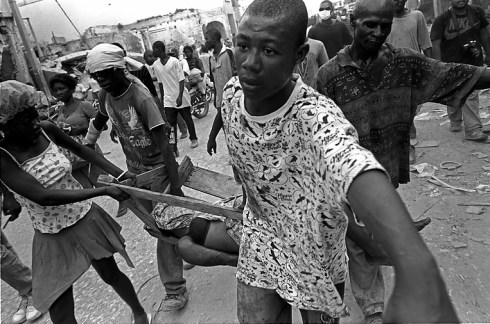
Osama Cherisma, Fabienne's father (back right), and others carry Fabienne's corpse. Photo: Edward Linsmier
How many other photographers did you see at the scene? Do you know the photographers’ names?
I would estimate that there were anywhere from 6-10 photographers that photographed at various points throughout Fabienne’s death and journey home. I do not know any other full names of the photographers except for Michael Mullady, Nathan Weber and myself.
The atmosphere among the photographers was very professional. The feeling in the air was that this was something important and we were all going to do the best job we could in covering it. It was rather intense. We tried to stay out of each other’s frames and share the best angles when we could. I have to say that I was impressed with the other photographers there. They all seemed to care very much about what they were doing and they were all working very hard, hustling to get every shot they could.
How was the atmosphere? How did others behave?
As far as I know of the situation, all the photographers were very respectful of the situation. As I mentioned before, I did not experience any sort of backlash from the people we were photographing at all. As chaotic as the situation was, I felt that they were very open to us and even glad we were there.

Samantha Cherisma mourns and screams over her sister's body in the street. Photo: Edward Linsmier
How does Fabienne’s death fit in with the visual narratives of Haiti’s earthquake aftermath?
Any story like this, where people have been killed or are suffering, deserves to be done correctly and to be done correctly you need to have resources. I don’t necessarily mean monetary resources, but definitely enough to hire a fixer/translator on the ground. I don’t know if anything our fixer did saved our lives, but he kept us from harm’s way and without him, we definitely would not have made the pictures we made that day of Fabienne.
As far as how Fabienne’s death fits into the story of the earthquake – I think it’s an all too tragic piece of the puzzle. The Haitian people are some of the most resilient I’ve ever met. Most of them lead incredibly tough lives. Their own government has all but abandoned them. They have been deprived of so much that we take for granted. I think it was only natural for people to loot. Most Haitians live on less than $1US per day. They saw a chance to gain possessions that most of them would never otherwise be able to afford. I’m not saying it was right or okay to loot, I’m just saying that I understand why there were doing it.
Anything to add?
Something else worth noting – Our fixer was on the roof with the group of photographers after Fabienne had been shot. The police were still shooting and someone had the forethought to ask our fixer to yell to the police that journalists were on the roof and not to fire in that direction any longer. I look back on it and realize how important that was. Some of us automatically think we are excluded from danger in a situation like that but nothing could be further from the truth. I’m not saying we didn’t make any mistakes that day, but I want to emphasize how important it is to go into a situation like that as prepared as possible.
Cherisma or Geichmar?
[For the Adjustment Layer interview] I failed to include Fabienne’s name in my description of events. I cannot 100% guarantee the accuracy of the spelling of the name as I have seen it differently elsewhere. My caption information for my photos with the info our fixer provided for us (he had a pen and paper and was talking to family members) is as follows:
“Fabienne Geichmar, 15, was fatally shot by a stray bullet while looting from a store on Rue Marthely Seiee in the LaVille section of Port au Prince. Violence and looting have been commonplace in downtown Port au Prince since shortly after the earthquake that devastated the Haitian capital.”
I’m not sure why I wrote that it was a stray bullet… I think because that’s what I wanted to believe and also because I could not confirm that police had shot her.
– – –
Edward will be in Haiti a second time from the 18th to 26th March.
View Linsmier’s images from his first stint in Haiti.
– – –
ALSO IN THE ‘PHOTOGRAPHING FABIENNE’ SERIES
Part One: Fabienne Cherisma (Initial inquiries, Jan Grarup, Olivier Laban Mattei)
Part Two: More on Fabienne Cherisma (Carlos Garcia Rawlins)
Part Three: Furthermore on Fabienne Cherisma (Michael Mullady)
Part Four: Yet more on Fabienne Cherisma (Linsmier, Nathan Weber)
Part Six: Interview with Jan Grarup
Part Seven: Interview with Paul Hansen
Part Eight: Interview with Michael Winiarski
Part Nine: Interview with Nathan Weber
Part Ten: Interview with James Oatway
Part Eleven: Interview with Nick Kozak
Part Twelve: Two Months On (Winiarski/Hansen)
Reporter Rory Carroll Clarifies Some Details
Part Fourteen: Interview with Alon Skuy
Part Fifteen: Conclusions

READ THIS: Anna Pickard’s review of Gaga’s latest production-laden video says it all. Pickard uses screenshots and the driest of commentary.
“Lady Gaga has out-sexied the entire world and for this crime she’s landed in a semi-nudist jail. Luckily she has a well-known brand of mobile, and her friend Beyoncé, on hand to help,” says Pickard.
“In minute four this happens, Gaga touching herself, wrapped in police tape in a medium to maximum security prison … and that’s intercut with pics of her planning her escape with the help of some really high-profile product placements.”
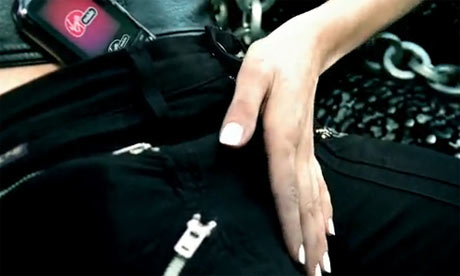
PRISON PHONES
Apart from the ridiculous fetishistic portrayal of jail, the violent skirmish greeted with laughs and the sell-out crotch-rub, the most offensive thing about the video is Gaga’s frustration at the phone line breaking-up.
Families across the United States have been fighting legal battles to break up the monopoly and racket that is prison telephone contracts. You can sign a petition here against MCI/Global Tel Link.
Unfortunately, many lawsuits have fallen away, but as the New York Times reported last November the public attention of lawsuits has brought about significant reform and lowered prices in a “terribly unfair system.”
I’m not saying that prison or jail inmates and families would necessarily be offended by a multimillion-dollar-pop-thing using a failing jail payphone as a prop for her next breast-thrusting million, I am saying that I am.

PRISONS IN MUSIC VIDEOS
This is not the first time I’ve been confused with popstars appropriating prisons for their music videos. Michael Jackson put on the full crotch-grabbing show in a prison chow-hall for his video They Don’t Really Care About Us.
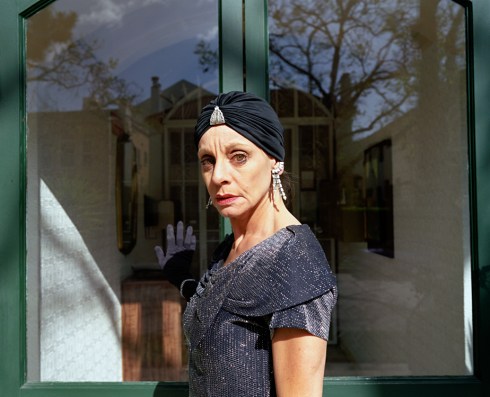
Sharon at the front door. Simone Lueck
CRITICAL MASS: 593 entrants, over 200 jurors, 181 shortlisted photographers, 50 finalists, 6 contenders, 2 eventual book deals.
For months, the Critical Mass jurors nudge and judge portfolio across the internet casting their opinions by way of prescribed digits – NO (0), YES (1), MEGA-YES (3), WOW (7). It’s numbers-gymnastics.
The 36,000 scores are then thrown into a big statistics cauldron and Shawn Records, one of CM’s organisers informed us back in November that the difference between the “lowest score on the list and the highest one that didn’t make the cut was just 0.01314411684.”
Down at the Photographic Center Northwest, Seattle the scores and calibration tables are forgotten as each of the Top50 winners is represented by a singe print chosen by juror Andy Adams of FlakPhoto.
RUNNERS AND RIDERS
The Top50 have been online for three months now. The names in the show are likely familiar, but the chosen prints possibly not. In some cases the anointed print on show didn’t satisfactorily deputize for the complete portfolio, and in other cases the strength of a single print was spur for a second glance at a portfolio.
Simone Lueck’s Sharon at the front door was a stand-out print, as garish and perky as the subject’s make-up. Sharon holds your stare as the direct sunlight degrades her skin by the second. “Let me help you with that door” I urged, worried for the integrity of the l’Oreal face-goop.
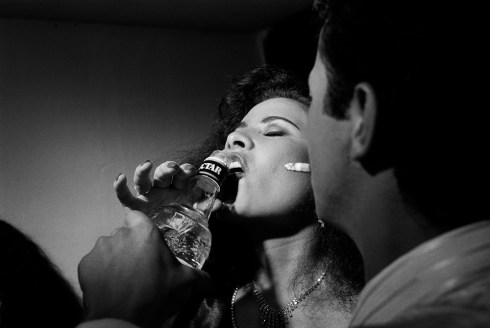
Aguardiente shots backstage at the beginning of the Miss Light pageant, Mesitas del Colegio, Colombia. Carl Bower
Women and the politics of appearance featured strongly throughout. Carl Bower’s project Chica Barbie examines the beauty pageant phenomenon of Colombia placing the contests within the context of the country’s pervasive violence; pageantry as escapism.
Bower’s work compresses pride, anxiety, routines, achievement and exploitation, but never casts aspersions upon this particular cultural more. Bower’s even-handedness presumably stems from his photojournalist background.
Bradley Peters’ print was banished to the stairwell, yet his work is strong enough to endure. Earlier on the night of opening, PCNW gallery director Ann Pallesen described juror Andy Adam’s FlakPhoto project as “off-kilter” – Peters is perhaps the best proponent of that look. Peters constructs scenes that so flauntingly blur art and documentary the viewer is hooked. I was befuddled last year when Peters came on the scene.
I liken Peters to Crewdson but without the six-figure budget; perhaps Crewdson on Valium. Peters also won the Conscientious Portfolio Competition, 2009.

© Bradley Peters

Ponce. Ellen Rennard
Also on the stairs, Ellen Rennard. Let me tell you, I generally don’t care for pictures of aninals but Rennard is the type of special talent to get my stubborn eyes seeing again. The runners and riders in the stables are partners, total equals. Respect runs through this series from photographer to subject, man to mammal. Rennard’s work is as compelling as any documentary portrait project I’ve seen in the past two years.
Dead dogs anyone? No, how about dead cats then? Mary Shannon Johnstone cares deeply enough about animal welfare and responsible stewardship that she went inside a North Carolina euthanasia clinic. Breeding Ignorance is a view we’ve not seen before and it may not be one you want to see again such is the visceral rendering of matted fur, stiff eyelids and garbage-headed biomass.

Cats Disposed. Mary Shannon Johnstone

Tree, Boston Public Garden, 2009. Pelle Cass
Talking about fur, Pelle Cass specializes in composite images of frantic activity, human and animal. The print from Selected People chosen for this show depicts a tree covered in scores of pudgy, russet squirrels surrounded by less fat humans and a flutter of birds in various stages of take off and perch. Cass’ work made me laugh, which is always a good sign.
Jane Fulton Alt’s portfolio Burn series is delicate but underwhelming if isolated. Fortunately, it is not isolated in that Fulton Alt has followed up on previous work with great intelligence. In 2005, Fulton Alt worked as a social worker in the aftermath of Hurricane Katrina. At dusk she’d document the ruined city. Burn series continues the same washed out grey of her Katrina series Look and Leave, only here it is smoke and not the “toxic, metallic air” of New Orleans. Fulton Alt observed upper respiratory problems among post-Katrina survivors and it as if this work is a lingering acknowledgement of legacy complications after the fact. Disasters are never just natural or man made but always a spiteful conflagration of the two … the air needs to clear … the dust needs to settle … the poisons sometimes burn slow.

Burn No. 81. Jane Fulton Alt
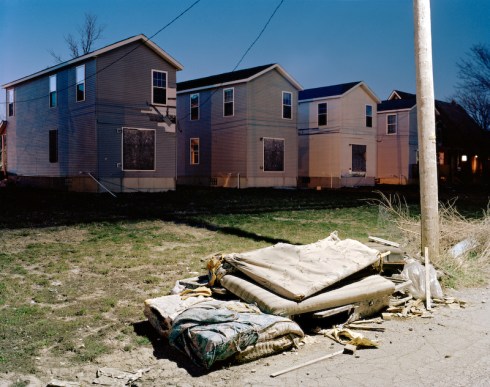
Alley Behind Ferris St. © Will Steacy
I really enjoy Will Steacy’s politic (his blog rants are a breath of fresh air) and he seems to be one of the hardest working photographers out there. The chosen print was luminous. However, I get the impression that Steacy only cares about these streets in as much as the debilitating effect they have on their inhabitants and itinerants. I’d have like to have seen one of his figure studies.
Manuel Capurso and Samar Jodha both pierced the darkness with portrait studies. Capurso’s chiaroscuro isolates his subjects and communicates the loneliness of life’s latter stages. Jodha literally spotlights the Phaneng people with whom he has lived for four years; they are a people on the verge of extinction and he has photographed every member of the 1,500 deep tribe. Both artists were effective.
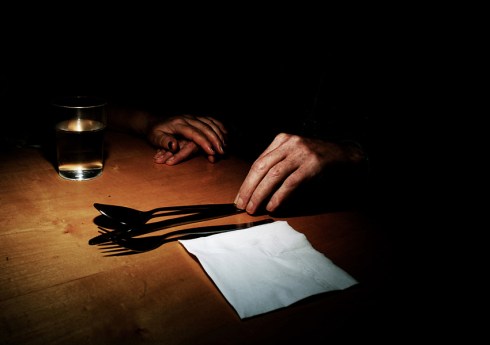
Untitled. © Manuel Capurso

Phaneng 1. Samar Jodha
Alejandro Cartagena was one of the two book award winners this year and I wouldn’t argue with the selection; he is doing immensely important work about mass-suburbanisation/social-housing projects in Mexico. However, I would argue for the case of half a dozen prints from his portfolio before the one chosen for this show.
David Taylor and Victor Cobo are also engaged in important inquiries both probing issues of immigration and policing, family and place. In each case though, the print did neither of their theses any favours. Cobo’s print was bright and with humour but, without context, it receded quickly from memory. Taylor’s print was large and empty but perhaps that was the point to suggest the illegal immigrants as helpless, lost and losing agency?
Definitely spend time with Cartagena, Taylor and Cobo’s online portfolios as I think they are three vital political thinkers in photography. Perhaps that was the problem, my hopes for the print were too high ?…

Mi Abuela, México, 2003 © Victor Cobo

Untitled © Ed Freeman
Up until last Friday, Joni Sternbach had single-handedly carried the genre of surf photography. She now has Ed Freeman to help her with the load. Generally, I dislike pictures of surf (bar the odd Friedkin print) as much as I dislike pictures of animals, but Ed Freeman’s print really stood out. His online portfolio is as balanced too. Definitely the surprise of the evening.
Finally, leaving the best to the last, Andrea Camuto’s print romped home with the win in the ‘gut-punching-and-my-world-is-better-informed-for-seeing-this’ category.
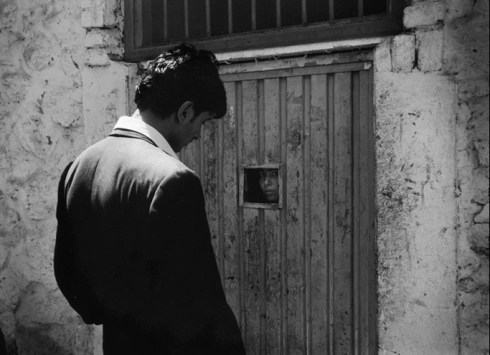
Visitation, Waleyat woman's prison, Afghanistan © Andrea Camuto
Camuto is interested in the needs of families to survive as they have migrated in and out of Afghanistan and in and out of the capitol Kabul in bids to find livings.
From Camuto’s statement, “Feeling great compassion for their struggles, I was compelled to return several times, most recently in 2009. As my ties with these families deepened, I followed them into such places as the women’s hospital and the women’s prison. Each trip furthered my understanding of the political and social complexities of Afghan culture. Entrenched attitudes, coupled with rampant illiteracy, create the oppressive conditions under which Afghan women are forced to live. In these photographs I call attention to these ordinary Afghans, who go unnoticed and unrecorded in the larger narrative of the conflict in Afghanistan today.”
While the chosen print is a literal depiction of enclosure, the house arrests and claustrophobic hardships of rural life as portrayed in Camuto’s work bring a heavier weight to bear on the viewer. Camuto’s is the latest in a slew of projects I’ve seen recently coming out of the AfPak region that don’t depict military engagement. These personal struggles, significantly, are dictated by larger political and infrastructural battles currently being fought in Afghanistan.
The helplessness served up in Camuto’s work is bitter blow and one that lasts.
– – – – –
EXPOSED: CRITICAL MASS will be on show at the Photographic Center Northwest, 900 12th Avenue, Seattle, WA 98122 until the 18th May.

 Prison Photography