
You are currently browsing the monthly archive for July 2013.
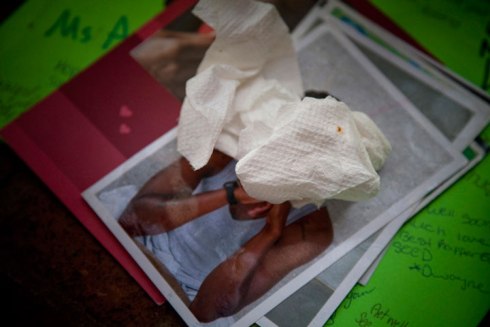
Washington, DC – 2012. “Even though it was a split second decision that caused those women their lives, it was not just one decision. My life pretty much sprouted out of control as far as me being teen mother, high school drop out, unemployed, drug addicted, alone; I was just immersed in the life of crime,” says Lashawna Etheridge-Bey.
This blog post is long overdue. Gabriela Bulisova is a committed multimedia storyteller who, for the past few years, has shaped stories about post-prison lives and focusing often on the experiences of women re-entering society.
In the excellent Convictions (2012) — a video about Our Place, a D.C. non-profit assisting currently and formerly incarcerated women as they transition out of the criminal justice system — Bulisova notes that over 1 million U.S. women are under correctional supervision (prison, jail, probation or parole) and that the female prison population has ballooned by over 830% in the past 30 years. Yes, you read correctly; an eightfold increase in the number of women locked up since 1980. There are 200,000 women behind bars.
Bulisova’s latest piece Time Zone “portrays the story of Lashonia Etheridge-Bey, a 39-year-old resident of Washington, DC, who spent half of her life in prison for a double murder and was paroled in December 2011. It focuses on Lashonia’s personal transformation while in prison, her difficult yet highly successful reentry into society, and the conflicts that remain within herself and with family members,” says Bulisova.
You can view a gallery of stills from Time Zone here.
When she was 16, Etheridge-Bey shot two teenage girls dead. She spent 20 years in prisons and due to her self-discipline and model behaviour was granted parole at the first hearing.
What is interesting about Time Zone is that it doesn’t focus on the systematic problems of the prison industrial complex. Instead, it focuses on the details of Etheridge-Bey’s own story. By exploring family ties, Etheridge-Bey’s feelings of guilt (at one point, she asks, “Do I deserve to forgive myself?”) her support systems and her coping strategies, Bulisova weaves a tale full of complex issues and challenging questions.
I almost feel like Time Zone should be screened in prisons and jails as an example of how extremely difficult circumstances are surmountable. If an incarcerated person has the right discussions, strong resolve and faithful allies in dealing with the past and future then
Etheridge-Bey credits prison — or more specifically, the fact it extracted her from society and a tough life — as a turning point. Prison forced her to examine her life. She took the opportunity and is undoubtedly a success story.
To say that prison is “good” by any definition is difficult for people such as I who advocate for prison-reform. But, of course, prison is only good if an incarcerated individual develops their own skills to make the most of limited resources available. All the while, prisons should meet basic health and safety needs, which is not always the case.
Through tenacity and discipline, Etheridge-Bey propelled her self-improvement. She maintained strong relationships with her family (her daughter’s words in the video are impressive, realistic and hopeful); she accumulated college credit while she was inside; she has beaten the hurdles to employment and study that many post-release felons face.
Reentry can be very difficult. The stigma of incarceration can be very difficult. Not every former prisoner will be as successful as Etheridge-Bey. The question we must ask is how much do we want to invest in people who have made mistakes — sometimes terrible, life-costing mistakes? If people must be locked up, how can we think imaginatively about maximizing the opportunities for prisoners to find a new track?
If you share the notion that prisons should be about rehabilitation and not warehousing, then how far do we push those efforts? For example, with 85-90% of all incarcerated women having suffered a history of domestic and sexual abuse, where is the line between their responsibility and society’s responsibility to break them from entrenched cycles of victimhood? Do we expect women to “pull themselves up by the bootstraps, regardless of their situations? I hope not.
If we must incarcerate people, we should expect and demand a change for the better. We must demand that institutions are imaginative and reflexive enough to match prisoners’ efforts toward self improvement. And to nurture those efforts, instead of stymie them.
I applaud Etheridge-Bey’s efforts. Unfortunately, her great advances are not typical of incarcerated women in America.
I don’t think prisons are invested in recognising the skills and potentials of individuals. Access to meaningful programs and relevant pedagogy varies widely, state-to-state, so I must be careful not to over-generalise, but often, personal advancement is achieved in spite of the system and not because of it.
Clearly, the use of incarceration only as a last resort would go a long way to maximising resources for prisoners. Improved and robust education, easier family visitation procedures, smaller facilities, better mental-healthcare, and better nutrition to name a few factors, prisons can do more, much more, to assist prisoners — both men and women — to realise their full potential.
Sondheim Artscape Prize
Along side Larry Cook, Caitlin Cunningham, Nate Larson, Louie Palu and Dan Steinhilber, Gabriela Bulisova is currently shortlisted for the Sondheim Artscape Prize.
The six finalists for the Sondheim Artscape Prize have their artwork installed in Special Exhibition Gallery of the Walters Art Museum, 600 N Charles St, Baltimore. (June 29 – August 31). The award announcement and reception is this coming Saturday, July 13th, at 7pm.

Following its 66th AGM earlier this week, Magnum Photo Agency announced that Olivia Arthur and Peter van Agtmael are its newest members.
Good choices. Peter’s a nice guy and was kind enough to offer up images and his first hand account of a story we weren’t even sure was a story. I have not met Olivia Arthur. She is a photographer I’ve admired for a long time. I am amazed (and a little embarrassed) that I’ve not mentioned her photography before here on the blog.
Jeddah Diary is one of the standout photography projects of recent years. Now is a good time to feature some images and publicly applaud Arthur’s tenaciously delicate observations of Saudi women.
In 2009 , the British Council invited Arthur to conduct a two week photography workshop with women in Jeddah, Saudi Arabia. Jeddah Diary does not feature the photographs made by Arthur’s students; the products of the workshops largely remain a mystery. Instead, Jeddah Diary is comprised of Arthur’s own fragmentary observations and photographic concessions that emerged as she tried to make sense of depicting a veiled subject.

The cultural and religious traditions of Saudi Arabia restrict the opportunities to photograph many women who are not wearing the abaya. As I understand, both Arthur and the women did make images of each other unveiled, but the images could not seen or distributed; conceived of, but not shared.
Arthur says that her first impression of the city of Jeddah was that public spaces were empty. Perhaps the important (human) interactions went on behind closed doors? The abaya is only one form of cover in Saudi society. The fabric of architectures, court yards and corridors bend and shape relationships.
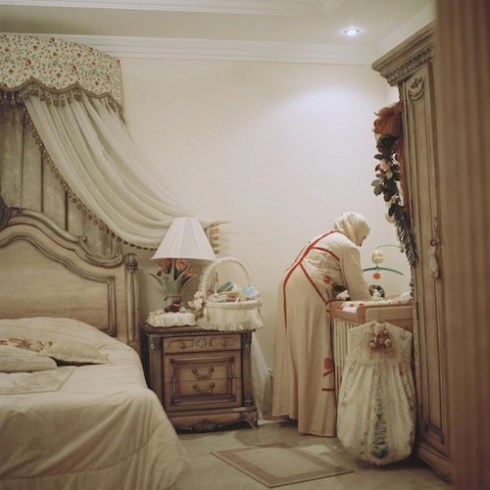
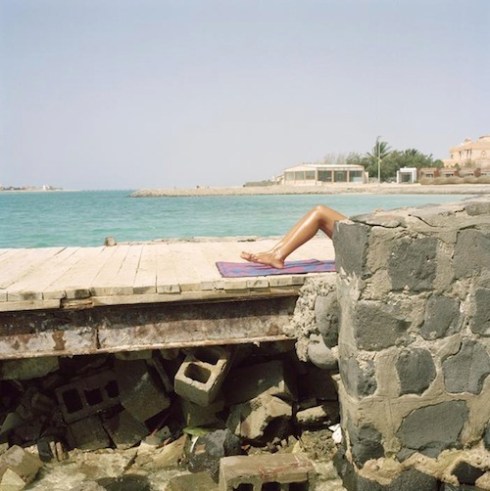
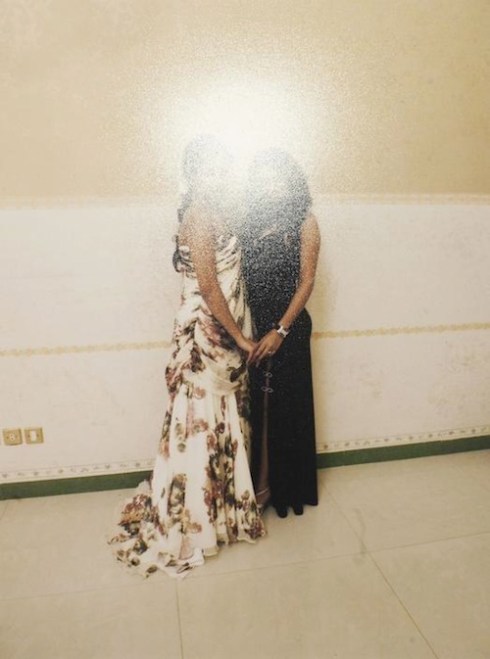
Saudi society thwarts many of the visual relationships — photographer/subject and photographer/audience — that are taken for granted in secular countries and in less traditional regions of the Arab world. As such, Jeddah Diary is a collection of work-arounds and solutions; rephotographed portraits, limbs and parts of people, plays with spotlight and night shadow to obscure identities.

The parameters of negotiation between Arthur and the women about what could be shown trod, at times, strange ground. After using flash to anonymise her subject (above photo), Arthur showed it to the women and they responded, “That’s great, but can’t you show a bit more of her eyes so people can see how beautiful she is?” asked some of the women.
These unique discussions led to photographer and subjects becoming close friends. Arthur says:
“On my first trip to Saudi I worked in medium format but this photo was taken on my second trip, using a little Panasonic Lumix. Because this was the sort of camera the women themselves used, when I used it they started to stop seeing me as a photographer and saw me instead as a friend. At the beginning I’d been clear with them that – as professional photographer – I wanted to show these pictures, but the funny thing was that when I switched cameras they relaxed and I ended up taking pictures that afterwards they didn’t want me to use.”
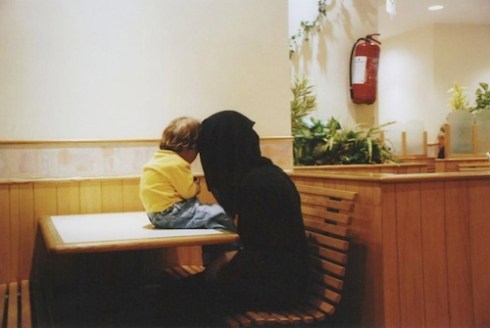
For me, the most compelling images are those of women veiled and in everyday moments; sitting on a kitchen counter, in a restaurant; fooling around while sharing tea. These are intimate events and the challenge to depict a hidden subject can be solved the moment one abandons a battle against restraints. Arthur’s interactions and discoveries are central to the book Jeddah Diary.
“I just thought, let’s take people on the journey that I went on, and show how confusing and contradictory it can be rather than trying to explain it; that’s the point when it finally made sense to me.”
And because of Arthur’s efforts, it starts to make sense for us. As Antone Dolezal remarks in his review of the book, “Jeddah Diary tells a story that could only be informed from a female perspective … a story both hidden from the world of men and only privately discussed in the world of women.”


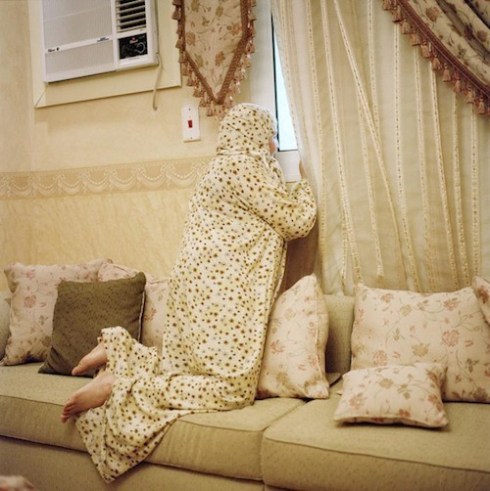
Jeddah Diary, by it’s nature cannot make full sense to us. Or rather, if we adopt our usual insistence to see idenifiable faces, and know names, and have place and date stamps attached to each image, we’ll be sorely disappointed. Arthur’s primary consideration was to protect her friend-subjects. As Sarah Bradley notes in her review of the book:
“It’s hard to tell who we are looking at in the images — some girls are named, but we see few faces, and in a small postscript Arthur makes it clear that in no way should one infer that the girls attending illegal parties are the same girls depicted elsewhere in the book. Her thank-yous show that many chose not to be named.”
Jeddah Diary is a moment of slippage. It is a document of the undocumentable. In that regard it is also a moment of reflection — and, for me, a cause of sadness — on the fact that Saudi women have limited choices in how they operate in society and interact with the world. Fashion is a flip topic, but clothing is not. It’s a simple point to make, but the abaya limits self-expression. I wouldn’t want to state the degree to which self-expression is limited or even what the results (positive and negative) emerge from a single, designated type of garb for one gender in a society.
The women in Jeddah Diary were, based on Arthur’s report, ambivalent about the project. And, I feel, probably reluctant to think of images as agents for social change.
“I was surprised how few of them had any major feedback. When I was there and tried to ask them how they felt about their situation, they’d say, “You know what – we’re okay” so I’d leave it. They were happy to be in the photographs but they’re not bothered about the comment I’m making on their society.”


 Prison Photography