
You are currently browsing the category archive for the ‘Activist Art’ category.

A CARTOONIST GOES TO JAIL
In June 2014, Los Angeles-based cartoonist Elana Pritchard was arrested for violating a court order. When she bailed out on July 3, she had little-to-no money and an overworked public defender. Her prospects didn’t look great.
“I knew I’d have to serve time for my violation,” Pritchard wrote for LA Weekly. “That’s when my mentor, animator-director Ralph Bakshi, advised me to *document my exploits*.”
Pritchard was jailed in the Los Angeles County jail system for two months. First, she spent 5-weeks at Century Regional Detention Facility (CRDF) in Lynwood, and closed out her remaining 3-weeks at Twin Towers Correctional Facility in downtown L.A.
ACCESS, OBSERVING & DRAWING
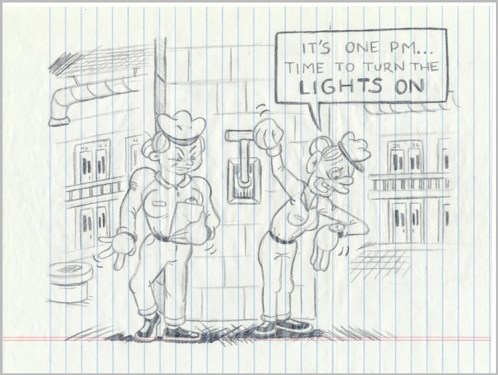
As you know, I deal with photographic imagery mostly, but I am always eager to point out creative efforts in other mediums that illuminate critical criminal justice issues more efficiently, powerfully and intelligently than photography. Pritchard’s cartoons from jail are honest, wry and direct.
“Armed with nothing more than a golf pencil and whatever paper I could get my hands on, I drew the strange world into which I’d been dropped,” says Pritchard. This was the draughtsperson’s equivalent of a two-month photojournalist embed!
They get to the root of those daily indignities that establish power-relations between guards and prisoners. Simultaneously, those power-relations ratchet up tensions for everyone in the jail.
As you look through these cartoons, I ask you to wonder is the “strange world” Pritchard reveals — of cold showers, dirty laundry, confiscated belongings, midnight cell-counts, competitions over basic sanitary products, food scarcity, sly put-downs and much more — one that we can accept, or one that we can ignore?
The unreasonable claustrophobia of the jail is made visceral in Pritchard’s drawings. I’d argue she conveys the experience of jail far better than many photographers can and have.
————
I discovered the comics at the Prison Arts Coalition blog and hastily made inquiries as to whether I could repost the cartoons and Pritchard’s commentary here. Gratefully, I was given permission.
Scroll down, here, to read Pritchard’s reaction to the cartoons’ publication in LA Weekly. I also recommend you read the original LA Weekly article in which Pritchard explains the context for each image.
————
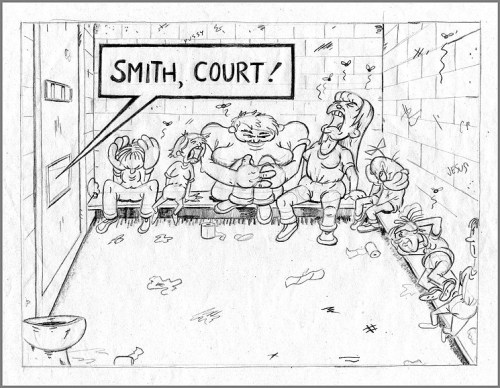
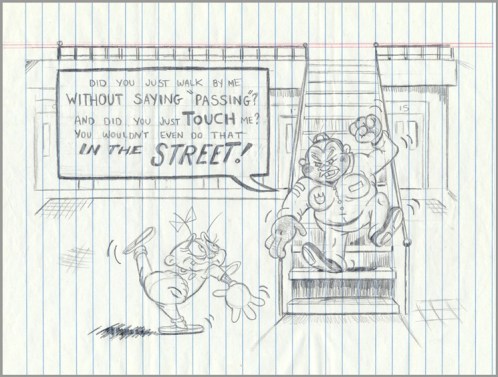

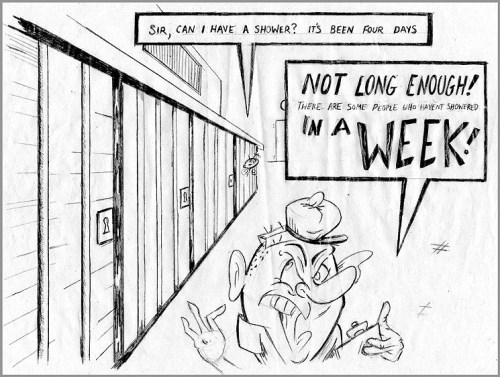
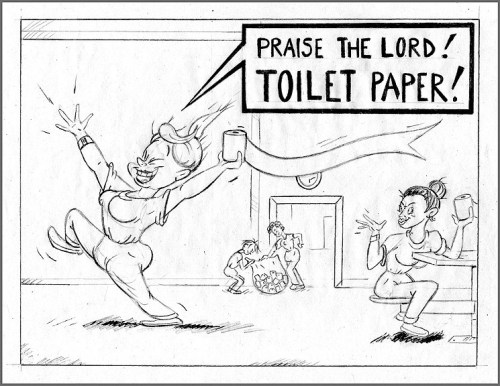
“I Wanted To Remind Us We Were People”
I couldn’t be more pleased with the response to my cartoons from Los Angeles jail system. People from all over the world have written to me expressing their support for what I have done and their contempt for inhumane practices for incarcerated peoples everywhere.
I have been in communication with the LA County Sheriff’s department and they have told me that due to these comics they have issued a new policy that all inmates must be given showers within 24 hours of entering the jail. We are scheduled to meet to discuss further improvements. And throughout all of this it seems the original, humble message of these comics is sticking: that we were people.
Even though we had a barcode on our wrist with a number and were called “bodies” by the staff, we were still people.


Many people in jail are still on trial and haven’t even been found guilty or innocent yet. Many people made mistakes that you or I have made before in private, only they got caught. There were mothers in there that missed their children. There were kind people in there that cared about the arts and cared about each other.
I drew these comics to make us all laugh and remind us that even though there was a whole group of of people with badges and better clothes than we had telling us we didn’t matter … we DID matter and we WERE PEOPLE.
In that the comics were successful, and for that I am proud.
—————-
All images were first published in the LA Weekly, 2015.




ELANA PRITCHARD
Elana Pritchard is a cartoonist in Los Angeles. Before she landed in jail she worked as an animator on Ralph Bakshi’s film, Last Days of Coney Island.
She is currently raising money on Kickstarter to complete her animation, The Circus.
You can follow Pritchard on Twitter at @elanapritchard.
PERMISSIONS
All images were first published in the LA Weekly, 2015.


Only yesterday did I listen in full to MLK’s more-than-infamous I Have A Dream speech. Now I know that every American kid studies it in middle school, but I didn’t grow up in the U.S.
Not only did I listen, I watched. This animation — which was made in 2013 to commemorate the 50th anniversary of MLK’s oration at the March on Washington in August 1963 — is just the most poignant and sensitive of treatments.
Take 17 minutes out of your day. Any day. But particularly this one.

ACTIVIST-SHAREHOLDERING
I love the term “activist-shareholder.” I envision a person wearing protest t-shirts at the AGM, or the organisation of a silent bloc that suddenly bursts into action and derails the agenda of a meeting. Activist-shareholders are moles in the system. Granted they are very visible roles, and it is soon very obvious as to why they have bought shares in a corporation whose practices they oppose, but still. yay for the little man.
Alex Friedmann, associate director of the Human Rights Defense Center and managing editor of Prison Legal News is one such activist shareholder. He made the reasonable proposal that private prisons make attempts to rehabilitate prisoners. Shock horror! And, guess what? The private prison company refused.
I just adore these tactics. If the prison industrial complex is to be dismantled it’ll take an untold amount of imagination and the combination of many tactics. Friedmann’s colleague at Prison Legal News Paul Wright was on hand this week to remind us that talking about the problem is not always doing something about the problem. Wright spoke with Alysia Santo for The Marshall Project, in a provocatively titled interview piece Sure, People Are Talking About Prison Reform, but They Aren’t Actually Doing Anything.
Go forth, let your imagination run wild.
Below, the Human Rights Defense Center press release:
Nation’s Largest Private Prison Firm Objects to Resolution to Fund Rehabilitative, Reentry Programs
Nashville, TN – Last Friday, Corrections Corporation of America (NYSE: CXW), the nation’s largest for-profit prison firm, formally objected to a shareholder resolution that would require the company to spend just 5% of its net income “on programs and services designed to reduce recidivism rates for offenders.”
The resolution was submitted by Alex Friedmann, associate director of the Human Rights Defense Center and managing editor of Prison Legal News. An activist shareholder, Friedmann owns a small amount of CCA stock; in the 1990s he served six years at a CCA-operated prison in Clifton, Tennessee prior to his release in 1999.
“As a former prisoner, I know firsthand the importance of providing rehabilitative programs and reentry services,” Friedmann stated. “I also know firsthand the incentive of private prisons to cut costs – including expenses associated with rehabilitative programs – in order to increase their profit margins.”
Citing data from the Bureau of Justice Statistics, the resolution notes that “Recidivism rates for prisoners released from correctional facilities are extremely high, with almost 77% of offenders being re-arrested within five years of release.” Further, “[t]he need to reduce recidivism rates for offenders held in [CCA’s] facilities is of particular importance, as two recent studies concluded that prisoners housed at privately-operated facilities have higher average recidivism rates.”
The shareholder resolution states that it “provides an opportunity for CCA to do more to reduce the recidivism rates of offenders released from the Company’s facilities, and thus reduce crime and victimization in our communities.”
CCA filed a formal objection with the Securities and Exchange Commission (SEC), seeking to exclude the resolution from its 2015 proxy materials distributed to shareholders. In its objection, CCA argued that the resolution relates to “ordinary business operations,” comparing it to other shareholder resolutions that have, for example, sought to require companies to “test and install showerheads that use limited amounts of water.”
In a press release issued by CCA last year, the company announced “a series of commitments” to rehabilitative programming, stating it would “play a larger role in helping reduce the nation’s high recidivism rate.” At the time, CCA CEO Damon Hininger claimed that “Reentry programs and reducing recidivism are 100 percent aligned with our business model.”
“CCA’s objection to a shareholder resolution that would require the company to spend just 5% of its net income on rehabilitative and reentry programs demonstrates the lack of the company’s sincerity when it claims to care about reducing recidivism,” stated HRDC executive director Paul Wright. “Evidently, retaining 95% of its profits isn’t enough for CCA – which isn’t surprising, because as a for-profit company CCA is only concerned about its bottom line, not what is best for members of the public, including those victimized by crime.”
“If CCA was serious about investing in rehabilitation and reentry programs for prisoners who will be released from the company’s for-profit facilities, then it would not have objected to this resolution,” Friedmann added. “But it did, so we can draw our own conclusions.”
–
The Human Rights Defense Center, founded in 1990 and based in Lake Worth, Florida, is a non-profit organization dedicated to protecting human rights in U.S. detention facilities. HRDC publishes Prison Legal News (PLN), a monthly magazine that includes reports, reviews and analysis of court rulings and news related to prisoners’ rights and criminal justice issues. PLN has around 9,000 subscribers nationwide and operates a website (www.prisonlegalnews.org) that includes a comprehensive database of prison and jail-related articles, news reports, court rulings, verdicts, settlements and related documents.
For further information:
Alex Friedmann
Associate Director
Human Rights Defense Center
(615) 495-6568
afriedmann@prisonlegalnews.org
Paul Wright
Executive Director
Human Rights Defense Center
(561) 360-2523
pwright@prisonlegalnews.org
Image source: ACLU

I was invited by WIRED to write about Josh Begley‘s work Prison Map. The article is Aerial Photos Expose the American Prison System’s Staggering Scale:
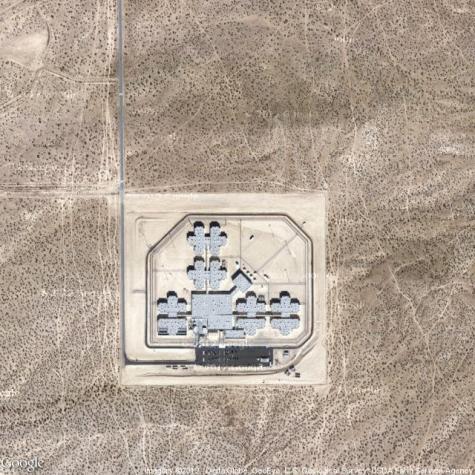
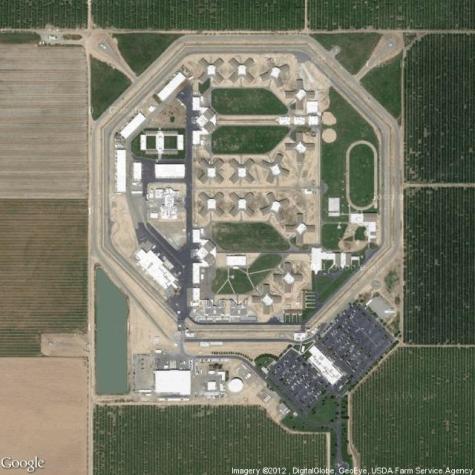
There are some 2.2 million people behind bars in the United States. That’s more people than there are in all of New Mexico. And there are more jails and prisons than colleges and universities in this country. Still, it can be difficult to grasp the scale of incarceration in America, in part because so many of these facilities are tucked away far from view in rural areas.
Prison Map provides a sense of the enormity of it all by giving us a fascinating vantage point from which to view the architecture of incarceration. Begley’s created a vast visual compendium of the nation’s jails and prisons, comprising more than 5,300 aerial images that offer a compelling metaphor for the rapid expansion of the American prison system.
“Prison Map is about visualizing carceral space,” says Begley. “We have terms like the ‘prison industrial complex’ but what does that actually look like? If you were to stitch together all these spaces of exception, how might they appear from above?”
Read more at WIRED.






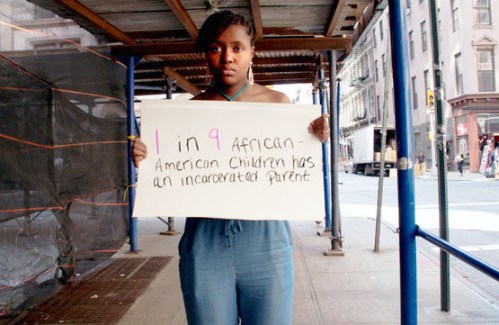
In the final two days of fundraising, Echoes Of Incarceration is a long term project that helps children of incarcerated parents to make documentary films about the effects of America’s prison industrial complex — on society, on us, on families, on communities, and mostly on children without one or both parents behind bars.
There are an estimated 2.7 million children in America with one or both parents in prison or jail. Mass incarceration has created fundamental weaknesses in society. Mass incarceration as easily impacts individuals as it does vulnerable groups (the poor, the under-educated, the discriminated against) and often we perceive the effects as lasting only years, or being contained within the experience of one identified moment, lifetime or geographical space. We neglect to recognise that mass incarceration is piling pressures on top of problems on top of expectations on top of America’s young, developing citizens.
We live in a society in which vast numbers of youth must negotiate formative years without parental support. The prison industrial complex has burdened our youth with an almost inconceivable set of problems that they did not ask for, and they do not deserve.
Echoes Of Incarceration brings much needed scrutiny to the issue of mass incarceration and crucially it does it through the lens of the innocent people who have inherited a broken, brutalising system we made. Their latest productions deal specifically with the Bill of Rights of Children with Incarcerated Parents.
Please, fund this important project.
Below is a 2009 production made by Echoes Of Incarceration


Art For Justice has a new exhibition opening in Philadelphia.
Free Library of Philadelphia, 1901 Vine Street, Philadelphia, PA 19103. (Between 19th and 20th Streets on the Benjamin Franklin Parkway)
Jan. 12 – Feb. 15, 2015

I was astounded when a press release (copied below) hit my inbox. Currently, private prison corporations have no legal requirement to provide the same types and amount of information that the public and journalists can demand of state and federal prisons!
A new law looks to correct this disparity.
Last week, U.S. Representative Sheila Jackson Lee (D-TX) reintroduced the Private Prison Information Act (PPIA) in Congress. The bill, HR 5838, requires non-federal correctional and detention facilities that house federal prisoners to comply with the Freedom of Information Act (FOIA).
The Human Rights Defense Center made the following press release last week:
Private Prison Information Act Reintroduced in Congress, to Ensure Public Accountability at Privately-Operated Prisons
Currently, private companies such as Corrections Corporation of America (CCA) and the GEO Group are not required to comply with FOIA requests even when they operate facilities that hold federal prisoners through contracts with federal agencies, and are paid with public taxpayer funds. This includes privately-operated facilities that house immigration detainees.
Alex Friedmann, associate director of the Human Rights Defense Center, and Christopher Petrella, a doctoral student at UC Berkeley, have worked closely with Rep. Jackson Lee’s staff over the past two years to reintroduce the PPIA during the 113th Congress.
Various versions of the PPIA have been introduced since 2005; however, private prison firms and their supporters have lobbied against the bills. For example, CCA’s federal lobbying disclosure statements have specifically referenced lobbying related to the PPIA.
Friedmann and Petrella argue that because private prison corporations rely almost entirely on taxpayer funds, and perform the inherently governmental function of incarceration, the public has a right to obtain information pertaining to private prison operations. In short, the government should not be able to contract away the public’s right to know through FOIA requests.
Friedmann testified before the House Subcommittee on Crime, Terrorism and Homeland Security in June 2008 in support of a previous version of the Private Prison Information Act.
A coalition of 34 criminal justice, civil rights and public interest organizations submitted a joint letter to Rep. Jackson Lee in December 2012, followed by a renewed letter on June 11, 2014, expressing support for the PPIA and encouraging her to reintroduce the bill.
The letter noted that “If private prison companies like CCA and GEO would like to continue to enjoy taxpayer-funded federal contracts, then they must be required to adhere to the same disclosure laws applicable to their public counterparts, including FOIA.”
The signatories to the joint letter included the Center for Constitutional Rights, Center for Media Justice, Ella Baker Center for Human Rights, Florida Justice Institute, Grassroots Leadership, Enlace, In the Public Interest, National CURE and FedCURE, Justice Policy Institute, Justice Strategies, Prison Policy Initiative, Private Corrections Institute, Southern Center for Human Rights, The Sentencing Project, Southern Poverty Law Center and Texas Civil Rights Project. The NAACP has also voiced support for the PPIA.
“This bill is about public accountability – to ensure that for-profit prison corporations, which assume the role of the government when incarcerating federal prisoners, must comply with the same Freedom of Information Act obligations as federal agencies such as the Bureau of Prisons,” said Friedmann. “That is only fair and reasonable, but private prison companies will most likely object to the bill, as they favor secrecy over fairness.”
“The introduction of the Private Prison Information Act constitutes just the first step in bringing transparency and accountability to an industry that’s funded almost entirely by your and my tax dollars,” Petrella added. “We’ll continue to work tirelessly until this bill is brought to fruition.”
For more information:
Visit the Private Prison Information Act website.
Alex Friedmann
Associate Director, Human Rights Defense Center
(615) 495-6568
afriedmann@prisonlegalnews.org
Christopher Petrella
(860) 341-1684
christopherfrancispetrella@gmail.com

Untitled by Derrick Quintero and Ann Catherine Carter. From the “Surrogate Project”
WHAT
This week, apexart announced the three winners of its Unsolicited Proposal Program. One of the selected projects was Life After Death and Elsewhere, organized by Tom Williams and Robin Paris.
WHO
Artist and educators, Paris and Williams coordinate the best prison arts program I’ve never written about.
They work in tandem with prisoners on death row in Tennessee. The Riverbend Maximum Security Institution imprisons 79 people on death row. Eleven prisoners — Abu Ali Abdur’Rahman, G’dongalay Berry, Tyrone Chalmers, Gary Cone, John Freeland, Kennath Artez Henderson, Nikolaus Johnson, Donald Middlebrooks, Harold Wayne Nichols, and Derrick Quintero among them — have worked with Paris and Williams on a few projects. I have admired their practice for a long time.
I’d be embarrassed about bringing their work to you when they are already so far down their creative paths if I didn’t think they still had long and beautiful journeys planned out.
You can see a lot of their work, stretching back 18-months, on the R.E.A.C.H. Coalition blog.
WHERE
Earlier this year, in Nashville TN, in collaboration with artists from Watkins College of Art they produced the exhibition Unit 2 (part 1) from which several of the images included herein originated. Recently, they completed Unit 2 (part 3). In both cases they partnered with small local galleries to put on the events.
PHOTOGRAPHY’S USE
Photos feature heavily in the collaborations between the condemned men and outside artists. For the series “Add-Ons” an outside artist would provide a prompt in the form of a drawing or piece of writing but often an image. The prisoner would then add to it by either drawing or writing directly on the print, or riffing off of it in words and sketches to create a second companion piece.
For the series “Surrogate” a prisoner would make a request for someone on the outside to do something for them by proxy — to enjoy a library full of books, to eat a hearty breakfast prepared to precise specifications, or to make a family portrait. In many cases the evidence and *shared experience* was documentation usually in the form of a photo.
AN ADVOCATE’S MESSAGE
While the process in producing these works is necessarily personal and intimate, the sharing of the artwork and the political urgency needn’t be. Paris, Williams et al. want to use exhibitions as moments for discussion and public education. Namely, they want to contribute to the anti-death penalty movement. As Paris told Hyperallergic, “The system of legal defense for capital cases is shoddy and poorly funded at best; there are no rich people, to my knowledge, on death row. We incarcerate more of our population than any other country. I could go on and on. It’s shameful. It’s not who we think we are as a country.”
PROPOSAL
This isn’t prison fetishism. The men on death row alongside the artists and students corralled by Paris and Williams are collaborators in the fullest sense. I think it is significant that the winning proposal was written by the prisoners; I think it may have been a deciding factor for the judges on the quality, intent and pedagogy of the art.
The prisoner-artists’ proposal reads:
During the past year, the state of Tennessee has staged a nearly unprecedented offensive against those individuals it has sentenced to die. A state that has executed only six people since 1960 has recently scheduled ten executions. As prisoners on death row, and imminent victims of that state-sponsored violence, we represent the “bare life” described so powerfully by historians and philosophers. During the past two years, however, through an unusual partnership with artists, writers, and educators in Nashville, we have endeavored to make our circumstances visible to those beyond the walls of prison. Through published writings and art exhibitions, we have addressed a public that knows as little of our lives as they do of the indignities of belly chains or the menacing shimmer of razor wire.
Our past exhibitions have often included collaborations with artists and art students on the outside. We have created “add-on” drawings (exquisite corpses, more or less) with people beyond the prison, and we have started sketchbooks before sending them out for strangers to finish. We have composed “surrogate” assignments for outsiders to realize (photographs of the stars, for instance, which some of us haven’t seen in 25 years, or the libraries in cities that we will never visit). We have made gifts of our art works and offered them to visitors to the opening of an exhibition in exchange for their photographic portraits. In one show, we exhibited a diorama that traces the all-too-common path from poverty to prison, and in other, we exhibited our personal snapshots and family photos to offer the world a glimpse of our social lives and to show that we are more than prisoners and men condemned to death
In response to your call, we propose an exhibition that will feature designs for our own memorials alongside our representations of the lives we would pursue if we were free. We have all been condemned to death, and the state of Tennessee intends to kill us, but some of are innocent, and we all hope to demonstrate that we are more than the sum of our worst deeds—or that we might be.
The works we will submit will include drawings, paintings, photographs, models, and text-based pieces. Some of us will submit statements outlining reasons for refusing to design their own memorials.
Kudos to them and all involved. Hope to be in NYC when it shows! Robin Paris and I are currently in conversation and I hope to share that back-and-forth with you in the future, but until then, I’d like to use this recent success as an excuse to share some images of the prisoners’ work.
Images courtesy of Guardian, Hyperallergic, Solitary Watch.
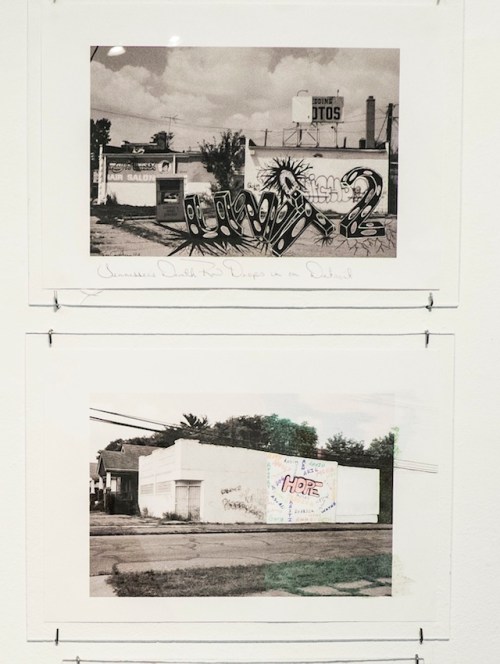
Upreyl Mitchell and Harold Wayne Nichols, “Untitled” (add-on artwork), acrylic and colored pencil on photograph, 13″ x 9″ in (photo courtesy Robin Paris)
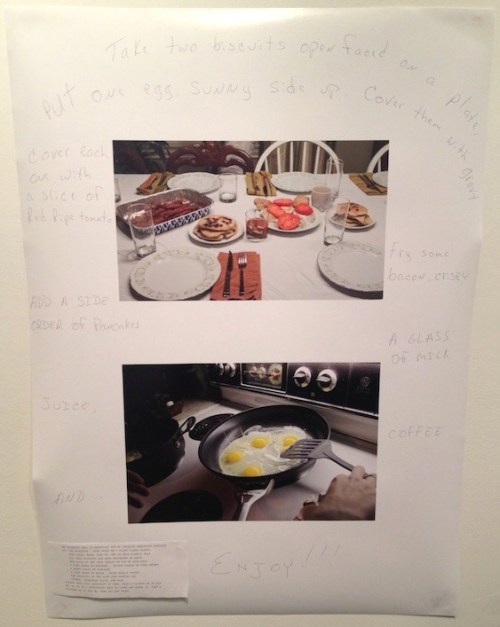
Mika Agari, Jessica Clay, Amy Clutter, Robert Grand, Kristi Hargrove, Robin Paris, Sharon Stewart, Tom Williams, Weng Tze Yang, and Barbara Yontz, “Surrogate Project for Harold Wayne Nichols: Breakfast for Dinner,” photograph.

Donald Middlebrooks, ‘Silence is Compliance’ (acrylic on canvas board)
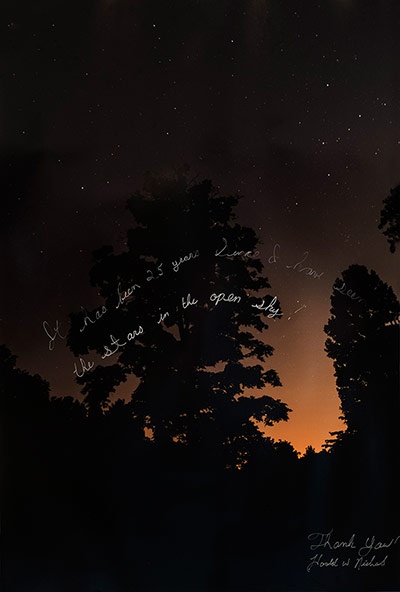
‘The Night Sky’ by Robin Paris and Tom Williams with writing by Gary Cone, Harold Wayne Nichols, and Donald Middlebrooks. From the Surrogate Project
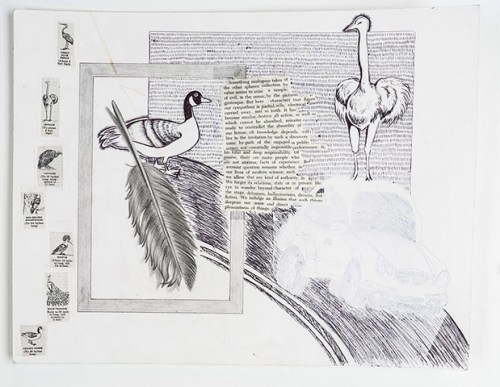
Nickolus Johnson and Zack Rafuls, “Untitled” (add-on drawing), mixed media on paper, 14 x 11 in.
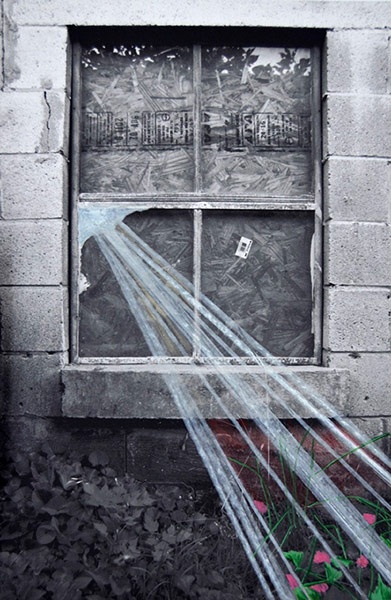
Photograph and drawing, by Upreyl Mitchell and Kennath Artez Henderson. From the Surrogate Project.
ARTISTS
Robin Paris is associate professor and chair of the Department of Photography at Watkins College of Art, Design & Film in Nashville, Tennessee. She is a graduate of The Evergreen State College in Olympia, Washington, and the Savannah College of Art and Design, and she has taught at Belmont University and The University of the South, Sewanee. Her work has appeared in exhibitions throughout the country. She has been co-facilitating the art workshop in Unit 2 (the Death Row unit) of the Riverbend Maximum Security Institution since 2013. Her recent work has involved collaborations with its residents.
Tom Williams is assistant professor of art history at Watkins College of Art, Design & Film in Nashville, Tennessee. He is a graduate of Stony Brook University and the Whitney Museum Independent Study Program, and he has taught at the School of Visual Arts, the Museum of Modern Art, New York University, and Vanderbilt University. His writings have appeared in Art in America, Grey Room, and other publications. He has been co-facilitating the art workshop in Unit 2 (the Death Row unit) of the Riverbend Maximum Security Institution since 2013.
APEXART
apexart is a non-profit arts organization in Lower Manhattan that was conceived to offer opportunities to independent curators and emerging and established artists, as well as to challenge ideas about art, its practice and curation. apex art is at 291 Church Street, New York, NY 10013 USA and it puts on exhibitions, Fellowship Program, publications, and public programs. It is free. Contact is 212 431 5270 or info@apexart.org. Hours are Tues – Sat 11am-6pm.
UNSOLICITED PROPOSAL PROGRAM
Anyone, from anywhere, may submit an idea-based exhibition to the Unsolicited Proposal Program. Each annum, three winning proposals are presented at apexart as part of its year-long calendar. Proposals remain anonymous and judged by an international group of 100+ artists, curators, writers and arts professionals. Each juror reads at least 50 proposals, in randomized order. Each proposal receives as many as 25 votes.
“We believe it is the most objective and fair process of evaluation that we have found,” says apexart. “Submissions are reviewed anonymously and solely on the strength of their idea. Previous curatorial experience is in no way required. Supplemental materials are not accepted to further level the playing field.”
The eventual ranking of proposals is made available online to all applicants.

 Prison Photography