
You are currently browsing the category archive for the ‘Amateur’ category.

Prisoners of the Cebu Provincial Detention and Rehabilitation Centre dance the Rico Mambo. Photo Credit: Bernie Ledesma, 2008
UPDATE 10.05.12: They just did Gangham Sytle
– – – – – – – – – – – – – – – – – – – – – – – –
My general endeavour with Prison Photography is to ask readers to assess the visual culture surrounding prisons and prison populations more critically. The videos and photos in which prisoners present themselves beyond all stereotypes are important. The back story is revelatory too.
The routines are the result of a new approach to rehabilitation in Philippine prisons (8 facilities at last count) beginning at Cebu Provincial Detention and Rehabilitation Center (CPDRC). The program was initiated by Byron Garcia the brother of Cebu Governor (Warden) Gwendolyn Garcia. Ms. Garcia was the first female warden at Cebu, which leaves me wondering if the novel dance program is the result of progressive governorship or just an accident of uncomplicated nepotism.
Byron Garcia introduced an exercise program where the prisoners marched in unison, starting out with marching to the beat of a drum, but moved on to dancing to pop music; he began with one of his favourite songs, Another Brick in the Wall (Part 2) by Pink Floyd. Early on, Garcia selected camp hits In The Navy and Y.M.C.A. by The Village People for the program.
All of this is well known to webnerds who follow the biggest viral videos. Thriller has had over 50 million views.
The list continues – MC Hammer’s Can’t Touch This, Laura Brannigan’s Gloria, Bonnie Tyler’s I Need a Hero, Van Halen’s Jump, and Queen’s Radio Ga Ga. The dancing inmates of CPDRC are self-proclaimed “World Entertainers” now and have been featured on pretty much every major global news source. Here’s the BBC’s article.
The routines are endearing to the point that one’s will to know the perhaps-less-than-shiny-happy-reality behind the dancing program is shoved to the back of the mind.
Predictably, as with all things related to penology it is not quite as simple as clapping inmates dancing together, forgetting their rivalries and jigging toward reform.
The dance program is compulsory. “The British Channel 4 Documentary Murderers on the Dancefloor broadcast in January 2008 portrayed life in the prison. The program showed various inmates praising Byron Garcia, the founder of the initiative – many of whom had tattoos praising Mr Garcia. However, it also featured an anonymous ex-inmate who claimed Mr Garcia employs certain prisoners to beat prisoners who refuse to dance. Garcia was filmed in the documentary holding an American M4 Carbine, saying, “This is an M16 M4 rifle, and it can make people dance”, before aiming the gun at the cameraman. This statement was acknowledged as a joke by the narrator. His Youtube account states any accusation that any form of abuse goes on as part of the program is false, and the program serves the purpose of reforming the inmates.” (Source: Wikipedia)

Prisoners at Cebu Provincial Detention and Rehabilitation Centre form a cross shape. Photo Credit Bernie Ledesma, 2008
Garcia maintains that prisoners dance in honour of Peace Advocates, their Catholic Archbishop and against dissenters of the church. I find it hard to believe that all 1,500+ prisoners dance to voice the exact same political or religious opinion. There is certainly coercion at work here, but I think it is that of forced empty comment than of physical torture for those who abstain.
The show is put on monthly and the gantry around the yard is full of fans; likely family and friends but also genuine admirers. I heard of one spectator’s description of goose-bumps each time she watches a new routine. I can’t go that far but I must admit that the exercise, diversion, surface camaraderie and sincere adulation the prisoners enjoy must be extremely positive. It is worth noting that male and female inmates dance together. Could you really expect to see co-ed dance therapy in any US prison?
UPDATE
Read Marco Bohr’s The Story Behind the Dancing Inmates for a 2011 critique of CEBU and some images of the collapse of the shocking regime prior to Garcia’s arrival.
For the best still photography of CPDRC inmates in action go to Bernie Ledesma’s Flickr Set or his JPG Magazine “Jailhouse Rock” Feature.
POSTSCRIPT
All of this, while focusing on the policies of progressive prison authorities distracts us from the ongoing heinous conditions in Philippine prisons, the detention of children alongside dangerous adults and the ongoing abuse of those minors.
Special Emergency Response Teams (SERTs) are commonplace. Less so perhaps are the “sports team” group shots seen here at the end of a good days work out.

Training Exercise, Team Portrait. Photo Credit: I.M.T.T. 2004
Personal politics dictates how one feels about these constructed scenarios. To me they just seem unfortunate sad – not because of what they are, but because of what they represent. However, we must accept that tactical training within prisons is conducted with the same professional intent as that of any police authority or force of shock and awe. With caution, I’d say these trainings are a reality of prison management, but insist that they should not be considered an inevitability.
Once you get past the unnerving brevity of the group portrait, it is the second unposed image (below) that arrests the attention. It differs from other official images from within prison walls because of its ambiguity. As an isolated image, it is not clear whether the confrontation shown is genuine or not. Without the referenced source, could this be read as an actual suppression of inmate violence? How many eyes would be keen or informed enough to tell if the prisoner and guard uniforms were those of controlled dress rehearsal?
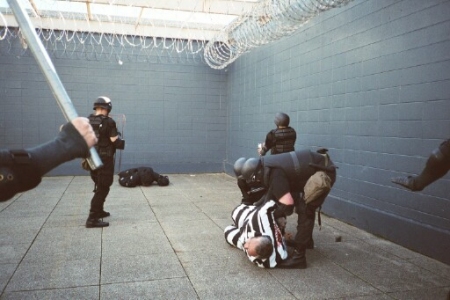
Training Exercise. Photo Credit: I.M.T.T. 2004
From building arguments of fact concerning the Abu Ghraib photographs, Errol Morris talks about the inherent traps for viewers of images, “You look at a photograph and you think you know all you need to know. That here you have a veridical piece of reality to look at. And, you need look no further. It, of in itself, is enough. You look as these infamous photographs that came out of Abu Ghraib. You look at the photographs of Gilligan, the prisoner on the box with leads, and of Gus, the prisoner on the leash, and you think you know what these are images of. ‘This is despicable, blah, blah, blah’ … You need look no further … and I believe noone looked any further, [they] presumed to know what the images were about and wrote articles accordingly.”
Morris adds to his general point, “We try to figure out the world by looking at things, and nothing we ever create is complete but you try to figure out what our relationship is to reality – to the real world.”
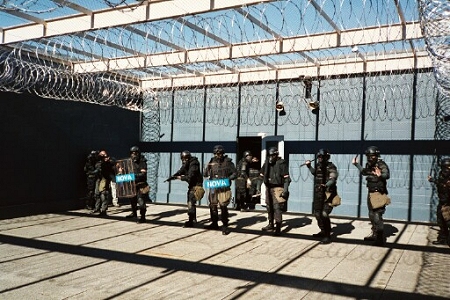
Training Exercise. Photo Credit: I.M.T.T. 2004
In a world of visual bombardment where deliberate disturbances between reality and fantasy are now commonplace have we lost interest in the strength of imagery and its testimonies? Images are mistakenly and willfully misrepresented and misinterpreted. In many ways, this is a fine game – a novel game. But does the game keep people on their toes or does it lead to apathy and disinterest? As Morris asks “What is true and what is false?” Without the proud group portrait to provide context would viewers have cared to question the seeming brutality of the second photograph?
Or am I missing the mark here? Is a lack of visual curiosity and/or sophistication really the problem here? Or, is the real problem the viewers normalisation to images of violence? Do the two issues compound one another? I would argue that many folk are too familiar with images (often involving wire, concrete walls and the ephemera of incarceration) to presume that the attacks meted out are a) unjustified or b) outside of the legal allowances of a prison authority. The issue of ‘Reality’ almost becomes redundant.
Perhaps, even, this worrisome trend of anesthetised reaction to human suffering can even be stretched through the interwoven spectacle of modern society and placed at the door of second rate video games. Prison Tycoon 4: Supermax, as featured recently on BLDGBLOG challenges the gamer to draw the most profit from prison administration; “Grow your facility to SuperMax capabilities, housing the most dangerous and diabolical criminals on earth – all for the bottom line.”

Prison Tycoon 4: Supermax. Screenshot. Source: IGN.com
I have never liked role playing video games that incorporate violence. But I am not an opponent pointing to them as the cause of delinquency among societies youth. I just don’t like them. Prison Tycoon is less gratuitous than Grand Theft Auto and the like. But I don’t know if this is any comfort. To manipulate a virtual prison population with “friendly interaction and fighting between inmates dependent upon mood and gang affiliation” and to rely on “guards [who] will subdue aggressive prisoners, medical staff to treat injuries, chaplains administer to prisoner’s spiritual needs and therapists talk to prisoners to lift their spirits” seems a bit too sinister and calculated for an evening of gaming.
And the ability to use “96 detailed prisoner model variations created to allow for a wide and varied prison population” and use a “unique ‘builder within a builder’ system to open your buildings and place their interior content wherever you like” in addition to the “over 100 different rooms and objects to place within the prison buildings, each one allowing prisoners to interact with them on various levels and each one having different effects on the prisoner’s mood.” seems like a gamer’s invitation to unleash virtual gang violence akin to those most unfortunate of prisoner abuses in real life.

LAN Party. Source: http://www.davesdaily.com/pictures/391-lanparty.htm
Really, why does this game exist? I suppose it is just completing the loop – the gamer, as a God of Pixels, can create criminals in his other games and then manipulate them in this one.
For more information about High Risk Prisoner Transportation, Corrections Crisis Response, Cell Extraction, Escape Apprehension Training, Suicide Bomber Mitigation Tactics, Tactical Weapon and Explosive Training, Athermal Weapon Sight Usage and Finnish Sniper Training please visit the International Mobile Training Team Website. If all that seems like too much reading then just go to the IMTT promotional video and watch grown men in costume run around with guns to a butt-rock soundtrack.
Update: Prison Photography collated a Directory of Photographic & Visual Resources for Guantanamo in May 2009.

- A detainee kicks a soccer ball around the central recreation yard at Camp 4, Joint Task Force (JTF) Guantánamo Bay, Cuba, June 10, 2008, during his daily outdoor recreation time. Detainees in Camp 4 get up to 12 hours of daily of outdoor recreation, including two hours in a central recreation yard. Photo Credit: U.S. Army 1st Lt. Sarah Cleveland
Just gratefully recieved a nudge from an urban conspirator to check out these 30 vetted photographs posted on the Boston Globe website. Obviously, many were taken during the same media tour I mentioned in the last post. Enjoy!
This blog is 10 weeks old. At that same age an infant is lifting its head and neck without help, blowing bubbles, smiling and cooing. I reckon this blog is straining its neck, blowing hot air, cooing to no-one, but certainly smiling to itself. So, things look good. I’d like to propose a vague rhythm for my posts. Now, read carefully for I shall say this only once.
Every week or so you’ll see long, well-researched and edited pieces about critical prison issues. Between these “anchor” posts, to keep the juggernaut powering on the information-super-motorway, I’ll post items a little more flimsy. They’ll definitely be prison and photography related, and usually with great visuals and little text. This is a warning to all you early readers to decipher the serious stuff from the really serious stuff.
So, without further ado let me bring to you a quite incredible image. In browsing the United Nations’ official photography galleries I came across this curious image tagged as “Prison”
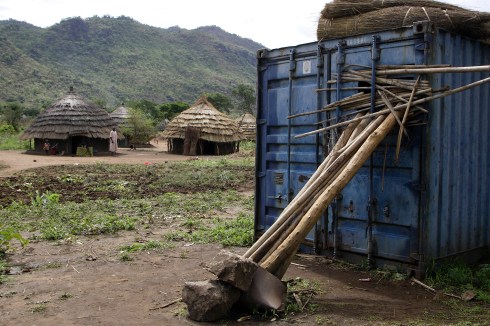
The container serves as a detention facility. Human rights and protection officers made an inspection of the capabilities of the local police and prison service. UNMOs from Torit were engaged in a long range patrol to Chukudum along with various civilian sections of UNMIS in order to assess the security and social conditions of the area.
Sudan, at last count, with 12,000 prison inmates had the lowest prison population of any North African country. In fact, Sudan is doing very well at not locking its population away. It is joint fifth, with Angola, of all the African nations for the lowest prison population (36 per 100,000 people). Sudan is surpassed by Mali (34), Nigeria (33), Gambia (32), and Burkina Faso (at a mere 23 inmates per 100,000 people)! Source.
These figures should absolutely be compared to US figures where 1,000 of every 100,000 American adults are behind bars. 1 in every hundred US adults is under the jurisdiction of federal or state corrections! It’s madness, it’s broken and it’s costing a fortune. (I warned my politics might creep through every so often).
Torit and Chukudum are in the very southeast of Sudan, close to the borders of Uganda and Kenya. This site is over a thousand miles from the Darfur region. It’s even further to the border and refugee camps of Chad. I have no comment on Darfur here. I only wanted to point out that as we grasp and grapple to understand the people in the world around us and we conjure makeshift plans and patchwork solutions, sometimes they involve small personal sacrifices and sometimes they involve locking other human beings in shipping containers.
As of August 2002, Sudan had 125 sites of incarceration – 4 federal prisons, 26 local government prisons, 46 provincial prisons, 45 open and semi-open prisons and 4 reformatory centres for juveniles. I wonder what the nomenclature is for this box? The picture was taken in April, 2007 by Tim McKulka, who has also done some photography covering the Angola Prison Rodeo in Louisiana, an event of which I have opinions. Indeed, I have a piece up my sleeve on my hard drive, awaiting…
Note: Ignoring the pink elephant in the room, I have previously avoided talking about Abu Ghraib. What could I add to a topic so exhaustively dissected? However, after listening to Philip Gourevitch speak at a local bookstore I am urged to write.
Mention ‘Prison’ and ‘Photography’ and the collective conscience defaults to the Abu Ghraib pictures. There is no escaping this fact as there is no escaping those images. The Abu Ghraib photographs inform and corrupt key dialogues of our global society – war & power; geopolitics & the psychology of surveillance; Iraq & imperialism; Western & Islamic relations; and military operations & media-constructed otherness. Add to that list, uncomplicated human cruelty.
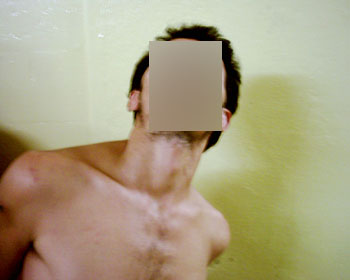

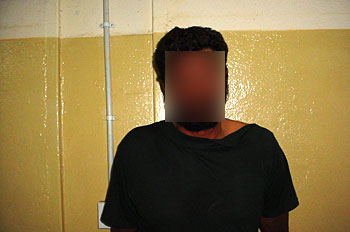

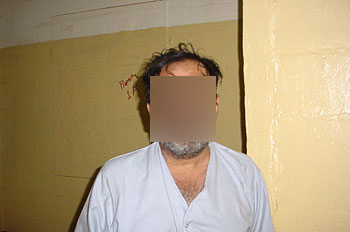
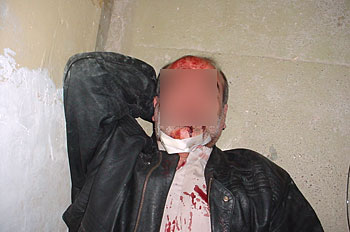
Those images have seeped into more spheres of conscious and sub-conscious thought than the most successful of photojournalist essays. This is emergence and pre-eminence of the Abu Ghraib photographs as the most current strongest visual “player”. Former strongest players have included Robert Capa’s images of the Normandy Invasion; or (Nick) Huỳnh Công Út’s photograph of Kim Phuc running from a napalm attack on Trang Bang, Vietnam; or Eddie Adams’ photograph of police chief General Nguyễn Ngọc Loan executing a Vietcong prisoner, Nguyễn Văn Lém. As Gourevitch said, “If a photojournalist had taken those [Abu Ghraib] images he or she would have been celebrated and decorated for their public service.”
Those photographs are many things. They are evidence of a corrupted system bereft of accountability. They are the most important images of the War on Iraq. When recollected, they should never be separated from the exacting malevolence of the Rumsfeld Department of Defense. They are already established as the most commonly shared images of global culture. The hooded prisoner is a 21st century icon. Perhaps, partly, this is why Americans rallied to make an immediate icon of Obama; to purge a nation’s collective visual memory, and to replace negative, shameful images with positive, hopeful, primary-coloured pop-motifs.



Gourevitch talked about the craft of the interview. The Paris Review, which he has edited since 2005, recently released the third of a four volume anthology of interviews with 20th century writers. Gourevitch noted the simplicity of the method and pointed out that in 1953 when the Paris Review was founded, no publications were interviewing writers. Literary criticism had become high brow and, to many, obsolete; it talked about the text but never the artist. The Paris Review was the first legitimate peek into the private lives, motivations and pathologies of poets and authors. Fellow writers could scrutinise every spoken word and omitted detail of their contemporaries. The Paris Review, in its early days, served as the exposé – the gossip column – for the literary world.
For fifty years, until his death in 2003, George Plimpton was editor of the Paris Review. It is fitting that Plimpton’s large shoes should be filled by a writer and journalist who has made an art form of the interview. Gourevitch’s acclaimed book We Wish to Inform You That Tomorrow We Will Be Killed With Our Families was based on information gleaned from an unhurried, matter-of-fact tour of Rwanda where he simply talked to people. Rwandans didn’t have their own journalists clearing the way for testimony in the immediate aftermath of the genocide and Gourevitch found support for his theory that “All people need to talk”. He described Rwandans culturally as the opposite of effusive, but maintained this didn’t mean they were unwilling to share their experiences.



For Standard Operating Procedure, accompanying the profound Errol Morris movie (which has unsurprisingly suffered stymied distribution in the US), Gourevitch sat in on 100 hours of Morris’ questions (approximately half of Morris’ interviews).
Following Gourevitch’s presentation, I asked him if there were any atypical motivations for the American servicemen and servicewomen agreeing to the interview process. Was there any information they were keen to convey? Gourevitch was quite clear. There was a single shared motivation for Sabrina Harman, Lynndie England and colleagues. The interviews are one long exercise in self-representation. Prior, the soldiers had been silenced, criminalised and later written off as “bad apples” by a military narrative designed to shield the senior accountable authorities. The media was partly complicit and the soldiers “were pissed off”, stated Gourevitch.
From the moment the US military command learnt of the pictures, the soldier/guards of Abu Ghraib were set up for the fall. The military sequestered the reservists away and lined up a raft of charges for each soldier. The US military sat on those charges hoping that if it could retrieve and control the images, it wouldn’t have to bring the matter to public attention through trial. The US military visited homes of the soldiers’ family members back in the US. They demanded computers and deleted files. After some time, it was clearly apparent to the families of the Abu Ghraib soldiers that their sons and daughters were being made scapegoats. An exact single source of the images has never been pinned down, but Gourevitch contends it was a disgruntled family member who finally unleashed the digital photographs to a world swiftly buying into the prevailing Department of Defense narrative.
We Have Seen Their Actions, Let’s Hear Their Words
The Abu Ghraib photographs can and should be understood only in the context of their production, which is to say, by a group of individuals trained as soldiers and ordered to guard prisoners in a decrepit facility; by photographers who were compelled to document precisely because they couldn’t comprehend the atrocities; by a group of soldiers influenced and hardened by one another; by a group of soldiers under no direct or pre-written guidelines; by a group of soldiers with complex thoughts, manipulations and haunted memories. Morris did us a public service with his movie and it is fitting that the accompanying book by Gourevitch features no images.
Of course, what the global community needs now is an equally comprehensive documentary project bringing together the testimonies of all those held and tortured at Abu Ghraib.
Note: I wanted to avoid resorting to the common and most shocking images of Abu Ghraib that we’ve seen so often – box, blanket, hood, wires, scrotum, pyramid, puddles, dogs, blood, shit, thumbs, leash, limbs, body bag – and I don’t exactly know why. Salon put together a responsible collection of all 291 Abu Ghraib images if you need to put those infamous images back into the context of the prison facility.
The Artistic Legacy of Abu Ghraib
Ridiculously, artists that have chosen to reflect the systematic abuses at Abu Ghraib have come under fire.
Clinton Fein’s ingenious reconstructions of the Abu Ghraib crimes drew criticism for many selfish reasons (an unwelcome return to problematic images despite their obvious construction, a project of a sadist, a re-opening of a cultural wound?). The intelligence of Fein’s project was that it challenged our premature numbness to the original Abu Ghraib photographs and forced a renewed pathos toward a subject that we’d never known anyway. Are we supposed to feel something toward Fein’s models?
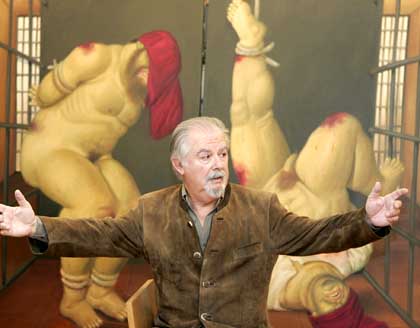
Colombian painter Fernando Botero gestures front of his new paintings depicting the horrors of U.S. guards’ abuse of captives at Iraq’s Abu Ghraib prison, Monday April 11, 2005 in Paris, France. Botero says he became so upset that he felt compelled to produce works showing his trademark chubby characters naked and being blooded by Americans. (AP Photo/Francois Mori)
Fernando Botero‘s work has won plaudits around the US. I think his work is excellent for many obvious reasons, so don’t call me a cynic when I say Botero’s work is more easily accepted because his Beryl Cook cherub-grotesque style, and the fact he is a Latin American commenting on a war to which Latin America remained external. Put another way, he serves up the shit sandwich with relish, whereas Fein left it in the bowl. Here’s an official presentation, here’s Berkeley enjoying the show and here’s the AP writing about it before it caravanned around America.
And finally, Chris Bartlett (Photographer) and Daniel Heyman (Painter) have teamed up to produce the Detainee Project which creates portraits of individuals illegally detained throughout America’s war on Iraq. George Soros helped Bartlett give detainees dignity and representations beyond hoods, nudity and dogs.

 Prison Photography