
You are currently browsing the category archive for the ‘Interview’ category.

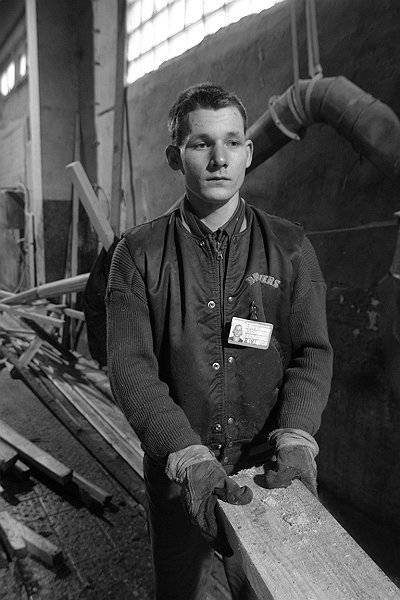
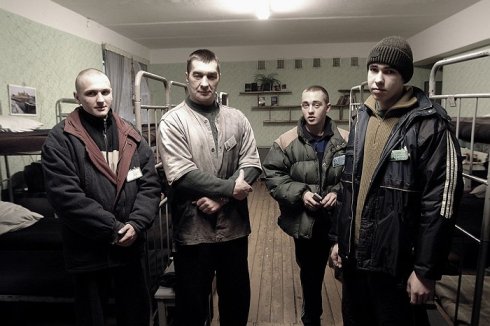
In 2004, Delmi Alvarez documented – over three days – the activities at Skirotava prison in Riga, capital of his adopted home Latvia. We discussed his motivations, the difficulties of access and human rights in Latvian prisons.
Q & A
Why did you decide to do a project inside a prison? Did you decide specifically on Skirotava?
For many years I’ve been interested in what happens inside prison walls. It was not the first time that I secured a permit to enter a prison.
I chose Skirotava because I live in Latvia and – through my work – I am an eyewitness to human rights [abuses]; Latvia is on the black list for its human rights.
I was working for SestDiena magazine. After many emails and calls, and with the help of the former chief editor Mrs. Sarmite Elerte, I got a permit. (Mrs. Sarmite Elerte, like many journalists and myself at Diena company newspaper, was made redundant).
My aim with the photo essay was to study the living conditions of [Latvian] inmates. After visiting Skirotava, I asked to visit more places but at the last moment my permit was denied. Many Latvian prisons don’t have good conditions. Simply, Latvians don’t care about that.
What sort of laws and attitudes exist within Latvia toward crimes, prisons and criminal justice?
I would prefer not to talk about that. I had many problems arise due to my opinions on this subject. In Latvia there is no freedom of speech.
Was it difficult to gain access?
You can imagine. From every direction, I faced questions – who I am; why I was interested; and what were my aims, etc.
But as I said earlier, Sarmite Elerte is a great person and she was always watching out for stories about humans rights. Without her letter of recommendation I would never have gained entry.
If you are trying to enter [Latvian] prisons at which human rights are under scrutiny, you are – for the authorities – like a spying enemy. Once you first enter, you must have a meeting with a few officials and they ask many questions.
This project happened in 2004. Perhaps things have changed today, but I didn’t have a good experience with the people that manage permits.
I would like to go back to give a lecture about photography to the inmates because they were very interested.
You’ve said that prisoners in your pictures are “children of dictatorship”. Can you explain that statement?
Many of them are from the times of Stalin, Soviet rule and KGB. Parents and grandparents of most inmates are from those times. Stalin was [seen as] a dictator by many Latvians.
In Latvia, the minority groups are called “aliens” and there are a large controversies over these minorities. I don’t really want to enter into these issues because it is not my country and Latvians need only study the issues and put things in order.
But something is real, Latvia is for Latvians and they are proud to fight for that. With that logic, they have good reason to want to manage their country before others, but there is an increase of extremism and nationalism. This is bad.
Many inmates come from remote poor areas in Latvia that survive without services. In these places, both Russians and Latvians live. Then, once in the prison, Russians and Latvians are not friendly and it is not a safe place for either group.


What ages are the prisoners? Where have they come from?
During my three-day visit, one officer had a talk with me in his office. He told me about the rules of my visit – no questions; no names; and no photos directly of the inmates without their permission.
In truth, I didn’t – don’t – want to know who they are and from where come from. Imagine … If I knew the person I was photographing was a rapist and killer, I wouldn’t be able shoot neutrally, I wouldn’t want to see into the eyes of the guy and I would be very affected.
I prefer that I don’t know about the person’s past. We are human. I know that many of them are children of drug addicts, alcoholics, and thieves. I know that they are not at fault being to born in this environment.
My question is: What can society and systems provide to help them find a way and be accepted? I am sure that there is lack of reentry programs in the prisons. In the US and other more developed countries there are programs like this. Why not in Latvia?


What reputation does Skirotava have to people for Riga and/or Latvia?
I have no idea, but when I said in a lecture that I had been inside, people looked at me as if they were looking at diabolo (sic).
What were the responses from staff and inmates to your work?
[During the visit] I was always with two officers and I wasn’t allowed to talk with inmates. The officers were not allowed to talk with me [about my work]. But, one inmate asked me to shoot a picture for his mother. With permission of an officer, I made a portrait for the [inmate’s] mother. This made me happy.
I wrote in the article that prisoners like novels and books. The next week, hundreds of novels, books and magazines arrived at the offices of SestDiena magazine!
Any animosity?
For the first visit, the editors assigned a writer to accompany me. Okay, we arrived, passed the check control, left matches, phones and all the stuff that you are not allow to carry inside. After that point we went to the secure areas of the prison – the real prison.
We went into a big empty yard, a big Comanche (sic) territory where hundreds of eyes are watching you: Who the hell are you boys? What are you doing here, cowboys?
One of the inmates approached the writer and told him something in Russian. After that the writer told me, “I am getting out of this fucking hell!” And I stayed alone. Later, I reported this to my editors and they said I needed to write the article myself.


Did you get a pair of gloves?
Yes! Absolutely. It was a big surprise. I have this pair of gloves at home. I saw one inmate making gloves and I asked him if it was possible to buy a pair. The guy didn’t answer me because an officer was near. Later, my translator said that the inmate would make me a pair. I received the gloves some time ago and I asked to pay, but the translator told me, “They are waiting for you to talk about photography [as payment]”. I never got that permit to return. I am sorry about that.
Thanks Delmi.
Thanks Pete.
BIOGRAPHY
Delmi Alvarez (1958-) grew up in Vigo, Galicia, northwest Spain. He has worked as an electrician, street nightclub-ticket seller, bartender, gardener to support his studies. In London, as a photojournalist, he contributed to AP, AFP and Reuters agencies. In 1991 spent one year in Cuba working in a documentary project about the life of the Cubans. From 1990 till 1993 he covered the Yugoslavia war as correspondent and photographer with La Voz de Galicia newspaper. The experience shaped his personal opinion about conflicts and following the deaths of friend-photographers Alvarez no longer cover conflict zones. Since the mid-nineties, Alvarez has worked on a long term documentary project Galegos na Diaspora documenting the spread of Galician people across the globe. The project has taken him to every continent. In 2006 the Galician Government invited Alvarez to develop a photographic project documenting and promoting the ancient pilgrimage route to Santiago de Compostela. Alvarez is currently working on projects with Magnum photographers Ian Berry and Richard Kalvar. Alvarez has lived among the Galician diaspora in Riga, Latvia since 2002. http://www.delmialvarez.com/
PART FOURTEEN IN A SERIES OF POSTS DISCUSSING PHOTOGRAPHERS’ ACTIONS AND RESPONSES TO THE KILLING OF FABIENNE CHERISMA IN PORT-AU-PRINCE, HAITI ON THE 19TH JANUARY 2010.
Alon Skuy, photographer for The Times in South Africa, was in Haiti from 17th – 22nd January.
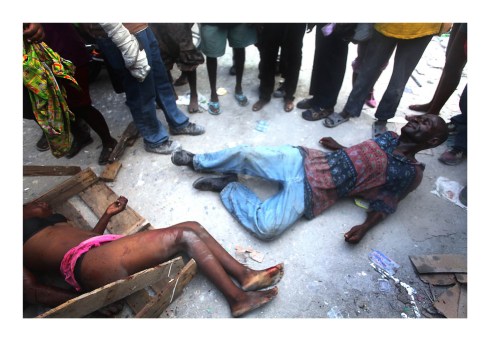
Fabienne was shot at approximately 4pm. What had you photographed earlier that day?
General looting and destruction in the downtown area of Port-Au-Prince.
How many other photographers did you see at the scene? Do you know the photographers’ names?
Contrary to another article on this site, there were three South African Photographers on the scene: myself, Felix Dlangamandla and James Oatway.
How was the atmosphere? How did others behave?
The atmosphere was very tense and thick with emotion. It was quite a chaotic scene. Photographers were jostling for images. On the whole, I feel that the photographers behaved
respectfully on the scene.
Did you discuss the tragedy with other photographers?
Yes, briefly on the scene with the two other South African photographers, we were all aware of each others presence.
How long was it until her family and father arrived to carry away Fabienne’s corpse?
About 30 minutes.
How long did you follow the group as they carried her away?
For about three kilometers down the main road.
Where was their destination? How far away was that?
Their destination seemed to be a market where Fabienne’s mother, as well as other relatives may have been.

How does Fabienne’s death fit in with the visual narratives of Haiti’s earthquake aftermath?
An important event to cover, imperative to show the desperation due to lack of aid getting through, and the inhumane fashion in which the law enforcement behaved at times. The family were obviously really distraught.
– – –
Both images © Alon Skuy. From top, Osam Cherisma mourns the death of his daughter Fabienne; Amante Kelcy, Fabienne’s mother (in white), mourns the loss of her daughter.
– – –
ALSO IN THE ‘PHOTOGRAPHING FABIENNE’ SERIES
Part One: Fabienne Cherisma (Initial inquiries, Jan Grarup, Olivier Laban Mattei)
Part Two: More on Fabienne Cherisma (Carlos Garcia Rawlins)
Part Three: Furthermore on Fabienne Cherisma (Michael Mullady)
Part Four: Yet more on Fabienne Cherisma (Linsmier, Nathan Weber)
Part Five: Interview with Edward Linsmier
Part Six: Interview with Jan Grarup
Part Seven: Interview with Paul Hansen
Part Eight: Interview with Michael Winiarski
Part Nine: Interview with Nathan Weber
Part Ten: Interview with James Oatway
Part Eleven: Interview with Nick Kozak
Part Twelve: Two Months On (Winiarski/Hansen)
Reporter Rory Carroll Clarifies Some Details
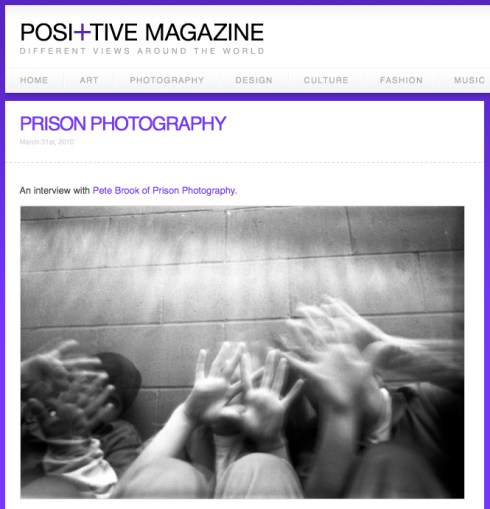
Last month, Giacomo Cosua from POSI+TIVE Magazine got in touch to see if I’d be amenable to an interview about my project here at Prison Photography.
It has been a while since I took a step back for an objective look. And – believe it or not – it is the first time someone has asked me to name Prison Photography‘s best article.
Thanks should also go out to Melania Comoretto, Sasha Maslov, Nathalie Mohadjer, Steve Davis, Robert Gumpert, Yana Payusova and the girls of Remann Hall for their images to illustrate the piece.
PART ELEVEN IN A SERIES OF POSTS DISCUSSING PHOTOGRAPHERS’ ACTIONS AND RESPONSES TO THE KILLING OF FABIENNE CHERISMA IN PORT-AU-PRINCE, HAITI ON THE 19TH JANUARY 2010.
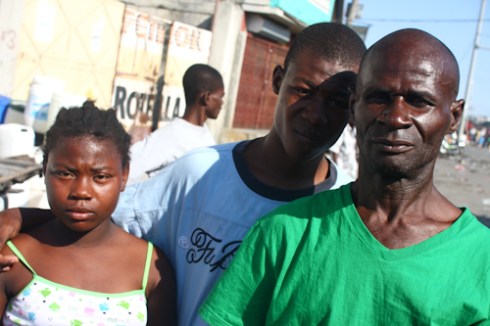
Photo: Nick Kozak
On 20th January, the day after Fabienne’s death, Nick Kozak was walking through an unfamiliar neighbourhood of Port-au-Prince. Kozak’s fixer had warned him that the area might be unsafe. Then a man and two youths approached him.
The exchange was brief. Kozak took two photographs of the three. At the time Kozak did not know the details of Fabienne’s killing.

Photo: Nick Kozak
The man was Osama Cherisma, his daughter, Amanda and son, Jeff.
Describe the interaction.
I was approached by them. I photographed them because they asked me to help.
I was with a guy who was helping me with translating and our exchange was very quick. I was a bit nervous about my surroundings as I believe we were close to Cite Soleil.
I did not know that his daughter was shot by police. From what I had understood in our short time together was that there had been some sort of gang related shootings and that she was an innocent bystander.
How long was the exchange?
Very short, about 4-5 mins.
When you say they were looking for help, what sort of help?
They were looking for help in the sense of being heard I think. They were distraught, of course, and wanted to be heard. I guess they just wanted to talk to someone who might be able to tell the ‘world’ about their tragedy. Sadly, I did not even learn much about Fabienne Cherisma at the time, interestingly, we are putting the pieces together now.
Do you think it was because you had a camera in hand that they thought you could help?
Yes, I think that because I was a foreigner with a camera they thought that I could ‘help’, but I won’t theorize much as our encounter was indeed very short.
Do you expect that this family has any chance of achieving justice (however that is defined) or is Haiti too unstable to deal with the death of this single girl?
I can’t imagine that this family will achieve justice in Haiti for this death but mind you I only spent five days there and my knowledge of the country’s situation is limited. I do believe that the country is too unstable and has too many ongoing problems that have been so severely augmented by the earthquake for this family to be properly attended to.
Who was talking to your translator? The father?
Mainly the father, Osama was talking, yes. I was writing down a bit of information about him and his family on a scrap piece of paper which I think I can still find at home.
What impression was left as you parted? Did the family seem as if they had a purpose to pursue?
I was a bit confused and unsure of what had exactly transpired. It left me sad but we had a destination and felt unsafe (because of what the guys I was with had told me) in the area that we met them in.
I’m not sure how to answer the second part of the question. By that time, I was already skeptical or soured by the whole place in that I felt that their fight for whatever they were pursuing was sort of futile. I thought that the girl had been shot by a stray bullet from the guns of thugs and that justice would be close to impossible to get. Hope that makes sense.
Nick’s assessment makes sense, but the entire situation does not.
How do we reconcile the world’s media focused on a family and their dead daughter one day and then their total abandonment the next? I am not saying the media, individual journalists or anyone is responsible for the welfare of the Cherismas, I am pointing out that often images are just props for disaster consumption and virtually no-one gives these people a second thought.
At the beginning of my first ever post on Fabienne Cherisma I quoted Guardian journalist Rory Carroll:
“The question is not whether Fabienne will be remembered as a victim of the earthquake but whether, outside her family, she will be remembered at all.”
Similarly, will Fabienne’s family be remembered?
– – –
ALSO IN THE ‘PHOTOGRAPHING FABIENNE’ SERIES
Part One: Fabienne Cherisma (Initial inquiries, Jan Grarup, Olivier Laban Mattei)
Part Two: More on Fabienne Cherisma (Carlos Garcia Rawlins)
Part Three: Furthermore on Fabienne Cherisma (Michael Mullady)
Part Four: Yet more on Fabienne Cherisma (Linsmier, Nathan Weber)
Part Five: Interview with Edward Linsmier
Part Six: Interview with Jan Grarup
Part Seven: Interview with Paul Hansen
Part Eight: Interview with Michael Winiarski
Part Nine: Interview with Nathan Weber
Part Ten: Interview with James Oatway
Part Twelve: Two Months On (Winiarski/Hansen)
Reporter Rory Carroll Clarifies Some Details
Part Fourteen: Interview with Alon Skuy
Part Fifteen: Conclusions
PART TEN IN A SERIES OF POSTS DISCUSSING PHOTOGRAPHERS’ ACTIONS AND RESPONSES TO THE KILLING OF FABIENNE CHERISMA IN PORT-AU-PRINCE, HAITI ON THE 19TH JANUARY 2010.
James Oatway is a Johannesburg based photojournalist employed at the South African Sunday Times. James was in Haiti from January 17th until January 28th. On the morning of the 20th – the day after the shooting James’ diary dispatch for the SA Sunday Times was published.
Fabienne was shot at approximately 4pm. What had you photographed earlier that day?
Earlier that day, not far from where [Fabienne was shot] I had seen a young man taking his last breaths. He had been stabbed in the neck and chest by fellow looters in a fight over a box of toothbrushes. People were stepping over the dying man. Then about five minutes later some men stopped and put his body onto a motorbike and took him away.

Photographer James Oatway says this is the man who shot Fabienne Cherisma. Photo: James Oatway
Did you see Fabienne get shot?
I was about two meters away from the policeman when he fired the fatal shots. He was behind me and fired two quick shots. Not knowing that anyone had been struck I spun around and photographed him gun in hand. Police were arresting a man on the street corner. I photographed that for about thirty seconds and then someone shouted that someone had been shot. I ran to where she lay on top of those frames. She didn’t have plastic chairs with her as some reports claimed.
How many other photographers/reporters did you see at the scene?
There were initially about five or six photographers there. While we were shooting a man came and took money out of her hand. I shot for about fifteen minutes. Word must have got out about the shooting because more and more photographers arrived.

Man takes the money from Fabienne's lifeless hand. Photo: James Oatway
Do you know the photographers’ names?
I only knew two other photographers names… Jan Dago and Jan Grarup. Both Danish.
How long was it until her family and father arrived to carry away Fabienne’s corpse?
Then about twenty minutes later the father and brother arrived. The father was already hysterical. I followed him onto the roof. He lifted her head up and then realized that it was his daughter and dropped her again. Then he and his son began carrying her away. It was at least three kilometers and there were many stops. Her sister and other family members joined the procession. There was a lot of screaming and wailing.
I withdrew at this point. There were too many photographers … and I became emotional. I had also stood on a nail which had gone deep into my foot. There must have been about fifteen photographers.
How did others behave?
There was a bit of jostling but nothing too bad or disrespectful.
How was the atmosphere?
The atmosphere was surreal.
Anything else?
I have her surname as “Geismar”. I have no reason to doubt my fixer who I saw write it down in his notebook. I will stick to Geismar as being her correct surname.
Prison Photography has consistently used Cherisma, the spelling used by The Guardian on its first dispatch following her death.
Elsewhere, I have seen the spellings ‘Geismar’ and ‘Geichmar’. Likewise, Fabienne’s father is referred to as both Osam and Osama, and sometimes both in the same publication. Fabienne’s mother has been named Armante, Armand and Amand Clecy in the reporting of different media.
– – –
ALSO IN THE ‘PHOTOGRAPHING FABIENNE’ SERIES
Part One: Fabienne Cherisma (Initial inquiries, Jan Grarup, Olivier Laban Mattei)
Part Two: More on Fabienne Cherisma (Carlos Garcia Rawlins)
Part Three: Furthermore on Fabienne Cherisma (Michael Mullady)
Part Four: Yet more on Fabienne Cherisma (Linsmier, Nathan Weber)
Part Five: Interview with Edward Linsmier
Part Six: Interview with Jan Grarup
Part Seven: Interview with Paul Hansen
Part Eight: Interview with Michael Winiarski
Part Nine: Interview with Nathan Weber
Part Eleven: Interview with Nick Kozak
Part Twelve: Two Months On (Winiarski/Hansen)
Reporter Rory Carroll Clarifies Some Details
Part Fourteen: Interview with Alon Skuy
Part Fifteen: Conclusions
PART NINE IN A SERIES OF POSTS DISCUSSING PHOTOGRAPHERS’ ACTIONS AND RESPONSES TO THE KILLING OF FABIENNE CHERISMA IN PORT-AU-PRINCE, HAITI ON THE 19TH JANUARY 2010.
Nathan Weber was in Haiti from January 14th to January 21st.
Fabienne was shot at approximately 4pm. What had you photographed earlier that day?
Prior to being in the area where Fabienne was shot we had been searching for the mass graves and visiting the port area. We walked from the port area through one of the markets to investigate looting. It was there on the street Rue Marthely Seiee that everything went down.
Once we made it down the streets we came to this area (a ghetto, as it was explained to me) where a large number of people were coming down the street at a fast pace. At that point we heard gun shots and proceeded 1.5 blocks in the direction of the gun fire where several police were standing at an intersection. From that intersection, I could see more police trying to disperse looters and we headed to a destroyed structure.
The structure’s roof acted as a ramp that people used to gain access to other rooftops in order to scavenge and take anything they could carry. After a few minutes we decided to climb up and onto that collapsed building to make pictures from a different angel and see just what was up there. Roughly 15 to 20 minutes passed and when most of the police headed away from the collapsed building used to access rooftops to arrest some people around the corner. For whatever reason I didn’t follow and stayed put on the roof.
Did you see Fabienne get shot?
I remember looking down on the street and there was a lone officer pointing his pistol up into the air in my general direction. I don’t remember hearing a gun shot but out of the corner of my eye probably 15 to 20 feet away I saw a girl fall. The roof I was standing on was somewhat steep, slippery and was covered with small granular pieces of concrete. At first I thought she had slipped and knocked herself unconscious as I had seen others fall and didn’t think much about it until I went over to check on her. To my disbelief I realized she wasn’t breathing and I discovered a large head wound. At that point my fixer was yelling for me come down from the roof as things were heating up down the street. I looked and him, gave a hand signal indicating that something very bad had just happened and stayed put. Within a couple of minutes several photographers were upon the rooftop and shooting the scene of Fabienne’s body.
How long was it until her family and father arrived to carry away Fabienne’s corpse?
It wasn’t very long maybe 20 minutes at the most before word spread to Fabienne’s family and her father arrived on scene.
How many other photographers did you see at the scene? Do you know the photographers’ names?
The picture below shows that scene where all the photographers in the area ascended. The only photographers I know in this picture are Ed Linsmier and Michael Mullady. I think there was only one other American journalist there and everyone else was from Norway, Mexico, France, etc.

© Nathan Weber
How was the atmosphere?
The atmosphere was pretty intense. This is the most high emotion environment I have ever been in. At one point I felt that we all needed to back off and stop shooting. I thought that the pictures have been made and stepping away from the scene was in order. I also gave thought to heading back to the hotel and transmitting my images. Until this point there hadn’t been a youth death involved in looting and I knew that I would be an important news story. I am so glad I didn’t leave and I waited to see what would happen.
How did others behave?
Everyone of the photographers on the scene were very professional. We all worked together to document the situation and did our best not to add or take away from the environment. Basically, we all acted within the Society of Professional Journalists (SP&J) ethics and guidelines.
Did you discuss the tragedy with other photographers?
I didn’t really discuss the tragedy with any of the photographers at the time, or at a later date. I know that for myself being focused on the scene and doing my best to capture what was going there kept me somewhat removed. It wasn’t until being back in the States that I broke down to my girlfriend about Fabienne’s death. It was extremely senseless and there was absolutely no reason for her to have been killed. As I understand this is a common thing in Haiti, and there is very little recourse if any for this type of incident.
How does Fabienne’s death fit in with the visual narratives of Haiti’s earthquake aftermath?
I think Fabienne’s death shows when there are environments that have total chaos, the only thing you can count on is uncertainty. The visual representation here is a snapshot of what people in Haiti are dealing with.
I’m not sure what will become of the images, where they will be used or their legacy. If nothing else maybe our coverage of what happened to Fabienne will show her actions of survival were not in vain.
WEBER’S VIDEO
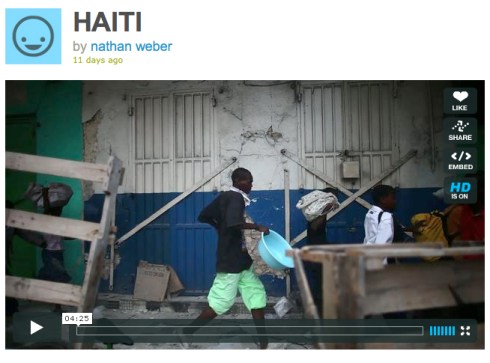
Nathan Weber has put together footage from before, during and after Fabienne’s shooting. (Content warning) Fabienne’s death is put in the context of the disorder of Port-au-Prince at the time.
Click on the frame below to be taken to Weber’s footage.
NOTE: Weber’s footage includes images of Fabienne’s dead body upon the roof, her father carrying her down the street away from the scene and the beginning of her family’s mourning. The footage is extremely descriptive. It is graphic in the sense that it shows a dead body. It is not bloody. It is very emotive.
I know that some people won’t want to see the footage and others will question its distribution. I am providing a link because it was provided to me. It is a accurate indicator of the atmosphere in LaVille on the 19th January, and in that regard a needed piece of evidence in the reconstruction of events.
– – –
ALSO IN THE ‘PHOTOGRAPHING FABIENNE’ SERIES
Part One: Fabienne Cherisma (Initial inquiries, Jan Grarup, Olivier Laban Mattei)
Part Two: More on Fabienne Cherisma (Carlos Garcia Rawlins)
Part Three: Furthermore on Fabienne Cherisma (Michael Mullady)
Part Four: Yet more on Fabienne Cherisma (Linsmier, Nathan Weber)
Part Five: Interview with Edward Linsmier
Part Six: Interview with Jan Grarup
Part Seven: Interview with Paul Hansen
Part Eight: Interview with Michael Winiarski
Part Ten: Interview with James Oatway
Part Eleven: Interview with Nick Kozak
Part Twelve: Two Months On (Winiarski/Hansen)
Reporter Rory Carroll Clarifies Some Details
Part Fourteen: Interview with Alon Skuy
Part Fifteen: Conclusions
PART EIGHT IN A SERIES OF POSTS DISCUSSING PHOTOGRAPHERS’ ACTIONS AND RESPONSES TO THE KILLING OF FABIENNE CHERISMA IN PORT-AU-PRINCE, HAITI ON THE 19TH JANUARY 2010.
Michael Winiarski is the US correspondent for Swedish newspaper Dagens Nyheter and colleague of photographer Paul Hansen (interviewed in part seven).

Osama Cherisma carries Fabienne's body down Boulevard Jean Jacques Dessaline, followed by his son, Jeff (18) and his daughter, Amanda (13). Photo: Paul Hansen
What were the dates of your stay in Haiti?
I arrived to Port-au-Prince in the morning of January 14th. I flew in from Washington (where I’m posted as correspondent for the newspaper Dagens Nyheter) through Santo Domingo. I left Haiti late on January 21st, by car to Dominican Republic.
Fabienne was shot at approximately 4pm. What had you reported on earlier that day?
Actually about the deteriorating security situation and looting in central Port-au-Prince.
Did you see Fabienne get shot?
No, I was by the car at Boulevard Jean-Jacques Dessalines when our driver came and told me that a girl had been shot. When I saw her she lay in the street.
How long was it until her family and father arrived to carry away Fabienne’s corpse?
When I saw her, the father was already there. I checked my watch which was exactly 16.00pm, so I assume she was shot at least 10-15 minutes earlier.
How many other journalists/photographers did you see at the scene? Do you know the names of these other media people?
Apart from Paul Hansen from Dagens Nyheter, I saw the Danish photographer Jan Grarup and the Reuters and AFP guys. I think I was the only foreign writer/reporter, and there also was a Haitian man who volunteered with translating some things the father said.
How was the atmosphere? How did others behave?
It was of course tense, with lot of crying, screaming and lamenting as we followed the crowd to the house of the Cherisma family. But the immediate threat of more shootings had subsided – no police were to be seen around us.
Did you discuss the tragedy with Paul or other journalists?
At that point only with Paul, and we did not hesitate that we should report the story.
Any other thoughts?
In Sweden, there were ethics discussions about Fabienne [and the photographs] by magazines and bloggers.
SWEDISH MEDIA DISCUSS THE ETHICS OF PUBLISHING PAUL HANSEN’S IMAGE OF FABIENNE
So upsetting is the photograph of a dead young girl, that Swedish magazines and bloggers responded to and questioned it’s use for Winiarski’s article (Swedish original / English translation).
The article humanised Fabienne and communicated the injustice and immediate devastation her death caused. It ends with a description of the family’s grief:
Fabienne’s little sister, Samantha, runs adjacent to [her father who carries Fabienne’s dead body] and roars in grief. It is only later Osama Cherisma will completely absorb what has happened. Then he will sit down and stare blankly ahead. But now he cries curses at the police who he believes took aim at his daughter.
We follow the weeping and despaired small group down the street, through the business district, to Fabienne’s home. It is only here when Fabienne’s mother Amante Kelcy hear what has happened to her girl. She falls apart in a crying, “Why? “Why? Why?”
Ever since the shot, the police are not to be seen. No police dare to enter these streets after a member of its rank and file killed one of the neighborhood children. No ambulance will be summoned. There is still no one to send. And Fabienne is already dead. Unnecessarily.
Osama Cherisma curses the police. “They are like animals, they are animals, “he says. “Why should my daughter pulled away in the prime of their youth?”

Fabienne's younger sister, Amanda Cherisma (13) and older brother, Jeff Cherisma (18) over the body of their sister. Photo: Paul Hansen
Dagens Nyheter, to its credit, acknowledged the concerns and answered them directly in an editorial. I paraphrase due to the vagaries of translation:
We are obviously very reluctant to publish pictures of the deceased. A reader emailed and questioned how we would handle the issue if the image depicted a fifteen year old girl in Sweden. The answer is that the situation in Sweden is not comparable – if Sweden were affected by a disaster of equal scale of that in Haiti, then publication discussions would be based on the circumstances of that event.
How families are affected by publication is another important issue to consider in the decision.
DN’s mission is to take the world closer to readers, even when reporting can bring discomfort. Michael Winiarski’s and Paul Hansen’s reporting in connection with this individual tragedy is strong and worthy – and not at all speculative. In our view, it’s publication was important.
The statement above can be construed as a standard media response – that while Dagens Nyheter is aware of the distress Hansen’s photographs may cause it readers AND the deceased’s family, it goes ahead with publication in the interests of information.
Respect is given in that the need for respect is articulated. Is this enough?
I remain a little uneasy. The photographers I’ve interviewed for this series have given their opinions, but still I wonder what Fabienne’s family actually think – especially eight weeks later – of the international coverage of Fabienne’s death.
– – –
ALSO IN THE ‘PHOTOGRAPHING FABIENNE’ SERIES
Part One: Fabienne Cherisma (Initial inquiries, Jan Grarup, Olivier Laban Mattei)
Part Two: More on Fabienne Cherisma (Carlos Garcia Rawlins)
Part Three: Furthermore on Fabienne Cherisma (Michael Mullady)
Part Four: Yet more on Fabienne Cherisma (Linsmier, Nathan Weber)
Part Five: Interview with Edward Linsmier
Part Six: Interview with Jan Grarup
Part Seven: Interview with Paul Hansen
Part Nine: Interview with Nathan Weber
Part Ten: Interview with James Oatway
Part Eleven: Interview with Nick Kozak
Part Twelve: Two Months On (Winiarski/Hansen)
Reporter Rory Carroll Clarifies Some Details
Part Fourteen: Interview with Alon Skuy
Part Fifteen: Conclusions
PART SEVEN IN A SERIES OF POSTS DISCUSSING PHOTOGRAPHERS’ ACTIONS AND RESPONSES TO THE KILLING OF FABIENNE CHERISMA IN PORT-AU-PRINCE, HAITI ON THE 19TH JANUARY 2010.
Last month, Swedish photographer Paul Hansen was named POYi Newspaper Photographer of the Year. The month before – from Jan 16th until Jan 28th – Hansen was in Haiti .
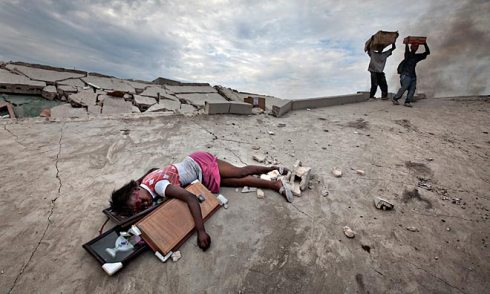
Photo: Paul Hansen
Fabienne was shot at approximately 4pm. What had you photographed earlier that day?
I was in the city of Leogane earlier that day to cover the destruction. Later in the afternoon I covered the ongoing looting in central Port-au-Prince
Did you see Fabienne get shot?
No.
How long was it until her family and father arrived to carry away Fabienne’s corpse?
I don´t really remember, and I don’t know exactly when she got shot – but from the time I got up on the roof until her father arrived I estimate it took around half an hour. But, the stress and trauma of the situation makes that estimate shaky.
How many other photographers did you see at the scene? Do you know the photographers’ names?
I saw five or six, but perhaps there was more. It was a very fluid situation. I know two of them – Jan Grarup and Jan Dagö, both Danish.
Did you discuss the tragedy with other journalists?
I discussed it mostly with my Swedish colleagues at the time, and I still discuss it today.
How was the atmosphere? How did others behave?
The atmosphere was very fluid and potentially dangerous, a young girl had just been shot in the head by somebody, and we were standing in the same spot. What baffles me is that the looting continued around this poor girl and that some of the other looters stole money from her hand and poked the body so that she started to slide/roll down towards us (photographers) – it was a very tragic thing to witness. How traumatized and desperate must these people be to act in this manner?
How does Fabienne’s death fit in with the visual narratives of Haiti’s earthquake aftermath?
I don´t really understand the question. If there is there something that “fits with the visual narrative of a disaster” in general I do not know what that would be. However, having said that, I think it is extremely tragic that a young girl had to die like that. For me, Fabienne’s death and her story is an poignant reminder of the need for a society to have basic security – with or without a disaster.
Anything else?
The more attention Haiti gets, the better. Fabienne’s death is to me an unnecessary tragedy – on top of the larger tragedy.
If the security would have been in place, an earthquake survivor like Fabienne and many more would be alive. I photographed several people killed by the mob/police/security personnel. The death of this little girl, killed over some decorative trinkets, saddens me deeply and affects me to this day. I frequently talk about her with readers, colleagues and friends.
I will never forget that horrible day.

Fabienne's mother, Amante Kelcy, after seeing Fabienne's dead body. Photo Paul Hansen
– – –
ALSO IN THE ‘PHOTOGRAPHING FABIENNE’ SERIES
Part One: Fabienne Cherisma (Initial inquiries, Jan Grarup, Olivier Laban Mattei)
Part Two: More on Fabienne Cherisma (Carlos Garcia Rawlins)
Part Three: Furthermore on Fabienne Cherisma (Michael Mullady)
Part Four: Yet more on Fabienne Cherisma (Linsmier, Nathan Weber)
Part Five: Interview with Edward Linsmier
Part Six: Interview with Jan Grarup
Part Eight: Interview with Michael Winiarski
Part Nine: Interview with Nathan Weber
Part Ten: Interview with James Oatway
Part Eleven: Interview with Nick Kozak
Part Twelve: Two Months On (Winiarski/Hansen)
Reporter Rory Carroll Clarifies Some Details
Part Fourteen: Interview with Alon Skuy
Part Fifteen: Conclusions

 Prison Photography