
You are currently browsing the category archive for the ‘Non-Prison’ category.

Nina Cleveland, 1999
Tom Jones (b.1964; resides Madison, WI) is a Ho Chunk Native American. All of his projects represent some aspect of the Ho Chunk tribe, but the series not to be missed is The Ho Chunk People.
Jones: “Historically it has been outsiders who have taken these photographs of Native Americans. We have generally been represented with beads and feathers; this example can be seen through the extraordinary photographic portrayals of Edward Curtis. While this is an aspect of our life, the emphasis of my current body of work is focused on the members of my tribe and the environments in which they live, giving a name and face to the individuals and their way of life in our own time. […] I am ever mindful of my responsibility to the tribe and to carry on a sense of pride about who and what we are as a people.”

After today’s verdict, it would be understandable if we concluded that – in the eyes of the law – Oscar’s life didn’t matter. The jury had verdict options of murder, voluntary and non-voluntary manslaughter. They choose the latter; the most lenient. After slaying Grant in front of hundreds of witnesses, Johannes Mehserle may well be out of prison in two years. face a five to 14 year sentence if he is not granted probation (Source for the correction).
There’s so much to say about this verdict. Simply, I’ll say today was a sad day for justice, for Oscar’s family and for his memory.
Print from Just Seeds
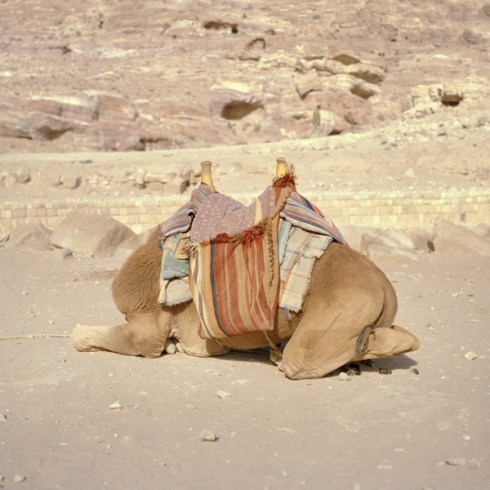
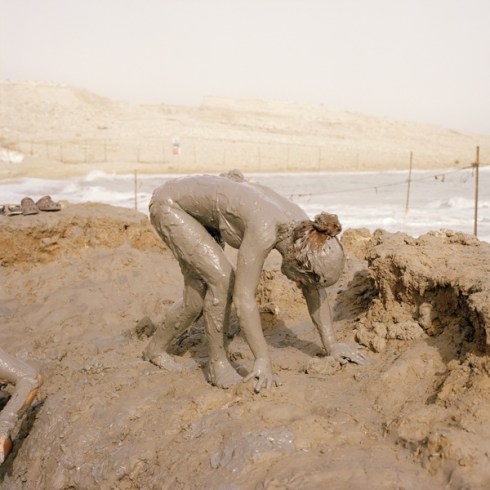
Irina Rozovsky has done a really good job at confusing me with her series One to Nothing. Intrigued by the palette, I found myself cycling through the edit over and over again, each time conjuring a new narrative in my mind.

Spread from Toppled
Toppled by Florian Göttke
Two weeks ago, Foto8’s Guy Lane reviewed Toppled by Florian Göttke. The review is what it is – a description of Göttke’s “(mainly) pictorial study of the destruction, desecration and mutation of many of Iraq’s plentiful statues of its former dictator.”
Lane’s conclusion points to the significance of Göttke’s study:
“Perhaps this might all appear somewhat peripheral, an iconographical diversion from the real business – invasion, subjugation, and expropriation – of Occupation. But from amongst Göttke’s collated written testimonies and reports, it is possible to sense something of the importance that was attached to the Coalition’s iconoclasm. For example, a BBC account of British activities in Basra concluded that ‘the statue of Saddam is in ruins. It is the key target of the whole raid.’ Meanwhile, in Baghdad a US army captain was ordered to delay destroying a statue until a Fox TV crew arrived. Most famously, the Firdous Square episode appears to have been – to a degree – choreographed for the benefit of the foreign media based in the overlooking Palestine Hotel. ‘American and British press officers were indeed actively looking for the opportunity to capture the symbolic action of toppling statues and have the media transmit these to the world,’ writes Göttke. As such, Toppled’s events and pictures correspond tellingly and damningly to the Retort group’s analysis of our ‘new age of war’.”
Would I buy the book? Probably not. The book is a concept. I understand the concept. And, the images are essentially props to the concept (illustrations of the new biographies of statues, of things).
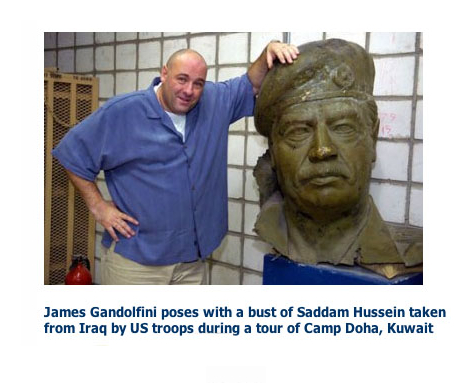
Besides, I can get my fill elsewhere. The best (most ridiculous) image – James Gandolfini meets the Butcher of Baghdad – is on the accompanying Toppled website.
SADDAM’S PERSONAL PHOTO ALBUM
Göttke’s work leaves me wondering how Saddam’s personal photo-album fits in?
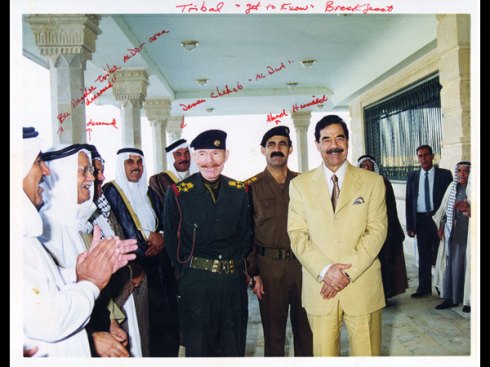
Similarly, these images were found and taken during the invasion of Iraq: “On the night of June 18, 2003, the soldiers in the 1-22 Infantry stormed a farm in Tikrit, Iraq, hoping to find a fugitive Saddam Hussein. They didn’t find their target, but they did find a consolation prize: Saddam’s family photo album […] When he returned from Iraq, Lt. Col. Steve Russell, the commander of the 1-22 Infantry, donated the album to the National Infantry Museum at Fort Benning, Ga.” (Source)
This is a reversal, no? Not the effigies of megalomania, but personal snapshots. Not public monstrosities but flimsy two-dimensional depictions. Would these have got pissed on and slapped with sandals? Would they have been torn up/burned up had Lt. Col. Steve Russell not slipped them into his luggage?
Also, to describe the collection (for media publication) as the dictator’s “personal album” is one thing, but to what extent were these Saddam’s photo-memories? Are these really the contents of an album he valued? Are we even glad that Saddam’s images still exist?
One final thought, how do we distinguish between the staging of Saddam’s images to the staging of the images in Göttke’s survey?
JAMAL PENJWENY
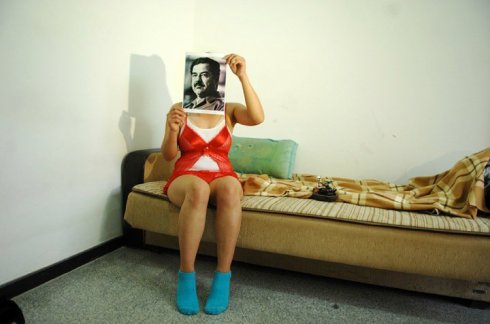
On a less-grander scale, Jamal Penjweny is attempting (with his Iraqi subjects) to make sense of the spectre of Saddam. The series is called Saddam is Here. It’s not great photography but I don’t think this type of playful exploration needs to be.
© Jamal Penjweny
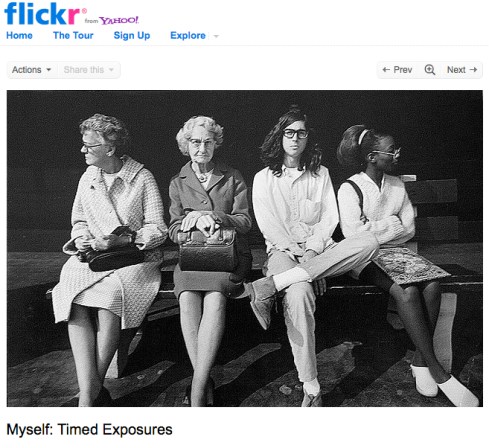
I was surprised to find that Mike Mandel has posted some photographs on Flickr. I thought legends stayed away from “the democratisation of the image.” And yet, Mandel has chanced his arm.
Incredibly, ten images from ‘Evidence‘ are even posted (All rights reserved).*
I was really taken by his mischievous ‘Myself: Timed Exposures’ (1971):
“In Myself: Timed Exposures I attached my 35 mm camera to a tripod and walked out into public space looking for situations to insert myself and create a picture. Once I found a likely opportunity I would set up the camera, release the self-timer on the shutter, and walk into the frame. The mechanical timer would noisily unwind for ten full seconds, allowing the world to change its complexion in front of my static lens. People, strangers to me, would be jarred for a moment from their routine and their perceived public isolation. I was standing uncomfortably close next to them, an abandoned camera buzzing a few feet away. I might say something or nothing at all. And suddenly, ‘click’, the machine had made its own “decisive moment” and only the film would know what latent treasure it owned.”

* ‘Evidence’, in my humble opinion, is one of the best photobooks ever produced.
Since getting to know photographer Robert Gumpert his discomfort with the current world of journalism has been a constant. He doesn’t gripe about technologies like some photojournalist elders (which I don’t have a problem with, by the way), but Bob can’t see a way back from slipping standards as we veer toward the bottom-line priorities of “Newsonomics.”
Bob says:
From the beginning there has been a fight in journalism over where the “firewall” between advertising and the newsroom should be and, as a related question, “what is news?” Is news what readers need to know, or what they want to know?
And so these two articles caught my attention.
The first is At Yahoo, Using Searches to Steer News Coverage. It’s a good headline and pretty much says it all. Yahoo will be using what the reader wants to know to determine content. This is now called democratizing content. In the past it was called tabloid news. […]
[Secondly,] “Gaps in Watchdog Journalism Reflected in News From a Trial.” You could not ask for a better example of why good aggressive journalism is needed and what happens when it isn’t around. The article concerns the coverage of a police torture case in Chicago by John Conroy. Everyone should read this article. I say read this article instead of his regular pieces because no one is employing Mr. Conroy anymore, and few news outlets are doing his kind of investigative reporting.
We are all, individually and as a country, more vulnerable for it.
Here, here! It’s a pleasure to know you Bob.
Photographer Glenna Gordon provided the image (below) to accompany Liberia’s inclusion on a recent Foreign Policy (FP) listing of failed states. She was not impressed by the piece – this is what she had to say:
“A couple of weeks ago, Foreign Policy ran one of those not-all-that-informed lists they called Postcards from Hell: Images from the World’s Most Failed States. In my book, a list that includes Yemen and Somalia alongside Ivory Coast and Liberia isn’t going to tell us that much […] Thanks FP, for often providing great news and analysis, and every now and then providing crappy link bait.”


Frida (forsythia), 35″x35″, c-print
As much as I respect the portraiture genre within photography, it just isn’t my thing. Perhaps I am not confident enough sifting the very good from the good? Nevertheless, I was really taken by Meera Margaret Singh‘s work – there is something very gripping about her series Harbinger. One of the subjects is her mother, others are strangers.
“Previously when I had worked with strangers, the awkwardness sometimes fueled the work. Now I’m being a bit more discriminate about whom I photograph and at what stage in our encounter.” (Source: Nymphoto interview, 04/02/09)

 Prison Photography