
You are currently browsing the category archive for the ‘Press’ category.
Update: Prison Photography collated a Directory of Photographic & Visual Resources for Guantanamo in May 2009.

- A detainee kicks a soccer ball around the central recreation yard at Camp 4, Joint Task Force (JTF) Guantánamo Bay, Cuba, June 10, 2008, during his daily outdoor recreation time. Detainees in Camp 4 get up to 12 hours of daily of outdoor recreation, including two hours in a central recreation yard. Photo Credit: U.S. Army 1st Lt. Sarah Cleveland
Just gratefully recieved a nudge from an urban conspirator to check out these 30 vetted photographs posted on the Boston Globe website. Obviously, many were taken during the same media tour I mentioned in the last post. Enjoy!
Note: Ignoring the pink elephant in the room, I have previously avoided talking about Abu Ghraib. What could I add to a topic so exhaustively dissected? However, after listening to Philip Gourevitch speak at a local bookstore I am urged to write.
Mention ‘Prison’ and ‘Photography’ and the collective conscience defaults to the Abu Ghraib pictures. There is no escaping this fact as there is no escaping those images. The Abu Ghraib photographs inform and corrupt key dialogues of our global society – war & power; geopolitics & the psychology of surveillance; Iraq & imperialism; Western & Islamic relations; and military operations & media-constructed otherness. Add to that list, uncomplicated human cruelty.
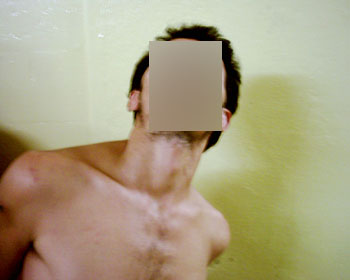
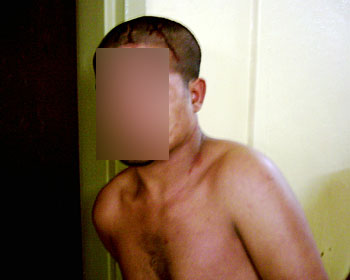
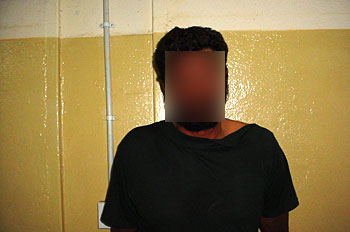

Those images have seeped into more spheres of conscious and sub-conscious thought than the most successful of photojournalist essays. This is emergence and pre-eminence of the Abu Ghraib photographs as the most current strongest visual “player”. Former strongest players have included Robert Capa’s images of the Normandy Invasion; or (Nick) Huỳnh Công Út’s photograph of Kim Phuc running from a napalm attack on Trang Bang, Vietnam; or Eddie Adams’ photograph of police chief General Nguyễn Ngọc Loan executing a Vietcong prisoner, Nguyễn Văn Lém. As Gourevitch said, “If a photojournalist had taken those [Abu Ghraib] images he or she would have been celebrated and decorated for their public service.”
Those photographs are many things. They are evidence of a corrupted system bereft of accountability. They are the most important images of the War on Iraq. When recollected, they should never be separated from the exacting malevolence of the Rumsfeld Department of Defense. They are already established as the most commonly shared images of global culture. The hooded prisoner is a 21st century icon. Perhaps, partly, this is why Americans rallied to make an immediate icon of Obama; to purge a nation’s collective visual memory, and to replace negative, shameful images with positive, hopeful, primary-coloured pop-motifs.


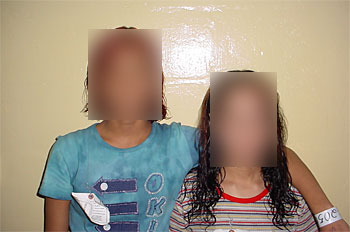
Gourevitch talked about the craft of the interview. The Paris Review, which he has edited since 2005, recently released the third of a four volume anthology of interviews with 20th century writers. Gourevitch noted the simplicity of the method and pointed out that in 1953 when the Paris Review was founded, no publications were interviewing writers. Literary criticism had become high brow and, to many, obsolete; it talked about the text but never the artist. The Paris Review was the first legitimate peek into the private lives, motivations and pathologies of poets and authors. Fellow writers could scrutinise every spoken word and omitted detail of their contemporaries. The Paris Review, in its early days, served as the exposé – the gossip column – for the literary world.
For fifty years, until his death in 2003, George Plimpton was editor of the Paris Review. It is fitting that Plimpton’s large shoes should be filled by a writer and journalist who has made an art form of the interview. Gourevitch’s acclaimed book We Wish to Inform You That Tomorrow We Will Be Killed With Our Families was based on information gleaned from an unhurried, matter-of-fact tour of Rwanda where he simply talked to people. Rwandans didn’t have their own journalists clearing the way for testimony in the immediate aftermath of the genocide and Gourevitch found support for his theory that “All people need to talk”. He described Rwandans culturally as the opposite of effusive, but maintained this didn’t mean they were unwilling to share their experiences.
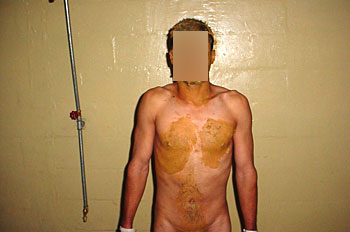


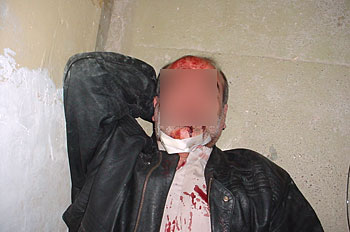
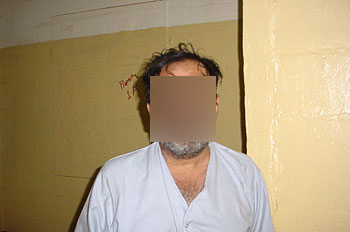
For Standard Operating Procedure, accompanying the profound Errol Morris movie (which has unsurprisingly suffered stymied distribution in the US), Gourevitch sat in on 100 hours of Morris’ questions (approximately half of Morris’ interviews).
Following Gourevitch’s presentation, I asked him if there were any atypical motivations for the American servicemen and servicewomen agreeing to the interview process. Was there any information they were keen to convey? Gourevitch was quite clear. There was a single shared motivation for Sabrina Harman, Lynndie England and colleagues. The interviews are one long exercise in self-representation. Prior, the soldiers had been silenced, criminalised and later written off as “bad apples” by a military narrative designed to shield the senior accountable authorities. The media was partly complicit and the soldiers “were pissed off”, stated Gourevitch.
From the moment the US military command learnt of the pictures, the soldier/guards of Abu Ghraib were set up for the fall. The military sequestered the reservists away and lined up a raft of charges for each soldier. The US military sat on those charges hoping that if it could retrieve and control the images, it wouldn’t have to bring the matter to public attention through trial. The US military visited homes of the soldiers’ family members back in the US. They demanded computers and deleted files. After some time, it was clearly apparent to the families of the Abu Ghraib soldiers that their sons and daughters were being made scapegoats. An exact single source of the images has never been pinned down, but Gourevitch contends it was a disgruntled family member who finally unleashed the digital photographs to a world swiftly buying into the prevailing Department of Defense narrative.
We Have Seen Their Actions, Let’s Hear Their Words
The Abu Ghraib photographs can and should be understood only in the context of their production, which is to say, by a group of individuals trained as soldiers and ordered to guard prisoners in a decrepit facility; by photographers who were compelled to document precisely because they couldn’t comprehend the atrocities; by a group of soldiers influenced and hardened by one another; by a group of soldiers under no direct or pre-written guidelines; by a group of soldiers with complex thoughts, manipulations and haunted memories. Morris did us a public service with his movie and it is fitting that the accompanying book by Gourevitch features no images.
Of course, what the global community needs now is an equally comprehensive documentary project bringing together the testimonies of all those held and tortured at Abu Ghraib.
Note: I wanted to avoid resorting to the common and most shocking images of Abu Ghraib that we’ve seen so often – box, blanket, hood, wires, scrotum, pyramid, puddles, dogs, blood, shit, thumbs, leash, limbs, body bag – and I don’t exactly know why. Salon put together a responsible collection of all 291 Abu Ghraib images if you need to put those infamous images back into the context of the prison facility.
The Artistic Legacy of Abu Ghraib
Ridiculously, artists that have chosen to reflect the systematic abuses at Abu Ghraib have come under fire.
Clinton Fein’s ingenious reconstructions of the Abu Ghraib crimes drew criticism for many selfish reasons (an unwelcome return to problematic images despite their obvious construction, a project of a sadist, a re-opening of a cultural wound?). The intelligence of Fein’s project was that it challenged our premature numbness to the original Abu Ghraib photographs and forced a renewed pathos toward a subject that we’d never known anyway. Are we supposed to feel something toward Fein’s models?
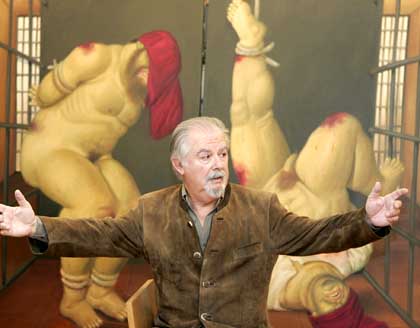
Colombian painter Fernando Botero gestures front of his new paintings depicting the horrors of U.S. guards’ abuse of captives at Iraq’s Abu Ghraib prison, Monday April 11, 2005 in Paris, France. Botero says he became so upset that he felt compelled to produce works showing his trademark chubby characters naked and being blooded by Americans. (AP Photo/Francois Mori)
Fernando Botero‘s work has won plaudits around the US. I think his work is excellent for many obvious reasons, so don’t call me a cynic when I say Botero’s work is more easily accepted because his Beryl Cook cherub-grotesque style, and the fact he is a Latin American commenting on a war to which Latin America remained external. Put another way, he serves up the shit sandwich with relish, whereas Fein left it in the bowl. Here’s an official presentation, here’s Berkeley enjoying the show and here’s the AP writing about it before it caravanned around America.
And finally, Chris Bartlett (Photographer) and Daniel Heyman (Painter) have teamed up to produce the Detainee Project which creates portraits of individuals illegally detained throughout America’s war on Iraq. George Soros helped Bartlett give detainees dignity and representations beyond hoods, nudity and dogs.
On a recent search of the Harry Ransom Center photographic archive at the University of Texas, Austin (an incredible collection) I came across this image by Arnold Genthe.
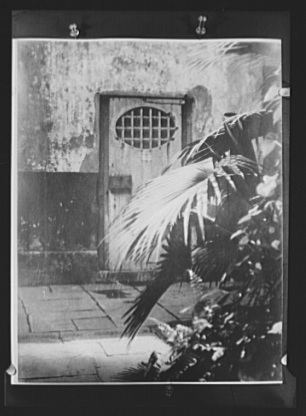
Arnold Genthe, Slave Prison (Calabozo), New Orleans, circa 1920-1926
Genthe is a widely respected practitioner of early photography, and (besides some notable exceptions) made it all the way out west before many others. Historians thank Genthe for having enough curiosity in the Chinese immigrants of San Francisco to photograph their community before the 1906 earthquake and resultant fire razed large swathes of the city. His are the only images of Chinatown from that time period.
Genthe’s Slave Prison, (Calabozo), New Orleans is, in all honesty, not an image that interests me very much. Without the caption I would not have known that this negative depicted a site of incarceration. It is reminiscent of Fox Talbot’s The Open Door; both images are mundane, both photographers pointed their lens at doors. One inconsequential but observable difference is that Genthe’s door is closed – which is, at least, consistent with the subject.
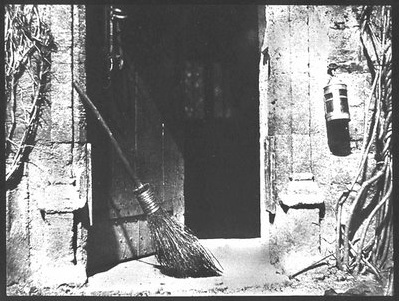
William Henry Fox Talbot, The Open Door, 1844
The Library of Congress record states that Genthe photographed the Calabozo between 1920 and 1926, and yet, in a reliable source I uncovered during a brief internet foray, it is stated the Calabozo was demolished in 1837. There are two likely explanations. One, Genthe was photographing another city jail and wrongly identified it as the Calabozo; or, two, Genthe set his camera up in the courtyard of the building that stood on the former site of the Calabozo (in which case the courtyard may have been original). There is uncertainty here that needs to be cleared up, but I don’t intend, here, to pursue the correct subject-hence-caption for Genthe’s sleepy image.
Despite the image’s astonishing banality, I was intrigued by the flawed description and I sensed an opportunity to sate my thirst for amateurish detective work. Furthermore, the fact remains it is an image of a prison; I was compelled to give it a second glance. I reasoned that a slave prison in a city that had operated under three different flags throughout the late 18th and early 19th century would have some intriguing history. The first questions that sprang to mind were: Do any other images of this same building exist? Do images of modern New Orleans’ prisons or jails exist that could provide interesting juxtaposition? I read and viewed whichever resources presented themselves readily.
Of the many passages that hooked me was this description from Louisiana: A Guide to the State (1947). It describes the conditions of the Calabozo.
An investigation in 1818 of the old Spanish Calabozo in New Orleans found the convicts “not provided for as humanity would dictate since many were destitute of clothing and others were almost destroyed by vermin.” Debtors were confined with the blackest of criminals. Entrance and exit fees as well as board and lodging payments were required of the prisoners. In 1861 a debtor was free after 90 days imprisonment, provided his keep for the interim had been paid.
Obviously, in the early 19th century matters of care while in detention & exit privileges were more easily negotiated by those with ready cash. A crude inequality that no longer remains, right? Possibly not. As I read this historical passage, I was also mousing over a slew of stories from modern newspapers that reported contemporary incidents of neglectful custodianship of men by state authorities.
The abandonment of prisoners in New Orlean’s jails during Hurricane Katrina is in no way more shocking than the early 19th century account. Within my web browser two centuries dissolved. Neglect, as the lowest common denominator, collapsed time. Men penning other men as animals showed itself ugly and unfortunate. The shortcomings of the system, the inflexibility of the system and the neglect within the system were revealed in New Orleans following Katrina in August 2005 as existed in 1818.
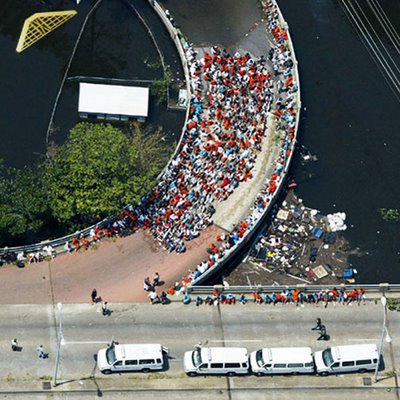
O.P.P. Inmates guarded on New Orleans overpass © AP
The BBC This World documentary Prisoners of Katrina details the week of fear, panic, riots and evacuation at Orleans Parish Prison. When Sheriff Gusman’s initial plan to retain the prisoners at O.P.P. through the duration of the storm proved to be a disastrous decision, a tactical team from Angola Prison bailed Gusman out. Over 7,000 inmates were herded out (via an engulfed freeway overpass) and relocated to 42 facilities over a period of four dehydrated, sun-scorched, unsanitary days. Accounts conflict as to whether any inmates died, but eye witness testimonies have reported floating corpses in the halls of O.P.P. during evacuation.
Still today, the Louisiana justice system has not recovered. It is in total disarray. Prior to Katrina O.P.P. held a variety of inmates including lifers, violent offenders, short stay non-violent offenders and (the most unfortunate group) those awaiting trial for offenses yet unproven. These inmates are now indistinguishable from one another because their case histories were lost in the hurricane. They are all just “in the system”.
It is contended that half of the evacuated prisoners have never been to trial. Hundreds of inmates were arrested for minor offenses, traffic fines, jay-walking and sleeping on the sidewalk. Hundreds of the prisoners do not know why they were arrested, and the system can’t tell them either. But neither can the system cannot exonerate them. Unconvicted men are now warehoused while the system tries to decide what the charge is for each inmate. Public defenders are leaving their positions in droves after seeing their caseloads increase by six, seven, even eight hundred percent.

Michael Democker, An inmate sleeps in his cell in the 10th floor psychiatric section of Orleans Parish Prison, 2008
Judge Calvin Johnson states that Katrina “blew the system apart” and they now cannot cope with the backlog of over 6,000 cases. To make matters worse still, the basement which stored the majority of files and forensic evidence was flooded destroying any hopes to rule on individual cases in a timely manner.
Three years on this is still a system in crisis. O.P.P. has been repopulated and inmates suffer doubly – firstly as victims of a system in deadlock and secondly as victims to the decrepitude of the O.P.P after the ravages of flood and riot. Unsurprisingly, those that suffer most are the poor minorities. Efforts to glean facts for a fuller story by interviewing outgoing inmates continue.
In Spring of 2008, the Times Picayune reported once more on the desperate need to overhaul the newly populated Orleans Parish Prison. When a hundred year storm converges with poor catastrophe-contingency-planning, it is those that have no means and no voice who are left to suffer longest. In the scramble to get cases heard, those without resources are shunted to the bottom of the pile. Not only are the poor and the minority populations suffering, but also the mentally ill. The stretched system has until recently only had lock up as a resort to deal with inmates with mental health care needs. The majority of the men in O.P.P. are poor and black and many of them are in the O.P.P for minor unproven offenses.
Where does all this lead? How does this relate to photography? The image above from O.P.P left a pit in my stomach. The pit lingered, long. I could not fathom why. Later, I remembered an image I had viewed the previous year. The two photographs had the same components; the orange jumpsuit, the seemingly unaware subject in the orange jumpsuit, the subject positioned as a motif of solitude, and (most oppressively) the downward angle of view as seen through the cell door window.
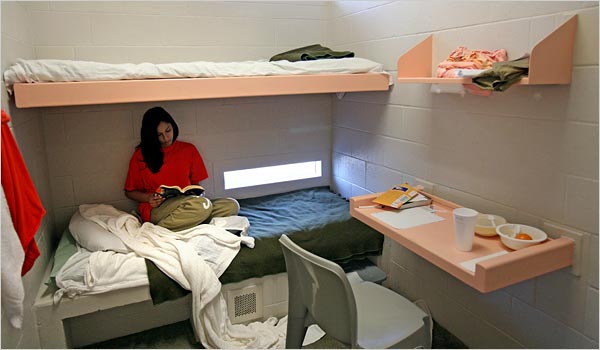
Monica Almeida, Nicole Brockett is serving her sentence for drunken driving in a pay-to-stay cell at the jail in Santa Ana, 2007
But look closer and one identifies small comforts – linen, spare linen, spare prison-threads, reading and writing material, food being saved for later. Nicole Brockett had committed a proven traffic offence. She was fortunate to be tried in Orange County and so have the option of incarceration with frills. Santa Ana Jail at $82 a day is not the most luxurious of the Californian “Pay-as-you-Stay” lock-ups. At Fullerton you can take your cell phone. Montebello and Seal Beach Jails allow iPods.
The New York Times did a great job of illustrating the cushty cells as elite privilege.
For offenders whose crimes are usually relatively minor (carjackers should not bother) and whose bank accounts remain lofty, a dozen or so city jails across the state offer pay-to-stay upgrades. Theirs are a clean, quiet, if not exactly recherché alternative to the standard county jails, where the walls are bars, the fellow inmates are hardened and privileges are few. Many of the self-pay jails operate like secret velvet-roped nightclubs of the corrections world.
The realities of these dozen or so city jails are a far cry from those at O.P.P. How is it the US criminal system fosters such inequality? How have tenets of consumerism and favouritism crept into state systems intended to administer lawful punishment? What clearer message do these two contrasting stories offer than to point out that there is no equality in our current justice system. Those that pay, just as 200 years ago, receive preferential treatment. In a country where race and class are indivisible, those not in a position to pay for cell-upgrades are more likely to be people of colour. How low have our standards dropped to allow bare-faced state authority to operate penal systems with buy-in/opt out clauses on comfort and cell-mates? How many more social institutions do we want to hand over to the amorality of supply/demand economics?
I was going to suggest that things haven’t changed in 200 years, but they have in fact gotten worse. When trangressors of the early 19th century were locked up they received the same treatment regardless of class or race. Now segregation can occur at the will (and wallet) of the inmate. The inmate can buy the comfort of their own cell and avoid the dangerous inconveniences of “hardened inmates”. By “hardened inmates” the New York Times is by definition referencing the typical inmate of the California penal system, which is to say a minority male or female, which is in the parlence of 1818, “the blackest of criminals”. It would seem discrimination between the races has always existed … the difference being that now the penal systems afford privileged prisoners the opportunity to act upon those discriminations.

 Prison Photography