
You are currently browsing the category archive for the ‘Words’ category.
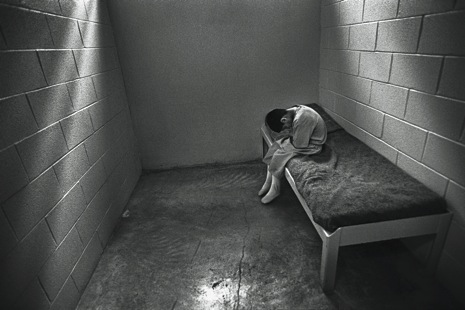
Ten-year-old Christian, acused of family violence, sits alone in his cell. It sounds harmless: “pre-trial detention.” But the reality is far different. In a squat block building in Laredo, Texas and in similar places around the nation children await trial or placement in concrete cells while the underlying issues that led to their behavior fester. Some are addicts who need treatment; others are kids battling mental illnesses. Many are angry and have been virtually abandoned by absentee or irresponsible parents. Some spend a few days, others months, but despite the efforts of a small corps of dedicated professionals, few actually receive treatment for the issues that brought them to juvenile hall. Photo: Steve Liss.
Last Autumn, I popped my head in at The New Yorker offices. If you can get yourself to the 20th floor of the Conde Nast Building I recommend it; lovely folk and The New Yorker’s photobook library is a treat.
When TNY staffers Whitney Johnson and James Pomerantz asked if I could recommend any prison photographers, I thought, ‘Yeah, how long have you got?’ Turns out, they already had the feelers out; they just wanted to check they had not overlooked anyone.
In the end they plumped for Steve Liss’ image of an incarcerated youth (above). In negotiating the image use, Steve was given – in a separate Photobooth blog post – a platform to talk about the collective American Poverty he founded. Fair trade.
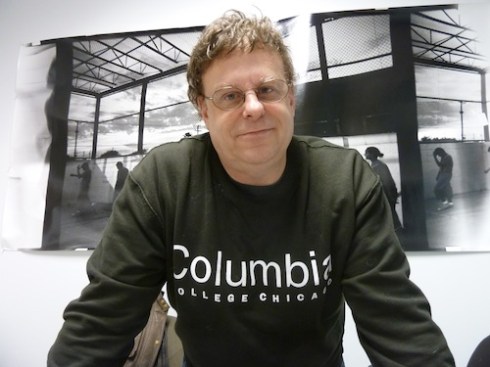
Steve Liss at his desk at Columbia College, Chicago with an image from No Place For Children to his back. Photo: Pete Brook
To be honest, back in November, I was just pleased to hear The New Yorker was doing a feature piece on American prisons. 10 weeks down the line, we now know that that feature is Adam Gopnik’s The Caging of America.
Gopnik delivers a scathing – but eloquent – telling of the story of mass incarceration in the U.S. He opens, as he should, with the shocking facts:
“There are more black men in the grip of the criminal-justice system—in prison, on probation, or on parole—than were in slavery then. Over all, there are now more people under “correctional supervision” in America—more than six million—than were in the Gulag Archipelago under Stalin at its height.”
and,
“In the past two decades, the money that states spend on prisons has risen at six times the rate of spending on higher education.”
and,
“Every day, at least fifty thousand men wake in solitary confinement […] where they see no one, cannot freely read and write, and are allowed out just once a day for an hour’s solo “exercise.” (Lock yourself in your bathroom and then imagine you have to stay there for the next ten years, and you will have some sense of the experience.)”
and,
“Prison rape is so endemic—more than seventy thousand prisoners are raped each year—that it is routinely held out as a threat, part of the punishment to be expected. The subject is standard fodder for comedy, and an uncooperative suspect being threatened with rape in prison is now represented, every night on television, as an ordinary and rather lovable bit of policing. The normalization of prison rape—like eighteenth-century japery about watching men struggle as they die on the gallows—will surely strike our descendants as chillingly sadistic.”
But where most of us might sit tight on feelings of anger or helplessness, Gopnik tries to find out why America cages people at six times the rate of other developed nations.
Gopnik leans heavily on the hypotheses of two formidable thinkers.
First, on the late William J. Stuntz, a professor at Harvard Law School who argued in his book The Collapse of American Criminal Justice that the scandal of our prisons derives from the Enlightenment-era, “procedural” nature of American justice and that the Bill of Rights favours procedure over principles.
Second, Gopnik summarises the work of Berkeley Law criminologist Franklin E. Zimring. His new book The City That Became Safe tries to fathom the dramatic drop in crime in New York in the context of what happened in the rest of America. “One thing Zimring teaches us,” says Gopnik, “is how little we know.”
In the first case, common sense does not prevail. If a trial is deemed to have been conducted correctly, then factors such as inadequacy of council, prosecutorial misconduct to the disadvantage a defendant may not be of importance; the legal procedure has been carried forth. It takes a lot to win a retrial. On the other hand, a defendant who is clearly guilty, may be set free due to a minor legal technicality.
In the second case, common sense – or more precisely compassion and dexterity of process – it is argued is all we might have left. Zimring shows us that New York’s 40% drop in crime, “didn’t come from resolving the deep pathologies that the right fixated on—from jailing super predators, driving down the number of unwed mothers, altering welfare culture. Nor were there cures for the underlying causes pointed to by the left: injustice, discrimination, poverty. Nor were there any “Presto!” effects arising from secret patterns of increased abortions or the like. The city didn’t get much richer; it didn’t get much poorer. There was no significant change in the ethnic makeup or the average wealth or educational levels of New Yorkers as violent crime more or less vanished.”
Instead it came partly from attentive policing in high-crime areas:
“As Zimring puts it, that a ‘light’ program of stop-and-frisk could be less alienating and just as effective, and that by bringing down urban crime stop-and-frisk had the net effect of greatly reducing the number of poor minority kids in prison for long stretches.”
This is an uncomfortable thesis for liberals and civil rights lawyers, but Zimring isn’t in the business of placating political groups and Gopnik is not in the business of avoiding difficult propositions.
The long and short of it is that the legal system is too rigid to adapt and that cultural ideas shift far quicker than legislators will, or are able to, respond to. Gopnik also suggests that too much of law-making is attached to partisan politickers unwilling to entertain approaches that don’t fit their staked ideology, even when actually work. In that way Gopnik echoes the arguments of beat cops and community workers who from first hand experience can tell you what is effective and what is not.
Gopnik amplifies Zimring’s conclusion that prisons have had very little effect in reducing crime. A multitude of other factors achieved that. Gopnik notes that 1 in every 100,000 men will commit a very serious violent act and these individuals should be locked away. You’ll get few arguments from prison reformers on that. But what of the other 730? (The U.S. incarcerates 731 per 100,000 people).
Surely then, it is incumbent on us as a society to demand non-custodial sentences for non-violent crimes. Clearly the drug war has failed, and drug users need treatment not imprisonment.
If there is one weakness in Gopnik’s article it is that he repeats too often his example that decriminalising marijuana would be a step in the right direction. Of course, it would and so would his other suggestions of “ending sentencing for drug misdemeanors and leaving judges free to use common sense (and, where possible, getting judges who are judges rather than politicians)” but we’re given no indication of how much of an effect the decriminalization of marijuana would have on reducing the prison population.
GOPNIK’S ARTICLE ARRIVES AT THE RIGHT TIME
These are enlightened times.
This week, dozens of people have emailed me to say that they’ve been affected by Gopnik’s article.
One prominent photoblogger wrote:
What’s interesting is that the article really illuminated the issue for me with several “ah-ha” type moments. Why is that photography doesn’t or can’t do that? I mean, I’ve been following Prison Photography for a couple years now and haven’t really had one of those “ah-ha” moments. Maybe I wasn’t paying enough attention? Or maybe I’m NOT looking for those “ah-ha” moments from photography. It all fits together though. I mean, now that I’ve read the Gopnik article, I view your work with Prison Photography much differently.
One prominent photographer wrote:
The whole business of emphasis on process over principles, I can’t tell you how often when I was doing the documenting the public defender and the courts that I thought this isn’t about justice this about slavery to the law. But what I really meant was that it was slavery to process. I ran into even more glaringly with a story on a death row prisoner in Missouri. The Missouri Attorney General actually said it didn’t matter that he was probably (actually he was more than probably) innocent, he had gotten a full and fair trial and they were going to kill him.
So there are two very important things for me to take away.
One – that I must always be crystal clear not only about what I write, but why I write. There are so many problems (death penalty, juvenile incarceration, aging prisoners, inadequate healthcare, poor representation for the indigent, separation of families, control of media, physical and psychological abuse, private prisons, immigration policy and detention, absent education and rehabilitation) with the criminal justice and the prison systems that each needs its space … and people need time to digest the issues and synthesise the information.
Two – the burden on me to talk about these complex issues in a clear way is made only more important because I think we’re experiencing something of a zeitgeist moment. More and more in mainstream media, the prison system is being discussed and challenged; practices that were considered standard are being looked at again; politicians from across the spectrum are happy to be “sensible on crime” instead of “tough on crime” (they may not share the same solutions but they’re agreeing that the system is broken.)
I really do feel we’ve past a tipping point and that the American people are aware now how their communities have been wrecked and that their money has been wasted.
The failed policies that created mass incarceration need to be scrapped and more humane solutions sought. For opponents, America’s archipelago of prisons has always been a moral issue, but now we see everyday Americans and their politicians speaking of it in the same terms. I’m hopeful we’ve begun to turn the corner.

Last night, a rogue bunch of characters descended on the Cornerhouse, in fair Manchester, to confirm that they were really people and more than just the phenomenal pixels they’d previously transmitted to the world.
Before the third beer, discussion had included environmental destruction in China, the rise of the newsprint for photo self-pubs, Polish Liverpool fans, Google Earth, Roma and Romania, photobooks, the power of Duckrabbit, why U.S. prisons are so bad, Sikhism, M.A. distinctions, hierarchies of needs, hierarchies of power within the photoworld, and freeing yourself of all of it.
Here’s the line up.







Prison Photography on the Road continues to creak its wings and throw itself down as many channels to make the PPOTR Creative Commons licensed content as accessible as possible.
CLICK HERE to access the PPOTR iTunes page
I’ve synced the PPOTR podbean account with iTunes. I presume it’ll be easier for others to connect through the iTunes platform.
Please download, share, distribute and attribute wisely and generously. Tell your friends.
LEGALESE
Prison Photography on the Road is licensed under a Creative Commons Attribution-NoDerivs 3.0 Unported License. All audio published at http://www.prisonphotography.podbean.com and hosted on the PPOTR iTunes page is available to the prison reform and photography communities free of charge.
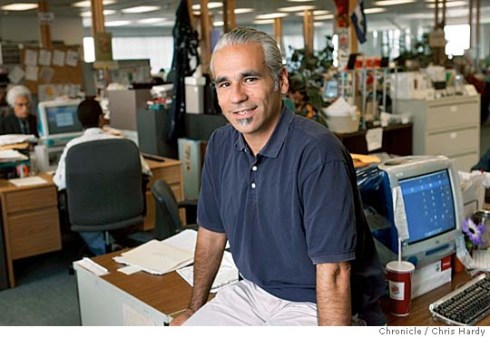
In 1996, David Inocencio began writing-workshops to youth detained in S.F.’s Youth Guidance Center. A zine developed and The Beat Within was born. It is the nation’s biggest weekly publication of incarcerated youth writing.
The first publication followed the murder of rapper Tupac Shakur as young people sought ways to publicize their feelings of loss. Originally, The Beat Within was a 6-page magazine. Today the full-fledged weekly magazine is at 70 pages.
For some contributors, The Beat Within is the first positive recognition they have ever received that they have a voice worthy of an audience.

The Beat Within staff and volunteers hold weekly workshops in many California county juvenile halls: San Francisco, Marin, Alameda, Santa Clara, Santa Cruz, Solano, Monterey, and Fresno. The Beat workshop model is replicated in Maricopa Arizona, in San Bernalillo New Mexico, Miami Florida, and Washington DC.
Each week, The Beat Within serves up to 700 detained youth and the San Francisco office provides internships and social services to more than a dozen formerly detained youth.
David Inocencio and I spoke about what it means to give juvenile prisoners a voice.
LISTEN TO OUR DISCUSSION AT THE PRISON PHOTOGRAPHY PODBEAN PAGE.
Below is To The Streets, a piece of writing by Lady Streetz, from Alameda, CA. It featured in Volume 16. 18/19 (p. 6) of The Beat Within.
It is a difficult read but it gives us an unmistakable view of some of the serious problems incarcerated youth, and particularly incarcerated women face.
Dear Streets
I want to write this letter to tell you how ashamed of you I am. How could you ever raised your hand to a female, what I want to know is what did I do so wrong that you had to lay your hand on me for the last months and months?
Why would you beat me, kick me out of my own car, and make me walk home bare foot? Where the hell do they do that at? I can’t believe you had the nerve to beat me in front of your friends and then make me sit out in the cold in my little dress.
Who gave you the nerve to take my keys and my phone? Did you buy my car, no! Did you buy my phone, hell no! Someday I hope to forgive you for all the shhh you did to me. Someday I will forgive but I will never forget.
I will never be the same since you happened to me. I stride to try to trust the black men staff here, but I’m scared they’re going to hurt me. I’m always scared someone is about to abuse me. Why? Because of you, because of all the times you beat me and left me bleeding. I hate you, You’ll never change women beaters.
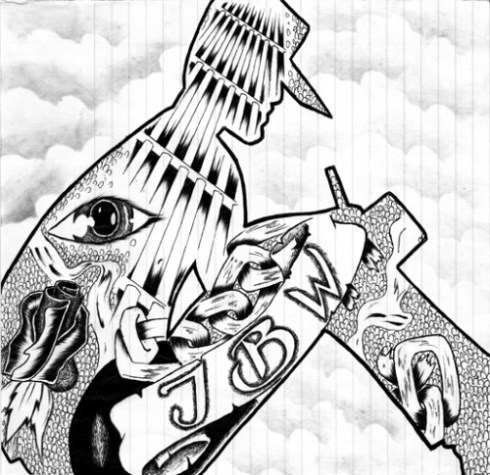
Artist unknown © The Beat Within
As many of you will know, I recently pitched Prison Photography on the Road on Kickstarter.
The video-pitch for any Kickstarter proposal is key, so I was very lucky to have Tim Matsui offer his time, advice and skills in multimedia for the filming of the video pitch. In offering his help, Tim became the first official supporter of the project so please allow me to say a few words about Mr. Matsui.
Tim was the very first photo-bloke I met when I arrived in Seattle three years ago. At that point, I already new of his committed and extended investigations into human trafficking.
By coincidence, an old university friend of mine worked at a Phnom Penh NGO that Tim had liaised with. As both Tim and I were in the same city, my friend urged us to connect.
Tim knew nothing of me.
Late in 2008, I had just launched Prison Photography and Tim, like many in those early days, was totally baffled about what it was. But he still agreed to meet for coffee. We spoke about Bergen-Belsen concentration camp, Tuol Sleng prison, Blue Earth Alliance, and the mores of the digital age. We didn’t see much of each other for well over a year, but we developed a mutual respect for each others work.
Last month, when I put out the call for help with filming (via the NW Photojournalism group) Tim didn’t hesitate. Two weeks later, he was over at my house with a two camera set up, separate audio track and a set of tricky questions.
Tim wears his heart on his sleeve. He works hard, and he’s also got a bunch of great ideas for his next story telling projects; the only thing holding him back is the hours in the day.
If you want to get to know Tim’s take on the world, photography and storytelling then his blog is a great place to begin. There you’ll find writing about his successes (his recently published Kivalina work, his Emmy nominated Mediastorm multimedia project for the Council for Foreign Relations); about breaking journalism relating to previous stories; about important pioneer projects in journalism such as BaseTrack; and about pressing global issues relating to our digital age, such as reports on conflict minerals in tech-manufacturing industry. You should also check out his very fun docu-short Sasquatch or Bust.
Tim, thanks for the integral help with Prison Photography on the Road. You are a gentleman.
When we get down to the poorest and most oppressed of our population we find the conditions of their life so wretched that it would be impossible to conduct a prison humanely without making the lot of the criminal more eligible than that of many citizens. […]
The vast majority of our city populations are inured to imprisonment from their childhood. The school is a prison. The office and the factory are prisons. The home is a prison. To the young who have the misfortune to be what is called well brought up it is sometimes a prison of inhumane severity. […]
This imprisonment in the home, in the school, in the office and the factory is kept up by browbeating, scolding, bullying punishing disbelief of the prisoner’s statements and acceptance of those of the official, essentially as in prison. The freedom given by the adult’s right to walk out of his prison is only a freedom to go into another or starve: he can choose the prison where he is best treated: that is all.
— George Bernard Shaw, The Crime of Imprisonment (1946), originally published as Imprisonment in 1925.
Upon reading this 80 year old quote from George Bernard Shaw, I couldn’t help think of the persistent economic inequality of Western capitalism. It’s difficult to fathom why the gap between the rich and the poor has accelerated. The gap is NOW the largest it has EVER been.
The U.S. income gap between rich and poor is the greatest among Western industrialized nations:
The data also revealed that the number of Americans at the very bottom of the income ladder are at record highs. About 6.3 percent of the population are below half the poverty line – $10,977 for a family of four – up from 5.7 percent. This was the highest level since the government began tracking this group in 1975.
Shaw petitioned for the erasure of private property. When Shaw won the Nobel Prize for literature, he took the medal but refused the money. We needn’t take a Shawesque position of martyrdom, just an honest look.
The Pew Center reported this week that those that lost MOST in the economic downturn were African Americans and Hispanic families.

NPR reports that the “mistake” African American and Hispanic families made was to by into the American Dream by way of bricks and mortar:
“What’s pushing the wealth of whites is the rebound in the stock market and corporate savings, while younger Hispanics and African-Americans who bought homes in the last decade — because that was the American dream — are seeing big declines,” said Timothy Smeeding, a University of Wisconsin-Madison professor who specializes in income inequality.
The statistics are repulsive:
The median wealth of white U.S. households in 2009 was $113,149, compared with $6,325 for Hispanics and $5,677 for blacks, according to the analysis released Tuesday by the Pew Research Center. Those ratios, roughly 20 to 1 for blacks and 18 to 1 for Hispanics, far exceed the low mark of 7 to 1 for both groups reached in 1995, when the nation’s economic expansion lifted many low-income groups to the middle class.
The white-black wealth gap is also the widest since the census began tracking such data in 1984, when the ratio was roughly 12 to 1.

How does this relate to prisons?
Well, it occurs to me that if one is living way, way below the poverty line, then the energy to worry about someone elses circumstances is going to be a low priority. If “free” society is in fact – as Shaw suggests – a prison of downward mobility then, quite simply, why bother?
Shaw goes on to argue that at least people in prison don’t have to worry about the provision of food, shelter, nor the payment of taxes. It’s a bleak point indeed when one begins to argue for the merits of prison above and beyond open society (we must also remember Shaw is writing before the era of mass incarceration about the jails of Edward V’s England; he might not so readily espouse the benefits of the U.S. Supermax.)
All this brings me to the ongoing debate about permissive attitudes and failing morality in modern society. Sometimes it seems the issue isn’t what the shared values should be, but that shared values should, at the very least, exist in some form.
In Rude Britannia John Burns’ Sunday Op-Ed for the New York Times, quoted was Ed Milliband, leader of the opposition Labour Party in the UK:
“What is a young person, just starting out in life, trying to do the right thing, supposed to think when he sees a politician fiddling the expenses system, a banker raking off millions without deserving it, or a press baron abusing the trust of ordinary people?”
In such terms, it’s obvious why people don’t care about prisoners or functioning penal institutions.
People are either poor and as such prisoners of society; or they’re cast early in adulthood as amoral, beer-swilling louts whose disruption is perceived as potentially requiring the discipline of prison; or they are witnesses to the crimes and corruption of those in power and conclude it’s a free-for-all anyway.
The drive for crass tabloid journalism, the reluctance for prison reform, the race-to-the-bottom rhetoric of war, and political gridlock over issues (debt ceiling, anyone?) are all driven by lack of imagination.
The UK and the US, in their own ways, could easily get behind an idea. The idea just needs to prioritise social justice action and be imaginative.

In South African slang “pap” means spineless, wet or without character.* Why anyone would want to make a demand for immediate pap (of such a description) is beyond me. And yet, in its chosen company name PapNow! unintentionally hits upon the central tenet of its bilious enterprise – namely a mindless demand for crap.
PapNow! announced itself in June as the place to buy and sell your own celebrity pictures.
The venture takes advantage of the fact everyone has a camera. In my view, PapNow! exploits peoples’ contorted versions of citizenship in a celebrity culture; that they should mimic, stalk and waste time over the looks of others. PapNow! is, one assumes, in it to make money. It is – in the guise of a business model – the reckless, wolfish, jealous little brother of citizen journalism.
Its online presence might just be enough for users to convince themselves PapNow! has value.
There may be other sites like PapNow!; I haven’t bothered the time to do research because I know I’d say the same about each of them. Besides, high value paparazzi shots will always find their monetised routes to the tabloids anyway. My criticism of PapNow! is based purely on how it lowers the bar for entry into the already bottom-feeding paparazzi industry.
The timing is remarkable. Last week, The News of the World scuttled it’s destroyed brand in the wake of the phone hacking scandal that united Britain in disgust. As far as the NOTW is concerned it’s good riddance to bad rubbish, but I worry now that newspapers’ role as arbiters of gossip and candid snaps may be adopted by the docile masses. By process of unconscious assimilation, could the consumers become the producers? Could we end up with a dominant visual culture of only street scuffles, fashion commentary, nipple-slips, antagonism, and up-skirt photography?
Hope not.
By the by, the etymology of the word paparazzi is rather interesting.
* I don’t know if the South African use of the word is innocuous or offensive. If it is rude I don’t want to offend anyone by its use, but the analogy served the argument well.


On this blog last week, I raised questions about the viability of the Leica Oskar Barnack Award jury process. The 2011 winner Jan Grarup is a colleague with one of the five jurors, Stanley Greene.
Grarup and Greene, with seven other photographers, co-founded the NOOR Images Agency, based in Amsterdam, The Netherlands in September 2007.
I emailed the offices of both the Leica Oskar Barnack Award and NOOR Images with the following questions:
Do you see this as a conflict of interest?
Did you foresee this as a problem before judging began?
Was Stanley Greene exempt from voting on entries by fellow NOOR photographers?
I am interested to know the jury process and if Leica Oskar Barnack Award believes it needs to defend itself against ethical questions.
The questions were designed to be relatively open and non-accusatory while getting at each bodies’ staked and defendable positions.
TINA WIESNER ON BEHALF OF THE LEICA OSKAR BARNACK AWARD
Leica Camera AG invited 5 jury members for the 2011 judging of the Leica Oskar Barnack Award / Newcomer Award.
The jury voted “unanimously” for the winner. There was no conflict of interest.
Please note that we received more than 2000 entries, representing photographers from 89 countries, many of them independent or working for renowned agencies. During the judging process, the jury concentrates on the editing of the series of 10 – 12 images and the information given about the story behind.
CLAUDIA HINTERSEER ON BEHALF OF NOOR IMAGES
One of our photographers was invited to be on the jury and another NOOR photographer was allowed to enter work according to the Leica Oskar Barnack entry rules.
The Leica Oskar Barnack organization has judging rules in place and a secretary to oversee these are being abided to. Like most other international photography competitions, their judging rules includes a clause that at crucial moments jury members have to announce specific working and/or personal relationships where there tends to be a conflict of interest. I know that Stanley Greene has made no secret of the fact that he, Jan Grarup and seven other photographers (and myself) founded a photography collective several years ago. Taking into account the professionalism of the other jury members of this year’s LOB competition, and trusting the fact that the Leica Oskar Barnack secretary does his/her duty, I trust that the multi-membered jury’s decision was made on the basis of the outstanding quality of Jan Grarup’s work, rather than on the basis of one jury member’s particular business interest.
In his career, Jan Grarup has been honored with some of the most prestigious awards from the photography industry and human rights organizations, including: World Press Photo, UNICEF, W. Eugene Smith Foundation for Humanistic Photography, POYi and NPPA.
Looking at other international photography contests you will be amazed how often jury members are professionally or – as is very common in our industry – personally (on the basis of friendships) related to photographers whose work is rewarded.
A few things:
I am still unclear as to whether Wiesner’s “unanimously” means Greene voted or abstained on Grarup’s work; whether his vote was important or not to Grarup’s win.
Hinterseer’s argument is a little more convincing than Wiesner’s, mainly because she explains the mechanics of the jury process.
Grarup’s past awards have no relevance to this issue.
Hinterseer softens the blow by saying pretty much that this sort of thing happens all the time. And it is this last point that I think is the take away. I’ve not given it any thought in the past. Let’s change that.
I took a quick look at the judging process at the World Press Photo and noted Stephen Mayes, managing director of VII Photo. I thought it a pretty safe bet that a VII Photo photographer won something at WPP. Sure enough, Ed Kashi won the Contemporary Issues: 2nd Prize Singles.
No judgement on Kashi, Mayes or VII; I’ve just used them to illustrate Hinterseer’s point. Besides, the labyrinthine WPP jury process probably rinses out much direct influence.
So, I’ll conclude with two questions. 1) Is this situation – as suggested – really unavoidable? 2) If so, what are we to make of this web of casual association and sanctioned incest when it comes to industry awards?

 Prison Photography