
You are currently browsing the tag archive for the ‘Photographers of Prisons’ tag.
Note: Ignoring the pink elephant in the room, I have previously avoided talking about Abu Ghraib. What could I add to a topic so exhaustively dissected? However, after listening to Philip Gourevitch speak at a local bookstore I am urged to write.
Mention ‘Prison’ and ‘Photography’ and the collective conscience defaults to the Abu Ghraib pictures. There is no escaping this fact as there is no escaping those images. The Abu Ghraib photographs inform and corrupt key dialogues of our global society – war & power; geopolitics & the psychology of surveillance; Iraq & imperialism; Western & Islamic relations; and military operations & media-constructed otherness. Add to that list, uncomplicated human cruelty.
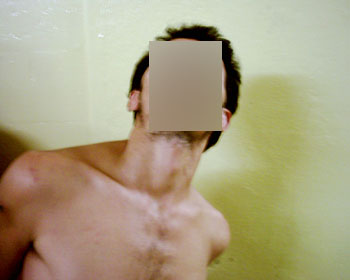

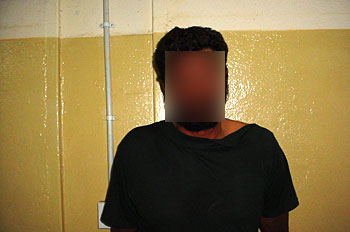

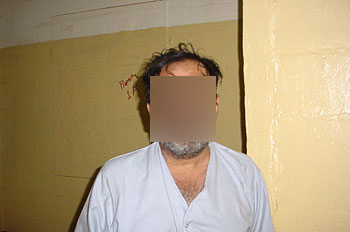
Those images have seeped into more spheres of conscious and sub-conscious thought than the most successful of photojournalist essays. This is emergence and pre-eminence of the Abu Ghraib photographs as the most current strongest visual “player”. Former strongest players have included Robert Capa’s images of the Normandy Invasion; or (Nick) Huỳnh Công Út’s photograph of Kim Phuc running from a napalm attack on Trang Bang, Vietnam; or Eddie Adams’ photograph of police chief General Nguyễn Ngọc Loan executing a Vietcong prisoner, Nguyễn Văn Lém. As Gourevitch said, “If a photojournalist had taken those [Abu Ghraib] images he or she would have been celebrated and decorated for their public service.”
Those photographs are many things. They are evidence of a corrupted system bereft of accountability. They are the most important images of the War on Iraq. When recollected, they should never be separated from the exacting malevolence of the Rumsfeld Department of Defense. They are already established as the most commonly shared images of global culture. The hooded prisoner is a 21st century icon. Perhaps, partly, this is why Americans rallied to make an immediate icon of Obama; to purge a nation’s collective visual memory, and to replace negative, shameful images with positive, hopeful, primary-coloured pop-motifs.



Gourevitch talked about the craft of the interview. The Paris Review, which he has edited since 2005, recently released the third of a four volume anthology of interviews with 20th century writers. Gourevitch noted the simplicity of the method and pointed out that in 1953 when the Paris Review was founded, no publications were interviewing writers. Literary criticism had become high brow and, to many, obsolete; it talked about the text but never the artist. The Paris Review was the first legitimate peek into the private lives, motivations and pathologies of poets and authors. Fellow writers could scrutinise every spoken word and omitted detail of their contemporaries. The Paris Review, in its early days, served as the exposé – the gossip column – for the literary world.
For fifty years, until his death in 2003, George Plimpton was editor of the Paris Review. It is fitting that Plimpton’s large shoes should be filled by a writer and journalist who has made an art form of the interview. Gourevitch’s acclaimed book We Wish to Inform You That Tomorrow We Will Be Killed With Our Families was based on information gleaned from an unhurried, matter-of-fact tour of Rwanda where he simply talked to people. Rwandans didn’t have their own journalists clearing the way for testimony in the immediate aftermath of the genocide and Gourevitch found support for his theory that “All people need to talk”. He described Rwandans culturally as the opposite of effusive, but maintained this didn’t mean they were unwilling to share their experiences.



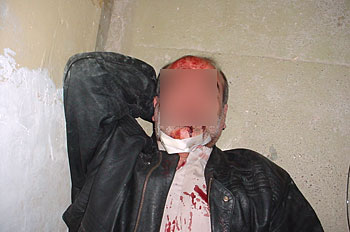
For Standard Operating Procedure, accompanying the profound Errol Morris movie (which has unsurprisingly suffered stymied distribution in the US), Gourevitch sat in on 100 hours of Morris’ questions (approximately half of Morris’ interviews).
Following Gourevitch’s presentation, I asked him if there were any atypical motivations for the American servicemen and servicewomen agreeing to the interview process. Was there any information they were keen to convey? Gourevitch was quite clear. There was a single shared motivation for Sabrina Harman, Lynndie England and colleagues. The interviews are one long exercise in self-representation. Prior, the soldiers had been silenced, criminalised and later written off as “bad apples” by a military narrative designed to shield the senior accountable authorities. The media was partly complicit and the soldiers “were pissed off”, stated Gourevitch.
From the moment the US military command learnt of the pictures, the soldier/guards of Abu Ghraib were set up for the fall. The military sequestered the reservists away and lined up a raft of charges for each soldier. The US military sat on those charges hoping that if it could retrieve and control the images, it wouldn’t have to bring the matter to public attention through trial. The US military visited homes of the soldiers’ family members back in the US. They demanded computers and deleted files. After some time, it was clearly apparent to the families of the Abu Ghraib soldiers that their sons and daughters were being made scapegoats. An exact single source of the images has never been pinned down, but Gourevitch contends it was a disgruntled family member who finally unleashed the digital photographs to a world swiftly buying into the prevailing Department of Defense narrative.
We Have Seen Their Actions, Let’s Hear Their Words
The Abu Ghraib photographs can and should be understood only in the context of their production, which is to say, by a group of individuals trained as soldiers and ordered to guard prisoners in a decrepit facility; by photographers who were compelled to document precisely because they couldn’t comprehend the atrocities; by a group of soldiers influenced and hardened by one another; by a group of soldiers under no direct or pre-written guidelines; by a group of soldiers with complex thoughts, manipulations and haunted memories. Morris did us a public service with his movie and it is fitting that the accompanying book by Gourevitch features no images.
Of course, what the global community needs now is an equally comprehensive documentary project bringing together the testimonies of all those held and tortured at Abu Ghraib.
Note: I wanted to avoid resorting to the common and most shocking images of Abu Ghraib that we’ve seen so often – box, blanket, hood, wires, scrotum, pyramid, puddles, dogs, blood, shit, thumbs, leash, limbs, body bag – and I don’t exactly know why. Salon put together a responsible collection of all 291 Abu Ghraib images if you need to put those infamous images back into the context of the prison facility.
The Artistic Legacy of Abu Ghraib
Ridiculously, artists that have chosen to reflect the systematic abuses at Abu Ghraib have come under fire.
Clinton Fein’s ingenious reconstructions of the Abu Ghraib crimes drew criticism for many selfish reasons (an unwelcome return to problematic images despite their obvious construction, a project of a sadist, a re-opening of a cultural wound?). The intelligence of Fein’s project was that it challenged our premature numbness to the original Abu Ghraib photographs and forced a renewed pathos toward a subject that we’d never known anyway. Are we supposed to feel something toward Fein’s models?
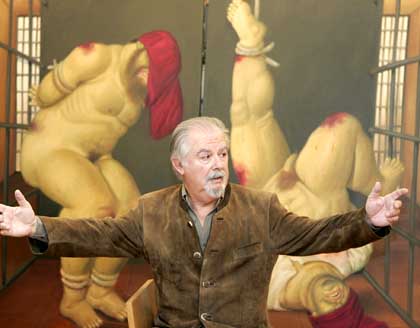
Colombian painter Fernando Botero gestures front of his new paintings depicting the horrors of U.S. guards’ abuse of captives at Iraq’s Abu Ghraib prison, Monday April 11, 2005 in Paris, France. Botero says he became so upset that he felt compelled to produce works showing his trademark chubby characters naked and being blooded by Americans. (AP Photo/Francois Mori)
Fernando Botero‘s work has won plaudits around the US. I think his work is excellent for many obvious reasons, so don’t call me a cynic when I say Botero’s work is more easily accepted because his Beryl Cook cherub-grotesque style, and the fact he is a Latin American commenting on a war to which Latin America remained external. Put another way, he serves up the shit sandwich with relish, whereas Fein left it in the bowl. Here’s an official presentation, here’s Berkeley enjoying the show and here’s the AP writing about it before it caravanned around America.
And finally, Chris Bartlett (Photographer) and Daniel Heyman (Painter) have teamed up to produce the Detainee Project which creates portraits of individuals illegally detained throughout America’s war on Iraq. George Soros helped Bartlett give detainees dignity and representations beyond hoods, nudity and dogs.
Google announced today that it has come to an arrangement with TimeInc to host the LIFE Archive. The archive is one of the largest collections in the world comprised of over 10 million images. This is an incredible new resource for photophiles worldwide. Twenty percent of the images went live today.

Carl Mydans. American flag draped over balcony of building as American and Filipino civilians cheer their release from the Japanese prison camp at Santo Tomas University folllowing Allied liberation of the city. Manila, Luzon, Philippines. February 05, 1945
A very preliminary search using the keyword “Prison” returned twelve pages of 200 images. I was struck by the strength of the handful of images from the Santo Tomas Prison Liberation Series (Manila, Philippines). The Carl Mydans photographs were captured in the days following the camp’s liberation by allied forces. It was one of four camps liberated in the space of a month in January/February 1945.
Rest assured, I will return to this archive in time to source material and discuss more widely the politics of power partially described by the photographic collection. “Mexico Prison“, with over 150 images, certainly looks like interesting material.

Carl Mydans. Freed American and Filipino prisoners outside main entrance of Santo Tomas University which was used as a Japanese prison camp before Allied liberation forces entered the city. Manila, Luzon, Philippines. February 05, 1945
I would like to make clear that this is a hastily put together post and its main function is to draw attention to this fantastic whale-sized new archive – I might go as far to say our archive – I might even go as far to say its bigger than a whale. I do not condone personal whale ownership.
I would also like to clarify that while the LIFE Archive refers to the Santo Tomas Complex as a prison, it was in fact an internment camp – not that naming conventions matter to those who were subject to its walls and discipline. Still, we must always bear in mind the different types of sites of incarceration; what they purported to do; what, in truth, they did; from what context they arose and operated; and how they fit into our general understanding of humans detaining other humans.

Carl Mydans. Emaciated father feeding Army rations to his son after he and his family were freed from a Japanese prison camp following the Allied liberation of the city. Manila, Luzon, Philippines. February 05, 1945
Personally, I encountered a strange coincidence over this matter. Internment camps are low on my list of primary interest. I am not an expert on internment camps. But, only yesterday I received a fantastic email from a Berkeley art history undergraduate who is focusing on the work of Ansel Adams, Toyo Miyatake and Patrick Nagatani at Manzanar War Relocation Center, California. From the internet monolith that is Google to the academic interests of aspiring students, the histories, memories and powerful images of Second World War internment push themselves to the fore of thought.

Carl Mydans. Two emaciated American civilians, Lee Rogers (L) & John C. Todd, sit outside gym which had been used as a Japanese prison camp following their release by Allied forces liberating the city. Manila, Luzon, Philippines, February 05, 1945
It is conventional wisdom that World War II had two sides. Unfortunately, the military definitions of ‘ally’ and ‘enemy’ spilled into civic life with catastrophic consequences. The US internment of Japanese nationals and Japanese Americans has since been proved to be based not on national security but state-sanctioned discrimination. As testimonies and images attest, where stories are concerned, there are more than two sides.
Click here for the LIFE Archive on Google. Here is an obituary for Carl Mydans, the photographer at Santo Tomas. Try here and here for first-hand account of detention and to find audio and visual resources about Santo Tomas Internment Camp.
Two weeks ago, I was lolling in bed with the local NPR station airing in the background. It was one of those times when the free sway between sleep and wake buoyed the iterations feeding the subconscious. The words from the waves were deep and clear and the meanings my own to navigate without the filters of plain-sailing reality. The whole reverie was quite comforting. Rick Steves was at the mic and his words about ‘otherness’ charted the same course my thoughts had – many times previous.
Rick Steves is a travel journalist who is keen to see (American) tourists embrace an less-disneyfied, more-connected type of travel. He was answering a listener’s question about border towns, but instead of responding with specific tales from specific towns Steves was much more interested in excavating the structure of thought that defines the appreciation of border towns. What parameters of thought do we rely on when thinking about borders? Why do border towns gain notoriety? Why do border towns evoke fear, love, misery and hope? Why do borders bring people escape, opportunity, exploitation, largess and threat?
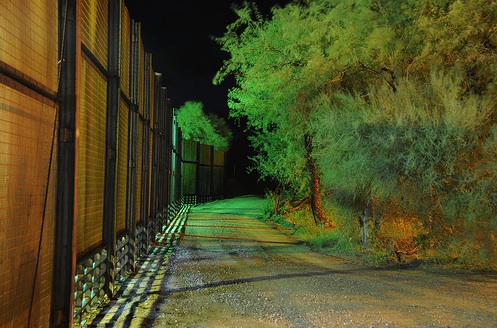
Photographer: Glyph Hunter, US Mexico Border
Before I quote Steves’ answer, I want to put his response into the context of my somnolent appreciation. Borders delineate two forms of existence; the difference sometimes extreme, and sometimes barely recognizable. Nevertheless, borders are defined by the imposition of different rules on either side. Borders have many manifestations and, unfortunately, walls have become a recent embodiment of bi-national relations.
Prisons also have central to their function the imposition of one set of rules on one side of the wall in order to maintain the prevailing rules on the other. A border delineates the exterior reaches of a territory, whereas the prison exists within the interior. The prison, historically, is less porous than a border and is more heavily policed – although in the case of the US border the distinctions are becoming less evident.

Photographer: Eros Hoagland
In short, I believe prisons (and other sites of incarceration) should be thought as systems of state/corporate authority, based on the lowest common economic denominators, based on the concealment of activity and the creation of an excluded class whose definitions are open to manipulation. In the most tragic interpretation of Edward Said’s theory, I contend that on the other side of prison walls, just as on the other side of border walls, “The Other” exists.
And so, Rick Steves:
I am standing on top of the rock of Gibraltar. I read that this is the only place on the planet where you can see two continents and see two seas come together. There are tiderips. It is a confused sea, but there is food there. And all the seagulls go to the tiderips and the salmon are underneath, and the swarms of little herring, and so on … and it is a fascinating thing when two bodies of water come together. It makes danger for your boat, but there is food there and that is where the fish come and that is where people go for sustenance and that where the action is. And I am standing on the rock overlooking the tiderips. And there’s the ocean going freighters and the local people worried about the maritime environment. There are the stresses between Christianity and Islam which is just over [the water] in Africa, and that morning I was stood in a church, which was built on the ruins of a mosque, which was built on the ruins of a church, which itself was built on the ruins of a pre-Christian holy site! And if you can go to the places where cultures come together that’s where you have tension and you can have opportunity.
Translation – expect, witness and embrace difference in novel ways. Choose between tension and opportunity.
We have tension now [in America]. If we have unsophisticated political leadership, and dumbed down media and an electorate that doesn’t expect its neighbors to be nuanced and complex and more thoughtful in how they approach these challenges right now then the places where these cultures come together will be a big, expensive headache. And if we have smarter leadership and we engage the world, then the places where the cultures come together will be a plus. When we have cultures coming together in a constructive way it becomes a blessing instead of a curse. If it’s “my way or the highway” and if it’s just shock and awe then it’s not going to work.

Photographer: Eros Hoagland
Steves wasn’t talking about methods of incarceration, but his structuralist description that clearly defined ecological, socio-cultural, tectonic and psychological tensions of borders reflected society’s same unconscious antagonism that I have observed in popular thought. At best the American public is apathetic; at worst, it breeds searing hatred of those on the other side of the walls.
In the case of prisons, the American public has been duped by dumbed down media – Cops, News bulletins disproportionately reporting crime, movies that exploit false stereotypes of prisons and prisoners. In the case of prisons, the American public has been scared by the shock and awe tactics of politicians – “Tough on Crime” rhetoric. In the case of prisons, the American public has been fooled by an unsophisticated civic leadership that panders to the public’s desire to not think any further than “throwing criminals” in prison – massive prison expansion, state budgets dominated by corrections spending. Prisons have become a big expensive headache.

Photographer: Jon Lowenstein
We need to stop ignoring the harsh facts about prisons and we need to bring them closer to our society, in which they sit. We need to reevaluate the failed prison expansion experiment of the past 30 years and we need to look upon the problem as an opportunity for sensible decision-making. We need to stop our fear and anger from dictating our reason and we need to analyse the system and not judge those subject to it.
The prison is a focus of hard emotions for those who reside, work and visit. It is a tumultuous place with fierce tensions. Those of us on the side of the wall with more resources and opportunity should think about how we can affect existence on the other side. We shouldn’t be fooled by the physical barrier dividing us because history has only ever shown that walls are temporary and humanity lasting. We should not allow the concrete walls to harden a psychological barrier to the communities on the other side. We should not find excuses – we should find opportunities.
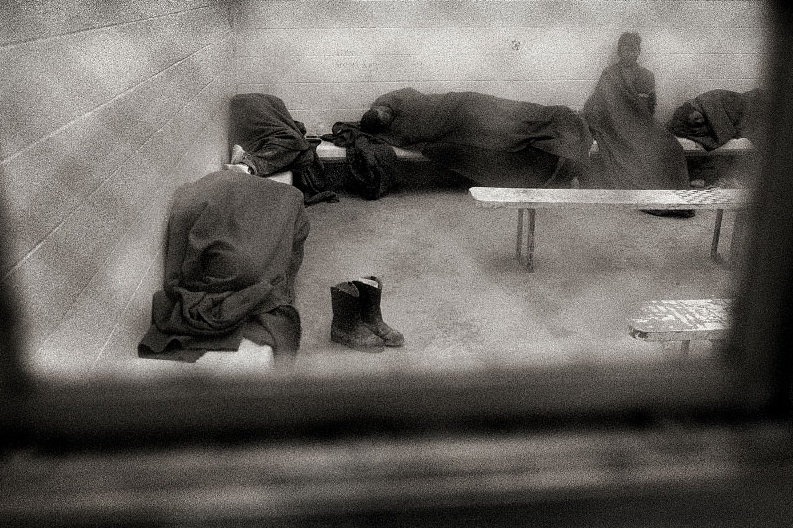
Photographer: Jon Lowenstein
And with this said, it is apparent why photography as a medium appeals so personally to me. Of all media, photography seems one of the most responsible. Photography has a history of social responsibility. Photography, some would argue, takes a bit more effort than TV. If photography is to be allied to the moving image, I prefer it allied to cinema and film. I hope to support this theory over many more posts.
Image notes:
Eros Hoagland has recently done some excellent work in newly constructed prisons of Southern California that I shall return to soon.
Jon Lowenstein is extending his portfolio rapidly. He rightly won plaudits for his documentary work in South Chicago schools back in 2005. He continues his commitment to Chicago.
Glyph Hunter, by his own admission, got lucky and caught a great exposure.
Wild thanks to Brendan over at Anxiety Neurosis for publishing on the world wide web my recent heartfelt plea to close friends. My words are now world wide … and webby. Seriously, I’d encourage you to read his analysis as he said, with some degree of wit and intelligence, what I had relied on the New York Times Opinion Page to say for me.

David Alan Harvey, Title Unknown, from Living Proof 1 series
I’d advise that you don’t read on after Brendan’s discussion of the propositions regarding criminal justice, as the tone changes to one of outrage and profanity. Do, however, consider Brendan’s intriguing solution to our failed social experiment and financial black hole we know as the prison-industrial-complex.
My daydreams might seem a little strange to you. I envision a system of work-camps spread throughout California. Low-level offenders (obviously non-violent) would be siphoned away from the concrete and steel onto various prison farms. They would become, possibly for the first time, acquainted with the world of plants, dirt, sky. They would be required to till the soil, sow the seed, reap the harvest and above all else participate in a cycle of life greater than their own. The crops (organic, obviously) would be distributed throughout state agencies providing food for the convicts, prisons, schools and state hospitals. Imagine school-children eating something that hadn’t be processed and purchased from a profit-driven third party with no regard for the kids’ health or well-being. At night the inmates of my farms would take various classes both academic and trade-oriented. They could see therapists, take workshops or paint the distant mountains in watercolor. Whatever they need to show them something outside of the life they’ve known. They would have free range of the property in question, requiring a couple fences and a small staff of guards. Where are they going to run to?
Knowing Brendan as I do, he hides here a vulnerable idealism that we would all like to embrace but the bottom-line mentality of modern life has disappointed us too often. We keep our arms folded. Brendan’s main points are uncontestable though – remove non-violent offenders from prisons; engage them in more than wall-staring for 23 hours a day; provide meaningful, even plentiful, opportunities for rehabilitation, education and therapy. Unfortunately, all this costs money and when CDCR struggles to cover the cost of inhumane lock-up the chance of seeing an individual-oriented rehabilitation is less than zero.
Work-camps do exist in California and they specialise in training for fire-abatement. This is a far cry from Brendan’s organic farming initiative, but probably skills in bio-diverse agriculture are as handy as skills in fire suppression. As we continue to burn fossil fuels and globally-warm our summers, growing local crops and putting pay to the 3,000 mile caesar salad, will be as relevant as beating annual forest fires.
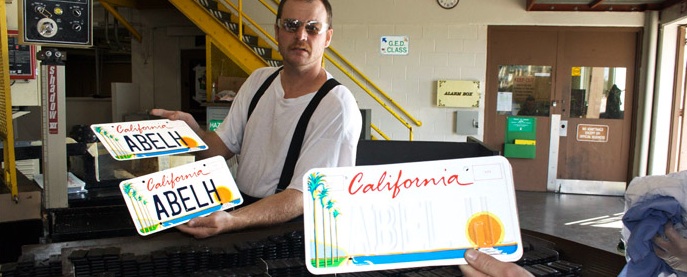
Photographer Unknown
But if we are talking about productive inmates it is worth noting that the CDCR runs the Prison Industry Authority paying inmates anywhere between 30 cents and 95 cents before deductions. This is a body that provides state departments with furniture, uniforms and California drivers with their license plates. Many have described this system as “Modern Day Slave Labor”. If it seems that way, it’s because it is.
CDCR runs the PIA because the state profits from it. Engaging the inmate in daily activity is essential, but we should try to move away from repetitive factory production, or at the very least break it up with other outlets of energy (and ideally even creativity). What other administered programs could occupy inmates’ time? We must consider here programs that do not turn an immediate product or profit – but secure long term savings for society as the inmate is provided with skills and self esteem. The PIA uses 5,900 CDCR inmates. What do the remaining 312,511 men, women and children under CDCR jurisdiction do?
These are general questions (and admittedly subjective gripes) for which there are no correct answers. Nevertheless, with so many systemic problems we should only focus on the problems we can affect and the most timely problems of the CDCR. Californians’ priorities now must be to prevent the motion to change the criminal-justice system into a “victim-vengeance system” (Prop. 9) and the motion to broaden the state’s definition of crime, subjecting thousands more citizens to the abuses of a failed system (Prop. 6).
In the meantime, we can all focus on the watercolour opportunities available to inmates at Wasco State Prison.

Wasco State Prison's new solar field
Note on Images: David Alan Harvey’s image here is included purely for aesthetic reasons. The author confesses no background knowledge of the image, only an intrigue in the juxtaposition between uniform-pressed youth and caricatured-inmates subjected to the humility of stripes and trucker hats. Even if these young men grew up and/or went to the same schools together, there is no relationship between them now. All this is neatly summarised by the wielding of the gun. The guard pays attention to the camera almost unaware of his responsibilities over his shoulder. The rifle makes the guard’s close personal observation of inmates unnecessary; the guard has a back-up. With the use of weaponry, any misdemeanour can be remedied/snuffed out within an instant.
I do not know David Alan Harvey’s views on the prison industrial complex. If I ever acquire that knowledge I will be sure to share it. As well as his website he also has a solid blog.
Disclaimer: This post, while making use of photographic imagery is a non-objective commentary. It has more to do with the author’s politic than an academic look at the photographic medium.
If the first post of an anthology is supposed to bear weight then I shall face this expectation head on – in fact I’ll insist upon it. San Quentin was the first American prison I visited. In the summer of 2004, I conducted research at the San Quentin Prison Museum (SQPM), analyzed the exhibits and evaluated its predominant narrative. I found, as with many small museums it suffered from the vagaries of volunteer staffing, poor marketing and unreliable access. Above all, however, the SQPM’s biggest failure was that it employed a historical narrative that ended abruptly in the early 70s and omitted contemporary issues of the California prison system. It was a particularly noticeable failure given the number of problematic issues faced by the CDCR – overcrowding, under-staffing, inadequate health services, dilapidated buildings – and especially noticeable as the named problems were severe-to-acute at San Quentin prison.

The piecemeal SQPM collection was brought together by an appeal and a spirited drive that saw former prison employees alongside local enthusiasts donating artifacts they had acquired in times past. The museum’s narrative ends in approximately 1971 – a year in San Quentin’s history widely considered as its most traumatic. Racial tensions and new variations of Marxism, both inside and outside the walls, were growing and divining credence among disparate groups. It wasn’t so much that the prison, as an apparatus of state, was being called into question; more that the militant Black Panthers, with their cohesive social critique of modern America, led the questioning.
White America didn’t know where to position itself. This was revolution in its most-feared guise and, in so being, paralysed many Americans who were unable to objectively judge the Black Panthers’ arguments.

On the 21st August, an infamous day at San Quentin, George Jackson took over his tier of the adjustment center and attempted an armed escape. The escape failed and he was one of six people who died. The only SQPM artifact to speak of this event was a rifle mounted as centerpiece in a wall-display of weaponry.
This same rifle was discharged by a former prison guard, from the hip, along a tier of cells during the insurrection. It was shot indiscriminately as the guard ran the length of the tier. Of course, the museum label beneath the semi-automatic weapon doesn’t volunteer this information.
The interim president of the San Quentin Prison Museum Association in 2004 was Vernell Crittendon. In mid 2007, Darcy Padilla, a freelance San Francisco based photographer, went to photograph Vernell on his daily duties. The images were to accompany an article by Tad Friend entitled Dean of Death Row in the July issue of The New Yorker. The article does a remarkable job of describing Vernell’s astounding work history, heavy responsibilities, personal amiability and curious (but not fallacious) role-playing. Padilla’s pictures were to accompany Friend’s article, which was and is the most thorough examination of Vernell’s personality, motives and politic. It was a timely piece of journalism as retirement for “Mr San Quentin” approached.
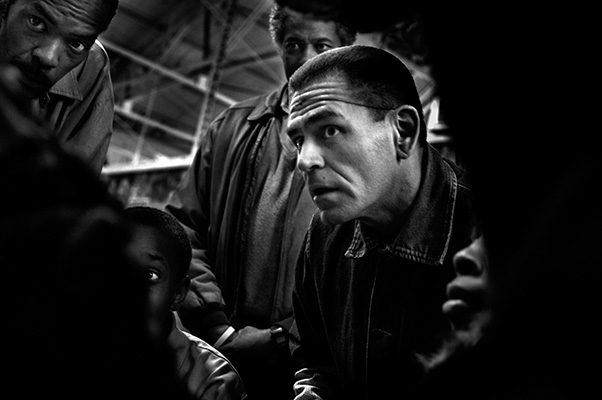
Vernell gave me access to the museum and invited me to tour the prison. He was the only staff member at San Quentin I had any meaningful interaction with, but he played out his multiple roles with aplomb. Vernell was a personal guide and shopkeeper at the museum, historian on the prison-yard, eye witness in the gas chamber, and state department mouthpiece throughout. The first 250 words of my M.A. thesis relied on Vernell as the segue into the issues at, and description of, both the museum and the prison;
Lieutenant Crittendon has thrived as the public relations officer of San Quentin Prison. He is poised, gregarious, proud of office and a great raconteur. His enthusiasm for facts, years and tales of San Quentin blur the man and employee – if a distinction was necessary – and he confesses a long-standing predilection for history.
Vernell is familiar and distant simultaneously. He can always dictate the terms of an exchange but in so doing somehow doesn’t insult his company. Tad Friend, for the New Yorker, expertly summarized how Vernell navigates discussion and parries unwelcome inquiries;
Vernell excels at dispensing just enough information to satisfy reporters, and his sonorous locutions and forbearing gravity discourage further inquiry.
I found myself comforted (never duped) by Vernell’s version of events even when I didn’t believe his words 100%. I always felt that Vernell had said much more by what he excluded and it was my privilege to have witnessed his reticence.

Tad Friend’s economical ten page summary of Lt. Crittendon’s career is, in my opinion, the best reflection of a complex man with shrouded emotions and conflicting duties you are likely to find. What then of Padilla’s task to illustrate the man and the article? She does a fine job. From the evidence of the images on her website (only one of which was used for the article) she had only one window of opportunity on one day to capture her shots. I suspect she shadowed Vernell’s work for a little over an hour for the assignment. Already the odds were stacked against Padilla. We cannot know how well she and Vernell were acquainted beforehand, but prior acquaintance doesn’t necessarily mean an easier time capturing the most faithfully depicting portrait. It is fair to say, however, if Padilla had worked within the walls at San Quentin prison before (which is likely) she certainly knew Vernell. Furthermore, in the interests of another’s professional duties, Vernell was always accommodating.
Judging from the few clues in her principled, varied and continuing series AIDS in Prison, the image below could be from San Quentin. These background hills, however, could as easily be Vacaville or Tracy’s surrounding topography.
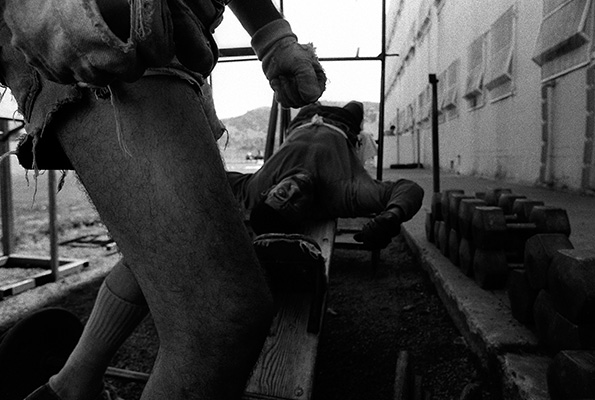
Back to San Quentin. Padilla’s San Quentin series captures the solitude of the yard; Vernell is alone in many images. During the days at many prisons the yards are empty. If they are not empty they are more likely being used as necessary routes for groups of traversing prisoners rather than ‘free’ time. When the prisoners are at recreation in the yard (a privilege that differs facility to facility), the staff is at distance unless addressing particular inmate inquiries or directing a group of inmates to their next secure location. Any visitors in the yard at this time (which I have been in San Quentin) are usually following closely the instructions of the guards. Regardless of reasons for being in San Quentin, the slowness of movement from one area to another is characteristic of all people’s experiences. Keys, locks, keys, calls, response, keys, locks, keys.
It is likely Vernell had to hunt out some activity involving inmates to vary the picture content. There is a chronic lack of rehabilitative and counseling programs throughout the stretched CDCR, but in reality, if there is one prison that is trying to counter this trend, it is San Quentin by means of its atypically large pool of Bay Area volunteers, the committed efforts of the Prison University Project (San Quentin is the only state prison that offers a college degree program) and not least the efforts of Vernell himself, “Crittendon helped oversee inmate self-help programs like No More Tears and the Vietnam Veterans Group, and was an adviser to many others. Every other Friday, as the centerpiece of a program called Real Choices, which tries to set wayward urban kids on responsible paths, [Vernell] would escort a group of ten-to-eighteen-year-olds into the prison to meet lifers, who tried to talk some sense into them.”

When Vernell is not photographed alone on the yard (look at the reflection of only him and Padilla in the fish eye mirror) he is taking a back stage to the activities of others. Vernell would not want to interfere in these rare interactions between prisoners and visitors from the outside. Vernell’s approach was typical of a San Quentin staff member; constant observation, constant vigilance and a silent restraint. I rationalized that this was simply a sensible approach – minimize ones own noise and be best positioned to pick up on the small signals/noises around. Words and gesture is used with strict efficiency at San Quentin.
Vernell’s open hand gestures, lumbering gait, deliberate pauses and dramatic referrals to the contents of his satchel are all part of an ensemble he has developed to impose the pace of an interaction and, I believe, to reassure the inmate. He promoted from the ranks of prison guard a long time ago, and so had the benefit of a different type of relationship with the prisoners. He was no longer the enforcer – in truth, he was often the only chance a prisoner had to negotiate a desired variation from system norms. Vernell never did favours per se but he could always see any request, however small, on its own merits. Now he is retired. His formal San Quentin spokesman duties went to his successor Eric Messick. Vernell self-adopted responsibilities were diluted by other staff and may have disappeared altogether. Padilla’s photographs do well to reflect a man carrying out his most unextraordinary job tasks. I think Vernell may be happy that the world has a few images of him to counter those charged press images of him outside the East-gate on the night of an execution.

A modest welcome to all readers.
It is likely, if you are reading this in late 2008, you know me personally and you are acting upon a recent announcement of mine. Thank you for stopping by. I am taking the steps, finally, to submit to the world a long-gestating collection of ideas. If you do not know me personally, I am humbled by your browsing across my page. Please let me know how you came across the Prison Photography blog.
The forthcoming, ever-growing collection of posts will reflect my interests in art history & its social contexts, prison reform, the representation of prisoners in contemporary media, power & knowledge, and the experience of humanity within legal, illegal and disputed systems of incarceration.

Memory Museum, Cordoba, Argentina
The resultant trove of image and text relies upon the medium of photography to focus argument. Photography is the single criteria that defines the boundaries of my inquiry and it serves to unify the many stories and systems it has documented.
I am interested in all forms of art production within sites of incarceration. I have a keen interest in art therapy, its uses and measurements of success. I have strong political views about the nature of prison systems across the globe. I have a mild obsession with former prisons that have now entered the heritage industry reconstituted as museum or other cultural site. But these are not the prime concerns for this blog, and while some of my writing may point to these related ideas, and indeed even overlap, my primary interest is to look at photography as a visual resource, put it in a context of socio-political production and draw sensible conclusion.

 Prison Photography