
You are currently browsing the monthly archive for November 2012.
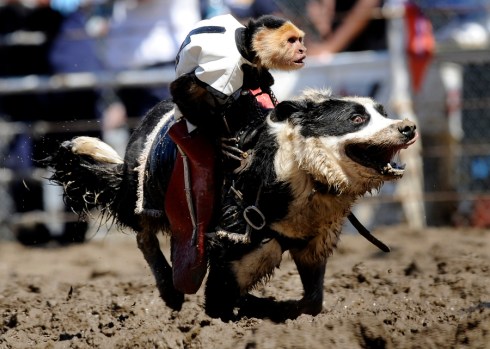
I’ve seen Bettina Hansen a few times in recent months (she’s a recent transplant to Cascadia) but never once did she think to mention this awesome photo.
Maybe I got sucked in by the fact it is A FRIKKING MONKEY RIDING A SHEEP DOG IN SOME MUDWORLD MAMMAL OLYMPICS! … maybe the photo is a document of animal misuse. It’s mad-bonkers.
Either way, this photo of animals being forced to do unnatural things under the watchful eye of humans seemed to say more about the Angola Prison Rodeo than the thousands of images I’ve seen of people at the Angola Prison Rodeo. It’s a weird event.
See Bettina’s full set from the Angola Prison Rodeo.
(All of this explains the title to this interview with me from ages ago. I never understood the title at the time.)

Disclosure: Clayton Cotterell and I are good mates. I once made this *cake* for him on his birthday.
Tell us a bit about your new series Arrangements.
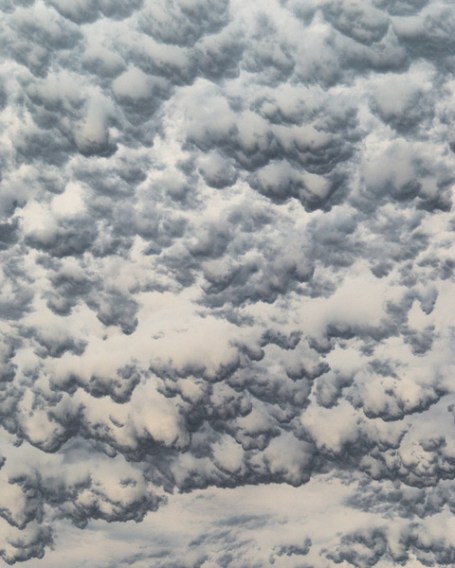
First of all, Arrangements needs a proper title, but it’s a work in progress so I suppose it’ll do for now. In Arrangements I’m referencing the current language of photography of post-productions, studio practices and manipulations. It’s definitely a trend and it is a shift that has opened the door for a lot of people to experiment. We’re seeing a lot of the same imagery. Lots of patterns and fabrics, and mirrors to create something – props that are about perception and optics.
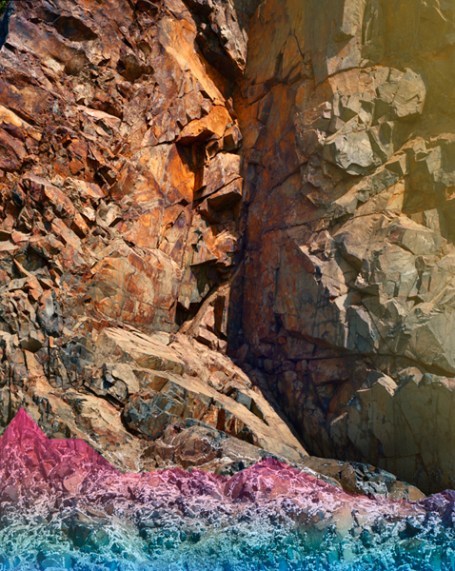
But I’m looking for naturally occurring abstractions. Arrangements is basically an old school approach to new school imagery. I’m recognizing moments [of light, color and form] when they happen in real life. I’m interested in photography that is out in the real world. I mean, taking a moment and making it into a two-dimensional image, that’s always seemed abstract to me.
When you talk of current studio experiments are we thinking of photography such as that of Jessica Eaton or Georg Parthen?
My friend Sarah Palmer won the Aperture prize. Sarah is doing constructions in the studio. Her work looks at signs in visual language. I am interested in these signs and symbols and contemporary visual language but finding these things out in the real world.
When I was in SVA grad school, if anyone shot straight photographs, people were really concerned that it would be placed within the realm of documentary. In a lot of people’s eyes, the straight photograph isn’t artistic like it once was. Paul Graham’s essay The Unreasonable Apple is really important; he’s the most interesting photographer dealing with straight photographs and with sequencing.

You have a particular relationship to nature?
I’m a rock climber so my connection is direct and physical. I’m in awe of towering cliffs and the sublime nature of mountains. I don’t know whether it’s dumb to talk about climbing. Is it that interesting?
I think so. You spend weekends on rock faces. You don’t spend all your time chasing photographs.
It’s easy to get burnt out about something if you obsess over it constantly, especially if you want to keep it going all your life.
I’ve been taking pictures since I was 14 and even then I was serious about making a good photograph. Now, photography is part of who I am and what I do, but I’m not constantly doing it.
Why do you go climbing?
I can’t get the high any other way. I like aggression but I don’t like aggression put on me by someone else. I like pulling hard on a hold and using my muscles. Doing something that is scary but I don’t have to worry about anyone else injuring me. It’s not like wrestling or football.
And photography? Fun or bruising?
The best thing for me is when I start working on an image and figure, ‘Yes, there’s something here.’ I do love having exhibitions, putting something together and having it on the wall. It can be laborious and frustrating but when it’s on the wall it is super rewarding.
The pace that you’re working at, it seems like photography fits in between all the other stuff in life.
At this point in my career, I don’t feel pressure to be producing tons of work. I have no gallery. I have no expectations set upon me except from myself.
I go in waves of producing a lot and then looking at what I’ve done. I’ve been fairly consistent with shooting for the last year and I feel good about it. That’s where the new language comes into play. I don’t think I can have a deadline with my photography. I only know it when I see it.
That’s refreshing, no?
I’ve been studying photographs for a long time and I’m interested in new images. I can see something and know what focal length I want to shoot it at before I even pick my camera up.
I need to change my environments pretty often to find new things. I’ll walk around the neighborhood just to get my eye going but I rarely get something. Being in new places help, which is another reason why I really like photography. You have to be in the place at the time to make the picture. I could never work in a studio.
How do you characterise the Portland photo scene?
The Portland photo scene has a lot going for it and I’ve really only been exposed to what I assume is a small portion. Many of the photographers I’ve met I’ve known about for some time – Shawn Records, Teresa Christiansen, Corey Arnold.
I’ve only been here a year but already feel like I have a strong community of peers. In terms of the gallery scene, I think it’s growing. Spaces like Ampersand Gallery & Fine Books are indicative of a new sensitivity to fine art and vernacular photography praxis here in Portland.


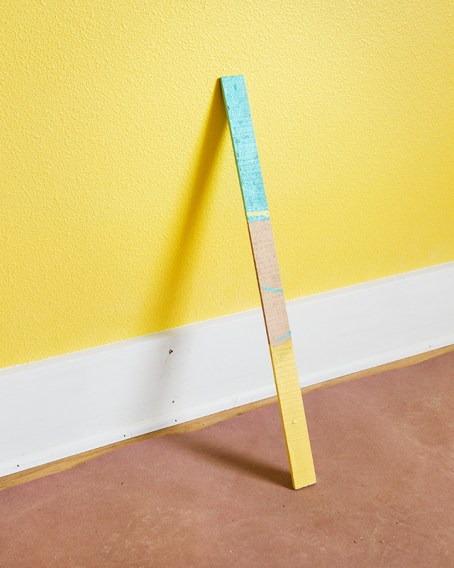

Photo: Timothy Briner, from It’s A Helluva Town, in Businessweek.
THE BEST SHOT
Timothy Briner is doing the most different stuff. Whether being different will distinguish it from the crowd, we’ll see.
I was disappointed with early coverage of the Hurricane. Given the superstorm conditions photographers were getting many more misses than hits.
The biggest miss was TIME’s first dispatch of Instagram images the day after Sandy hit. Only Michael Christopher Brown of the five photographers – Kashi, Quilty, Lowy, Wilkes and Brown – had some successful frames. TIME has continued adding to its gallery of Sandy images so the older photos (31 – 57) are toward the end.

Photo: Michael Christopher Brown/TIME. Con Edison workers clean a manhole on 7th Avenue and 22nd Street in Manhattan. Source
BUT, photographers were not at fault. It was editors’ mistakes to publish below par images. Half of the photographers images I saw in the first 36 hours were from assigned photographers carrying smartphones. In low light, blustery weather the smartphones fell way short of the test.
THE MONEY SHOT
Kenneth Jarecke lays into TIME for their use of Instagram photos. Okay he references Gene Smith where there is perhaps little relevance and lists all sorts of other reasons such as Instagram getting rich of millions off other peoples’ content, but those are not the core of his burning anger. Jarecke is angry because the pictures are poor, and I can’t disagree with him. Of TIME, Jarecke says:
It’s shameful and you should be embarrassed. Not to say these shots weren’t well seen (which is the hardest part), just that they were poorly executed. Which is to say they fail as photographs.
What was weird was that in a Forbes article largely defending TIME mag’s use of Instagram images there was little discussion of the images qualities, more an emphasis on stats and page views.
Time’s photography blog, was “one of the most popular galleries we’ve ever done,” says [Photo Editor, Kira] Pollack, and it was responsible for 13% of all the site’s traffic during a week when Time.com had its fourth-biggest day ever. Time’s Instagram account attracted 12,000 new followers during a 48-hour period.
Pollack’s description of Lowy’s bland, color-field image of a wave chosen for the print magazine’s front cover as “painterly” due to its low res sums it all up; the TIME cover is known to favor photo-illustrations over straight photographs.
THE CHEAP SHOT
Sometimes articles are written as if it is still some surprise that amateur photographs shape our media and consciousness. American Photo describes the lifecycle of a viral photo.
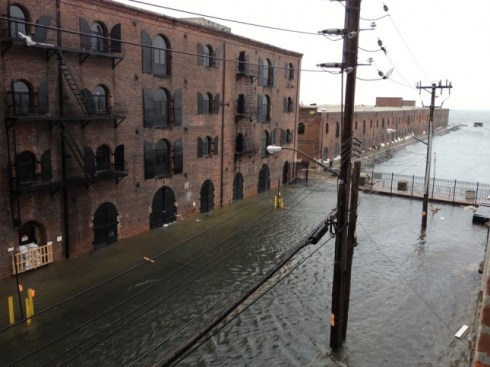
Photo: Nick Cope. Rising flood waters as seen from the window of his Red Hook, Brooklyn apartment.
When we’re all hungry for information and we’re all sharing everything we can get a peek at then an amateur snap, if it is informative enough, will find it’s way to us very quickly.
I admire that American Photo quoted fully from this dude who got that photo.
“It was hard to track [the photo’s path to “viral”] — I was also preparing for a hurricane at the time! And for a good part of the morning I was at a cafe in the neighborhood, chatting with the owner who was mixing up Bloody Marys, and so it was a combination of hanging out with folks in the neighborhood and getting prepared for the storm. And then I start getting all these calls.”
THE TRUSTED SHOT
As ever, Damon Winter makes a bloody good fist of it for the New York Times.
The BIG Atlantic In Focus delivers with a typically epic selection off the wires. Crushed cars, boats on boats, burnt embers, friends hugging/crying, aerial shots of devastation, gas lines, strewn debris (homes), rescued old english sheepdog, destroyed pier and amusement rides, phones charging, pitch black streets, canoe in a living room, downed bridge and then this incredible picture by Seth Wenig of food being dumped.
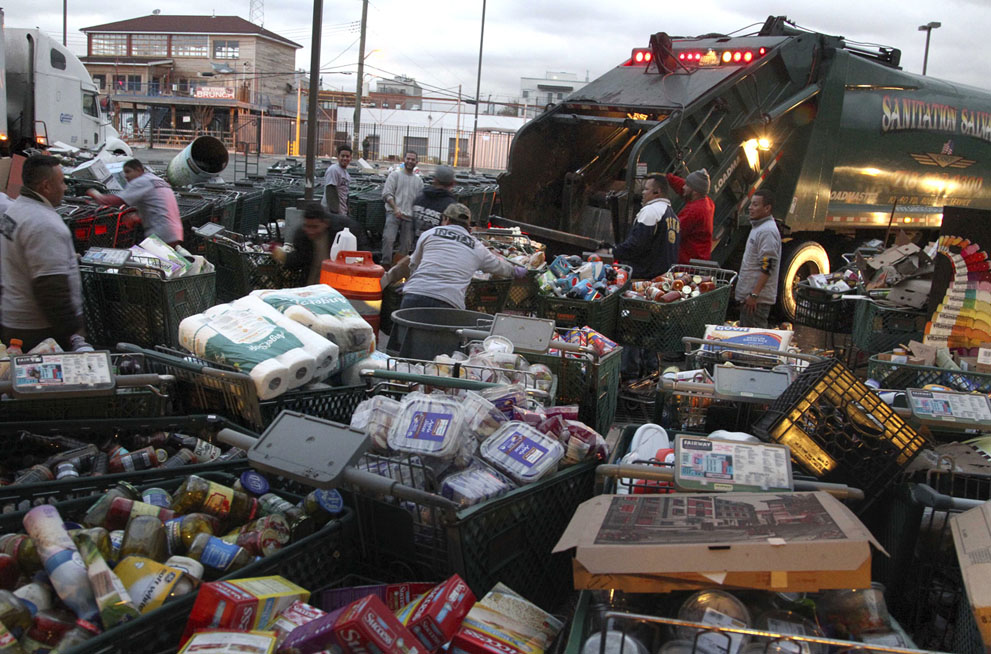
Men dispose of shopping carts full of food damaged by Hurricane Sandy at the Fairway supermarket in the Red Hook section of Brooklyn in New York, on October 31, 2012. The food was contaminated by flood waters that rose to approximately four feet in the store during the storm. (AP Photo/Seth Wenig)
THE HORROR SHOT
Gilles Peress‘ very personal letter in which he appears to be having a breakdown is shared with the world.
“I have to say that in twelve years, to have shot pictures at 9/11 downtown, and again downtown in 2008 when the financial system collapsed, and now, is intense: big city, big tragedies, and a sense of having entered into a different period of history.”
I really want to know who CK and GH, the letters recipients, are.
Peress talks about homelessness and the poor being forgotten in the delivery of aid and services. Michael Shaw at BagNewsNotes wrote about the homeless being forgotten in the coverage.
Back to In Focus. Today, another good edit by Alan Taylor’s team. These two images stood out.
John De Guzman photographs a massive pile of mucky, busted furniture and appliances.

Photo: John De Guzman. A street lined with water-damaged debris in Staten Island.
John Minchillo photographed a lady who is better camouflaged than the national guardsmen beside her. I wonder what she bought at Whole Foods?
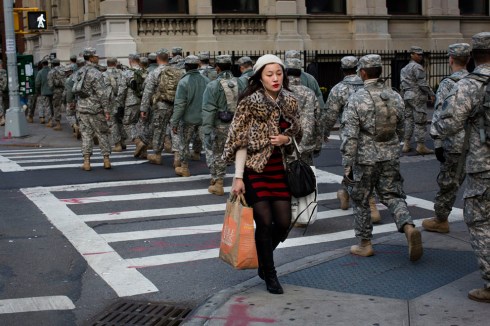
Photo: AP Photo/John Minchillo. A woman passes a group of National Guardsmen as they march up 1st Avenue towards the 69th Regiment Armory, on November 3, 2012, in New York. National Guardsmen remain in Manhattan as the city begins to move towards normalcy following Superstorm Sandy earlier in the week.
THE EVERYTHING SHOT
Everybody’s been very excited about the New York Magazine’s cover aerial photograph of a lightless Lower Manhattan.
It’s only fitting to finish these thoughts with a nod to two perhaps lesser feted Instagram photographers – after all, Instagram had record number of hashtaggles for #Sandy #HurricaneSandy and #Frankenstorm.
Wyatt Gallery has been following clean-up closely.
Clayton Cubitt is a bit more wry in his approach including this GSV comparison which is typical of Cubitt’s sideways thinking on most things visual. Good stuff.

Photo: Clayton Cubitt. Posted on Instagram, “One day you’re living the American dream. The next…”
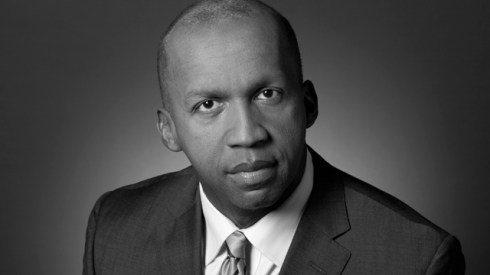
Photo: Robin Holland. Source: Bill Moyers Show
Bryan Stevenson founder and executive director of the Equal Justice Initiative (EJI) made arguments to the United States Supreme Court in May 2012 against the sentencing of Juvenile to Life Without Parole. He is fervently against the death penalty and has consistently pointed out the injustices within the US legal system that benefit the rich over the poor.
This is the second part of a two-part conversation with Prison Photography. You can read part one here.
– – – – – – – – – – – – – – – – – – – – – – – – – – – – –
PP: While presenting at TED, you encouraged the audience to educate themselves about communities beyond their circles, but you also warned the audience that the type of awareness that spurs you and your work – an awareness of profound inequality in American society – “will get to you”. Can you expand on that?
Bryan Stevenson: It is a challenge. It’s a new relationship with the world of injustice, poverty and bias that implicates you in ways in which you are otherwise not implicated. That’s both a burden and – in my judgment – a privilege, because to be able to respond to those things animates human beings in ways that very few things do. It creates meaning and purpose that can be transcendental.
I think the way you do it is by trying to insulate yourself from the politics of fear that have created many of these dynamics. We very rarely ask ourselves ‘What are we afraid of?’, ‘What are we angry about?’ but in public life we’ve been encouraged through our political leaders to be very angry about crime, to be very afraid of the society that we live in. There are things that we should be legitimately angry and legitimately concerned about, but I think as a world view this is a very destructive way to live.
When you’re consumed with fear and anger you make decisions about how you treat other people, even about how you think of your own needs, that often time leads to inequality, injustice and oppression. When you look at every example of massive human rights violations the story always begins with a narrative around fear and anger. I think one of the things we have to do is step back from that and begin to ask harder, more critical questions about the issues around us. Is it better to punish crime or to prevent crime? Are there things that we can do to reduce the prison population? Is it better to have a free population or an incarcerated population? If you start asking those kind of questions it will lead you to different policy outcomes than the outcomes we’ve largely elected.
What that means for individuals – and I think for me – is that you sometimes have to say things which are challenging; you have to be willing to stand when everyone else is sitting and be the voice that says ‘But what about this?’ You have to be willing to speak when everyone else is quiet. That’s not always easy and that’s not always comfortable. Certainly for me, it has at times been pretty overwhelming and vexing to be the target of other people’s anger and frustration because of what I am saying and who I am representing.
It has been frustrating to deal with this wall of ignorance when people are making decisions with so little information and with so little context of the people whose lives are being directly affected. What it has taught me is that I do have to believe things I haven’t seen and that is not always easy for people to embrace but I think it essential if you are going to create justice, if you’re going to create a new world.
As a little boy, growing up in the civil rights movement you’d hear Martin Luther King say, “The moral arc of the universe is long but it bends toward justice.” I heard the words, I understood their individual meaning but I didn’t really get what he was talking about until I became actively engaged in advocating for people who were hated and condemned.
One of the great challenges for our generation and community today is that so much of academic training is trying to deconstruct the things we believe, know and understand, and to make you accept the status quo – it is really intended to make you less idealistic, less aspirational, less confident that you can change the world in which you inhabit. That is unfortunate and while we have to be smart and strategic, we still have to be hopeful and we still have to believe in things we haven’t seen.
PP: This year you presented arguments in the cases Jackson vs. Hobbs and Miller vs. Alabama at the US Supreme Court. How did it go?
Bryan Stevenson: The United States Supreme Court is a tough room full of smart, thoughtful people who know these issues inside out. They ask a lot of difficult questions. Many of the justices asked some interesting questions about what sort of remedy would be necessary if relief were granted which is more encouraging than if they had asked no questions! I was pleased that the court granted review – that’s the hard part. There are thousands of petitions filed every year and the court rarely grants review, so for the court to do so on such an important constitutional question like this is even less common.
PP: In June, The Supreme Court ruled that all mandatory life sentences without parole given to children 17 and younger are unconstitutional. What happens now?
Bryan Stevenson: EJI will be dealing with as many of those cases as we can. We have made commitment to over 100 people in the last few months. We prepared to help those who would be affected by a favorable ruling. A lot of these kids don’t have right to counsel so even if the court grants relief, they’re going to have a hard time finding the legal help they need to get their sentence corrected. We’re trying to take that up.
In addition to ending LWOP for children, we are committed to ending the incarceration of children with adults. There’s still 27 or 28 states that put kids in adult facilities so that’s another campaign we’re trying to advance. We’ll take those cases on. We’re very interested in ending the underage prosecution of children; there is still a lot of states that have no minimum age for trying a child as an adult so frequently 9 and 10 year olds are looking at adult prosecution, something we think should never happen and we’ll keep doing those cases no matter what the court rules on Miller and Jackson.
PP: EJI was one of the earliest organizations to partner with Richard Ross. He has provided EJI with photographs for its reports and advocacy. In April, I wrote a piece for Wired.com titles Uncompromising Photos Expose Juvenile Detention In America about Richard’s photographs. What does photography do or change – if anything at all – in helping EJI describe these worlds we can talk about but rarely see?
Bryan Stevenson: I think photography is essential. There’s no question that Richard’s images provide a power and an intimacy to these issues that cannot be achieved any other way. It is important for photography and photojournalism to be a component of the kind of work we’re trying to do because in many ways the issues we’re discussing are underground issues.
We don’t really know what prisons and jails look like. We don’t know what the people inside them look like. We have some very outdated and exaggerated presentations of jails and prisons in popular culture. I don’t think people can get a perspective on what it is like to lock someone down 23 hours a day, year after year, decade after decade. We don’t understand what it is like for a child to be in custody in an adult facility where the risk of sexual assault is 10 times greater than it would be for an adult. We don’t know what it is like to go week after week with no contact with anybody who is not either a prisoner or a prison guard, which is true for many of our clients.
There is cruelty, real misconduct and brutality in prisons. There are all of these realities that good photographers can expose and give a lens to that is critical. Richard’s work has been hugely influential and we’ve worked with other photographers to bring these issues to light. Our first report in 2007 was mostly photographs, driven by images by Steve Liss who’d spent time in facilities taking photographs of young kids incarcerated.
Until we show people these children and the conditions of confinement in which we find these children we are not going to be able to get people to deal carefully and honestly with these issues. Photo-advocacy is critical to the work we do.
PP: Once an image is made and seen of a child in a prison cell it smashes all the stereotypes that you talked about within our a culture of fear?
Bryan Stevenson: That’s right.
PP: You argued at the Supreme Court that Juvenile Life Without Parole (JLWOP) is cruel and unusual. Definitions of cruel and unusual change over time. We perceive punishments as cruel and unusual depending on what we collectively consider socially reasonable. What do we need to do as a society to label practices that lead to mass incarceration as cruel and unusual?
Bryan Stevenson: We need to be quite intentional about how recognizing that having the highest rate of incarceration in the world is a negative thing. It is not a good reflection on a society that is committed to freedom and equality. We’re going to have to be as deliberate in our efforts to eliminate and reduce mass incarceration as we have been in creating it.
We have to begin a conversation where we say it would be better if 1 out 3 young men of color were not in jail, prison, probation or parole. It would be a positive thing if we solved the problems of drug addiction and misuse in our society rather than just continuing to imprison people. If you orient that way, then you can ask ‘What can we do instead?’
One of the things EJI talks about is having a deliberate target of reducing the prison pollution by 50% over the next 6 or 7 years. We have to be intentional. Drug policy is the largest contributor to our current prison population. We started about 30 years ago making something like simple drug possession a crime. We made drug addiction a crime. If we thought about drugs and drug abuse as a healthcare problem, rather than a criminal justice problem not only would we not be saving the thirty, forty, fifty thousands dollars a year to it costs incarcerate a person who has a health problem we could actually begin to pursue the interventions that reduce drug addiction. Redirect the resources.
That’s not just good for the government and for taxpayers; it’s good for families and communities. That orientation would go a long way to move us forward and eliminate these race disparities and the disparities that are created by class and status. If we did that seriously over the next 2 or 3 years we would dramatically reduce our prison population almost overnight.
If we added to that a punishment system and scale influenced by what science has to teach us about rehabilitation, behavior modification, about how human beings can recover, I think we’d also save billions of dollars – billions with a B – on resources that are now being invested in doing nothing more than warehousing people, further damaging them before we release them back into society.
There are states where we spend over $100,000 per year to keep teenagers incarcerated. I can’t identify any educator who couldn’t make better use of those dollars. Most educators will tell you that for half of that – for a quarter of that – invested in each child you are working with, you could do some magical things to re-orient them and prevent crime and the problems we’re trying to deal with in the public safety sphere. We must approach this problem by first acknowledging it’s a PROBLEM, it’s not just an aspect of life in America that we incarcerate the poor and disadvantaged.
You’re right; the notion of cruel and unusual has evolved. It is rooted in a concept of how we relate to one another, but it is also related in a vision of human rights and human dignity that the framers of our constitution understood was critical in a free society. If we tolerate cruelty and violations of human rights we sow the seeds of destruction, discontent and animosity that ultimately undermine any free community. That’s why we can never make peace – in my judgment – the type of cruelty we see too much. To say to any child of thirteen, ‘You are only fit to die in prison’ is cruel. I don’t think you need a law degree or a degree in adolescent development to acknowledge that. You just need to be willing to think critically and honestly about what protecting children requires. A lot of these issues are much more simple than people think.
PP: It’s the first time I’ve heard someone put a figure on targets for decarceration in America. A reduction of 50% would mean releasing more than 1.1 million people. That figure would scare the hell out of most Americans.
Bryan Stevenson: [Laughs] Only because they don’t know who those people are!
There are hundreds of thousands of people in jails and prisons who have never committed a violent crime, they’ve never hurt anybody. We have close to a million people in prison for non-violent property crimes or drug crimes. Frankly, if someone stole $50 from your house, you’re never going to get that back in our current system, but you can imagine a world where the obligation to pay back to restore and to compensate the victims of crime in ways that are meaningful could replace the use of prisons to punish and crush folks.
All of a sudden a whole host of things are happening that I think are positive to our society; once we begin defining and describing how people get to prison and who they are, the idea of reducing the prison population becomes a lot more attractive. Also, when we start talking about the collateral consequences of the money we’re spending; we are undermining education in this country because of mass incarceration. We are depleting resources for public safety because of mass incarceration. We are stripping basic services and public utilities because of mass incarceration.
PP: At TED, you said that as a society we will not be judged by our technology. Will we be judged by the fairness of our laws?
Bryan Stevenson: Our laws express our fundamental norms and our fundamental values; I think it more complex than just our laws or just our technology. It has to do with the dynamics in our community. If we get comfortable with widespread racial bias and discrimination; if we get comfortable with a widespread population of people who are desperately poor; if we get comfortable with these vertical relationships then we are destined to become a different kind of America – an America that is not defined by commitment to fairness, equality and opportunity.
We have to pay attention to all of the strategies and techniques that create opportunity, and technologies are at the heart of that, design is at the heart of that, even entertainment can stimulate the kind of creativity we need. Those are important parts of it, and so are our laws. Ultimately, for me, the measure is what we do with technological tools and where we stand. There are more people living under the poverty line today than there were forty years ago. That’s a bad thing. Having 2.3 million people in jails and prisons is a bad thing. The growing population of people who have permanently lost the right to vote who are African-American – after the civil rights struggle – is a bad thing. The despair and hopelessness that I see in poor communities and minority communities – where 13 year old children believe they’re either going to be dead or incarcerated by the time they are 21 – is a bad thing. We will ultimately have to measure our commitment to society and to our norms and values by how we respond to those problems.
PP: And you’re helping us learn deeply about the problems, and offering solutions. More power to you. Thank you Bryan.
Bryan Stevenson: Thanks Pete.
– – – – – – – – – – – – – – – – – – – – – – – –
The first part of this conversation was published October 31st, 2012.
Below is Stevenson’s full TED presentation.

 Prison Photography