
You are currently browsing the monthly archive for January 2017.

‘Chasing the Dragon’ © Robert Saltzman / Juan Archuleta. From the series “La Pinta: Doing Time in Santa Fe”
–
I’ve heard from a couple of folk that when I started Prison Photography, they laughed at its folly. Not only had a bleeding-heart liberal thug-hugger come along to explain a world no-one cared about to no-one in particular, but silly-little-leftie-me would run out of projects and photographs in no time. Not only had I picked a subject nobody cared for, I’d neglected to do the proper amount of research and maths.
Well, more than eight years later, and I’m still stumbling upon scintillating projects that challenge my ever-evolving timeline of prison-based visual arts. Case in point La Pinta: Doing Time in Santa Fe, a collaboration between Robert Saltzman and the prisoners of New Mexico State Penitentiary, in Santa Fe, NM.

© Robert Saltzman / Keith Baker. From the series “La Pinta: Doing Time in Santa Fe”
Saltzman first visited the prison in 1982 to visit a friend and thereafter was fascinated by the lives behind the walls. Despite a massive riot less than two years prior, Saltzman convinced the warden to allow him in with his 35mm SLR, three lenses and camera-mounted flash. Saltzman gave assurances he was there as an artist and not as a reporter.
Over 9 months, Saltzman made 500 images on Kodachrome64 film. He picked the 35 strongest portraits but still wasn’t happy. They failed to tell a fraction of the stories or reflect even a small slice of the range of emotions he encountered. So he printed the 35 out and mounted them on white illustration board. He sent them back in, a few at a time, with a request.
“Please use the white space however you want,” Saltzman told Popular Photography in 1985.
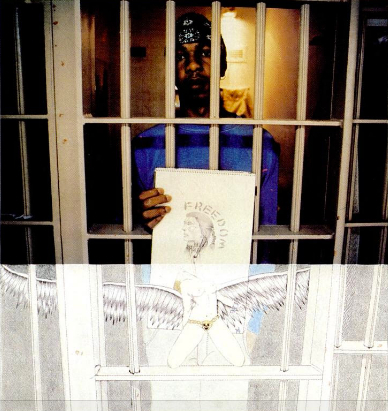
© Robert Saltzman / Jonathan S. Shaw. From the series “La Pinta: Doing Time in Santa Fe”. Screengrab from Google Books scan of an issue of Popular Photography (Vol. 92, No. 3, March 1985, pages 66-69 + 141, ISSN 1542-0337)
Some photographers would be happy to get in and out with some portraits and call it a day. Plaudits to Saltzman that he distanced himself enough to make a hard call about the nature of his pictures. And with it adding more time and uncertainty to the project.
28 total works came back. In the first exhibition of La Pinta: Doing Time in Santa Fe, 11 were shown. Later, 14 were exhibited.
“The drawings and writings, coupled with Saltzman’s portraits, communicate a poignant and often tension-filled commentary on the prison experience,” writes James Hugunin, art historian, expert on prison imagery and curator of a 1996 show Discipline and Photograph which included Saltzman’s work.
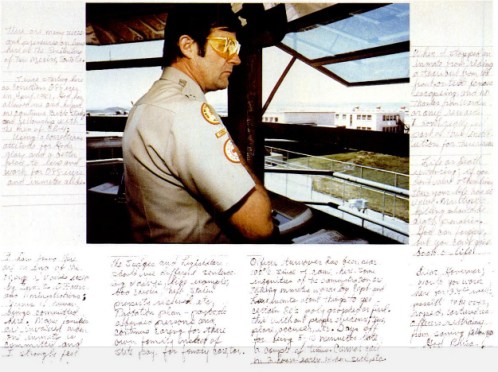
© Robert Saltzman / Ralph K Millam. From the series “La Pinta: Doing Time in Santa Fe”. Screengrab from Google Books scan of an issue of Popular Photography (Vol. 92, No. 3, March 1985, pages 66-69 + 141, ISSN 1542-0337)
This work excites me because it avoids easy categorisation. This type of collaborative work is standard-fare these days with a new generation of practitioners inspired by the social justice priorities of photographers like Wendy Ewald, Anthony Luvera, Eric Gottesman and many more. In the early eighties however, when Saltzman et al. made these, collaboration was considered a bit amateurish. God forbid you allow scrawls upon photographs! Pencil was meant only for contact sheets, editing and for marking crops for the darkroom. Note that among famous photographers Robert Frank made some good scrawls on his stuff in the 70s for himself and for ad campaigns in the 80s and we all know Jim Goldberg’s Rich and Poor (1977-78) was before its time and the high-profile example of a photographer handing over prints for subjects to write upon.
With the exception of Danny Lyon, all the photographers I know that preceded Robert Saltzman in photographing inside US prisons–Steven Malinowski, Gary Walrath, Joshua Freiwald, Sean Kernan, Cornell Capa, Ruth Morgan, Douglas Kent Hall, Taro Yamasaki–were invested in keeping the camera, and thus the message and interpretation, in their own hands. Given the times and the preciousness of access, it makes sense that photographers would internalise society’s general attitude toward them as special messengers. (I should flag here, as I always do, that Ethan Hoffman’s work and book Concrete Mama was exemplary of this time in terms of giving over great space for his imprisoned subjects recount their stories.)
I wouldn’t say that photographing prison guards hadn’t happened by the early eighties, but it was unusual. So for Saltzman to get the written reflections of guard Ralph K. Millam (above) is significant too. Most photography projects within prison focus on the prisoners and very few focus on both the kept and the keepers.
In short, due to both its subject matter and approach, Saltzman’s La Pinta is landmark. Prisons weren’t photographed much in the early eighties and certainly not for as long as a year, the time it took Saltzman to complete the work. Its collaborative methodology allows for heightened emotional impact and positions it ahead of other works that later used similar formulas and embodied likeminded sympathies.
See more here.
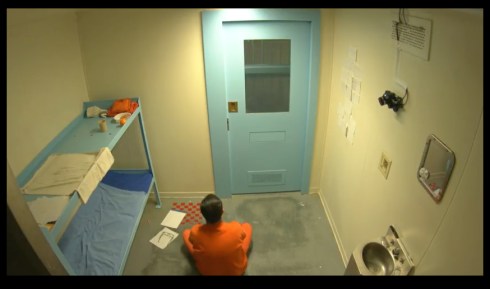
Screengrab from the VICE webpage livestreaming James Burns’ 30 days in La Paz County Jail, Parker, AZ. Captured 02.01.2017
VICE reporter James Burns is spending 30 days in solitary confinement in La Paz County Jail in Parker, Arizona. You can watch any time. He’s into his third week. Why? Good question. Burns has many a good answer. He explains:
Unlike most of the rest of the planet, America embraces this practice at almost every level of the system—local jails, state and federal prisons, mental health facilities, you name it. By most estimates, solitary ensnares 65,000 to 100,000 people at any given time in the United States. Just this past month, a study from Yale Law School carried out in coordination with the heads of state prisons across America suggested nearly 6,000 of them have been in solitary for three years or longer. And like most layers of the American criminal justice system, solitary disproportionately impacts people of color.
It’d be one thing if this practice of confining people in cramped, isolated cells worked—if all the loneliness and human misery had a point. But report after report (and study after study) suggests solitary brutalizes the incarcerated and in some cases may even make them more likely to hurt others when they get out.
I’ve just watched 15-minutes. My immediate response was one of anxiety. Usually when I view a screen it’s with interest in a narrative (documentary film), or for clear information (news broadcast), or for the development of script and fictional character (TV), or the footage is reflexive of itself as a medium (video art), or it’s a quick, cheap laugh (cat GIFs). In other words, there’s always something happening, or about to happen. Or there’s mystery, tension or story arc; something’s coming up and something will change. The livestream puts me on edge because there’s no obvious movement in it, for it. We see everything in Burns’ world and at his disposal and it’s almost nothing. The footage not only holds no change, it inhabits the near-complete absence of any potential for change.
If the cell was to erupt in action, it’d likely be in a moment of Burns’ crisis or breakdown. Watching, I find myself simultaneously tormented by the lack of action but also fearful of anything extreme (because it’ll be very negative) actually happening. If Burns can last the 30 days and the “program” runs its full course I hope Burns can quietly survive.
I wasn’t convinced about the 30-day livestream as a form when VICE launched it on the 14th December, but having spent an hour with it I am greatly intrigued. (As I type have the feed playing in another browser tab, and the audio of Burns pacing his cell passing an orange from one hand to the other)
This isn’t active reporting but it is a full 30-day long report. It isn’t time-based art, but it is without doubt performative and requires investment by, and presence from, the audience. The slow-pace and anti-narrative are very effecting.
We cannot ignore the full cooperation of the jail administration though. Lieutenant Curt Bagby explains La Paz Sheriff departments motives:
“Having cameras in our facility showing any part of the process is an easy thing for us to agree to because we take great care to follow the rules set forth for us by the Arizona guidelines on dealing with our incarcerated population. We are happy to show the general public the way we operate as we have nothing to hide. We understand VICE wanted to highlight the practice of solitary confinement, and we are willing to show how it is done here.”
I and many other activists could list countless prisons and jails in which a month-long live web-feed of a cell would not be considered or carried out. Merely the noise from a disturbance on the tier would be enough to put of most administrations. I don’t know the configuration of other cells and corridors in the pod or the block Burns is in, but I have heard noises from beyond his cell suggesting that a large disturbance would be clearly audible. I take Bagby at his word and I speculate he derives confidence from a belief or measurement that La Paz County Jail is less volatile than other facilities.
After years of conjecture about prison and jail administrators’ attitudes toward cameras, I’m interested to read Bagby’s statement on cameras relationship to transparency and management. It also is a clear indicator that no external factor will dictate the outcome of this experiment. Only mental stress upon Burns will end the confinement prematurely. We wait either for nothing or for total disaster. By occupying this box (at considerable risk to himself) Burns embodies the fact that confining others to solitary results either in absolutely nothing or in the complete destruction of the spirit.

 Prison Photography