
You are currently browsing petebrook’s articles.
WAR
In many ways I am surprised it has taken so long for a reel of film to make such an immediate impact on American audiences. The wikileaked military footage Collateral Murder shows us exactly what war is; war is the erasure of doubt, benefit of doubt in the face of procedure. The procedure of war is to kill.

Photographer Namir Noor-Eldeen runs for his life in the midst of a US 30mm machine-gun assault
Following the helicopter gunman’s requests to engage, the wait for the permission is one of the most haunting silences I’ve heard. And then, murder. Is it any wonder PTSD follows such carnage?
PRISONS
Ever since Change.org published With 140,000 Veterans in Prison, We Can Do Better last Veteran’s Day I have been aware of stories about the links between violence and suffering abroad with violence and suffering within US communities.
This week two stories surfaced – one from either side of the Atlantic – which illustrate two common scenarios for returning service men and women. The first is clinical depression in the from of Post-Traumatic Stress Disorder, and the second is clinical depression in the form of addiction and aggressive behaviours.

At the Mid-Orange Correctional Facility in Warwick, N.Y., service dogs share a room with the prisoners who help train them. Photo: Stephen Crowley/The New York Times
PTSD
Stephen Crowley visited Mid-Orange Correctional Facility in Warwick, N.Y. to document the Puppies Behind Bars program. (I have mentioned this initiative before at a NY womens prison).
The program at Mid-Orange serves as rehabilitation in the form of responsibility, “softening up” and purpose in the direct service to outside communities. One of the growing communities to benefit from personally trained service dogs are America’s war veterans.
Staff Sgt. Aaron Ellis, suffering from PTSD had not been to the supermarket in three years until his prison-trained service dog gave him the confidence to step into the stimulating environment.
Watch the New York Times’ slideshow A Canine Treatment for PTSD.
CRIME
The Times Newspaper (UK) published From Hero to Zero reporting the fortunes of three ex-soldiers who’ve done time. Their addiction and aggression is often the result of either undiagnosed or untreated PTSD. The Times:
There is a widespread belief that post-traumatic stress disorder, occasioned by Britain’s engagement in two brutal wars, is behind the large numbers of veterans who offend. The truth is muddier. PTSD normally takes several years after the traumatic event to set in.
The Howard League for Penal Reform has launched an independent inquiry to bring this to public attention in the UK.

Former UK soldier, Michael Clohessy sleeps with a sword under his pillow. Photo TIMES Newspaper, UK
One of the biggest stumbling blocks for understanding and working to improve the prospects of the veteran/prisoner population is that the exact figures are not known and estimates vary wildly. The Times:
We send too many ex-servicemen to prison. How many, nobody is sure. A recent study by the National Association of Probation Officers (Napo) estimated that there may be as many as 8,500 ex-servicemen in prison out of a total prison population of 92,000. Harry Fletcher, assistant general secretary of the organisation, believes that around 8% of Britons in jail are from the forces. The vast majority of these offenders are from the army, and a large majority of the ex-army are from the infantry. But other groups have taken issue with Napo’s findings. The Ministry of Justice and the Ministry of Defence conducted their own survey, which they published in January, concluding that only 3% of the prison population were former members of the military — around 2,500 veterans in total.
I think the title of the Times piece suggests it all – From Hero to Zero.We freely project the character of a man based upon our knowledge of his or her publicly performed actions. This is okay, but it mustn’t be only form part of our assessment. Heroes are never heroes, and zeroes are never zeroes; they are stereotypes. Stereotypes are often benign but sometimes damaging and paralysing to good judgement.
WHAT TO THINK?
Our prisons are filled with a wide variety of people with a wide variety of faults, competencies, potential and histories. For the most part, the authorities are aware of this, but I am not always convinced the public is.
Is it in our interest to think of these diverse populations in prison? Does this affect how we consider prisons and prison reform?
What do we need to see (photography?) – as well as read – to think of prisons in more reflexive ways?

Last week, I said that photographs from Guantanamo now teach us nothing. I should qualify that statement; photographs will tell us nothing new of the military operations, procedures and especially not future plans for the site.
It does not mean, however, that photographs are useless. Visual sources can be presented to refine existing positions of that illegal and politically foolish site.
Looking at the same set of photographs by Tim Dirven, Robert Hariman of NO CAPTION NEEDED has drafted a position that describes the growing and inevitable non-utility of Guantanamo as it relates to the discredited policy that originally led to its construction and use.
“An architecture of stupidity begins to emerge. For example, the extreme functionality of the space that actually inhibits any reasonable use, much less any use that might lead to resolution of the larger conflict. Also perhaps the over-design of the security apparatus: tables bolted to the floor within a cage will have their rationale, but there is something so excessive here that it has to be a sign of arbitrary rules, endless procedures, and near-complete inattention to anything else but the literal replication of the machinery of power. Nor is that a dynamic process, but one that depends on stasis, on the inactivity, boredom, and habitual resignation to routine evident in the guards’ postures.”
“[Guantanamo] prison is a monument to stupidity. It is not enough to reform the prison, however. My point is that the national security state produces stupidity because it depends upon stupidity. The national interest of a democratic people may be served well by reason, but the modern state, to the extent that it is a regime of coercive control, will rely on another mentality: stupidité d’état.”
(My bolding)
It was either Beierle or Keijser (one of the Mrs. Deane halflings) who emailed and pointed out Simon Menner‘s photographic series Objects – 2010.

FAKE HEAD. Pillow, hat, paper, piece of Tetra Pak, hairs from a broom. @ Simon Menner
Typology is a trendy term that gets banded about easily these day but I have no better term for the straight photography of objects as these. Menner is the latest photographer in an ever-increasing line of prison tool and prison weapon typologists.
In 2005, Marc Steinmetz photographed the manufactured items of Santa Fu, Celle, Wolfenbuttel and Ludwigsburg prisons in Germany. (Featured on PP, July 2009)
Brett Yasko produced the independent book Shiv that features eleven prisoner-made weapons from the collection of Chris Kasabach and Vanessa Sica. The shivs were confiscated in the 1980s at Rahway – now known as East Jersey State Prison. Yasko’s photographs were presented in Design Observer’s feature Art of the Shiv.
Prior to 2008, Toño Vega Macotela was visiting Santa Martha Acatitla Prison, Mexico regularly and his photographs were showcased by Toxicocultura recently (via James).

Cooking Grill No.2 © Toño Vega Macotela

Pages of Brett Yasko's book 'Shiv'. © Brett Yasko

Multibladed Shiv. Image © Brett Yasko

Radio Receiver within Encyclopedia. © Marc Steinmetz, 2002

RADIO. Book, electronics (the title of the book translates “The Reputable Merchant”) © Simon Menner
The usual commentary for these types of typology is to admire the ingenuity and resourcefulness of the inmate. Notably, all four photographers have given “backstories” or contexts for the production and/or confiscation of the objects they’ve photographed. For example, Menner explains, “The objects presented here have all been seized in prison cells of the Berlin Tegel prison.” Menner also thanks the staff for allowing access. These extra details are essential if we are to avoid wonder and mere image-consumption.
These typological studies run the risk of serving politiicised positions; of becoming metaphors for human creativity or resistance.
(Worse still, the item and/or photograph is reduced to an objet d’Art.)
THE SOCIAL LIFE OF THINGS
Menner himself is concerned with how images and stories may or may not attach themselves, “What fascinates me here is the very old question of how much of the final object is already “inscribed” in its parts, even before its creation. And by asking this question I also ask a basic question on the nature of images. How much of a story is visible in the images, even before the story itself is unveiled?”
So what do you first think or ask when viewing these images? For me, I want to learn about the institutions, penology and prevailing criminal justice culture in which these inmates functioned:
With regard Yasko’s work – Why were so many shivs made at Rahway? And what led to two collectors acquiring them? With regard Menner and Steinmetz, what uses were dummy pistols and mobile phones put to inside those German prisons?
Fine art representations of these objects mustn’t be the end product in their object biographies. Narratives in the “Social Life of Things” do not end but morph.
The photographs of Yasko, Steinmetz, Macoleta and Menner impose new readings and establish new jumping off points for inquiry.

Device to hide a mobile phone. © Simon Menner

DUMMY PISTOL from blackened cardboard; found on June 23, 1988, in an inmate’s cell in Stammheim prison, Germany, after a fellow prisoner tipped off the jailers. The dummy was hidden in an empty milk pack and was most probably intended to be used for taking hostages in an escape attempt. @ Marc Steinmetz

It’s only fair to compare Obama’s 2009 outing with the big rabbit with George W. Bush’s 2008 appearance.

But sometimes pigment trumps pixels.

Painting by Dan Lacey
Plaut on racial tensions, sick politics, terrible stats and a worst case scenario:
For most South Africans, Eugene Terre’Blanche was a throwback to another era. But his death is a blow to the country’s image of racial tolerance, fostered so carefully by Nelson Mandela.
Some are likely to believe that the fact that his alleged attackers were arrested so rapidly smacks of a cover-up. Others, on the minority far-right fringe, will see his death as a vindication of their assertion that whites cannot live under black rule.
It is a tragic fact that more than 3,000 white farmers have been murdered since the end of apartheid in 1994. And it is possible that some people may seek retribution.
Mr Terreblanche’s funeral could become a rallying point for such sentiment.
Source: Terre’Blanche death brings Zuma appeal for calm, Sunday, 4 April 2010
UPDATED: Ben sent over the link for SnagFilm’s page for the full-length documentary The Leader, his Driver, and the Driver’s Wife.
– – –

Terre’Blanche was beaten and hacked to death in his home yesterday. The violence is no less horrific than that meted out by supporters of Terre’Blanche’s A.W.B. Party upon Black South Africans. On one occasion, A.W.B. members confronted Black miners as they surfaced at the pit-head after their shift and attacked them with clubs and machetes.
Terre’Blanche instigated many acts of heinous violence and murder. Terre’Blanche was also a terrorist. The Guardian:
In 1998, Terre’Blanche accepted “political and moral responsibility” before South Africa’s Truth and Reconciliation Commission for a bombing campaign to disrupt the 1994 elections in which 21 people were killed and hundreds injured.
Terre’Blanche’s A.W.B. Party was separatist and outside of the political mainstream but that doesn’t mean Terre’Blanche himself was disconnected from the apartheid era government of the 1980s and 90s. The A.W.B. existed for so long (since 1973) because of a constant fringe element willing to embrace white supremacist politics in South Africa
The Leader, his Driver, and the Driver’s Wife
In 1991, my favourite documentary maker Nick Broomfield, made The Leader, his Driver, and the Driver’s Wife. This film is available to UK readers on Channel 4 and for the rest of us on Youtube in seven parts.
Throughout the documentary, Broomfield drops in rumors and reports of sporadic violence by A.W.B. members against Black men, women and children. These matter-of-fact inserts, along with the run around he himself experiences as a working-journalist, is the volatile and irrational world in which Terre’Blanche’s racist rhetoric thrived.
When murdered, Terre’Blanche was 69 years old. The manner in which he antagonised and brutalised other humans about him, it is a wonder he lasted that long.
– – –
Note: I highly recommend Broomfield’s work, particularly Biggie and Tupac.

I just ran across these. They belong to a narrative of a science-fiction scenario that I am not familiar with.
Check out all of Lugonious‘ classic-toy futurescapes!


– – –
All this appreciation of Lego brings to mind Legofesto‘s more sinister, reality-based Lego sculptures of abuses at Abu Ghraib and Guantanamo – here, here, here and here.
Happy weekend!

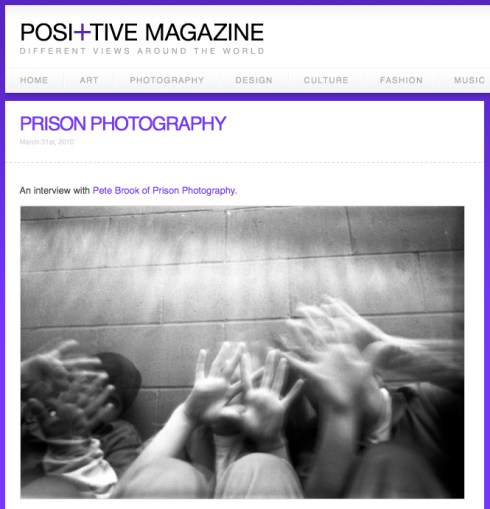
Last month, Giacomo Cosua from POSI+TIVE Magazine got in touch to see if I’d be amenable to an interview about my project here at Prison Photography.
It has been a while since I took a step back for an objective look. And – believe it or not – it is the first time someone has asked me to name Prison Photography‘s best article.
Thanks should also go out to Melania Comoretto, Sasha Maslov, Nathalie Mohadjer, Steve Davis, Robert Gumpert, Yana Payusova and the girls of Remann Hall for their images to illustrate the piece.

 Prison Photography