
You are currently browsing the category archive for the ‘Activist Art’ category.

OPEN ENGAGEMENT 2016
If you’re not going to Oakland for the Open Engagement (OE) conference in April 2016, you’d better have a good excuse. It”ll be great. it’s on the theme of POWER, Angela Davis and Suzanne Lacy are the keynotes and a call for proposals is now open.
“Local, national, and international artists, activists, academics, cultural producers, administrators, curators, educators, writers, thinkers, doers, and makers of all ages are encouraged to propose programming,” says OE.
Proposal deadline: November 2, 2015.
OE is an annual conference about socially engaged art. I’ve been to a couple of past iterations and I recommend.
The Oakland Museum of California (OMCA) hosts OE 2016, April 29–May 1. Additional sites throughout the Bay Area will also be satellite venues.
“Power is the ability to make desired results happen,” says René de Guzman, OE 2016 curator. “We invite participants to explore this concept broadly and expansively. What is power in the present age? How do we effectively demand it—and how we create it for ourselves? What are the innovative strategies for empowerment before us? What are the mechanisms by which we ensure fair and equitable distribution of power for all? How do we conceive of ourselves and how do we share power with others?”
“Founded in 2007, OE is the only conference on this subject of this scale that operates on an inclusive open call model that supports emerging and established artists and collaborates closely with national institutions,” says OE.
They’re asking for proposals for presentations, panels, discussions, workshops, events and interventions. Logistical support projects and social gatherings are also welcome.
You also win points if your proposal is site specific or in some way reflexive. In plain language, get to know Oakland and Oaklanders. Better still, propose collaborations with some locals.
OE wants you to know that “OMCA brings together collections of art, history, and natural science under one roof, featuring indoor venues with capacities ranging from 6–260, including a hot tub lounge and a partial airplane, and outdoor spaces that can accommodate 50–500, including the garden and Peace Terrace.”
PHOTOGRAPHY + SOCIAL PRACTICE
A good resource to plug your photo-brain into the prerogatives of OE is Photography As A Social Practice. I am an occasional contributor. Also, check out the recent projects sponsored by the Magnum Foundation’s Photography Expanded program.
Please take a peek at my review of the exhibition Social in Practice: The Art of Collaboration, curated by Deborah Willis and Hank Willis Thomas.
Finally, you cannot miss the e-book Wide Angle: Photography As A Participatory Practice edited by Terry Kurgan and Tracy Murinik.

WHAT’S IN A NUMBER?
Four years ago, after decades of legal battle, the Supreme Court of the United States ordered California to reduce its state prison population by approximately 30,000 people. Instead of looking seriously toward cheaper and safer alternatives to custody, the state redirected a lot of those convicted of crimes into the county jail systems and stopped receiving citizens with sentences of less than 3-years into the state prison system. California, essentially, swapped one set of cells for another set of cells. This was a process called Realignment.
County administrators balked at the notion and the jails creaked. So, the state dove into its budget and redirected money toward the counties. In most cases, the counties opted to build new jails.
On top of realignment was, one year ago, Prop 47 which downgraded several non-violent felonies to misdemeanors and reducing sentences for thousands in the process. So, at a state level, the statistics read as though the Golden State is putting fewer people in boxes. But the picture isn’t so rosy, as the latest “Decarceration Report Card” from Californians United for a Responsible Budget (CURB) shows.
This is the third time CURB has graded California counties on whether they’re reducing the number of people incarcerated and investing in community solutions, or whether they’re building new jails.
“This year, for the first time, every county received a failing score,” says CURB. “Since 2007, $2.2 billion of jail construction funding has been approved by the state for local jail construction. Twenty-three counties are already building new jails. Five are building two or more jails. And thirty-two counties are applying for the current round of jail construction funding.”
THE APPROPRIATION OF LANGUAGE … AND MONEY
The correctional system employs hundreds of thousands of people; it has a labor capital to nurture and a workforce perversely both exploit and “protect”. This means, the system must move with the times and move where the money is. With a nation now enlightened to how racist, classist and abusive prisons and jails are, the new common consensus is that we must treat, educate and rehabilitate prisoners, not merely lock them away. As such, treatment and rehab is a new-found “boom sector.” The state has adopted the reform language of anti-prison activists, twisted it to their own rhetoric, and are chasing the increasing number of dollars being earmarked for rehab.
“These jail projects are being promoted as ways to help incarcerated people and their families–improving mental health treatment, adding classroom space, and providing so-called gender-responsive care,” says CURB.
Do not be fooled. #AllJailsAreFails. We don’t need better jails, we need fewer jails.
The highest judges in the country ruled California’s prisons as unconstitutional and medically negligent. What makes us think that the state agencies can provide a functional version of rehab or treatment? Or even that citizens would willingly trust the agencies that incarcerate to treat?
CURB
Californians United for a Responsible Budget are the best. So far, the report has received the following coverage:
Report Blasts Jails Building (Sonoma Union Democrat)
Orange County Blasted For Seeking Jail Expansion Over Alternatives to Incarceration (OC Weekly)
California Spending Billions on New Jails (TeleSur)
Pacifica Evening News. Starts at 25:33 (KPFA)
HOW TO STOP A JAIL
Do you live in California? Is your county trying to build a new jail? Check out CURB’s tool-kit, How to Stop a Jail in Your Town!

DOUBLE METAPHOR
“Being in the prison system is like you go into a maze and never come out,” said an incarcerated to man to artist Sam Durant in the months preceding Open Source, a city wide public art project in Philadelphia.
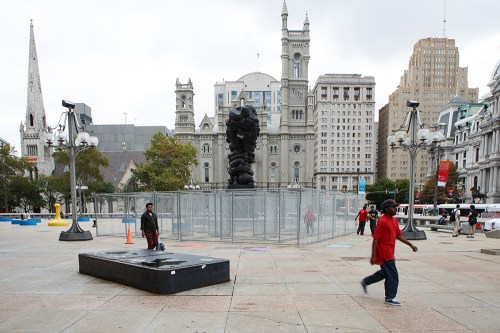
Durant has erected Labyrinth, a 40x40ft maze of chain-link fence, in Thomas Paine Plaza, across the street from City Hall. The public have been hanging personal responses on the maze fence using it as a stage to consider mass incarceration. Durant intended that the structure which begins as transparent will gradually become opaque with the publics additions.
Philadelphia is a sadly fitting venue. The prison industrial complex has had a particularly acute effect on Philly communities and Pennsylvania as a whole. PA has one of the largest and strictest prison systems. Philadelphia has a jail system with a history of beatings, discrimination and scandal.
It would be folly to think that politicians are going to correct the problems of a bloated, abusive system without the help of the citizenry.
“The maze functions as a double metaphor, symbolizing not only the struggle of criminals caught in the Department of Corrections but for how, as a society, we are all navigating the labyrinth of mass incarceration,” says the Open Source website.
During his recent visit, the Pope didn’t take the opportunity to publicly shame City Hall and those who work within, but Durant’s sculpture obliquely does.
I like this art.

Sam Durant
Sam Durant is a multimedia artist whose works engage a variety of social, political, and cultural issues. Often referencing American history, his work explores the varying relationships between culture and politics, engaging subjects as diverse as the civil rights movement, southern rock music, and modernism. He has had solo museum exhibitions at the Museum of Contemporary Art, Los Angeles; Kunstverein für die Rheinlande und Westfalen, Dusseldorf, Germany; S.M.A.K., Ghent, Belgium; and the Govett-Brewster Art Gallery, New Zealand. Durant shows with several galleries, including Blum and Poe, Los Angeles; Paula Cooper Gallery, New York City; Praz-Delavallade, Paris; and Sadie Coles Gallery, London. His work can be found in many public collections, such as the Art Gallery of Western Australia, Perth; Tate Modern, London; Project Row Houses, Houston; and the Museum of Modern Art, New York. Durant teaches art at the California Institute of the Arts in Valencia.
CREDIT
Photos by Steve Weinik.

I’m being facetious of course. Playful, yes. And earnest, oh yes.
Love the Hurford Center for Arts and Humanities (HCAH). Over at HCAH, they’ve got Matthew Callinan the hardest working man in the Greater Philadelphia area and the fellow who gave me my big break.
Callinan, the campus exhibitions coordinator at Haverford College, builds four shows every year, from the ground up. He’s interested not in the big names per se but the emerging ideas of curators, artists and collectives who’ll connect Haverford students to the world as it is now.
And there’s a good amount there for photo-lovers, too. For example, the recent The Past is a Foreign Country a solo show for François-Xavier Gbré and Possible Cities, curated by Ruti Talmor including the work of photographers Sammy Baloji, Pieter Hugo, Salem Mekuria, Sabelo Mlangeni, Guy Tillim and IngridMwangiRobertHutter.
Check out the archive. There’s Zoe Strauss and Hank Willis Thomas, too.
Oh, and how could I miss the current show?!?! The Wall In Our Heads is a themed show about the Berlin Wall, curated by the legendary Paul M Farber who has written extensively on the TV show, The Wire. Do not miss Farber’s paper The Last Rites of D’Angelo Barksdale: The Life and Afterlife of Photography In The Wire.
How better to follow this hotbed of innovation than through the Instah?
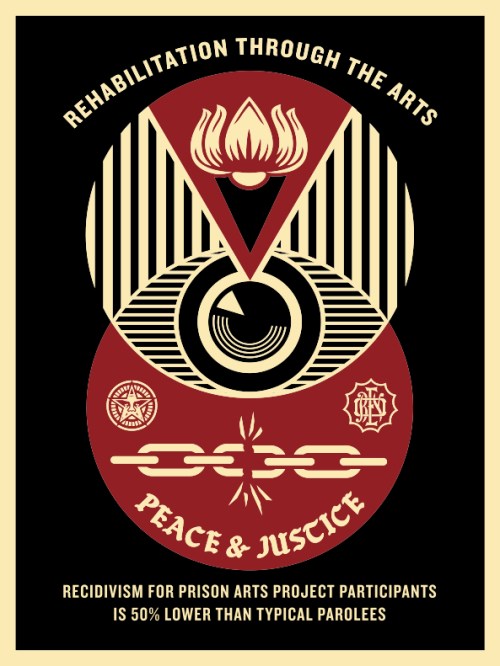
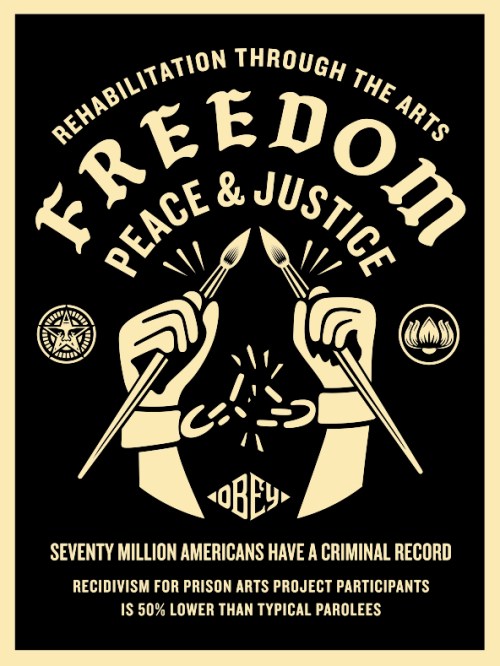
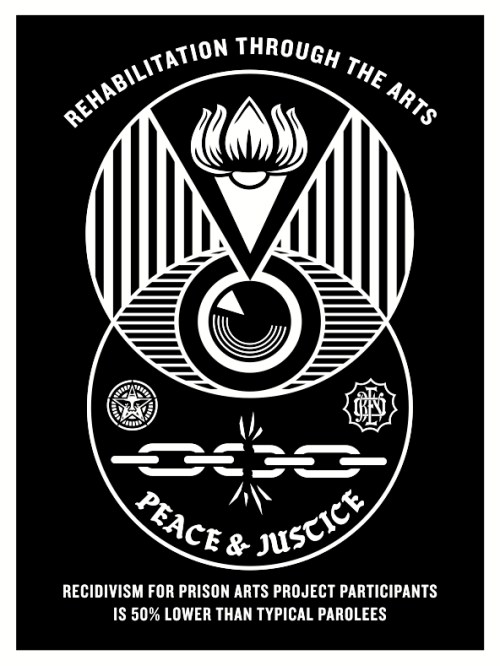
The high priest of street art just dropped half-a-dozen posters for use by your good selves against the prison industrial complex. #abolishprisons.
Made as part of the Philadelphia Mural Arts-organized Open Source project, they are classic Fairey, but the are free. And they are weapons in the fight.
“Open Source is a month-long, citywide celebration of innovation,” says Mural Arts. “Curated by Pedro Alonzo, the 14 projects of Open Source reveal aspects of Philadelphia’s urban identity. Open Source encourages artists to engage in community-centered explorations, addressing a variety of topics, including immigration, recycling, mass incarceration, the environment, community reinvestment, and displacement.”
The 14 artists at large in Philly are the Dufala Brothers, Sam Durant, Shepard Fairey, JR, Ernel Martinez & Keir Johnston, MOMO, Jonathan Monk, Odili Donald Odita, Michelle Angela Ortiz, Sterling Ruby, Jennie Shanker, Shinique Smith, Swoon and Heeseop Yoon.
Did I mention OBEY Fairey’s works were FREE? Download a PDF of the graphics here.



Be Their Megaphone
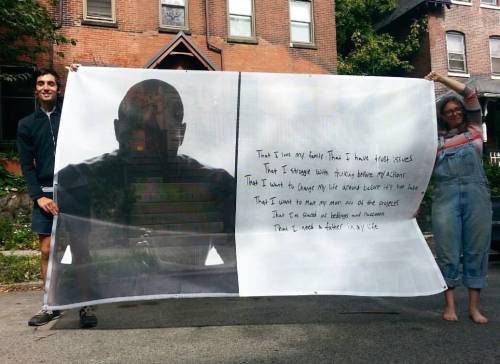
At 5 o’clock on Friday evening, advocates for juvenile justice system reform are marching on the General Assembly in Richmond, Virginia. You can join them.
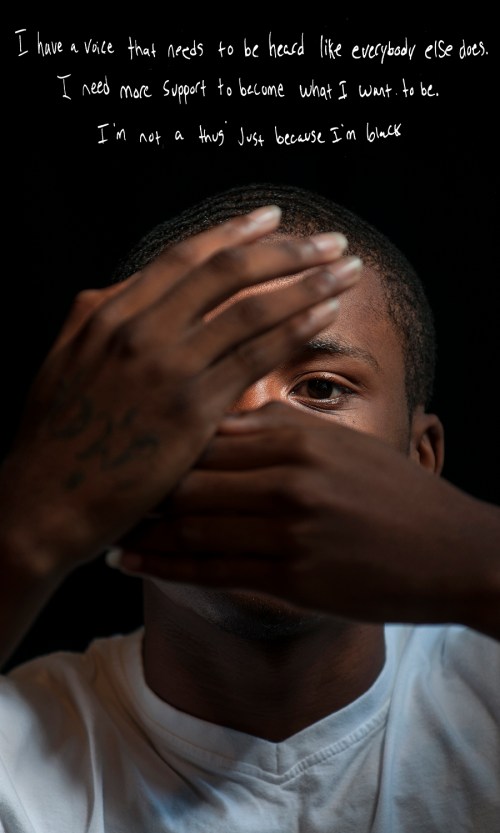
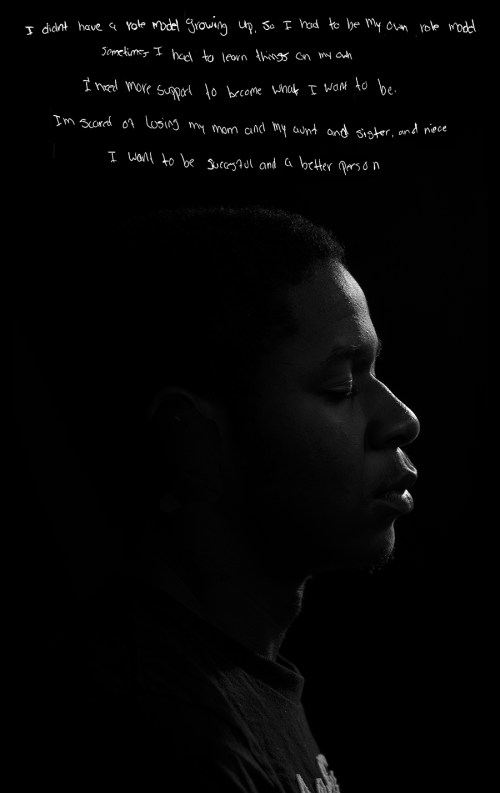
The Justice Parade for Incarcerated Youth will present, to the powers that be, the work produced by incarcerated youth this summer, as part of the Performing Statistics project. In the parade, a broad coalition of artists, legal and policy experts, community activists, faith leaders and returning citizens will champion the work. It’ll bring art onto the streets and ask the public to imagine a society without prisons for children.
Take drums, banners, trumpets, instruments, foghorns and your loudest songs and chants.
Carry art and banners made by incarcerated youth. Be their presence on the streets.
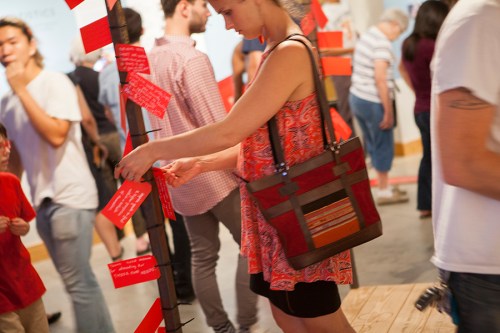
Take your own signs that answer the question, “How can we create a world where no youth are locked up?”

WHEN
Friday, October 2 at 5 p.m. Speakers at 5:30 p.m. Walking begins at 5:45 p.m.
WHERE
General Assembly Building 915 E. Broad Street, Richmond, VA 23219.
Parade goes from the General Assembly Building to the ATLAS gallery at the ART 180 art center for teens and youth. ATLAS is currently showing the Performing Statistics exhibition featuring creative work by incarcerated youth that talks about their experiences being incarcerated and alternatives to the system.
Be Their Megaphone

CONTACT
Mark Strandquist — 703-798-6379
Trey Hartt — 703-946-5217
performingstatistics@gmail.com
Performing Statistics is a Richmond-based art and advocacy project that connects incarcerated teens, artists, and Virginia’s top legal experts. The project is part of Legal Aid Justice Center’s RISE For Youth campaign.
Be Their Megaphone

THE TIME IS NOW
On the 13th October, the Supreme Court of the United States will convene to rule on Montgomery v Louisiana. Essentially, the decision will be made as to whether the ban on Juvenile Life Without the Possibility of Parole (handed down by Miller v Alabama in 2012) should apply retroactively. That is, should men who were tried as adults and convicted to LWOP before 2012 have their cases and sentences re-adjudicated?
Of course, I hope that we’ll see some return to common sense and see the United Sates turn toward the practices of the rest of the industrialised world by not putting kids in boxes for the rest of their natural lives.
At this crucial political moment, a new, interactive archive has launched online that brings the stories, images, characters and history of JLWOP to you.
The Natural Life Archive is a collection of extended interviews and portraits from the film Natural Life. Filmmaker Tirtza Even is harnessing the internet to bring us dozens of hours of testimony that she just wasn’t able to fit into her film. The archive is the third and final component of Natural Life — 1. the feature length single-channel video; 2. a gallery installation; and 3. this interactive online archive.
VISIT THE NATURAL LIFE ARCHIVE
BLURB
The project, produced and directed by Tirtza Even alongside the legal efforts of the Law Offices of Deborah LaBelle, challenges inequities in the U.S. juvenile justice system by depicting, through documentation and reenactment, the stories of five individuals who were sentenced to Life Without Parole (Natural Life) for crimes they committed as youth. The five will never be evaluated for change, difference or growth. They will remain in prison till they die.

There are over 2500 inmates in the U.S. who are serving a Life Without Parole sentence for a crime they committed as juveniles. The U.S. is the only country in the world that allows Life Without Parole sentencing for youth. The project’s goal is to portray the ripple-effect that the sentence has had not only on the incarcerated youth and their victims, but also on the community at large.
The video data accessible through the online archive is interfaced through a two-tiered navigable Quicktime movie. On the lower tier are phone interviews with the featured characters, coupled with staged scenes of life in prison reenacted by a group of high-school actors, and shot at an abandoned prison in Michigan. On the tier above is material drawn from over 50 hours of interviews with individuals who were involved with the crime, the arrest and the sentencing of the featured inmates. Among them judges, lawyers, police officers, reporters, wardens, teachers, child psychiatrists, legal experts and victims’ family members. The interviews are grouped in association with each of the featured inmates’ stories and are selected by moving the cursor to the right or left side of the image.
VISIT THE NATURAL LIFE ARCHIVE
BIOGRAPHIES
Tirtza Even is a practicing video artist and documentary maker, producing both linear and interactive documentary video work that represents the less overt manifestations of complex and sometimes extreme social/political dynamics in specific locations (e.g. Palestine, Turkey, Spain, the U.S. and Germany, among others). Even’s work has appeared at the Museum of Modern Art, NY, at the Whitney Biennial, the Johannesburg Biennial, as well as in many other festivals, galleries and museums in the United States, Israel and Europe, and has been purchased for the permanent collection of the Museum of Modern Art (NY), the Jewish Museum (NY), the Israel Museum (Jerusalem), among others.
Deborah LaBelle is an attorney, professor, writer and advocate who focuses on the application of human rights for marginalized communities. She has been lead counsel in over a dozen class actions that have successfully challenged policies affecting the treatment of incarcerated men, women and juveniles and their families. Ms. LaBelle is a Senior Soros Justice Fellow and, the first American recognized by Human Rights Watch as a Human Rights Monitor. In addition to her private practice, she is director of the American Civil Liberties Union’s Juvenile Life Without Parole Initiative. Ms. LaBelle is a recipient of Michigan’s State Bar Champion of Justice Award, recognized as one of Michigan’s top lawyers and received the National Trial Lawyer of the Year Award from the Public Interest Foundation (2008) and National Lawyer Guild’s Law for the People Award (2008). She received the Wade Hampton McCree Jr. Award for the advancement of social justice presented by the Federal Bar (2009) and the Susan B. Anthony Award from the University of Michigan (2010).

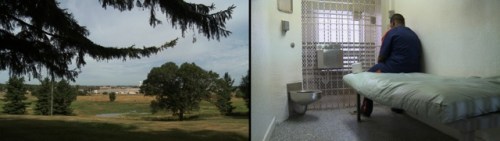
Set photo, from the filming of Demos: Wapato Correctional Facility. © ERNEST
In the northern reaches of Portland Oregon, in the quieter quarters of the St. John’s neighbourhood, sleeps a beast. Wapato Jail was built for $58 million but never opened. It has sat vacant since 2004. It has been used as a film set. They tried to sell it. At one point, the City of Portland put out an open call for alternative uses proposals. Some suggested it could be used as a garden and rehabilitation center. Others suggested it could be used to house Bush, Cheney and other war criminals.
Wapato has costs the tax payer $300,000 per year (a conservative estimate) to just keep the thing offline. One long expensive joke. Systems normal but never operational.


Demos: Wapato Correctional Facility, video still, 2015. © ERNEST
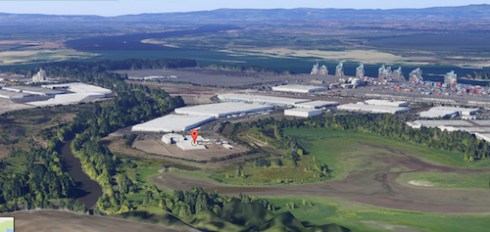
Screengrab of a Google Maps angled, aerial view of Wapato Jail, looking northwest.
ERNEST and DEMOS
When the arts organisation c3:initiative moved into St. John’s in 2014 it didn’t take them long to turn its focus to the empty jail. c3:initiative sponsored artist collective ERNEST as artists-in-residence. ERNEST have produced a multi-medium art installation, film, a book and public programs.
“Demos: Wapato Correctional Facility probes the many concerns that the vacant jail suggests: breakdowns in democracy, prevailing power structures,” reads the exhibition statement.
During ERNEST’s early research they discovered that coyotes had dug under many fences. Video footage shows that they will scale fences too to cross and inhabit the lush ground within the jail perimeter. These wily mammals, that have roamed the area far longer than the jail has stood, have found a way to ignore the unwelcome interruption of a hard and fast boondoggle. Coyotes continue their evolved routine and instead of fighting the jail just orient themselves around it. Ultimately, they operate to ignore the jail’s presence and minimise it’s impact on their rhythms.
Is the coyote a good metaphor? Might we find new solutions to old problems if we approach prisons, jails and social ills with a similar low-key pragmatism. Prisons might be the problem but so to might our strategies of opposition?
“Acting as a conjuror of sorts, the character of Coyote leads the video component of Demos, transforming the specific architecture, history and politics of Wapato Jail into a platform for conversation and collaboration,” says the press release.
While ERNEST are allied to prison reform and abolition arguments, their work doesn’t necessary look like the typically political and didactic protest-imagery. Bringing the subtlety of fine art to a brutish topic such as the abusive prison industrial complex is intriguing. I don’t know what to expect truthfully, which is why I am in Portland right now for tomorrow’s opening.
OPENING RECEPTION
Friday, September 18, 6:30-9:30pm
At c3:initiative, 7326 N. Chicago Avenue, Portland 97203.
Visitors are invited to join c3:initiative and the artists from ERNEST in marking the opening of Demos: Wapato Correctional Facility. Complimentary drinks and light refreshments will be served.
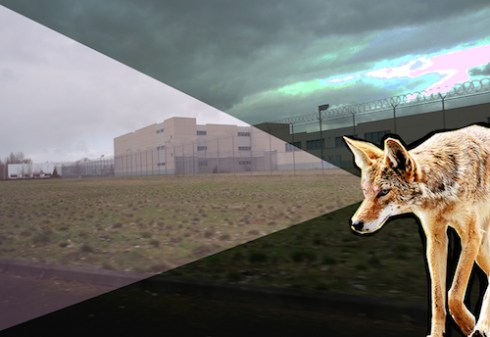
A graphic by ERNEST from an early conceptualisation stages of the project Demos.

Demos: Wapato Correctional Facility, video still, 2015. © ERNEST

Demos: Wapato Correctional Facility, video still, 2015. © ERNEST
THAT TITLE?
The project’s title takes its meaning from various interpretations of the word “demos”. The Greek word “demos” (pronounced “day-moss”), refers to the “village” or “people.” In English, “demo”, is used as a shorthand for “demonstration”, as reference to the “demo mix-tape”, or as the vernacular for “demolition”. ERNEST thus uses “demos” to refer to its interest in keeping their methods experimental and provisional, while creating opportunities for local participatory engagement.
PUBLICATION
The book, published by Container Corps, includes a collection of essays, artworks, research and primary documents. I have an essay in there about sketches made in solitary by a man named Ernest Jerome DeFrance.
The book’s contents are both specific to Wapato Correctional Facility, and related to general issues of incarceration, participatory citizenship, and the role of art in social justice and storytelling.
BIG SATURDAY EVENT
I’ll also be in the room for an open roundtable conversation — a broadened investigation of themes relating to the empty jail facility, both locally and nationally.
Saturday, September 19, 2015, 11am-1pm. Followed by a 12-1pm community meal and conversation.
I look forward to hearing from panelists:
Emanuel Price is the Founder and current Executive Director of Second Chances Are For Everyone in Portland, OR. S.C.A.F.E. works to reduce the rate of recidivism by providing support services to promote employment, empowerment, and community engagement for men in transition because Second Chances are for Everyone. Price is currently leading the organization in developing key programs and resources that will help reduce criminals going back into destructive lifestyles after being released from jail or prison. More information about Price is available here.
Melissa Salazar is a May 2015 graduate of Pacific Northwest College of Art, where she studied Communication Design. Melissa has recently become involved in activist work focusing primarily on incarceration of black and brown individuals. She has been influenced by events in her own life and seeks to bring awareness to an invisible society behind bars.
Yaelle Amir is a curator, writer and researcher who currently holds the position of Curator at Newspace Center for Photography in Portland, OR. Her writing and curatorial projects focus primarily on artists whose practices supplement the initiatives of existing social movements, rendering themes within those struggles in ways that both interrogate and promote these issues to a wider audience. She has curated exhibitions at Artists Space, CUE Art Foundation, Center for Book Arts, ISE Cultural Foundation, The Elizabeth Foundation for the Arts, Marginal Utility, and the Wallach Art Gallery at Columbia University, among others. Her writing has appeared in numerous art publications includingArt in America, ArtLies, ArtSlant, ArtUS, Beautiful/Decay, and Sculpture Magazine. She has also worked at major art institutions, such as the International Center of Photography, the Museum of Modern Art, and NYU’s Institute of Fine Arts.
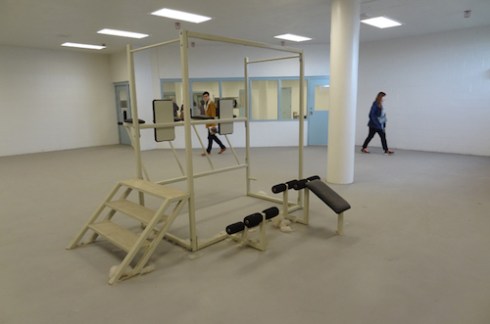
Members of ERNEST tour the gymnasium in the empty Wapato Jail, Portland, OR.

Demos: Wapato Correctional Facility, video still, 2015. © ERNEST
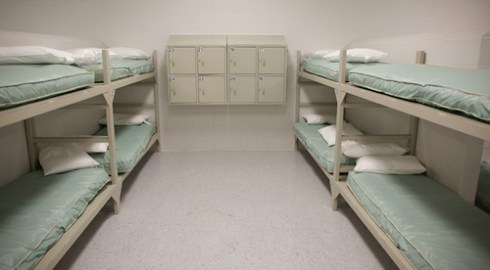
Photo taken in Wapato Jail, Portland, OR as part of ERNEST’s early research.
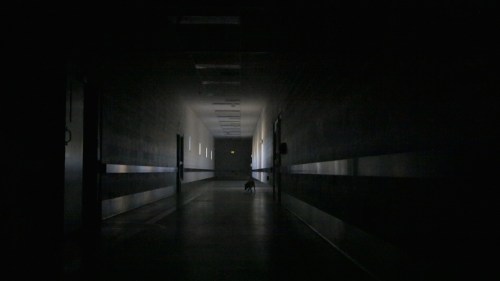
Demos: Wapato Correctional Facility, video still, 2015. © ERNEST
DETAILS
Demos: Wapato Correctional Facility
A project by ERNEST
September 18–November 22, 2015
Gallery Hours: Fri–Sun, noon–5pm at c3:initiative, 7326 N. Chicago Avenue, Portland 97203.
OTHER EVENTS
Reading Group: The New Jim Crow – Wednesdays, October 7, 14, 21, 7:00-8:30pm
Stories in Movement – Saturday, November 7, 5:00pm
No Thank You Democracy, The politics of non-participation, by Ariana Jacob – Sunday, November 22, 4:30pm.

 Prison Photography