
You are currently browsing the category archive for the ‘Documentary’ category.

British photographer Sebastian Lister is having a joint exhibition with Russian photographer Sergey Ponomarev entitled Russian Prison Theatre – A Photographic Journal at Pushkin House, London’s Russian Cultural Centre.
Earlier this year, I put Sebastian’s work into perspective with two contrasting posts; the first about the stereotypes of Russian prison imagery and the second about meaningful theatre programs as documented by Sebastian.
About the exhibition:
In 2009, British theatre director Alex Dower worked with prisoners in Perm Prison Colony 29, as part of Territoria International Contemporary Theatre Festival, staging three short stories – Chekhov’s The Burbot, Isaac Babel’s My First Goose, and prisoner Albert Sadrutdinov’s Butterfly.
Alex was accompanied by two leading photographers. The result is a set of extraordinary photographs that together provide a deep insight into contemporary Russian prison life – the prisoners, their work and their guards – as well as a view of a remarkable theatre project that captured the imaginations of the group of prisoners and took them on a journey beyond the narrow confines of their lives.
This collection of award-winning images presages the continuation of the companies work, in a prison in Kazan in November 2011.
Exhibition runs from Friday 16 Sept – Friday 7 October 2011, 4pm to 7pm Monday to Friday (and Sat 17 Sept – Sun 18 Sept, 11am to 4pm), at Pushkin House, 5A Bloomsbury Square, London, WC1A 2TA. Entrance is free.
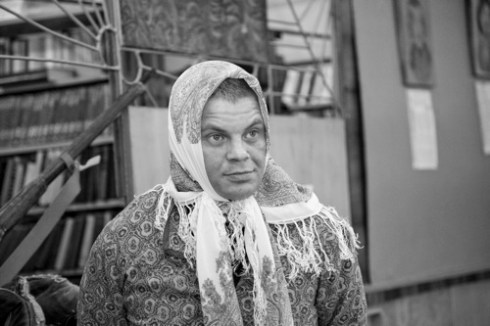
Sergei as Babushka © Sebastian Lister

Spanish photographer Fernando Moleres has embarked on a singlehanded and single-minded mission to improve the lives of juvenile prisons in Sierra Leone. His interview Visa Pour l’Image: Fernando Moleres’ struggle to help juvenile prisoners in Sierra Leone at the British Journal of Photography is a must read.
Moleres speaks of the incredible difficulty to raise money for his work – not his photography work, but his work to connect these children with their families (many of whom are unaware their children are incarcearated) and also his work to provide bail so as to “prevent the children seeing the walls of a jail in the first place.”
Moleres is clearly disillusioned by the lack of forthcoming support from groups he’d expect to be solid allies. Here’s some choose quotes that are a challenge to politicians and NGOs alike (my bolding):
“[In African prisons] you have more chances of dying in these prisons than anywhere else – you can die of diseases, malnutrition. Also, injustice is more flagrant than anywhere else. There are barely any lawyers, some detainees have spent years in prison without even going in front of a court. There is a deep injustice – deeper than in any other country such as Russia, India, Israel or the United States.”
“People don’t realise the extent of the injustice present in these prisons. They are forgotten by everyone. When I was asking for help to NGOs – the Red Cross, Médecins du Monde, etc. – no one, absolutely no one wanted to help me. Of course, I was there on my own initiative; so I didn’t have a project they could study, send to Europe for the green light, which would then be rescinded… There’s so much bureaucracy that in these cases it would just not be possible.”
“I’m the only one paying for all of this. I’m spending my own money. This exhibition, which is travelling around Spain at the moment, has received an award from the NGO Medecins du Monde. During the award ceremony, I asked them if they could help me finance this project. Their answer was no.“
“I think it would be easy for an organisation to force Sierra Leone to do something. The United Nations, for example, would be the perfect organisation to do so. Talking about the United Nations, when I was in Sierra Leone, a representative from the organisation came to the prison to visit the detainees. I went with him. He talked with a few dealers, the guards, etc. But when other detainees came to see him to denounce the injustice of the entire system, his answer was: “I’m not here to solve your personal problems.” This man, whose name is Antonio Maria Costa [his official title is Executive Director of the United Nations Office on Drugs and Crime (UNODC) and Director-General of the United Nations Office in Vienna], has access to the country’s vice president and home affairs minister. He could have done something about it, but he chose not to.“
Depressing stuff.
For my more general thoughts on Moleres’ work from Sierra Leone and other photographers who’ve documented juvenile detention in Africa see Fernando Moleres: ‘Merciless Justice’ from January, 2011.
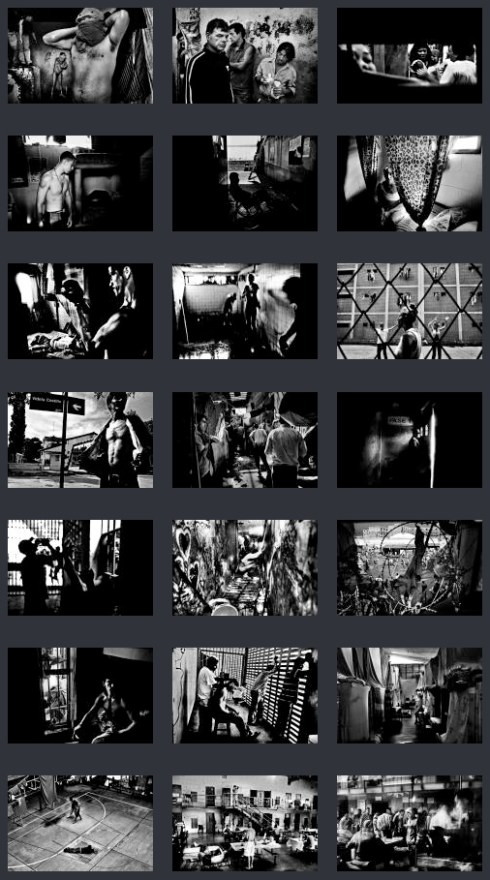
Valerio Buspuri‘s work from South American prisons is on view at Perpignan now. Buspuri says:
“A ten-year trip visiting 74 prisons for men and women in every South American country turned out to be a portrait of the continent, describing troubles, violence and massive overcrowding, as well as lifestyle, habits and the mood of the inmates. The story offers an in-depth view of the mind and soul of prisoners.”
Prisons as a portrait of a continent? That’s pretty bleak and too reductive for me.
The image of the prisoner using a “bathroom” probably sums up the vast differences in prisons between North and South American prisons; securing basic sanitary conditions is more of a concern than the other pressing issues of rehabilitation, and fair legal process.
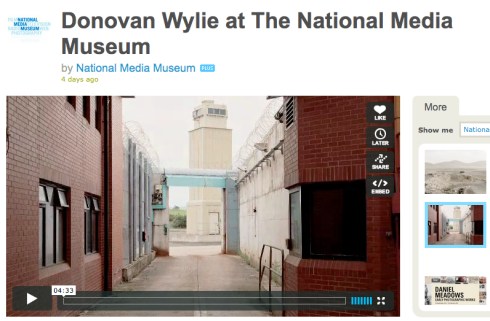
Donovan Wylie, whose work I’ve discussed before, talks about his approach photographing the retired Maze Prison (also known as Long Kesh).
Wylie, who describes his work generally as “conceptual-documentary” attempted at the Maze to pin-point the design decisions behind the politics behind the structures.

A Meeting of the Harvard Corporation, which invests Harvard’s endowment, guarded by police. © Gregory Halpern
As a resident alien, much of the American revelry is lost on me. But Labour Day? That’s a national holiday dedicated to the social and economic achievements of American workers. That’s something I can celebrate.
Today then, I point you in the direction of Gregory Halpern‘s neatly edged project Harvard Works Because We Do (it has a beginning, a middle and an end) about the service workers employed by Harvard University. From portraits to playful presentation (above) to messy colour film shots of a student sit-in to a successful outcome securing over $10 million in pay and benefits for the more than 1,000 service workers on campus.
Harvard Works Because We Do is a project full of character and a clear voice. Halpern was one of the sitting students. From his portfolio:
“Between 1994 and 2001, the endowment of Harvard University tripled, making the school the wealthiest non-profit in the world, second only to the Vatican. In the same years, Harvard heavily outsourced many service jobs to lower-paying companies, thus resulting in average wage cuts of 30% for the schools’ custodians, food-workers and security guards. In response, I got involved with a student group called the Harvard Living Wage Campaign and I began this project. My goal was to publicize the situation, to share the stories of a number of service-workers I had come to know, and to raise questions about the prevailing class-structure at Harvard and on college campuses in general.”
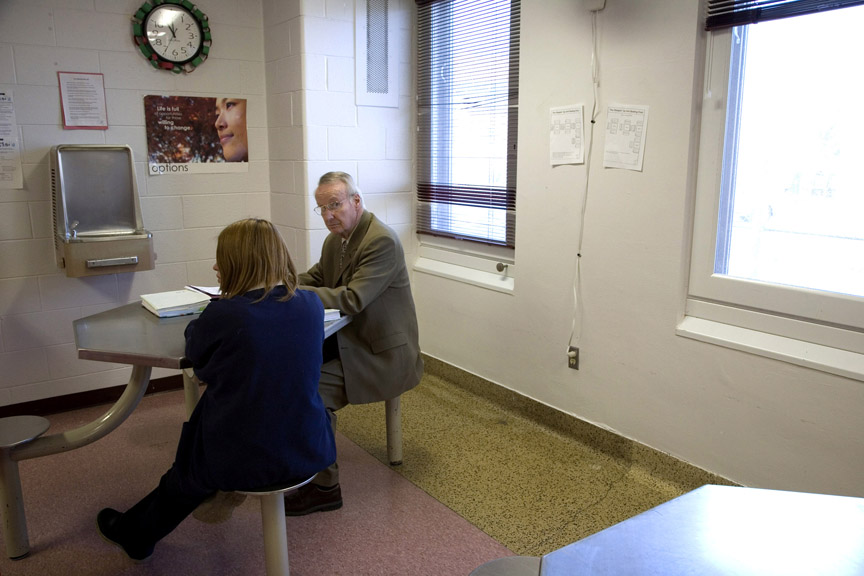
UPDATE 09.05.11 (11:45 PST): Sarah Hoskins emailed, “The warden who was there at the time, and allowed me access, had a lot of good programs for the girls. She told me once how many of them would commit crimes to actually get back in as it was often the only place where they were safe. I don’t know if you saw the stats in my overview regarding the abuse [“90% have been physically and/or sexually abused. The average age of first abuse is 9.83 years”]. Those numbers have always stayed with me. Especially as the mother of a daughter.”
– – – – – – – – – – – – – – – – –
In June 2007, Sarah Hoskins photographed in the Southern Oaks Girls School (now closed), a detention centre for youth operated by the Wisconsin Department of Corrections.
Girls School struggles with the limitations imposed by privacy laws disallowing the identification of minors. As a result we get interior architectural details, objects substituted for their makers and the backs of heads. This is no criticism of Hoskins as I’ve seen it many times before in photography of prison or jails where faces are off-limits to media.
This is a shame in one regard, Hoskins is shooting in a facility that houses youth with troubled lives and important stories, but looking through Hoskins’ lens we are made to feel outsiders. Maybe that’s a point that shouldn’t be dismissed? Maybe we need to accept photography in this instance for what it is – an act (and a product) that fully adopts and extends the poise, boundaries, prescribed separation of the site?
As compared to projects like Leah Tepper Bryne’s work from a NY State youth detention centre (I don’t know how Tepper Byrne negotiated permissions to show faces) Hoskins’ photographs leave you wishing for some more connection.
Of the portfolio, Girls School, I was most taken with the picture above and it is precisely because it bears a connection through eye contact. It’s an ambiguous connection to say the least; one might even argue it is a suspicious or patrolling look, but it is a look nonetheless.
Ed Kashi has recently confronted this same issue head on with Eye Contact an exhibition at the VII Gallery in Brooklyn and an interview with the New York Times’ Lens Blog in which he says:
“I think it’s because we don’t want to exist in our pictures. After 30 years of being a photographer, I don’t know if it’s a conceit. I don’t know if it’s self-delusion. But there is this idea that if somebody is looking into the camera, then somehow it’s inauthentic or it’s not a genuine moment. We don’t want anyone to think we were there.”
I’ve always been clear, as a viewer and a critic – I like collaborative photography in which the photographer is not stalking but engaging and discussing the ground they share with their subject. Photographers can’t disappear and there’ll always be images made that show that … often with the sharpest glance.
“If you want to be a successful street photographer I think you need to slow just a little bit, be a little more patient, be a little more humble, and slow it down a bit. I don’t believe in rushin’.” – Jamel Shabazz (Source)
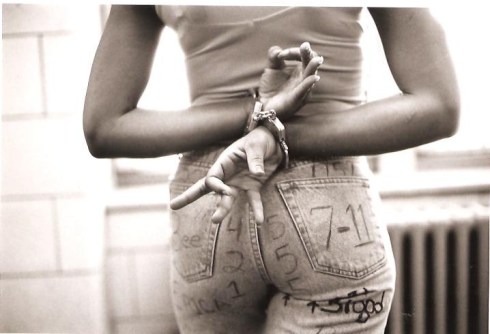
Female Blood, 1995 @ Jamel Shabazz
Jamel Shabazz is best known for his street portraiture of New Yorkers in the eighties. Shabazz has consistently delivered images of life, active bodies, colour, fashion and individual confidence. His is a street life on show.
Shabazz was also a correctional officer for twenty years, and for a large portion of that time at Rikers Island. Female Blood (above) is an image from the criminal justice system. It is heavy and deserves discussion, but for that we must wait. Jamel has agreed to sit down for an interview with me in October. To that end he has put up a print for fundraising toward Prison Photography on the Road.
Photographer: Jamel Shabazz
Title: ‘Female Blood’
Year: 1995
Size: 8″x10″
Paper: Resin coated black and white print.
Signed
Print, PLUS a postcard, mixtape (CD) and a self-published book – $600 – BUY NOW.
See also:
Interview with Format Magazine
New York Times Lens blog gallery, Through the Lens of Jamel Shabazz
Veteran journalist and photographer Sean Kernan, has kindly donated a print from his 1979 series In Prison to help with the PPOTR fundraising.

Photographer: Sean Kernan
Title: ‘Prayer’
Year: 1979
Size: 8″x12″
B/W inkjet, print. Signed.
Print, PLUS a postcard, mixtape (CD) and a self-published book – $425 – BUY NOW.
BIOGRAPHY
Sean Kernan is a widely exhibited photographer, writer, filmmaker and teacher. He has taught and lectured at Parsons The New School for Design, Pasadena’s Art Center College of Design, Maine Media Workshops and Santa Fe Photographic Workshops. When teaching, Sean focuses on creativity in photography. Sean is the author of The Secret Books (with Jorge Luis Borges), Among Trees, Photographs from Prison, and Kampala Boxing Club. Sean has won numerous awards, most recently an Honorary Doctorate from Art Center College of Design. His work has been exhibited in the US, France, Egypt, Greece, Mexico Korea, and Italy, and has been published in magazines world-wide. Sean has written about creativity, and the arts and commerce, in articles for Communication Arts, Graphis, Lenswork, Riverteeth, and others. In film, he was Associate Producer for the CBS special, To America., and he has worked on performances at MASS MoCA and Guggenheim Projects.
I’ll be interviewing Sean during PPOTR in late October.

 Prison Photography