
You are currently browsing the category archive for the ‘Documentary’ category.
Herman Krieger – stalwart of the Oregon photography community and Eugene resident – is a self-made specialist in the art of captioning. However, more than his quirky words, I appreciate the great lengths he goes to in order to document sites of the prison industrial complex.

View from Boise Gun Club, New Idaho State Prison. Herman Krieger
Krieger described the circumstances of the series, “The idea of making a photo essay on prisons and their settings came after driving from Tucson to Phoenix. The view of the prison in Florence, Arizona struck me as an odd thing in the middle of the landscape. At that time I was only looking at churches for the series, Churches ad hoc“.

With Lifetime Mortgage, Vacaville, California. Herman Krieger
“I then made some photos of prisons in Oregon and California. Others were made during a trip by car from Oregon to New York. I would have made a longer series, but I was too often hassled by prison guards who noticed me pointing a camera at a prison. They claimed that it was illegal to take a photo of the public building from a public road, and threatened to confiscate my film”, explained Krieger.

Room Without a View, Pelican Bay, California. Herman Krieger
Pelican Bay was opened in 1989 and constructed purposefully to hold the most violent offenders, usually gang members. Along with Corcoran State Prison, in the late 1980s, Pelican Bay ushered in a new era of Supermax facilities in California. They are remote (Pelican Bay is just miles from the Oregon border) and they are expansive. Their distant locations prohibit regular visits from inmates’ family members – a detail probably not lost on the CDCR authorities who sought to transfer, contain and stifle the aggressions of Californian urban areas.
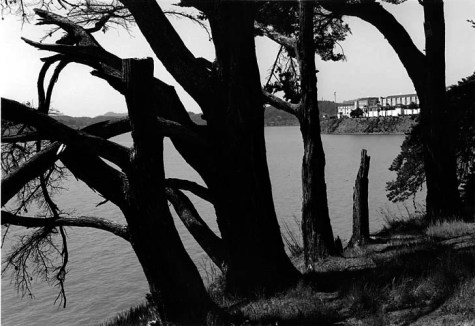
Bayside View, San Quentin, California. Herman Krieger
Having lived in San Francisco for three years, the policies, activities, controversies and executions at San Quentin State Prison were always well reported in the Bay Area press. One of the most frustrating repetitions of the San Quentin coverage was the journalist’s compulsion – regardless of the story – to remind readers of the huge land value of San Quentin and the opportunities for real estate on San Quentin Point.

Open for Tourists, Old State Prison, Wyoming. Herman Krieger.

Over the Hill, New State Prison, Wyoming. Herman Krieger
America is a large country. It should be no surprise that prisons are built in isolated areas – it makes economic sense to build on non-agricultural hinterlands and it makes strategic sense to purpose build facilities on flat open ground. More significantly, to locate these “people warehousing units” out of society’s view, allows convenient cultural and political ignorance for the authorities & citizens that sentenced men and women to America’s new breed of prison.
Krieger’s photographs summarise the key intrigues and detachment “we” feel as those excluded from prison operation and experience. Krieger, in some of his other images, gets closer to the prison walls and yet I deliberately featured these six prints precisely because of their disconnect. What terms, other than those of distance and exclusion, can we legitimately use in dialogue about contemporary prisons?
Lloyd DeGrane‘s work is long-term and it is honest. DeGrane would like to see more transparency surrounding American correctional facilities, “I think people, taxpayers should see what they’re getting for their money”. I came across DeGrane in James R Hugunin’s 1996 curated exhibit Discipline and Photograph.
DeGrane carried out his Prison series between 1990 and 2001, when he photographed within the state maximum security Stateville Correctional Center, Illinois and Cook County Jail in Chicago. The three photos featured here each depict scenes at Stateville.
DeGrane took the time to discuss the role of photography in sites of incarceration, a photographer’s best approach, the names and labels given to him by inmates and images of the spaces between cells.
Did you await each photo opportunity? While working, were you alone or accompanied on the corridor or wing?
“I was usually escorted by a counselor – an unassuming, non-threatening person. Sometimes I’d go into a unit and walk around by myself, being careful not to get out of the view of a correctional officer. Stateville is a maximum security facility so some of the inmates were violent offenders. I talked to the inmates directly, sometimes going into their cells. For the most part the officials let me browse freely and talk to any inmates I wanted. Things, to a point, were pretty transparent. When I came into a unit someone would usually yell out my arrival”.

Isolation Unit, Stateville Correctional Center, 1992. Lloyd Degrane
What is happening in the Isolation Unit photograph?
“This is the isolation unit – I called it ‘the jail within the prison’. Inmates who committed an offense in the prison were taken out of the general population and held there 23 hours a day with one hour for outside exercise. That [the display of legs and arms] was the first reaction to me being on the wing”.
“The inmates, for reasons unknown to me, thought I was a state official of some kind. But, after I got to talking with a few people independently I was able to photograph several inmates with no problems, with the exception of one inmate who would try to throw excrement at the guards”.

Lockdown Protest, Stateville Correctional Center, 1993. Lloyd Degrane
Explain the situation here, with the trash and food on the floor.
“That was taken in 1993. Inmates were ending a five day lock-down and totally disgusted by the lunch served (cold baloney sandwiches every day). So, they threw the servings out of their cells onto the floor. The floor of the wing is commonly known as ‘the flag’.”
“Guards eventually had to clean it up. I noticed when I came back the next week that the roach problem was severe. I had to tuck my pant legs into my socks so the roaches wouldn’t crawl up my legs”.

Protective Custody Unit, Stateville Correctional Center, 1992. Lloyd Degrane
The interaction between the guard and inmate in the protective custody unit is fascinating – it melds contortion, humanity, routine and unlikely types for the prison environment.
“The inmate was in the protective custody unit. That’s a pregnant guard that’s looking at him. He didn’t have a mirror so the only way he could see what was happening outside his cell was to stick his head out of the food tray slot.”
Did the subjects of your images, specifically inmates, see the photographs after they were produced/exhibited?
“I always made a small photo for the inmates. Sometimes they got them and sometimes the warden or captain (for reasons I do not know) didn’t get around to giving them the photo. But, I was able to get a little deeper into the lives of the inmates that received photos.”
How do you work?
“The images are made slowly and carefully. No surprises. Observation and discussion with the inmates and then photos. That was my modus operandi. It’s like going into someone’s home, they know you’re there! So, it’s best to be respectfully curious. Some inmates wanted nothing to do with me (I think they had committed other crimes on the outside and didn’t want to be recognized). Other inmates didn’t mind at all. I talked with people all the time. I think taxpayers should see what they’re getting for their money. Transparency is key. But, many prison officials believe the opposite and in their facility, they rule!
Final thoughts on the prison system?
Prisons – and not correctional facilities (as the State of Illinois has named their institutions) – the concrete human warehouses behind razor wire are just that! Buildings that confine people. It’s an existential experience in a world that is both separate from America but a big part of the American economy. One sees homemade signs along Interstate 55 that read, ‘Don’t shut our prison down’, ‘Save the prison, Save our jobs’ outside Pontiac, Illinois, home to another maximum security facility that may close because of state budget cuts.
Don’t get me wrong though, some people belong in prison. I met many men who raped innocent women, killed children, beat other men to death for a few dollars and some who murdered their cellmates. I was glad that I didn’t meet them in a dark alley in Chicago. But, one thought that always went through my mind was, most of these people will get out some day. Will they change for the better or just be better criminals?
You kept an index of how the prisoners referred to you. It’s length, variety and contradictions reflect well the complexity of social experience within correctional facilities. Can you remind us of the index?
This is my index of how inmates referred to me. Picture Man, White man, The Man White Mother Fuckin’ Press Man, Black Gang Lover, Spic Gang Lover, White Prisoner Lover, Straight Dude Looking for Something – Policeman, The Photo Man, The European, The Springfield Connection, A Fair Man, An O.K. Photographer, An Artist, Homes, Homey, Fuckin’ Photographer, Homo, Fuckin’ Camera Man, The Camera Man, Inmate Lover, The Police, Friend and Cute Mother Fucker (The label given to me by Richard Speck).
I have been supremely busy lately. I have eight projects in various stages of draft, but want to throw up some quality images, accompanying words and give a general shout out to Bangladesh’s photographic community.
Through my day job, I am familiar with Shahidul Alam‘s fine photography. I am more impressed by his stewardship of his nation’s photojournalist community, here, here and here. It was at Alam’s Blog that I discovered the images of Momena Jalil. I’ll simply repost the photographs and let them and the text speak for themselves.

Mother and Daughter in Cell, Momena Jalil, 2008
They were some 21 women. Some with with children who were free but had nowhere to go. So they stayed with their mother in captivity. It was a rare chance for us; it was the opening of the new women’s prison on eight acres of land situated on the Western edge of Kashempur. We were allowed because we were women and in those ten minutes we learnt what we could not have learnt in a lifetime. Losing one’s freedom strips us of the right to live. It is the strangest feeling, a chilling feeling. Freedom denied is freedom lost in the cradle of the life.

Cell, Momena Jalil, 2008. Having spent a year in prison already, 25-year-old Rahima still cannot reconcile with her living conditions.
‘It is difficult to cope with all that goes within the walls of a prison,’ she says. ‘There were times when the prison guards molested me…they do sexually abuse women,’ she says softly, hiding her face behind her white saree. As soon as the guards walk in her expression changes and she mutters, ‘we have no problems at all.’
From Jalil’s post it is obvious the system has affected the women very differently.
‘How can you not love the darkness, the stench, the suffocation and the crowds?’ asks fifty-year-old Khaleda in her raw husky voice. Her big eyes and rough expressions complement her loud and dominating voice. ‘After spending twenty-five years I don’t think I would ever want to go back. I get a taste of everything here – be it having tonnes of friends or being tortured, all of it is ‘fun’, she says sarcastically.
Khaleda knows the secrets of the prison, yet she refuses to speak up. ‘You know why I came here? My husband married another woman for no reason. He brought her home with her two children. I had done nothing. But he still did that. So I ate the two kids,’ she laughs aloud. ‘And then I got involved in a trafficking case and a lot more.’
In twenty-five years, Khaleda has seen the darkest sides of the prison. She has lived inside crumbled cells with no space to even sit or breathe. ‘I don’t like the idea of being moved to this new unit of the women’s prison. I love the people there. The Dhaka Central Jail is overcrowded, stinky, a torture hole but it’s still been my home for the past so many years,’ she says.
Khaleda is one of 200 women who are waiting to be shifted to the first female jail in Kashempur that recently opened.
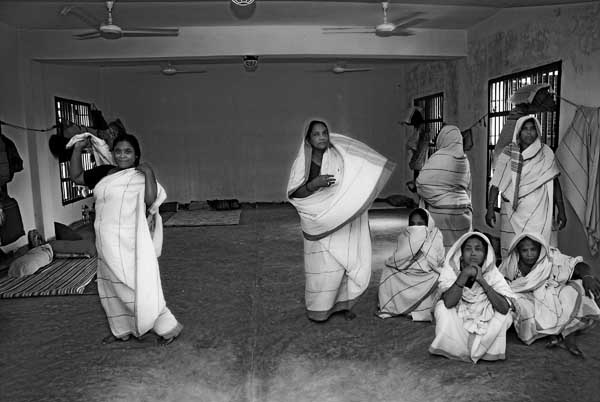
Women in a Cell, Momena Jalil, 2008
She was a mother, a daughter, a sister, a home-maker, a beloved wife but today she is only a prisoner behind bars serving a life sentence. She could have been many things but situation, time, circumstance and fate took all her rights to live free in society. Society finds them unfit because they cross the line of the law; they were not born to be criminals but time took them where they committed crimes… some killed step-children, some were found trafficking in-between borders, they were too many and we had too little time to know what crimes they were in for. We had ten minutes, the guards were rushing us, it’s unthinkable to let journalists roam inside a prison. But we have been there, my colleague and I; we saw faces up close, people who live among us, their faces hold the rumours of sisters, mothers…

 Prison Photography