
You are currently browsing the category archive for the ‘Fine Art’ category.

3 Years out of a Death Row Sentence (river)
It may have been her family member sucked into the U.S. prison system or it might be Amy Elkins‘ curiosity about the darker undercurrents of humanity that led her to pick up a pen and write to Americans on death row and serving life without parole.
Four years ago, Amy opened up communication channels with seven prisoners. “My original fascination was with the idea of being pulled away from society and how that affects people; how it affects memories,” said Amy during a sun-drenched interview in the garden of a Portland coffee shop.
“The whole project has been about searching,” says Amy. “I searched out these men on the internet, then I had to search my motives as to why I write these.” Later, Amy searched news clips and court transcripts to piece together the stories of the persons to whom she’d reached out.

26/44 (Not the Man I Once Was). Portrait of a man having thus far served 26 years in prison (18 of which were out of a deathrow sentence), where the ratio of years spent in prison to years alive determined the level of image loss.

13 Years out of a Death Row Sentence (river)
Unlike the fates of her condemned correspondents, Amy’s project Black is the Day, Black is the Night has no prescribed end-point.
As she has got know her pen-pals, collaborations have developed; common cell-house objects constructed, photographed and bought; portraits made from the last words of the executed; obscured quotes from the poems of her pen-pal friends; pixelated portraits of dead men walking, whose stories are dominated by the narratives of courts and institutions. Black is the Day, Black is the Night contributes new chapters … in some cases they might ultimately double as eulogies.
Of most interest to Prison Photography are Elkins’ composite landscapes. The catalyst for each is the description of a memory by one of Amy’s pen-pals – childhoods spent under cloudless skies, a born-again fascination with baptism rivers of the South, and wide open desert. Inmates had no access to images and Amy had only access to these scenes through their words. If reality exists for them or us, it’s a feeble reconstruction several steps removed. Searching again, this time through Google images.
To create the distorted landscapes and pixelated portraits, Amy uses a couple of mathematical formulas driven through photoshop. The numbers involved in each formula relate to the age of the pen-pal and the numbers of years they’ve been incarcerated. Amy wants to keep the algorithm under her hat, but it appears the longer they’ve been locked-up the more vague the visages become.

13/32 (Not the Man I Once Was)
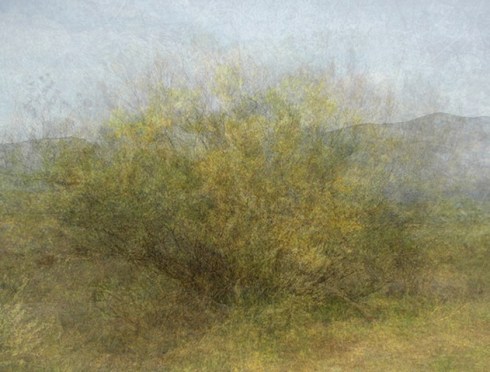
12 Years out of a Death Row Sentence (Dying Wish Retama Tree)

14 Years out of a Death Row Sentence (Dying Wish Retama Tree)
Currently, there are approximately 1,500 American citizens on death row.
“To be honest I’d never considered that this country has such a huge population of people on death row,” says Amy.
She began her research by signing up to one of the many online prison pen-pal services. The prisoners are categorized; one option ‘DEATH ROW INMATES’. “I clicked it and it was 50 pages; a sea of faces looking back at me. […] to click on one button and get hundreds of people looking for contact with the outside world. […] it’s difficult to describe. Nerve-racking and unnerving?”
Simultaneously engrossed and “freaked out”, Amy was conscientious in how she progressed. “It was never a photo project! I was just writing. I wrote with them for a year before I did anything with it. […] Part of that had to do with creating my own comfort levels,” explains Amy. “I deliberately contacted people who’d been in for 13 years or more. I didn’t want to write with someone who was angry. I wanted to be in touch with people who were at some sort of peace with the situation, who could look back and have some perspective.”
Of her seven original corespondents, three remain.
One was executed. The letters stopped coming and the news was confirmed through internet news stories. “No one went to his execution – no one from his family, no one from the victim’s family. He was poverty stricken. There was doubt in his case. He very well could not have done any of the things he was accused of. Every letter he wrote said ‘I am innocent’.”
Another pen-pal was released after serving 15 years, “He never contacted me [post-release]. He’s getting on with life. I hope he’s doing well,” says Amy.
A third pen-pal in Nevada wrote to explain that he was working on a novel and had developed a romantic writing relationship with another woman. He broke it off. “I was fascinated by that. It’s weird to be out here free and have them in there with relatively nothing and see them decide not to write. I respect that. They have so little, but they are careful about their time,” says Amy.
Amy’s pen-pal at San Quentin is erratic in his letters, writing after long periods of silence and often emerging from one [mental health] crisis or another. Amy has never felt that they’ve been able to develop a sustained relationship.
Her pen-pal in Mississippi writes on the 10th of every month but his letters are shorter now as he presses his last remaining options for appeal against execution. “From his letters he’s describing that it’ll be up before the year is out,” sighs Amy.
The sixth is in Georgia.

17/35 (Not the Man I Once Was) Portrait of a man having thus far served 17 years out of a deathrow sentence, where the ratio of years spent in prison to years alive determined the level of image loss.
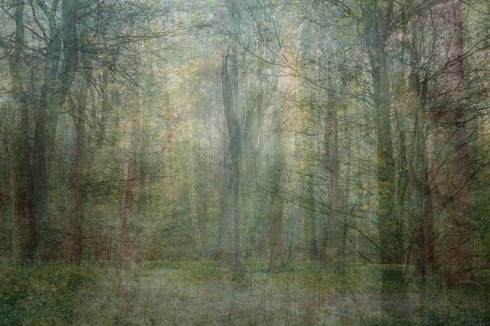
7 Years out of a Death Row Sentence (forest)

9 Years out of a Death Row Sentence (forest)
The most sharing, personal and colorful letters are from a lifer in the renowned Secure Housing Unit (SHU) at California’s Pelican Bay State Prison. Pelican Bay was America’s first SuperMax and currently the focus of the California Prisoners Hunger Strike. Of all her pen-pals, Amy can predict most this man’s future “The guy in Pelican Bay is going nowhere.”
On any given day in the U.S., there are 20,000 people held in solitary confinement.
“In California, solitary is a 6’x9′ cell with no windows and a steel door. I don’t think anyone would do well in that situation. People are extracted [from general population] and placed into these cells already upset and then they left to themselves. I don’t think prisoners are going to read the bible 30 times and then be okay,” speculates Amy, “I go stir crazy if I’m in my house for a day without going outside.”
Amy describes the Pelican Bay prisoner’s letters of unusual “formal British” tone. Unusual because he is originally from Tijuana, Mexico. “He must have been reading a lot of books?” wonders Amy.
“His first letter was 15 pages long and he said, very poetically, that he sits in his cell 23 hours a day. Once a day, he is shackled, walked down a corridor, on his own, and let into a concrete pen with 25 foot walls and a metal grate over it. He doesn’t describe it like ‘this is all I have, I can’t stand it here.’ He says he has 60 minutes of freedom, where he just gazes up at the sky; the only aspect of the outside world he can have. And even still, he watches the sky through a metal grate so it is not a pure version of open sky.”
Amy put out an open call for people to send her pictures of the sky. “I started making composites and sent them to him,” says Amy. “He didn’t understand the computer or photoshop. He hung them all up in his cell and wrote me back about how excited he felt being surrounded by skies. That was the first person I made something for and got feedback on. It felt like a collaboration. I started pulling images from other people’s letters. Other guys shared things about past experience, in some case decades prior. I’d repeat the process, make composites and send them.”
The prisoner at Pelican Bay has been in prison for 21 years, in solitary for 16 years. He has experienced another of Amy’s intrigues – juvenile offenders sentenced as adults.
“He went to Juvie, and he’s had no break in his incarceration,” says Amy.
“His mugshot was of him as a 13 year old boy. His profile read ’34 year old man, Pelican Bay State Prison’. But that was the last photo taken of him in the system. I’ve never been politically driven or hugely into criminal law. I’m just a portrait photographer interested in psychology and cultural anthropology. There is something about someone in that level of isolation, I just wanted to reach out. If that makes any sense.”

15/30 (Not the Man I Once Was)

4 Years Out of a Deathrow Sentence (ocean). A penpal 26 years into his sentence in a landlocked prison, described an early childhood memory that haunted him, of walking further and further into the ocean during low tide until the sudden depth and darkness before him overcame him with fear.
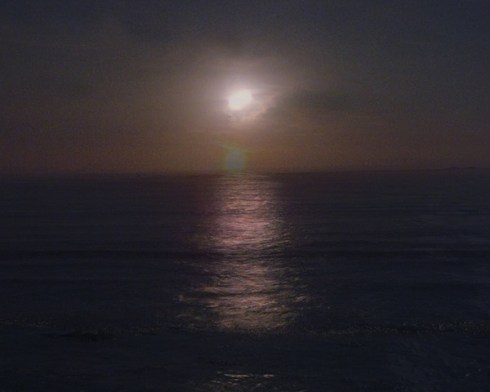
26 Years out of a Death Row Sentence (ocean)
Questions of whether or not Amy’s project in some way exploits these men have been floated before. She worked on the Black is the Day, Black is the Night “obsessively” during her Lightwork residency earlier this year.
“During my exit interview, the director expressed concern. How could I be this person in the world, who is fortunate enough to live a nice life, have a gallery, have nice things and focus on these individuals? He wanted to make sure I was ready for those types of questions. But, those question could be asked of all documentary work. It’s not about that; it is about getting the stories out in the world and having people think. I don’t know what people have in their minds [about me]. I’m not some “privileged girl” writing to “savage men”. No. I didn’t come in the project with any type of judgement. I like that I can talk about their stories in a way that’s not conventional. I think it’s correct that we can write; be trusting and share. […] I always write them back and I’m pretty open about my life as well.”
And the pen-pals reactions? “I don’t know if it’s that they’re bored or genuinely fascinated, but they’ve always expressed that they find it intriguing,” says Amy. “They’ve been sought out and they’re being interacted with. I’m not a housewife or someone for a church reaching out in those ways. I am their age and I’m reaching out with mail that’s perhaps a little more interesting than the average.”

Correspondence
To date, Amy has never profited from the project, but if – in the future – someone wanted to pay $10,000 for a landscape? “I’d sell. I’d send them the money. I have sent money to my pen-pals in the past. I have become friends with these men.”
The title, Black is the Day, Black is the Night, derives from a quote in a poem Amy received. “It spoke about that environment so well. The idea of being pulled away from anything. Experiencing no variance. Everything is the same; everything is dark. The poem is mind-blowing. Better for him to describe the situation than me.”
As the afternoon sun waned, and Amy and I squinted at the sky, that much was obvious.
All images © Amy Elkins

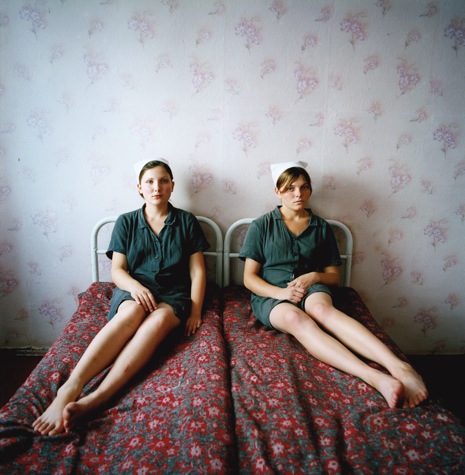
Last month the New Yorker Photobooth ran a sneak preview of Michal Chelbin‘s tentatively titled Locked series. At the time, I responded with some personal frustration that her portraits didn’t tell me enough of the subject’s experience. Having invited Chelbin to answer a few questions it is clear she uses ambiguity and mystery as tactics in her photography.
Q & A
When I first saw works from Locked I was fascinated, but I was also frustrated because I know so little about this region of the world. This was compounded by the incredible beauty of your portraits. After people have seen your portraits, what do you hope people will do, go on to think, talk about or read?
While I shoot almost all my work in Russia or the Ukraine, I feel that my interest is not social or geographical, but rather a mythological one. I return to these countries because they provide me with the visual contrasts that are the basic set up I am searching for – between old and new, odd and ordinary, as well as fantasy and reality.
When I record a scene, my aim is to create a mixture of plain information and riddles so that not everything is resolved in the image. A series of questions is asked when looking at these photographs – Who is this person? Why is he dressed like this? What does it mean to be locked? Is it a human act? Is it fair? What do we see when we look at a locked person? What do we usually think of when we hear the word “prison?” Do we try to find that his living conditions are reasonable, to comfort ourselves? Do we punish him with our eyes? Can we guess what a person’s crime is just by looking at his portrait? Does a killer still look like a killer? Is it human to be weak and murderous at the same time?
My intentions are to confuse the viewer and to confront him with these questions, which are the same questions with which I myself still struggle with.
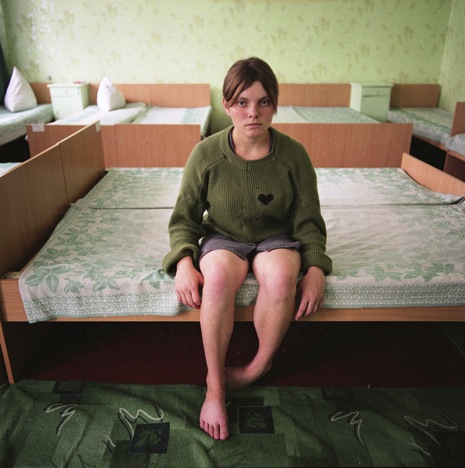
You’ve worked on this project for three years. You’re obviously very committed. Why prisons? Why prisoners?
Three years ago, while visiting the Ukraine, I passed along a high brick wall. Next to it stood two men. Our eyes crossed and I can still remember their eyes today – they expressed this mesmerizing human blend of fear and cruelty. I was later told this was a men’s prison and from that moment I wanted to see what was inside.
Why three years?
All my projects take more than one year to complete usually. I didn’t just go to one prison for several days and that’s it – this might have worked for a documentary photographer, but not for portraits, at least not for me. I shoot a lot in each trip but chose very few so to have a complete body of work require several trips. I wanted to visit several prisons, which meant [spending] more time. It takes time to organize.
How does Locked relate to your earlier bodies of work?
I think it is a direct continuation of Strangely Familiar and The Black Eye. I try to focus on people who have what I refer to as a legendary quality about them – a mix between odd and ordinary. I search for faces and eyes who express the complexities of life and for a gaze that transcends from the private to the common. I found it in the prison too.

From the series Strangely Familiar © Michal Chelbin

From the series The Black Eye © Michal Chelbin
How did you get inside the prisons?
Unfortunately, due to the nature of the project and the subject matter, I can not disclose how I got access.
You asked the subjects what they had been sentenced for. Is this information you’ll share with us, the audience?
I asked each subject what was he sentenced for, but only after the photo session was over. I didn’t want to this knowledge to influence me while shooting. I am thinking quite a bit about whether to share or not share this information. Usually people who see the images ask me what this person did and most viewers do want to know. But I don’t want it to become something “documentary”, like “this is a portrait of a rapist etc”.
I think that when the work will be shown in an exhibition, I will put this info available for the viewers but not next to the photograph (like in a separate list). Same in the monograph – maybe a list of plates in the end of the book, but not next to the image.
What makes a good portrait?
God … I wish I knew. Well, I can say that my images take the form of portraits and focus on visual contrasts. I find people to be the perfect subjects; they possess contrasting qualities that seemingly cannot co-exist in them as humans.
I like it when a photograph leaves a taste of mystery, or in other words, I think it works when an image presents more questions than answers. For me, the image is like a gate to thousand possible stories, some appealing and some troubling.
People often ask me about my interpretation to my photographs, since the images can be read in different, sometimes contradicting ways. My answer is that I honestly don’t know, and my opinion doesn’t really matter.
Were there any surprises or difficulties during the project?
There were hardly any difficulties with the subjects. Most of them agreed to be photographed. Especially in portraiture, it is impossible to photograph someone who doesn’t want to be photographed. So if someone refused, I respected it.
POSTSCRIPT
I neglected to ask Chelbin why the majority of her subjects are youths. As she said, Locked is a continuation of her other series Strangely Familiar and The Black Eye which are about gymnast/circus performers and young athletes, respectively. Through her lens, juveniles encapsulate contradiction.
I found this quote (my bolding) by Chelbin from an interview with Creative&Live about Strangely Familiar in which she describes her approach:
“Many of my subjects are adolescents, in this difficult age between innocence and experience and I try to create an informal scene, in which they directly confront the viewer. As performers I think they mature very quickly – with the seductive costumes, the show it self might be more for adults then for kids. They always had a fake smile on their face, “a mask”, so my first instruction was to tell them not to smile. It allowed me to focus on them as individuals.”
I am left to wonder if – outside the frame of her portraits – any of Chelbin’s incarcerated subjects have cause to smile?

FURTHER READING
A Conversation with Michal Chelbin, on Nympthoto
Interviews: Michal Chelbin and The Black Eye, on photo-eye
Spoken Word: Michal Chelbin, on Workprints
Sailboats and Swans: The Prisons of Russia and Ukraine, on TIME’s Lightbox

Schedule, 50x50cm, Ed. 3+2P/A
The two airliners flown into the World Trade Center towers were props of a devastatingly selfish and lunatic ideology. Ten years ago, my Dad and I watched the telly in his front room and watched the first tower burn and the second plane hit. It was just before 2 in the afternoon.
The visual shock of fireball plumes at eighty storeys above ground, or the dispersal of debris and bodies, or the engulfing clouds of dust over Lower Manhattan, cannot compare to the emotional shock and trauma spread far and wide as a result of those two murderous impacts on that clear September morning.
As I watched footage of the 9/11 Memorial in New York my heart went out to the victims’ families and I cannot imagine difficulties faced for those in their many journeys of healing.
Just as the events of September 11th 2001 make no sense, so too has the American response. I want to say simply that while sympathies for the victims and victims families are essential, sympathies for the Bush administration’s decade of war are not.
A few weeks ago, I got an email from James Pomerantz asking, “Have you seen this craziness?” James was referring to Francisco Reina‘s Strauss’ Legacy.

Peacemaker 03, 50x35cm, Ed. 3+2P/A
Strauss’ Legacy may be incendiary, angry and even a bit cack-handed, but as I’ve already suggested there have been many reactions to 9/11 and, I for one, am not ready to dismiss a photographic project based purely on the fact that the imagery is coarse and confusing. U.S. foreign policy since 9/11 has been coarse and confusing.
From Reina’s statement:
Strauss’ Legacy focuses on the so-called neocons and the way in which their presence in the American presidential administration on September 11, 2001 shaped events. Particularly close attention is given to the role played by a number of multinational corporations in a conflict which began under the name “Operation Enduring Freedom” and turned into a perfect market niche for multi-million dollar earnings. […]
Ideas were espoused by Strauss’s disciples and followers, leading to the creation of the Project for the New American Century (PNAC) in 1997.
PNAC is a highly controversial organization. Many people claim that the project advances the notion of total military and economic world dominance based on the idea that the 20th century was the “American Century,” and that this supremacy must continue into the 21st century. The only way to achieve this domination is by scaring the public with the specter of a dark enemy whose mere existence posed a threat to the survival of the American nation, thereby making it possible to carry out their ambitious plans. This is one of the goals of the neocons, and they were prepared to do whatever it took to attain it. September 11, 2001 was the match that lit the fuse on the savagery that continues today.
9/11 was a catastrophic day. For the 3,000+ people that died then and the hundreds of thousands that have died since in the folly that was the War on Iraq and in the unwinnable war in Afghanistan. Profits and gains have been made but very few of them have been for American families.

Enduring Freedom, 67x85cm, Ed. 3+2P/A
Donovan Wylie, whose work I’ve discussed before, talks about his approach photographing the retired Maze Prison (also known as Long Kesh).
Wylie, who describes his work generally as “conceptual-documentary” attempted at the Maze to pin-point the design decisions behind the politics behind the structures.

Untitled #1, by Steve Davis. From his ‘Captured Youth’ series. 8×10 on a 10×12 heavyweight archival paper, for $300. Signed. Special Edition of 4.
Steve Davis is an old buddy. I shouldn’t have been surprised he quadrupled-down on the generosity. He’s kindly offered a selection of prints to sell in order to raise money for my Prison Photography on the Road Kickstarter project.
Our conversation went something like this:
Pete: I didn’t want to ask, because I don’t want to interview you. You’ve answered everything I can think to ask. I mean we could talk about photography non-stop, but about prisons … (tails off)
Steve: What do you need?
Pete: Well, ideally some mid-level incentives, something around $300.
Steve: No problem, I’ll find some images, probably a couple that have not been seen before. We’ll print them small in a special edition of four, four of each, that way you can offer “a choice of one from four”.
Pete: Thanks Steve.
Steve: No problem.
Pete: No, really, thanks Steve.
Steve: No, really, no problem Pete.
– – – – – – – – – – – – – –
A Steve Davis print PLUS a postcard, a mixtape and a self-published book – going for $300. BUY NOW.
– – – – – – – – – – – – – –
CLICK ON IMAGES FOR LARGER VIEW
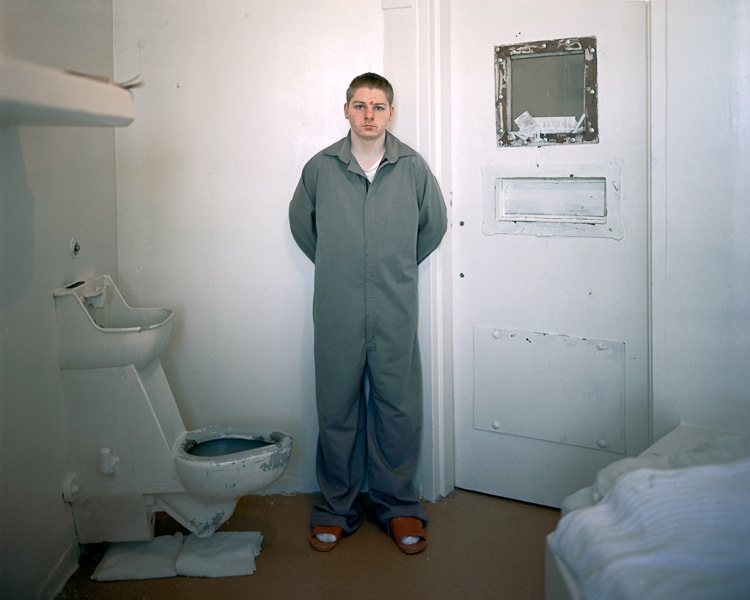
Untitled #2, by Steve Davis. From his ‘Captured Youth’ series. 8×10 on a 10×12 heavyweight archival paper. Signed. Special Edition of 4.

Untitled #3, by Steve Davis. From his ‘Captured Youth’ series. 8×10 on a 10×12 heavyweight archival paper. Signed. Special Edition of 4.
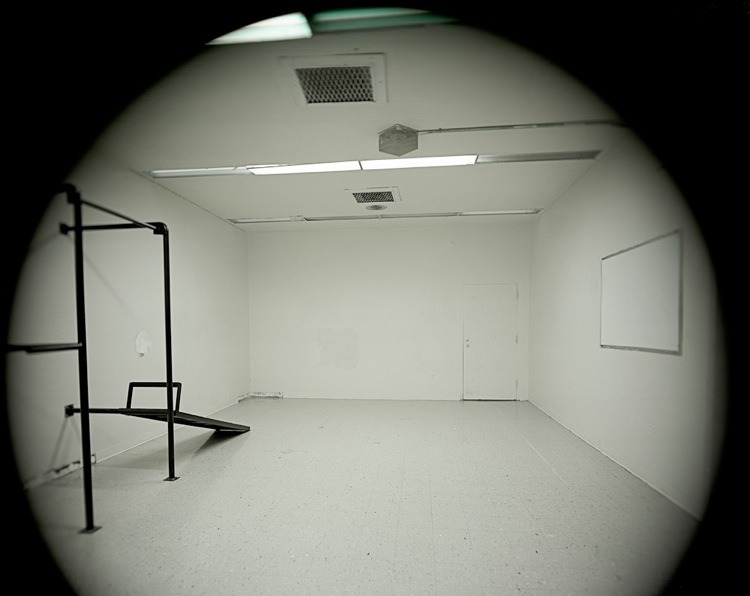
Untitled #4, by Steve Davis. From his ‘Captured Youth’ series. 8×10 on a 10×12 heavyweight archival paper. Signed. Special Edition of 4.
A Steve Davis print PLUS a postcard, a mixtape and a self-published book – going for $300. BUY NOW.
– – – – – – – – – – – –
See all available prints as part of my Kickstarter fundraising campaign.

The subjects of The Living Road, Noel Jabbour‘s portrait of prostitution on the Italian roadside, are not anonymous like those women in Mishka Henner, Paolo Patrizi and Txema Salvans‘ photography.
Other notable projects in Jabbour’s portfolio are Palestina, Palestinian Interiors and One Million $ Homes.
Thanks to Hester for the tip off.
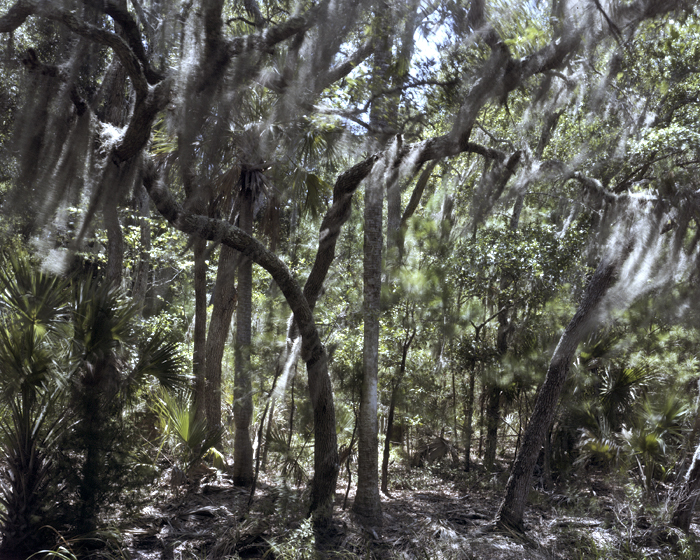
Forest, St. Helena Island, South Carolina, 2010
Dana Mueller ‘s series The Devil’s Den are studies of former prisoner-of-war camps in which German POWs were put to work by the US military. At the end of WWII, there were over 400,000 prisoners who worked on local farms and in small industries.
From Mueller’s project statement:
“There is an irony where these German soldiers, both high-ranking Nazi officers and foot soldiers, were tilling the fields, cutting the lumber, picking apples, taking care of the American soil. This caring, benign work with the land stands in complete contrast to the horrific actions by Nazis and German soldiers in Eastern Europe of that time, such as Hitler’s scorched earth policy. […] Romanticism has played a role in understanding the relationship of Germans to the landscape. In some photographs the land is overgrown appearing in a kind of primal state, suggesting the return to the original forest. It also suggests a Fascist aesthetic of purity promoted by pre-war German culture. Innocence and purity can be seen as a natural desire to regress after one has become corrupted.”
I was fascinated by this little known chapter of U.S. history. Dana answered a few of my questions.
How did you arrive at this subject?
History, politics, memory and our understanding of individual experiences verses collective memory of past events, especially war, always interested me. As East German, my ‘German’ identity was shaped by the two wars. I talked at length with Art Space Talk about my personal responses.
As much as this is a personal investigation I want there also, ideally, to be a collective engagement with places of our past. With passage of time comes nostalgia and romanticism, which is a very complex way of relating, looking at the past.
Jeff N. Wall – for Southern Photography – recently wrote about one photograph of mine; it was wonderful to know that someone would spend actual time discussing a photograph and as an American to relate it to his own American history.

Camp Edenton field, Northeastern Regional Airport, Edenton, North Carolina, 2009, Photograph by Dana Mueller and Bonnell Robinson.

Near Camp Camden, Kershaw County, South Carolina (branch camp under Fort Jackson, SC) 2010.
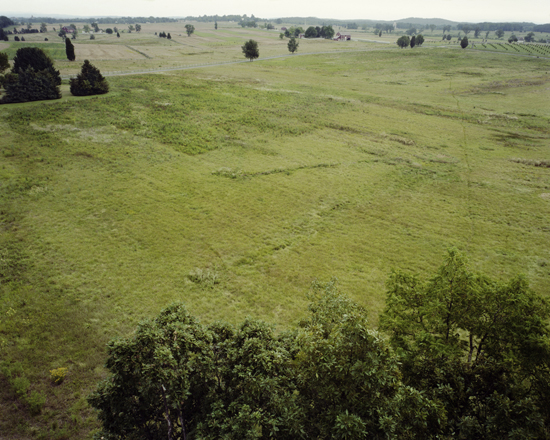
Site of Pickett’s Charge, Gettysburg, Adams County, Pennsylvania, 2009. In 1944 tents for a German prisoner-of-war camp were erected on the field of Pickett’s Charge.
How do you think of landscape?
There is power at just looking at a landscape knowing that an event took place at one time, it is not what we see that sparks our fascination with the past, it is what remains invisible.
Photography is often about witnessing and revealing, but not here. In The Devil’s Den I suggest and contemplate; in relation to the experiences the soldiers had, the American guards had and the civil population who had them work on their farms, married their girls, etc.; in relation to the landscape and German identity – both the mythical and very real ties to the land, the homeland which define one’s nationality, and the irony that German soldiers found themselves here.
I am interested in crossing historical planes, i.e. the site of Pickett’s Charge is not only relevant to my ideas but also to American [Civil War] history, and those two come together; both relate to war, participation, consequences and follies.
What are your influences?
Romanticism in literature: all W.G Sebald’s works, especially Rings of Saturn, Emigrants and On the Natural History of Destruction, Simon Schama’s Landscape and Memory, and many others that not necessarily discuss memory and landscape but have Eastern European backgrounds, i.e. Brodsky, Eva Hoffman, Milan Kundera, Czeslav Milosz. Also, the visual works of Anselm Kiefer and Casper David Friedrich.
How were the prisoners originally captured?
The North African Campaign by the allies began in 1940, between the Brits and the Italians. The Germans moved in in 1941. The U.S. got involved in late 1941 and militarily in 1942. Shortly after, the US Army created a prisoner-of-war camps all over the U.S. for captured German soldiers, many of whom were from Rommel’s African Tank Corps.
Others were captured at sea as German U-Boats neared the east coast, but there were not that many, and it happened sporadically. Many Germans were shipped from interim camps for German POWs in Normandy, France.
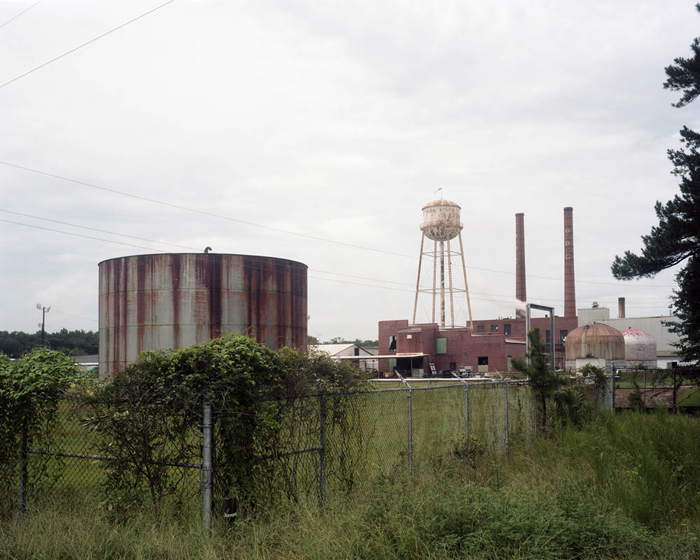
PPC factory near Camp Camden, Kershaw County, South Carolina, 2010. German prisoners-of-war worked at PPC factory between 1942 and 1946.
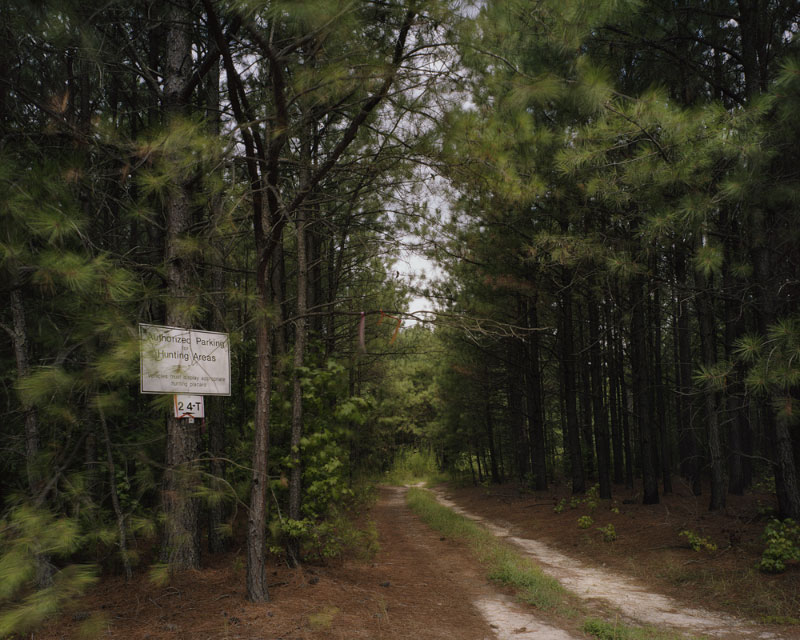
Camp Lee at Fort Lee Military Base near Petersburg, Virginia, 2009.

Camp Edenton, Northeastern Regional Airport, Edenton, North Carolina, 2009. North Carolina received its first group of POWs when German sailors were rescued from U-boat 352 that sank off the coast on May 9, 1942. The War Department eventually set up seventeen base and branch camps of Fort Bragg including Camp Edenton.
What happened to the prisoners?
Most prisoners were sent back to Germany after the war ended or a year later. The camps were in general also seen as rehabilitation facilities, where the American government wanted to re-educate the Germans in terms of democratic societies. As I talked to some historians, they mentioned that the foot soldiers and those less tied to Hitler’s ideology were stationed in camps on the east coast, higher ranking Nazi officers were send down south or west (Texas for instance).
Within a camp if there were a mix of soldiers, those who had allegiance to Hitler and never wavered and those who were happy to get out of the war, tensions existed and fights broke out. Therefore, they separated them depending on how ‘re-habitable’ they were. Nazis would rally at times in the camps but it never got out of hand as guards prevented revolts.
Most prisoners made friends with the Americans, they had their own newsletters, celebrated their holidays and some married American women. There were isolated escapes, most were caught soon after they fled. Most escapes were a result of the soldiers not wanting to return to Germany because Germany was completely devastated and life was better here, or Nazis knew they were not welcomed at home. Most prisoners had to return home unless, as I said, they married but those were very isolated instances.
Camps maintained strict guidelines and soldiers were treated well – times have changed when we look at Guantanamo Bay today.
Prisoners were used for labor, and some made even a little money so they could buy cigarettes and such. Off-and-on, some former German POWs come back to visit the camps and celebrate anniversaries even today. It’s strange to imagine that anyone would want to come back to where they were imprisoned. Not all was rosy – there were tensions between American guards and the prisoners, but overall the soldiers contributed to lumbering, harvesting, laboring in factories, etc and were tolerated by most of the American public. Of course, there were many Americans who thought ‘Why spend money to keep these people here?’ but as long as the prisoners contributed in terms of labor the practice became more accepted.
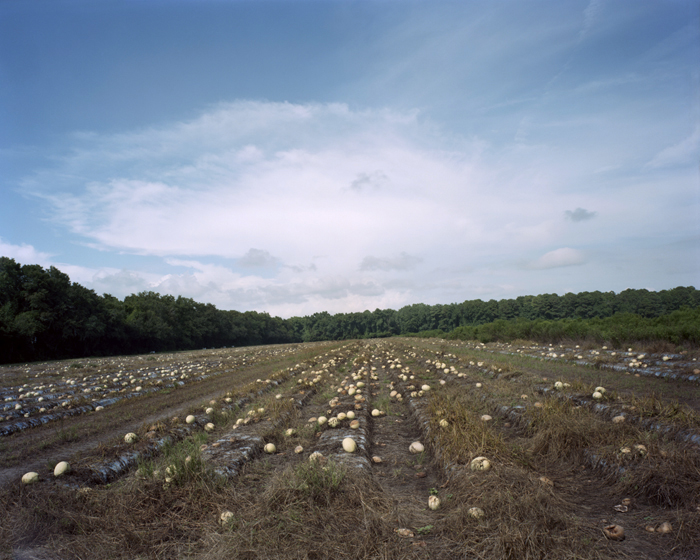
Melon field, St. Helena Island, South Carolina, 2010

Tomato field, St. Helena Island, South Carolina 2010. German prisoners-of-war stationed in Beaufort, SC, lumbered forests, worked in the fields and on farms at St. Helena Island.
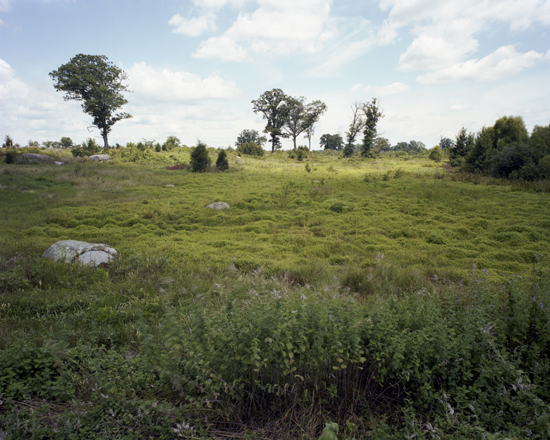
Gettysburg, Adams County, Pennsylvania, 2009.
Are these sites marked?
Not all of them are forgotten. Only some are marked and some are just known to be sites by locals or at the Historical Societies in towns. For example, the site of Pickett’s Charge which is imbued with American Civil War history was also, amazingly, the field where they decided to put up a German POW camp. I found a sketch of the camp in Gettysburg. In 1944, it was mostly just tents. Once winter arrived, they moved POWs to more solid structures, some existed on military bases already and others were built for them, such as Camp Pine Grove, Cumberland County, Pennsylvania. The foundations of the camp’s facilities are still visible underneath the overgrowth.
Other areas where prisoners actually worked I found through coincidence as I traveled along and inquired, for instance Sheldon’s farm and cotton field was owned by an American family whose son I met by chance near Elizabeth City, NC and who told me that he remembered the prisoners working in the field. His parents treated them well and the soldiers seemed content.
Camp West Ashley (below) is only place I photographed that had a marker. The ruin, which consists of a chimney, was saved by the residential neighbors who petitioned to save the historical spot instead of having it torn down, moved and the small piece of land used for development.
Other places are still working military bases, such as Camp Peary in Virginia (below) which I had no access to because today it’s the location of a covert CIA training facility known as “The Farm.” and I needed to improvise and find other ways of photographing it.
The camp at Beaufort, SC (below) was very interesting as the camp was located where is now a recreational park and structures of the building were only recently demolished, which made local news. So in terms of finding things, I base my direction of where I go on facts from literature, see below, or I just go to areas that are known to have had prisoners and I talk to people who might know the local history and then they tell me stories, or I find references at the local library or Historical Society.
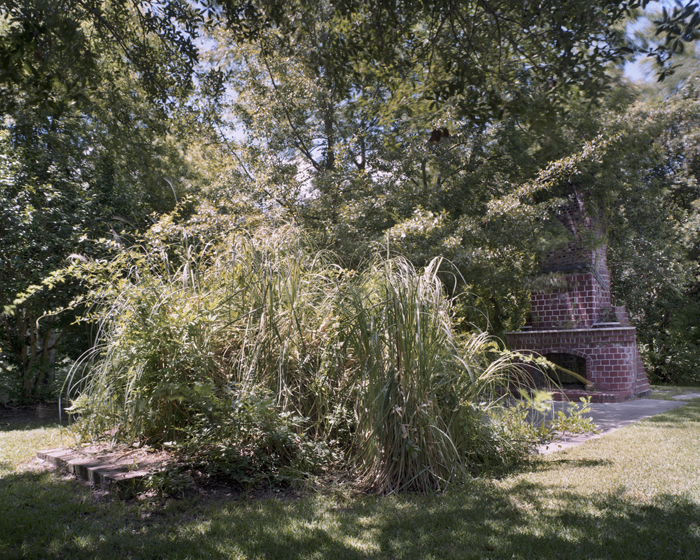
Camp West Ashley, Charleston County, South Carolina 2010. The remaining chimney marks one of five prisoner of war camps established in the Charleston area toward the end of World War II. The West Ashley camp existed for only two years and consisted mostly of tents.
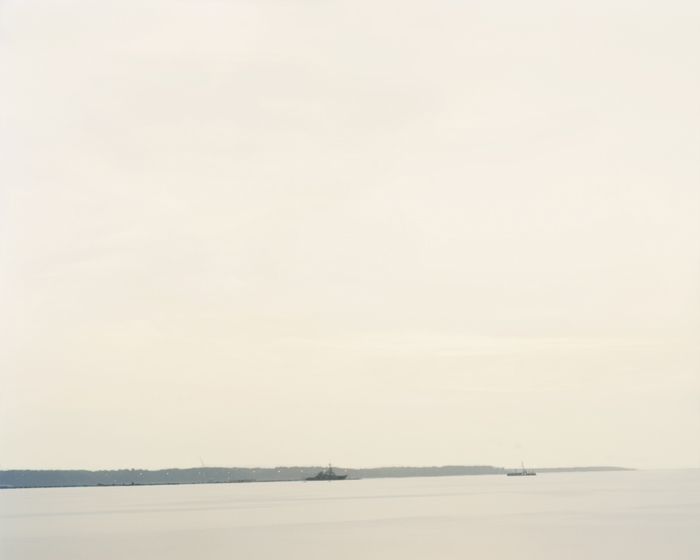
Camp Peary across the York River, York County, Virginia, 2009.

Site of former German prisoner-of-war camp, Beaufort, South Carolina 2010. The camp was located at Pigeon Point Park where barracks of the camp were recently demolished.
And finally, what resources exist for readers who want to know more about his shrouded episode of American history?
In regards to contemporary American politics, Hendrik Hertzberg at the New Yorker wrote Prisoners, a very interesting article some months ago. As for books, I recommend:
Stark Decency: German Prisoners of War in a New England Village, Allen Koop
Nazi Prisoners of War in America, Arnold Krammer
Hitler’s Soldiers in the Sunshine State: German POWs in Florida (Florida History and Culture), Robert D. Billinger Jr.
Stalag Wisconsin: Inside WWII Prisoner of War Camps, Betty Cowley
We Were Each Other’s Prisoners: An Oral History Of World War II American And German Prisoners Of War, Lewis H. Carlson
Behind Barbed Wire: German Prisoner of War Camps in Minnesota, Anita Buck
Guests Behind the Barbed Wire, Ruth Beaumont Cook
The Barbed-Wire College, Ron Theodore Robin
Nazi POWs in the Tar Heel State, Robert D. Billinger Jr.
Local libraries and Historical Societies have references to communities that housed German POWs. Both will have actual news materials and old photographs available. I found these original photographs of German POWs and campsites in Pennsylvania, at the Adams County Historical Society, PA.
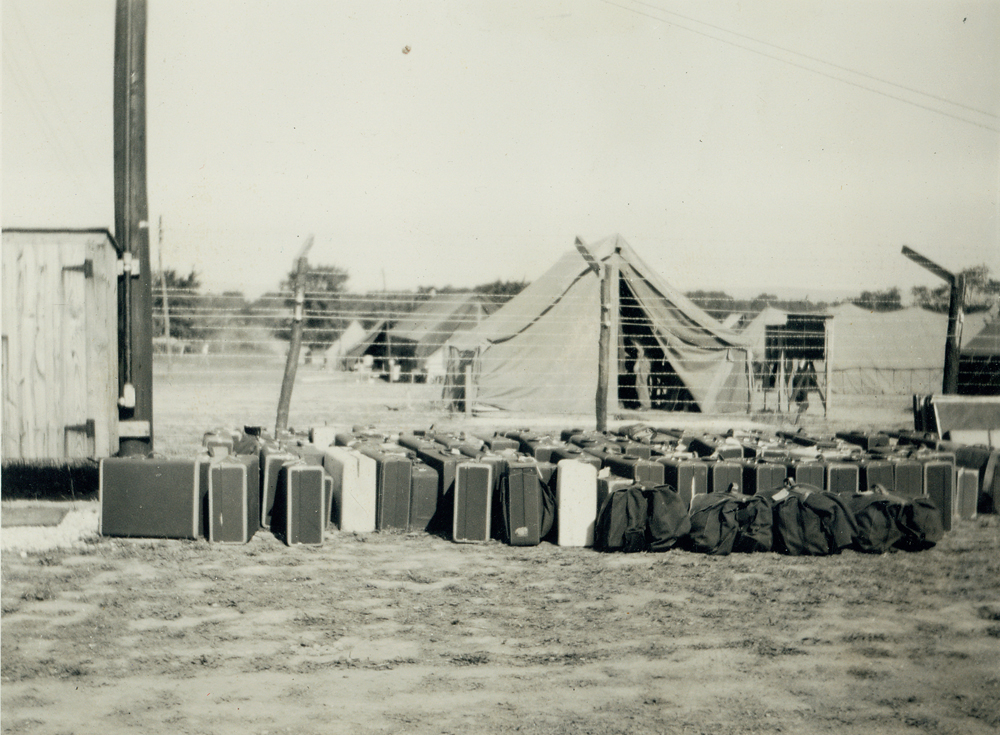
Copyright: Adams County Historical Society, Gettysburg, PA.

Copyright: Adams County Historical Society, Gettysburg, PA.

The Great Dismal Swamp, Virginia/ North Carolina border, 2009. © Dana Mueller
___________________________________________________________
*There’s some irony in the fact that one of the U.S. camps Mueller photographs is called Edenton. Eden? Paradise it was not. Likewise, in the UK, the most famous former POW camp is Eden Camp in Yorkshire, which is now a heritage museum.
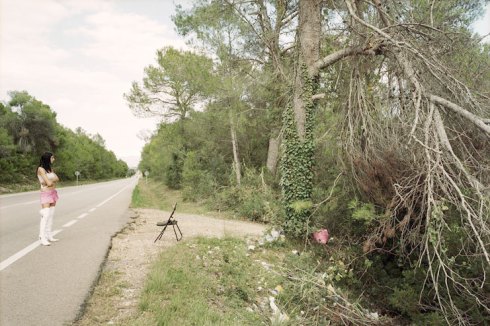
Following on from my comparative analysis of Mishka Henner and Paolo Patrizi’s documenting of Italian roadside prostitutes, a reader directed me to Txema Salvans‘ Spanish Roads.
I wanted to alert you of this series and suggest that the impact of this work and that of Henner and Patrizi for American (and in my case, British) audiences is the shock of the new. It is a surprise to see scenes of prostitution in public and plain view. The juxtaposition of illicit activity and wide open vistas is jarring and it corrects the over-romanticisation of Mediterranean culture that often occurs in the U.S.
Indeed, with Salvans’ work, one can begins to think that roadside prostitution may not be an uncommon part of the contemporary southern European landscape. From Salvans’ statement:
“These are the beings we fleetingly glimpse when our comings and goings in our safe cars allow us to perceive the scars of a landscape where both the city and the country disappear; uncertain scenarios that expose the cruelty of a breakneck productive culture that invents uninhabitable spaces that are nonetheless lived in.”


All images © Txema Salvans

 Prison Photography