
You are currently browsing the category archive for the ‘Fine Art’ category.

California State Prison, Corcoran. 2006, ink and pencil on paper, 52 x 156 inches.
Not a photographer, but an illustrator.
Within Buddy Bunting‘s Panorama series are five West Coast prison facilities. Prisons pop up in other series such as High Living too.
Bunting, like Sandow Birk and Alex Donis before him uses canny illustration to rifle home the banality of (secure) structures and signs in the mundane US hinterlands. Bunting’s grayscale world is one of malls, excavated hillsides, prisons and abandonment.
These subjects are old and familiar to American artists; artists who have attempted to reconcile their art with the psychology of deserts, gas stations and limitless geographies.
Bunting’s work is brooding, but most disturbingly it stakes out an invisible truth – that being, that post-industrial activities in dislocated rural areas are of sinister and charged ideological purpose.
The celebrated colour photography of Shore, Sternfeld and Eggleston is laconic, seductive and – admittedly – sometimes jarring, but never is it so critical or detached as Bunting’s work. Regarding detachment and the artist’s distance, the claim here that sketching has pushed out the great photographers may seem ludicrous and yet that is how I read Bunting’s very intelligent work.
READ & LISTEN
Jen Graves, the art critic for Seattle’s The Stranger (the best free newspaper in America) wrote this article and conducted this audio interview. Well worth your time!
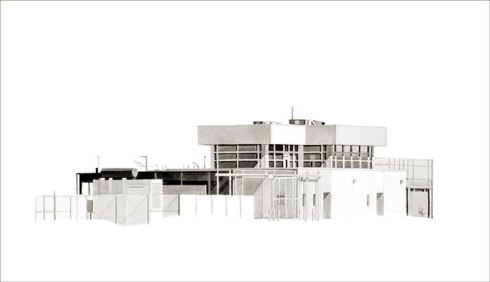
Oregon Gatehouse (its yellow mimicked the shade of rock looming behind as a train went through). 2008, ink and pencil on paper, 30 x 52 inches.
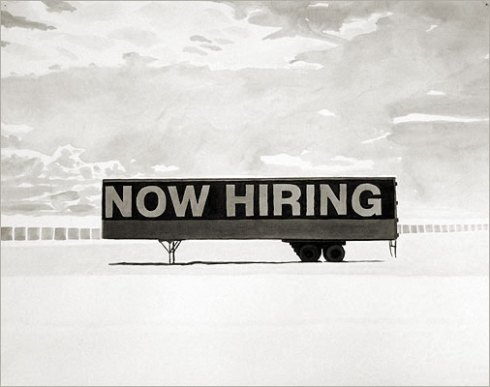
Walmart Distribution Center. 2008, ink and pencil on paper, 20 x 26 inches.

Claude Hankins
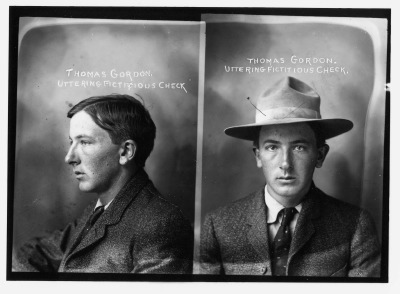
Thomas Gordon
Without question, the mugshot is a dominant “genre” in American photography. Least Wanted, aka Mark Michaelson, has released a book of his collected mugshots, Danny Lyon is fascinated by them, I’ve been seduced from time to time.
Arne Svenson is another artist who has put together mugshots (this time from the 19th century) to make a book. Svenson is a portraitist and his art is more complex when his collected mugshots and his headshots of forensic dummies & sock monkeys are considered alongside one another.
PRISONERS
“Svenson’s first book entitled Prisoners came about after the discovery of a collection of turn of the century glass plate negatives from Northern California recording convicted criminals as classic frontal and profile mug shots. He lovingly printed these negatives, bringing the subjects alive, and painstakingly researched each of their stories.” (Source)
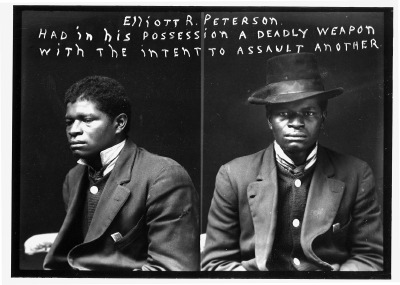
Elliott Peterson

W.M. Heron
FORENSIC DUMMIES
Svenson spent four years traveling around the country to coroner’s offices and law enforcement agencies photographing forensic identification aids in a classic portraiture style. Twin Palms Publications will publish a book of this work, entitled Unspeaking Likeness, in 2010.

© Arne Svenson
SOCK MONKEYS
Unsurprisingly, the public and the market love Svenson’s 200 Sock Monkey portraits.
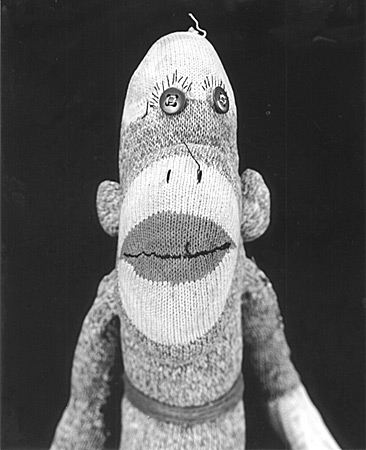
Sock Monkey #1761, 2001, Gelatin Silver Print. © Arne Svenson
See more at Jan Kesner Gallery

I found Pamela Bannos‘s portfolio via the MoCP, Midwest Photographers Project page. This was the same place I found the work of Tom Jones. There is plenty of other thought-provoking stuff (no prison photography though!) for you to while away an afternoon.
I am really taken by the quiet control of Bannos’ Some Untitled Pictures. Bannos: “In each of these found photographs I have tried to create a new history, or a new way of looking at a face or a gesture from another time. […] I am curious about how the illusion of photographic space can be re-constructed.”
More here.
Last week the Daylight/CDS Photography Award winners were announced. Sarah Sudhoff’s latest project stood out. Whether it is deep enough or lasting or I can’t say, but it stood out.
Sudhoff: “At the Hour of Our Death takes as its starting point [Phillipe] Aries’s observation that “death’s invisibility enhances its terror”. These large-scale color photographs capture and fully illuminate swatches of bedding, carpet and upholstery marked with the signs of the passing of human life. The fabrics which are first removed by a trauma scene clean up crew, are relocated to a warehouse before being incinerated. It is in the warehouse that I photograph these fragments stained with bodily fluids. I tack each swatch to the wall and use the crew’s floodlights to illuminate the scene.”
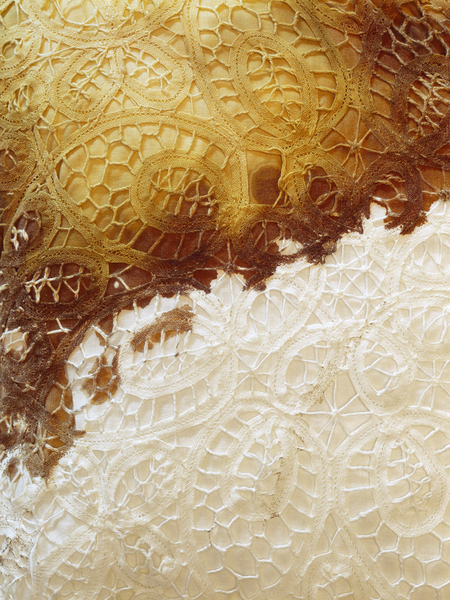
Illness, Female, 60 years old. Archival Pigment Print, 2010. 40 x 30 inches
Other series in Sudhoff’s portfolio are worth a look, notably Repository which is a self-portrayal project about Sudhoff’s cervical cancer in 2005.
I never realised powerhouse was so prolific.

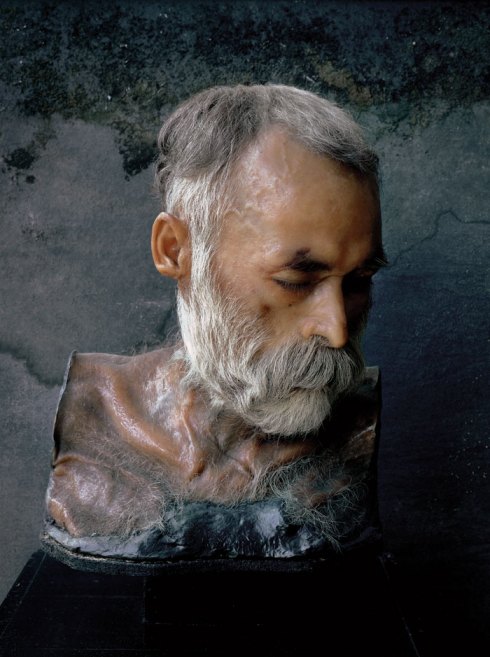
© Jack Burman Argentina No. 11, 2001
Jack Burman was interviewed by Nozlee Samadzadeh for the Morning News this week:
NS: The men and women in your portraits likely did not have say in how their bodies would be treated after death. Is it fair of you to further exploit them by displaying their photographs?
JB: Let’s try on “exploit.” My dictionary says “utilize (person etc.) for one’s own ends, esp. derog[atory].” I utilize them for my own ends—after anatomists have extensively utilized them for theirs, which include vital learning and instruction, yes—as well as, in some cases, which I think are understandable and unavoidable, academic career advancement. And my ends? They are as I said to breathe through the work I do and place before others, some of whom find clarity and worth in the prints. I make no profit—ever, in any material form—from this work. Strictly then? I “utilize…” in the way the dictionary said.
Burman’s book, The Dead (2010) was published by Magenta Foundation.
More info here.
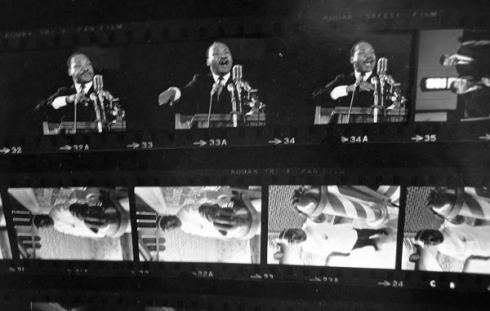
‘Digging into the strata of junk, he found more black-and-white mounted photos, some of them under a broken-down convertible that was one of several cars abandoned in the warehouse. He found the young Jesse Jackson preaching, Dizzy Gillespie playing his trumpet, and four black men—photographers apparently, from the cameras on display—sitting on the concrete front steps of the South Side Community Art Center. […] There was a box filled with negatives in labeled envelopes. There were negatives of Dr. Martin Luther King Jr., negatives of Abbie Hoffman, negatives of Lyndon Johnson. Next to this box was another one that was full of invoices; their letterhead said HOWARD SIMMONS.’ (Story)
(via)

Large hangars and fuel storage, Tonopah Test Range, Nevada, distance 18 miles, 10:44 am. © Trevor Paglen
I’ve tried talking about Trevor Paglen’s expansive oeuvre before, with particular reference to his documenting of Black Sites (US extrajudicial prisons). I don’t think I did a great job, which is why I am happy to see Joerg and Asim both grapple with Paglen’s contributions.
Conscientious interviews Paglen
‘What I want out of art is “things that help us see who we are now” – and I mean this quite literally. I think of my visual work an exploration of political epistemology (i.e. the politics of how we know what we think we know?) filled with all the contradictions, dead ends, moments of revelation, and confusion that characterize our collective ability to comprehend the world around us in general.’
Asim Rafiqui delves deep: ‘Photographing The Unseen Or What Conventional Photojournalism Is Not Telling Us About Ourselves.‘
‘[Paglen’s photographs] remind us how most photojournalists prefer to pander in the simple, the obvious and the conventional, while never engaging in the complex and crucual. Our newspapers and photographers have, either out of convenience, laziness or sheer careerism, chosen to veil the GWAT behind beautifully rendered and largely distracting projects produced from the confines of embedded positions on the front line.’
Of course, war photography is only one aspect area of photojournalism, but the argument can be made that criticism of war photography has stopped short, cowered or just missed the point. If one accepts that as the case, then Jim Johnson‘s three posts about the changing conventions in war photography (here, here and here) are a good lesson in how to think and see war photography, which let’s admit it, is a genre America still dresses in wonder and heroic myth.

 Prison Photography