
You are currently browsing the category archive for the ‘Fine Art’ category.

Neger (Nuba), 1964, 145 cm X 200 cm, Oil on canvas, Catalogue Raisonné: 45, Gerhard Richter
The Richter image above is NOT A PHOTOGRAPH, nor a video still.
Matt Niebuhr, one of the best thinking bloggers on art & photography, has beautifully presented the back story to this OIL PAINTING. It’s a must read.
When Richter released his Overpainted Photographs (2009) last year, I scoffed. I still do. I think them lazy. At least now, I can appreciate part of the reason he got there.
In terms of the intersection of painting and photography, Richter’s earlier works, such as Neger (Nuba), are far more interesting and – it goes without saying – technically superior.
Ten years ago, Katy Grannan’s photograph of Jeff Stackhouse accompanied The Maximum Security Teenager, a Margaret Talbot article for The New York Times Magazine. Talbot’s long piece explored the growing number of teenagers serving time in adult prison facilities. Stackhouse was fifteen when the article appeared in 2000.

‘Jeff Stackhouse’, Chromogenic print, 2000. Published in New York Times Magazine, September 10, 2000. Collection of the artist, courtesy Greenberg, Van Doren Gallery, New York City; Fraenkel Gallery, San Francisco; Salon 94, New York City. © Katy Grannan
Katy Grannan is best known for her domestic and nude portraits of women (often non-models who Grannan connects with via newspaper ads), so this photograph of Stackhouse is a relative anomaly.
Grannan graduated as part of the Yale MFA grads taught by Gregory Crewdson and known affectionately and disparagingly in equal measure as ‘The Yale Girls’. The complaint has been that Crewdson engineered their early exposure on the art scene with the Another Girl, Another Planet exhibition.
THE BOY
Stackhouse’s portrait was taken on assignment but was also included in the Portraiture Now: Feature Photography exhibit (Nov. 2008-Sept.2009) at the National Portrait Gallery along with photographs by Jocelyn Lee, Ryan McGinley, Steve Pyke, Martin Schoeller, and Alec Soth. The exhibit deliberately selected photographers’ work “for publications such as the New Yorker, Esquire, and the New York Times Magazine, each bringing their distinctive “take” on contemporary portraiture to a broad audience.”
Despite lengthy internet searches, I cannot find any information on Jeff beyond the NYT Magazine piece and a 60 Minutes piece, both shortly after his incarceration. Being tried as an adult, Stackhouse potentially faced a 30 year sentence – incredible if you consider his transgression:
‘Jeff was under a kind of house arrest imposed by the juvenile court – he wasn’t supposed to leave home alone except to attend school. But on Feb. 23, 2000, he was arrested again. He and three other neighborhood kids his age had been ”play boxing,” as the police report termed it, at the school bus stop, and Jeff had given one of the boys a bloody lip. After the fight, the boy and his pals set out for Jeff’s house, where they called him out on the lawn, got him in a headlock and punched him. Jeff ran into the house, found an unloaded antique shotgun that his mother kept in her closet and brought it out to wave at the other kids, shouting, ”Get off my property!” The three boys headed home in a hurry. No one was hurt, and two of the three did not even want to press charges.’ (Source)
THE MAN
Jeff obviously had severe problems as a teenager – as Talbot’s article described – but he would be 25 years old now. The Arizona Department of Corrections returns no record of an inmate with his name. He may have been released, he may have not?
My point? I guess this is merely one of millions of images that have no (widely-distributed) follow up. The forlorn circumstances of Jeff’s experience in 2000 do not exist now; they could be better or worse, but the absence of knowing renders this decade old portrait virtually obsolete.
The portrait was taken as part of a story; as an anchor and human face to the description of changing, harsher laws for sentencing youth. These laws deal in years and so it is that Jeff’s story has unfolded over years. Only we don’t know the details.
I am curious what other events have transpired for Jeff, and mostly I am interested what Jeff thinks about his brief feature in the national media, the fact he has been on the walls of the National Portrait Gallery and if any of that ultimately mattered or changed things for him.
– – –
More of Grannan’s work at Salon 94.
This excerpt (0.01 – 3.17 minutes) from Darkness and Light is particularly interesting in light of the recent unanimous celebration of Phil Toledano’s Days with my Father.
Avedon admits that his work was invasive and disturbing and that those tenets always exist within the arena for art. Avedon also faced accusations of exploitation for his later work In The American West.
Avedon’s work is good comparison to Toledano’s because reactions to Toledano’s work has been beyond positive. We have seen it as loving and we have seen it as our privilege; this is probably the case, but it doesn’t explain the absence of any discussion on ethics (however brief). Just a thought.
Personally, I am a fan of Toledano’s Days with my Father, and I wonder … do we respond to death differently today, do we respond to the approach of death in photography differently? Here’s a CNN clip of Toledano “blubbing” about his project.
Happy Fathers Day.

Landscape Tableau #1, Ivins, Utah, 2007. © Steven B. Smith
I have an increasing ambivalence toward New Topographics-esque studies of the American West. Steven B. Smith‘s work, however, is better than most.
Landscape Tableau #1 (above) captured my imagination. I presume these folk are under the supervision of a state or county department of corrections. What, here, is the link between the landscape and these men as it is enforced by a third party?

I followed Jehad Nga‘s work before on Somali Pirates and US Marines. It is in consideration of those two inquiries, and of Nga’s similar depiction of Kenyan boxers, I wonder about Nga’s choice to use the same shaft-of-light-in-the-dark technique to photograph the Turkana people of Northern Kenya. WSJ Online didn’t mention Nga’s repetition of form.
Nga photographed Turkana while covering the drought in Northern Kenya for The New York Times.
Turkana at Bonni Benrubi Gallery is 10 chromogenic large scale color works, framed in black with no mat and mounted to Plexi. DLK Collection has just reviewed Nga’s exhibition at Bonni Benrubi:
(Source: http://dlkcollection.blogspot.com/2010/06/jehad-nga-turkana-benrubi.html)
If DLK had accounted for Nga’s earlier projects it may have retreated away from attributing Nga’s technique to echoes of colonial ethnographic photography.
The real problem with Nga’s photography is that it’s production is a performance in which he as the photographer is implicated. Nga’s work is art, there can be no doubt. Nga’s portraiture will always bestow dignity upon sitters, but never inherently any understanding of the sitter. He is a director of his world.
STALKING THE ENVIRONMENT
Nga speaks well about My Shadow, My Opponent – photographs of Kenyan boxers. I especially like Nga’s comparison between the boxers in Kibera, Nairobi and US marines in Iraq in how they behave the longer they exist as a group.
Nga also offers this, “what attracted me initially was less the story component of a boxing gym, more-so the environment.”
Nga tempts us in with silky colour-saturated and pitch black prints. We are then duty-bound to position ourselves politically or emotionally with the subject; this is a lose-lose strategy.
Instead, we should be using Nga’s work as a springboard of natural interest into the very specific problems pertaining to this region of the world. Is a gallery wall the best way to reach the largest possibly number of potential supporters? Personally, I don’t think so, but this is a problem of distribution not solely one for the artists.
I support DLK’s expression of unease but I must disagree that, “Nga’s pictures undeniably draw the viewer into the individual narrative of a specific person or family.” Really? I see a lot of similar looking photographs.
I don’t think the issue is that things “haven’t changed much”, it’s that photographers and consumers of media haven’t changed enough, and Nga has hardly changed at all.
– – – – –
The British Journal of Photography interviewed Jehad recently, and Tewfic El-Sawy has been following Nga’s career closely for years (which for me brings up another debate we should be having about photographers now developing under the gaze of the photography blogosphere … but for another time!)

EL LAMENTO DE LOS MUROS
On March 31st 1977, Paula Luttringer, a 21 year-old pregnant botany student was kidnapped by police of the Argentine military junta and detained in an extrajudicial prison. During her five month detention, she gave birth to her eldest daughter.
Released abruptly during what she thought was transfer to a regular prison, she was forced to leave the country immediately to avoid another “disappearance.” She went first to Uruguay, finally settling in France. (Source)
During the Dirty War (1976-1983) hundreds of secret detention centres were established across Argentina for the purposes of interrogation and torture.
In 1995, Paula returned to Argentina and took up photography as a means to explore the memories, mental scars and the crimes against her and other women. El Lamento de los Muros (The Wailing of the Walls) is the result.
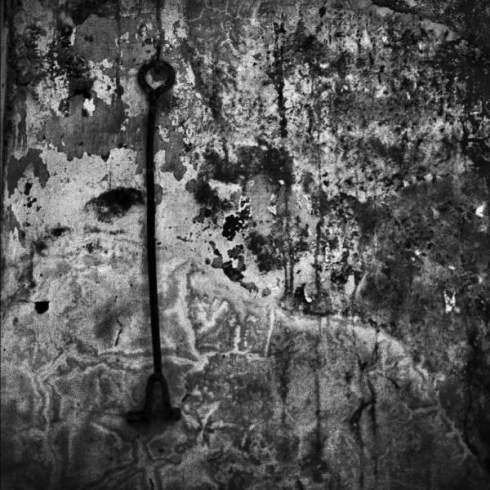
Three years ago, I met Paula. She had just enjoyed acclaim at the 2006 Houston Fotofest, and was searching for further funding to travel the exhibition and expand on the educational lessons attached to the project.
The Wailing of the Walls is about the violence brought against women and the continuing means by which those women cope and live in the aftermath. Paula was adamant; she only wanted funding from women. 100 donors to fund the gathered testimony of 100 survivors. This was a project by a woman, for women supported by women. The funding initiative was named 100×100.
PAULA’S WORDS
I have twice heard people urge Paula happiness in that she survived. Paula is unequivocal; having survived does not make her happy, living in a world in which people didn’t have to be survivors would make her happy. The violence once it is done, cannot be undone.
For more on Paula’s motivations for the project read this interview, this articleand listen to this audio interview.
RECOGNITION
Wendy Watriss and Fred Baldwin, of Houston Fotofest must be singled for special praise in bringing Paula’s work to a larger audience and consciousness.
The statements that accompany each of these images have been co-opted from Fotofest’s feature and from the George Eastman House page on Paula’s work.
‘THE WAILING OF THE WALLS’ IMAGES AND TEXT
“Walls that served to stifle the desperate screams, the cries of those tortured and raped, and the indescribable, agonized moans of those who, although they were freed, remain aware of their open wounds—who feel that they will never get out of that hole.”
Juan Travnik, Buenos Aires in the FOTOFEST2006 catalogue.
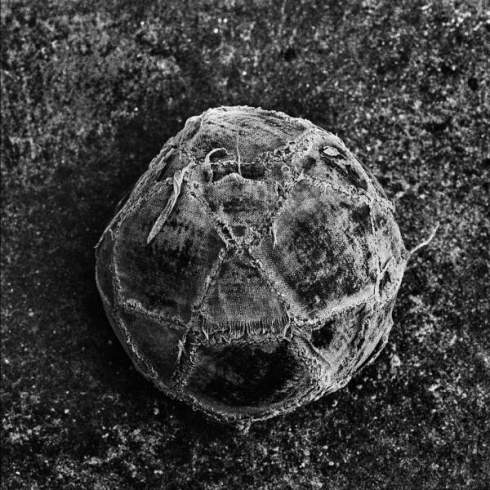
“It is very hard to describe the terror of the minutes, hours, days, months, spent there. At first when you’ve been kidnapped you have no idea about the place around you. Some of us imagined it to be round, others like a football stadium with the guards walking above us. We didn’t know which direction our bodies were facing, where our head was, where our feet were pointing. I remember clinging to the mat with all my strength so as not to fall even though I knew I was on the floor.”
Liliana Calizo was abducted on September 1st, 1976 in Cordoba. She was then taken to the Secret Detention Center “La Perla”
– – – –

“I went down about twenty or thirty steps and I heard big iron doors being shut. I imagined that the place was underground, that it was big, because you could hear people’s voices echoing and the airplanes taxiing overhead or nearby. The noise drove you mad. One of the men said to me: so you’re a psychologist? Well bitch, like all the psychologists, here you’re really going to find out what’s good. And he began to punch me in the stomach.”
Marta Candeloro was abducted on June 7, 1977 in Neuquen. She was then taken to the Secret Detention Centre “La Cueva.”
– – – –
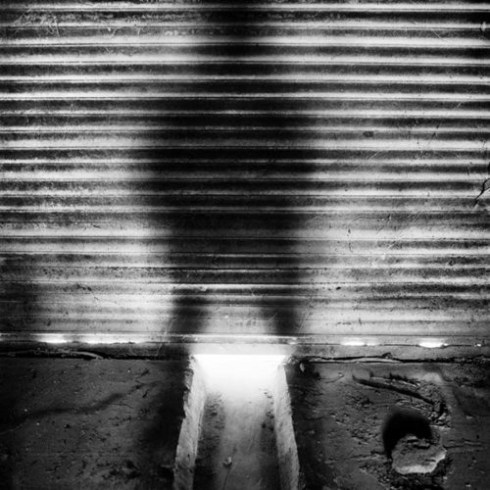
“And this marks you, it’s a wonderful feeling that stays with you the rest of your life. You’re left with this dual task: you have to be constantly working out what comes from the trauma and what from normal life. I have this dual task in life. I have to decide which feelings are the result of the trauma and what there is beneath of less intensity, more diluted, which is that what comes from normal life. So I talk to someone who has never been in a clandestine prison and then I play the role of a normal person and I realise what that involves, I step into normality. These things that happen to all of us who were victims of repression …”
Liliana Gardella was abducted on November 25, 1977 in Mar del Plata. She was then taken to the Secret Detention Center “ESMA”
– – – –
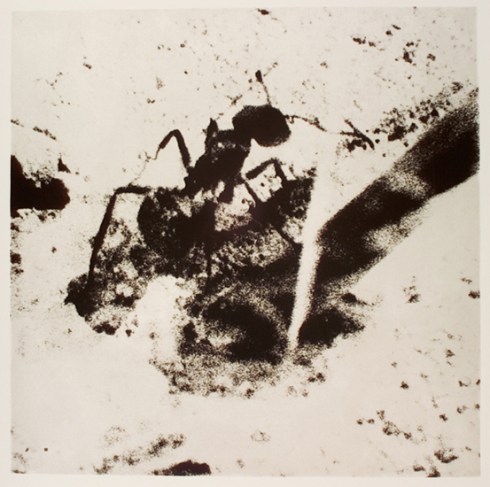
Ants used to come in and out, and I would watch these ants because they were coming in and then going out into the world. They were walking across the earth, the outside world, and then coming back in again, and watching them I didn’t feel so alone.
Ledda Barreiro,” La Cueva” Illegal Detention Centre
– – – –
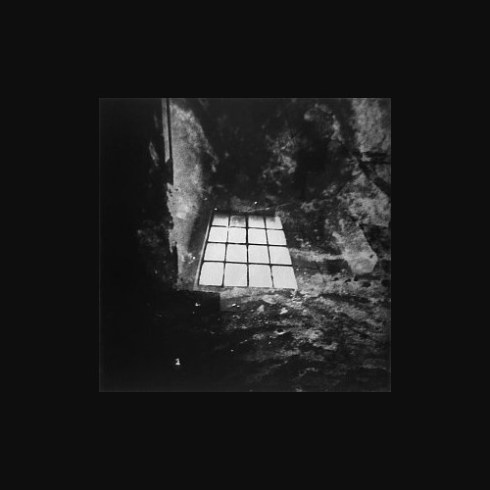
Source

Source
“Something strange used to happen at night, the screams of torture were different than those during the day. Even if the screams of torture are always the same they sound different at night. And it’s also different when they come to get you at night. The noises and the screams are not with me always, but when I do remember them, it makes me very sad. I am paralyzed by those screams, I’m back in that time and place. As somebody once said — and I’ve given this some thought and I think it’s right — although life goes on, although some of us were freed, you never get out of the pit.”
Isabel Cerruti was abducted on July 12, 1978 in Buenos Aires. She was then taken to the Secret Detention Center “El Olimpo.”
– – – –

Source
‘EL MATADERO’
It is worth noting an earlier project too.
The images below are from Luttringer’s earlier series El Matadero (The Slaughterhouse) for which she won the best Portfolio Prize at PhotoEspana (1999). The manhandling of carcasses through rooms designed for dismemberment is a shocking precursor to The Wailing of the Walls. Luttringer’s work echoes themes of mortality and the manipulation (herding, processing) of flesh.
Many people are gripped by the psychological charge of Roger Ballen‘s work, but the photography of Outland, Shadow Chamber and Boarding House obscures reality and fuses it with imagination. Luttringer’s work, on the other hand, is an attempt to mobilise our understanding of the historical moment. Photography is a tool for Paula, but the real import of this exercise is the oral testimonies recorded and written and the associated benefits that may have arisen for the women having shared their memories.
For me at least, the visceral images of El Matadero, are a solemn counterpoint to Luttringer’s work on kidnap and detention from Argentina’s Dirty War.

Source

Source
BIO
In 1999, Luttringer was chosen by the National Museum of Fine Arts in Buenos Aires as one of the twenty photographers of the ‘New Generation’. In 1999, she won the best Portfolio Prize at PhotoEspana, for her project “El Matadero”. In 2000, she was awarded an artist`s grant by the National Arts Fund of Argentina for her project “El Lamento de los Muros”. In 2001, she was made a Guggenheim Fellow for her project “El Lamento de los Muros”. Luttringer’s photography is part of the permanent collections of both The National Museum of Fine Arts (MNBA) and the Museum of Modern Art (MAMBA) in Buenos Aires; the Museum of Fine Arts in Houston (MFAH); the George Eastman House in Rochester, NY; Portland Art Museum in Oregon; La Bibliothèque nationale de France in Paris; and the Portuguese Photography Centre in Portugal. She currently lives and works in Buenos Aires and Paris.

Joerg has predicted this’ll be all over the photobioblogosphere, so I’ll oblige.
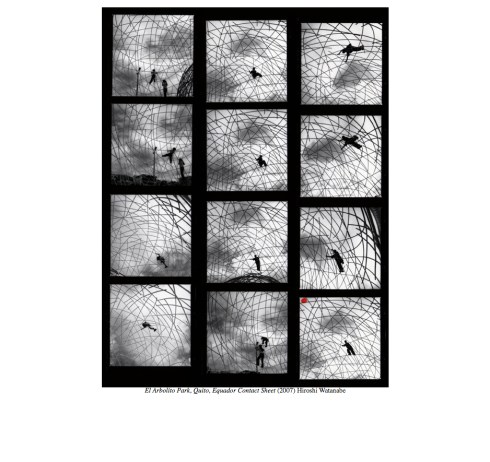
PROOF at the Edelman Gallery exhibits well known photographs with their original contact sheets.
Do I actually like the show or have I been instantly suckered by a seductive concept? I actually like the show; PROOF demystifies some of the lore about famous photography. We need to talk more about photography within the context of its manufacture.
My favourite? Hirshi Watanabe.
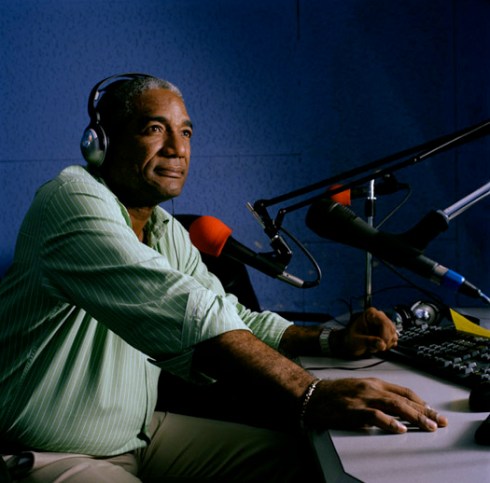
Two weeks ago, I participated in an OPEN-i webinar about Haiti imagery. Louis Quail, another of the panelists, committed eight days to photographing Haitians during the month of May.
I wanted to present Quail’s work here as his photographs are products of a quieter, more engaged process than a lot of the photojournalism created in the earthquake’s immediate aftermath.

The Haiti webinar is not posted yet, but a growing archive of OPEN-i webinars is available at its Vimeo channel.

 Prison Photography