
You are currently browsing the category archive for the ‘Non-Prison’ category.

‘Seance’. A photograph of a group gathered at a seance, taken by William Hope (1863-1933) in about 1920. The information accompanying the spirit album states that the table is levitating. In reality, the image of a ghostly arm has been superimposed over the table using a double exposure. From the Collection of the National Media Museum, UK.
Great set of Spirit Photographs on the Flickr for the National Media Museum.

‘Man with a female spirit.’ Collection of National Media Museum
Photographer and journalist, Ghaith Abdul-Ahad, reporting from an embedded position with the Taliban published a three part series of articles in the Guardian recently. They’re accompanied by a gallery of 11 images.
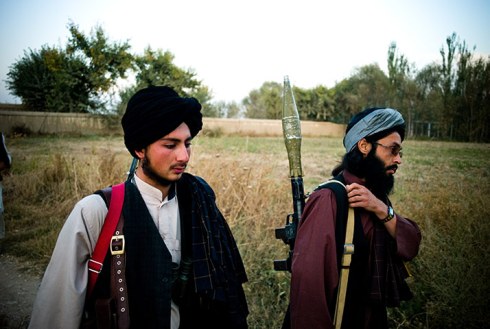
The fighters walk through a landscape of fields, criss-crossed with irrigation canals Photograph: Ghaith Abdul Ahad for the Guardian
David Campbell talks about how valuable (if visually ordinary) Abdul-Ahad’s images are. Valuable because of where they are, alongside the Taliban; it is rare to see Western journalism this close.
Abdul-Ahad’s first part, The Taliban troop with an east London cab driver in its ranks, reveals the seasonal fighting Afghan nationals take on, in some cases they come from Britain for a Summer of Jihad. One fighter will return to his job as a London Cab driver. As remarkable as it must be rare.
In the second part, Five days inside a Taliban jail, Abdul-Ahad tells of the suspicion that fell upon he and a colleague following a battle with American forces. Their belongings were confiscated and they were blindfolded & trucked to another area. They were then marched for 9 hours up a mountain.
Shortly before daybreak we reached a barn on top of a mountain. This was where we would be incarcerated for the following days.
The word prison usually implies a thick-walled building with gates, padlocks and guards. But in the Taliban concept of a jail, the gate doesn’t exist. The jailer was the gate, the prison cell, the executioner and sometimes, if you were lucky, your friend.
The prisoners and the guards lived in the same room, divided by an invisible line. Both groups slept on flimsy mattresses covered with an almost black layer of shining grime.
For the first night we were blindfolded with chequered Afghan scarves that reeked of grease and which served as our towels and prayer mats. After that night, we were only blindfolded when we were led into the adjacent barn to wash and relieve ourselves. The floor of this barn was covered with droppings of goats and humans.
Apart from the jailer, I counted seven guards in all, from frail teenagers to big, tough fighters. They lived in conditions that were not much better than the prisoners. They were not allowed to leave or carry mobile phones and had to spend the night in the cell with the prisoners, often with their feet tied to those of their prisoners. They were fed the same meagre food.
After their credentials had been verified by Taliban leadership in Quetta, they were released.
As we were about to leave, Lal Muhamad produced a thick bundle of dollar bills and tried to give us a hundred each. “This for your trouble,” he said. We refused, and began the long journey back to Kabul.
Finally, in part three, Talking to the Taliban about life after occupation, Abdul-Ahad speaks to a Taliban commander, an administrator and an ambassador.
According to the commander, the Taliban want to be less ideological, less oppressive.
The ambassador refers to the war’s origins and what the US can and should be protecting, “The Americans have one right only, and that is their right to be assured that Afghanistan will not be used against them and that is something the Taliban should give.”
EMBEDDING WITH THE TALIBAN
Journalists Najibullah Quraishi and Paul Refsdal have embedded with the Taliban before.
Onesided embedding with allied troops can be a problem.
 PRESS TV reports:
In response to a question by Press TV on Monday over the whistleblower website’s “leaks,” President Mahmoud Ahmadinejad said “let me first correct you. The material was not leaked, but rather released in an organized way.”
“The US administration released them and based on them they pass judgment …. [The documents] have no legal value and will not have the political effect they seek,” the Iranian chief executive added at the press briefing in Tehran.
Ahmadinejad stressed that the Wikileaks “game” is “not worth commenting upon and that no one would waste their time reviewing them.”
Here, Ahmadinejad proves how little reality interests him. As with every outside threat, he attributes it to a malevolent US. Why scream conspiracy? Especially when the leaked material is being corroborated by diplomats across multiple nations? It’s a ludicrous notion. I wonder what Assange thinks of Ahmadinejad’s accusation?!
[via Lede blog, NYT]
This week, the DVAFOTO boys pointed me in the direction of New York Times‘ Daphné Anglès video and “editor‘s choice” for the Canon Professional Network.
Anglès picked out ten photographs she thought worthy. One of them was this by William Price.
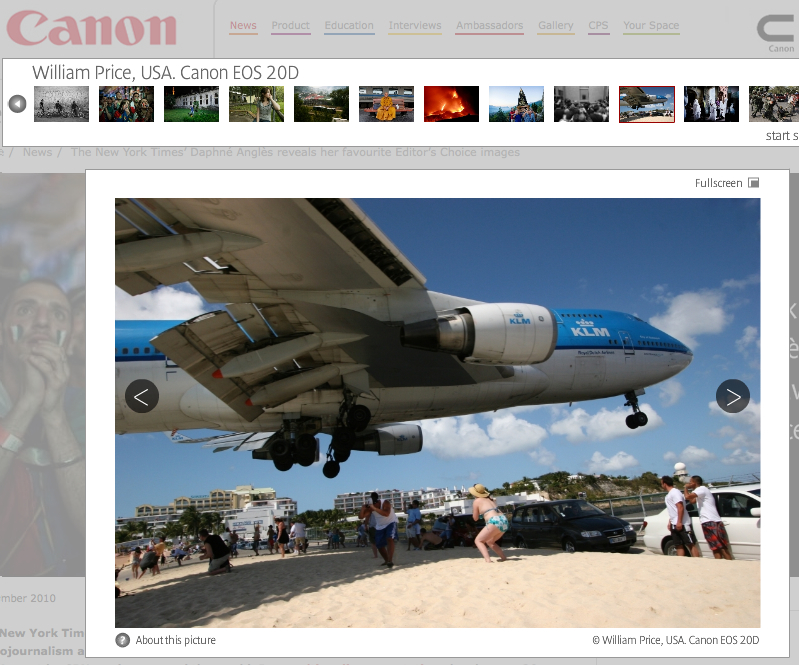
It’s not photoshopped. It’s at a beach on the Caribbean island of St Maarten.
Also this week, Stephen Bulger tells me Josef Hoflehner is showing his series Jetliner at the Galerie Nikolaus Ruzicska in Austria.
Hoflehner’s photos are also from St Maarten.
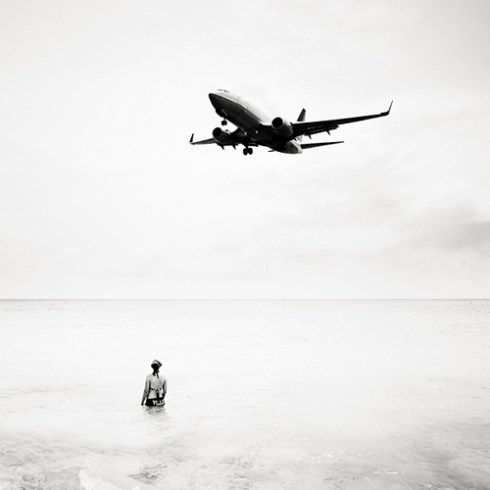
Jet Airliner #11, Continental Airlines Boeing 737-800, Arriving from Newark, NJ. © Josef Hoflehner
I recall in the past seeing other photographers take on this same subject. If pros are taking the time to be out there, I presume plenty of amateurs (and many tourists) must be too?
Ahem. Flickrrrr? Result.
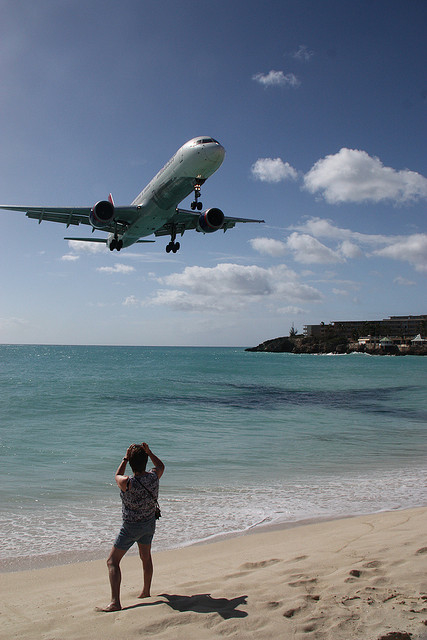
Image by Flickr user, Ike
A beach under an air-path is becoming iconic. It’s stunning, loud and easy to photograph. It encapsulates the compression of technology and leisure and it’s all about the madness and technological advancement in the age of speed. Now images of St Maarten are everywhere. Not a meme yet though (usually videos not images make it as memes).
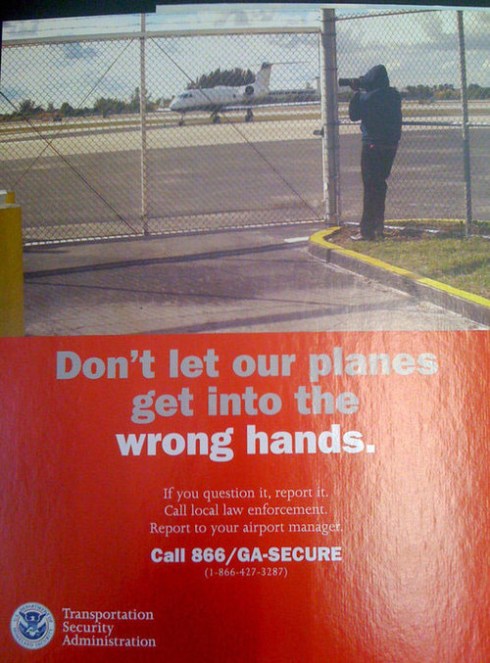
So, I wonder what That TSA Poster from a few months back was all about?
I was going to write a little something about That interview with Antoine d’Agata in Vice, but Darren’s got it covered:
“What is most troubling about D’Agata’s work is not specifically its content, but the rather trite assumption that life as a drug-addicted prostitute (in some conveniently distant place) contains more “truth” than that of, say, a suburban housewife or a plumber […] It remains a tiresome (if quite familiar) misapprehension that extremes of living can bring us closer to the most fundamental aspects of what it is to be human – as though there were no other kinds of truth.”
“The “reality” that he frames as an existential crisis is in fact an economic one, so his rhetoric is more like a transparent pretext for the way he has chosen to aestheticise what he photographs – a denial of his implied privilege. [d’Agata’s work] is beautiful and often daring, just not in the ways that he would have us believe.”
Well said Darren.
Put another way, and I heard this a few years back, “Oh d’Agata, he’s the Magnum photog who fucks and sucks his way around the world, yeah?”

Unexpectedly, my posts on prison tattoo photography have been very popular – [1], [2], [3], and [4]. Continuing the theme, I’d like to feature the work of Herbert Hoffman.
From an early age, Herbert Hoffmann (1919-2010, b. Pommern, Germany) was drawn to people with tattoos. He was educated in Berlin. During the Third Reich, tattooed people were seen as criminals and consequently, the tattoo culture diminished. In 1940, Hoffman signed up for basic military service with the German army. From 1945-49, Hoffmann was held prisoner of war by the Russians. When he returned to Germany he worked as a travelling salesman, and encountered many persons who were tattooed despite the old Nazi ban. While working Hoffmann always took along his camera and photographed the people he met. In 1961, Hoffmann opened his own tattoo studio in Hamburg, Germany.


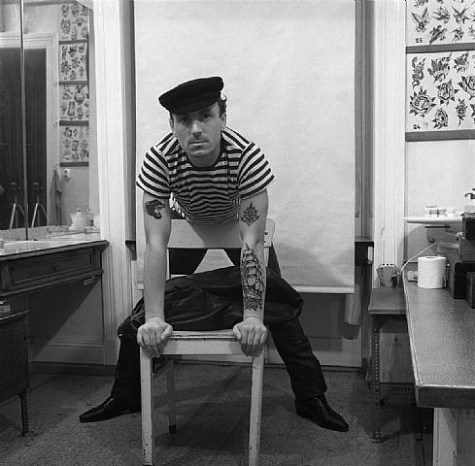
FIRST TATTOOS, THEN PHOTOGRAPHS
Hoffman distinguishes himself from photographers who look in at the tattoo culture from the outside. He defined the culture and then adopted the lion’s share of documenting it. Hoffman’s DIY method is like that of graffiti artists who return with a camera to make images of the surfaces which they have earlier decorated. (Notably, Hoffman’s tattooing preceded the rise of graffiti and its recognition as art/culture in the 1970s/80s.)
Aged 91, Hoffman passed away on June 30th of this year. Despite the indisputable novelty of his photographs, and his central position to German tattoo culture, Hoffman only received mainstream recognition very late in life. No surprise really; Hoffman was working with the maligned, ‘lowly vernacular’ medium of photography, to record the re-emerging tattoo subculture.


TEN HAAF EXHIBIT
Hoffman’s images are on show at Ten Haaf Projects in Amsterdam until December 18th. Ten Haaf Projects, Laurierstraat 248, 1016 PT Amsterdam, The Netherlands. Tel: 020-4285885 www.tenhaafprojects.com. And how good is this? At the Ten Haaf opening in October artist Henk Schiffmacher tattooed Hoffman’s designs on exhibition goers.
EXHIBITS / BOOKS
Hoffman’s books are here and a picture gallery of Hoffman’s life here.
Selected Solo Exhibitions: 2010 ‘Living Pictures’ Ten Haaf Projects Amsterdam; 2010 ‘St Pauli’s Souvenirs’ Galerie Lehmann Berlin. Publications: 2008 ‘Skinscapes, Die Kunst der Körperoberfläche’, text Herald Kimpel, Hrsg: H . Kimpel, Marburger Kunstverein Marburg; 2006 ‘Signs and Surfaces’ by Andreas Fux, Herbert Hoffmann, Ali Kepenek Hrsg Künstlerhaus Bethanien Berlin; ‘Mensch! Photographien aus Dresdner Sammlungen’, Hrsg: Wolfgang Hesse und Katja Schumann; ‘Kupferstichkabinett’, Staatliche Kunstsammlungen Dresden.
ALL IMAGES © HERBERT HOFFMAN

After looking at the TSA’s list of airports with Full Body Scanners, I’ve decided to drive to California for the Christmas Holidays. I’d already made the decision to stay in Seattle for Thanksgiving, so no immediate problems.
This post obviously spurred by the story of unlikely hero, John Tyner.
Some of you might be thinking that it’s not a big deal because those images are not saved, stored or transmitted, right. Wrong.
From the list below, if you’re flying anywhere meaningful in the US, some TSA agent is going to ogle your fancies.
Happy Holidays!
Airports who currently have imaging technology:
- Albuquerque International Sunport Airport
- Hartsfield-Jackson Atlanta International Airport
- Baltimore/Washington International Thurgood Marshall Airport
- Boston Logan International
- Bush Houston Interncontinental Airport
- Boise Airport
- Bradley International Airport
- Brownsville
- Buffalo Niagara International Airport
- Charlotte Douglas International
- Chicago O’Hare International
- Cincinnati/Northern Kentucky International
- Cleveland International Airport
- Corpus Christie Airport
- Dallas/Fort Worth International Airport
- Denver International Airport
- Detroit Metro Airport
- Dulles International Airport
- El Paso International Airport
- Fort Lauderdale-Hollywood International
- Fort Wayne International Airport
- Fresno Airport
- Gulfport International Airport
- Grand Rapids Airport
- Harrisburg International Airport
- Harlingen/Valley International Airport
- Honolulu International Airport
- Indianapolis International Airport
- Jacksonville International Airport
- John F. Kennedy International Airport
- Kansas City International
- LaGuardia International Airport
- Lambert/St. Louis International Airport
- Laredo International Airport
- Lihue Airport
- Los Angeles International
- Luis Munoz Marin International Airport
- McAllen Miller Airport
- McCarran International Airport
- Memphis International Airport
- Miami International Airport
- General Mitchell Milwaukee International Airport
- Mineta San José International
- Minneapolis/St.Paul International Airport
- Nashville International Airport
- Newark Liberty International Airport
- Louis Armstrong New Orleans International Airport
- Oakland International Airport
- Omaha Eppley Field Airport
- Orlando International Airport
- Palm Beach International Airport
- Philadelphia International Airport
- Phoenix International Airport
- Pittsburgh International Airport
- Port Columbus International
- Raleigh-Durham International Airport
- Richmond International Airport
- Rochester International Airport
- Ronald Reagan Washington National Airport
- Salt Lake City International Airport
- San Antonio International Airport
- San Diego International Airport
- San Francisco International Airport
- Seattle-Tacoma International Airport
- Spokane International Airport
- T.F. Green Airport
- Tampa International Airport
- Tulsa International Airport
Airports receiving imaging technology soon:
- Chicago Midway International Airport
- Houston William P. Hobby Airport
- Saipan International Airport
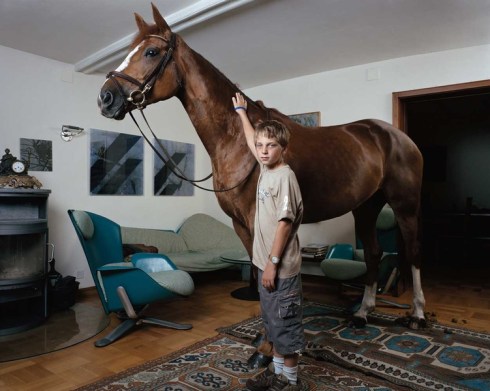
Jon Naiman. Familiar Territory, #21. Chromogenic Print. 32×40″ Image. Unmatted. 3/6. $3600
What is there not to love about Jon Naiman‘s series Familiar Territory? (More here)

 Prison Photography