
You are currently browsing the category archive for the ‘Non-Prison’ category.
The Oracle gathering? An International Mob of Mystery? Well, not exactly but given that Oracle is the main meeting of the world’s most influential people in the museum/fine art photography scene it is amazing the gathering flies under the radar year on year.
I’ve done some internet sleuthing to tell you some of what you need to know about the Bilderberg of the photography world.
Okay, it might not be so cloak and dagger as I have set it up, but The Annual International Conference for Photography Curators dubbed ‘Oracle’ has no web presence and no connection to the circles outside of the attendees. This (presumably intended) detachment is – simply put – a shame. Granted, these are people predominantly involved in museum curating, but still wouldn’t it be great to know what they are talking about when they meet each November?! Museums still feed into the photography ecosystem, and often define it.
Oracle began in 1982 as an informal gathering. In 2003, Deidre Stein Greben wrote, “Attendance at Oracle […] has grown from ten to more than 100 over the last 20 years.”
With such an organically unhurried growth, why should curators care to share their dialogues? Hell, the week might be the closest thing many of them get to a holiday. Add to that the fact that there’s no external promotion or grand narratives to push, it makes sense that no-one would take on the extra workload of interfacing with the public and all that entails.
I also think of photography curators as a similar breed to university professors; the culture of research, writing and custodianship of department agendas does not dovetail with blogging the discoveries and knowledge from their daily work. (David Campbell summarises well how the reluctance of universities to adopt social networking is to their detriment.) It’s a shame. How good would a Sandra Phillips blog be?!
The 2010 Oracle is ongoing right now in Israel (Jerusalem, I think).
This is where my sleuthing gets patchy but other host institutions/cities have included; Museum of Fine Arts, Houston (1992); George Eastman House, Rochester (1993); Washington (1999); Finnish Museum of Photogaphy, Helsinki (2000); Goa, India (2003); Museum of Contemporary Photography, Chicago (2004); Artimino, Florence (2005); Prague, Czech Republic (2006); Center for Creative Photography, Tucson, AZ (2007) and Paris, France (2009).
My guess is attendance is invitation only or some approximation thereof. Just because I gleaned a smattering of names, I’ll share them. Attendees have included Britt Salvesen, Director of photography and prints at LACMA; Doug Nickel, Professor of Photographic History at Brown University; Sunil Gupta, Artist, photographer, curator and educator; Allison Nordstrom, Curator of photography at George Eastman House; David E. Haberstich, Associate Curator of Photographs at the Smithsonian; Celina Lunsford, Director of the Fotografie Forum Frankfurt; Olivia Lahs-Gonzales, Director of the Sheldon Art Galleries in St. Louis; Dr Sara Frances Stevenson, Chief Curator of the Scottish National Photography Collection, National Galleries of Scotland (retired); Mary Panzer, freelance writer & curator of photography & American culture; Ms. Agne Narusyte, Curator, Vilnius Art Museum Photographic Collection, Vilnius, Lithuania; Shelly Rice, Professor of Arts at NYU Tisch School of Arts; Enrica Viganò, curator and fine art photography critic; Duan Yuting, founder of the Lianzhou International Photo Festival; Mark Haworth-Booth, Head of Photographs, Victoria & Albert Museum; Anne Wilkes Tucker, photography curator at the Museum of Fine Arts, Houston; Sandra S. Phillips, Senior Curator of Photography at San Francisco Museum of Modern Art.
Quite the list. And I can think of many other photography curators who presumably would attend (Rod Slemmons, Anthony Bannon, Brian Wallis, Charlotte Cotton, Malcolm Daniel?) Who knows?
It’s not a totally closed shop though. Despite the 2006 shuttering of the Oracle listserv, some plucky “Independents” have set up a NING type forum, Oracle Independents. It is sporadically updated with links to articles and events about historically significant photography. Currently there are 40 members, some names recognisable. But this doesn’t get us to the meat of those dialogues currently ongoing in Jerusalem.
Last thing to say, is that the museum world is separate from the worlds of gallery, photojournalist, fine art, auction house, social documentary, magazine, fashion and art-school photographies. Even if we did have a line in on the world’s leading curators’ discussions, the information may have no bearing on our aims, art or careers. Heck, we might not even be interested. But it’d be nice wouldn’t it?
Not wanting to be pessimistic, but unable to help myself, consider this quote from Marvin Heiferman, freelance author, editor and curator and “champion of the blue-collar nature of the silent majority of photographs.” Bear in mind he’s talking about very early Oracle, but nonetheless, the quote highlights potential disconnects between different orbits of the photography world.
“When I started looking at this new [Postmodern] work, I loved its nonchalance, intelligence and cheekiness, the fact that it was interested in both seeing and seeing through images. The photo world, though, wasn’t as amused, and didn’t have a clue what the small group of us was getting so jazzed up about. Toward the end of my stint at Castelli in the early 1980s—and then when I went off on my own to work with photographers and artists and produce exhibitions—I attended some of the early annual meetings of Oracle. This was a conference of photography curators from around the world who gathered together supposedly to talk about the future of the field, and was funded by Sam Yanes at the Polaroid Corporation. Polaroid supported a lot of progressive photographic projects in the 1970s and ’80s. It was, to say the least, disappointing to me that most of the attendees were more excited to fuss over 19th- and 20th-century work and issues of preservation and storage. But there were a handful of us—including Andy Grundberg, who was writing for the New York Times, and Jeff Hoone from Syracuse—who did our best to raise interest in the new work we were so excited by. No one seemed to care.” (Source)

Huntress with Buck, 2010 from the series ‘Hunters’, © David Chancellor
David Chancellor has won the Taylor Wessing Portrait Prize for his image of a young American huntress astride a horse in South Africa. It’s a worthy winner.
Unfortunately, for web audiences only the five shortlisted portraits are presented on the Taylor Wessing Portrait Prize website. There are 55 more in the accompanying exhibition.
Tom Martin‘s group portrait of children inside Ruyigi prison, Burundi (below, part of flyer) is one of the sixty portraits included in the Wessing show at the National Portrait Gallery, London.

I’ll be following up with Tom shortly for the background on the circumstances of the photograph, which are difficult to say the least; photographer Nathalie Mohadjer has talked at length here at Prison Photography about life in Burundi’s prisons. At 230% capacity, Burundi’s prisons are the most overcrowded in Africa.
THE WINNERS AND THE WINNERS
I don’t want to sound too simplistic here, but any additional exposure to the stories of the dispossessed – even in the context of a £12,000 award – is a good thing. Nathalie Mohadjer commented, “Let’s face it, Burundi just isn’t important to the world”. She has struggled to find interest in her work and I expect Tom Martin has experienced the similar dead-ends.
I am not idealistic and I know that distribution of images only changes little, but in light of the subjects recognised by the Taylor Wessing Prize (TWP) I want to be positive, constructive. The shortlisted entries over the years seem to be those that weigh skilled technique with a careful presentation of unexpected (often disenfranchised) social groups:
Photographic Portrait Prize 2010
Photographic Portrait Prize 2009
Photographic Portrait Prize 2008
Photographic Portrait Prize 2007
Photographic Portrait Prize 2006
Photographic Portrait Prize 2005
The TWP has a social conscience and it plays that to full advantage by picking striking portraits with direct routes to empathy. This is the mark of good photography, no? Everyone’s a winner.
The Taylor Wessing Portrait Prize Exhibition runs at the National Portrait Gallery from November 11th until 20 February and then at the Sunderland Museum and Winter Gardens from 16 April until 26 June.

João Silva, 44, a South African photographer on contract with The New York Times, stepped on the mine while accompanying American soldiers patrolling an area near the town of Arghandab in southern Afghanistan on October 23rd, 2010. Despite immediate help from medics, both his legs were lost below the knees. He is now recovering at Walter Reed Medical Center in Washington, DC.
Friends have set up a new website to sell his prints and raise funds for him: http://joaosilva.photoshelter.com/.
Please consider helping him. He is one of the major conflict photojournalists of our time, a husband and a father.
For all his work past, present and future let him know you’re thinking of him.
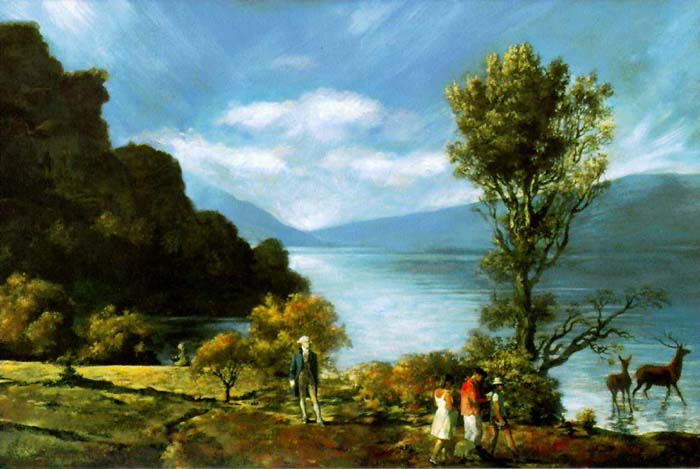
Komar & Melamid UNITED STATES: MOST WANTED PAINTING.
I am not asking here about photographs of America’s Most Wanted, I am asking quite literally about what photograph America most wants.
This question has virtually nothing to do with the most expensive photographs, as that list only tells us the dollars put behind one person or groups’ well-heeled want.
The question is not so ridiculous, nor should it be totally subjective. In 1994, Russian artists Komar and Melamid embarked via online survey to discover the appearance of the most and least wanted/desired paintings for people across different countries. George Washington chilling with three kids and a couple of wading deers (above) is – according to the science – America’s most wanted painting.
Komar and Melamid asked preferences toward colours, modern or traditional styles, old or new subjects, wild or domestic animals, natural or portrait, outdoor or indoor, realistic or different looking (if different whether exaggerations of real objects or imaginary objects were better).
They asked whether paintings should teach a lesson, relate to religion, be relaxing. They asked if paintings should be textured or flat, colors blended or separate, brush strokes or smooth paint, serious or festive, busy or simple, large or small. They asked if the painting should include geometric or random patterns. If the painting was of people should they be famous or ordinary, nude or clothed, working or at leisure, historic or recent figures, single people or groups.
Komar and Melamid asked for opinions on Picasso, Pollock, Dali, Monet, Rembrandt and Warhol. They also asked if they preferred black and white or colour.
[By the by, the letters about the survey are hilarious!]
If we were to do the same with photography on what criteria would we canvas response? As you think on that you may want to listen to America’s Most Wanted Song, as determined by a similar Komar and Melamid survey. If that doesn’t convince you about the wisdom of crowds then America’s Least Wanted Song will. We can, it seem, all agree on what is terrible!

I really would like to develop a list of criteria for defining what we want from a photograph:
B&W or colour; celebrity or ordinary people; pets or wild animals; square or rectangle shaped; people that look like you or people that look different to you; street or interior; with caption or no caption; candid or posed; family and friends or strangers; part of a story or single image; realism or abstract; In focus or blurry; historical or recent scenes; with or without border/sprocket holes; large objects or fine detail, obvious or hidden objects; visual pun or dry as a bone, film or digital, pixels or no pixels, starving or healthy environments?
Should a photograph be amusing, moralistic, quick to understand or engaging over time; deliver a message, educate, allow the viewer to escape, assist with dreams, show you things you know or things you don’t.
As for the touchstone photographs to gauge taste by? Opinions on the works of Steichen, Leibowitz, Apollo mission photographers, photobooths, Matthew Brady, school portraits, war photographers’ works, Joel Sternfeld, newspaper or magazine photographers, Gerhard Richter, Miroslav Tichy, porn videographers’ stills?
What would be – what is – America’s Most Wanted Photograph?
Below, for your viewing pleasure are the most wanted paintings of various other countries.
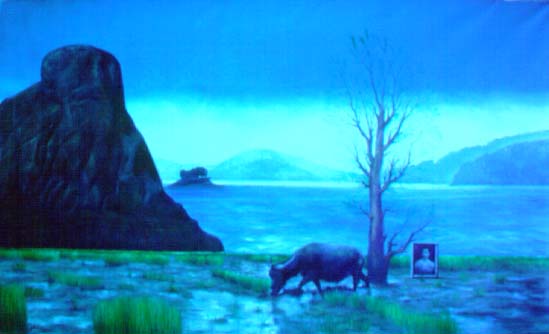
Komar & Melamid CHINA: MOST WANTED PAINTING
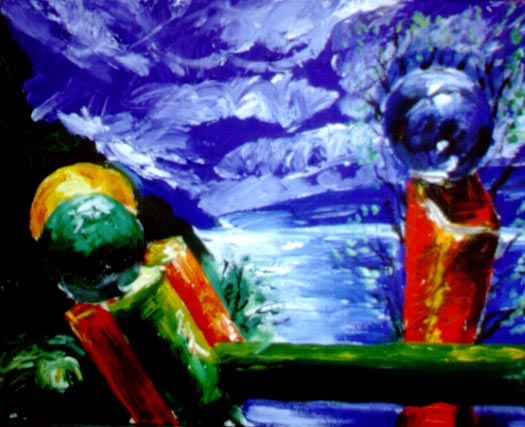
Komar & Melamid ITALY: MOST WANTED PAINTING
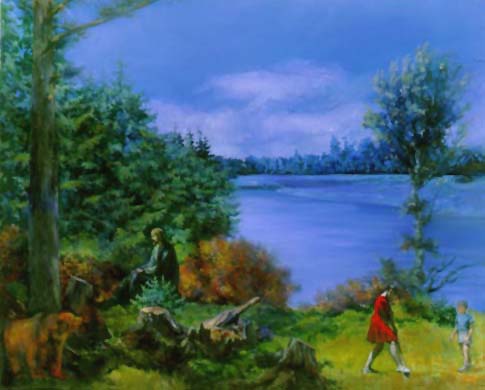
Komar & Melamid RUSSIA: MOST WANTED PAINTING
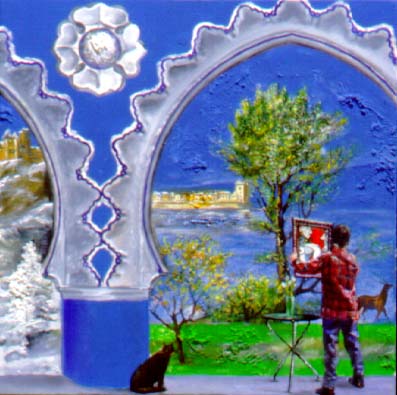
Komar & Melamid GERMANY: MOST WANTED PAINTING

Komar & Melamid FRANCE: MOST WANTED PAINTING
Painting by Numbers: Komar and Melamid’s Scientific Guide to Art, JoAnn Wypijewski (Editor) is available at all good thrift stores (and Amazon)
The pile is my system. Sort and pile. Sort and pile. Until the piles have disappeared.
– Kristan Horton
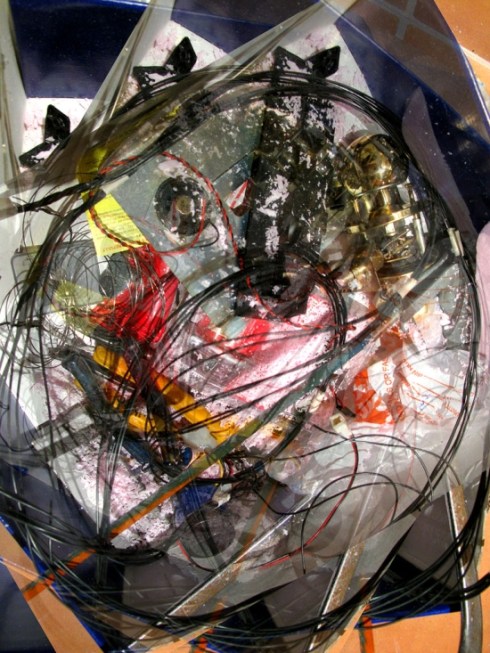
Orbit (doorknob), 2009. Digital colour photograph, Ed. 5. 134.5 x 101.5cm/ 53 x 40in. © Kristan Horton
Well, I guess this announcement saves me the review I was going to post … er, in a way. Kristan Horton has won the Grange Prize.
Earlier this week, I spent a couple of hours looking over the four shortlisted artists and watching the Grange Prize directed videos on youtube. I also had a listen to this slightly unsatisfying panel discussion among the artists.
Alongside Moyra Davey, Horton was my joint favourite. Josh Brand will make some important work with his photogram experiments but his time is yet to come. Leslie Hewitt‘s photography was not personal enough for me – her statements on history were far more expansive than Horton’s more personal musings about time. I think that subtle difference may endeared Horton to the voting public.
Oh, by the way, what should we think of a $50,000 prize for photography voted for entirely by the public?
Back to Horton. I dig his nervous energy, I dig the fact he’s not a “trained” photographer, and quite simply I like the composite-prints he has made of piles of stuff in his studio. I think they are nice objects.
What intrigued me about this prize was that the shortlisted artists were all gentle thinkers and their work was quite solitary. Maybe the humour in Horton’s sugar lump and popcorn models for Dr. Strangelove, Dr. Strangelove also swayed my preference?
All in all, the shortlisted works by the four artists were quite inaccessible required a lot of digestion (which, isn’t really a criticism). The videos and the audio also proved to me that sometimes artists are not the best people to speak about their work. They are so close they see and speak every nuance which can get in the way of immediate appreciation.
Sometimes objects can speak for themselves, which I think Horton’s do.
Former Vietnam veteran, prison inmate and junkie (“once the needle goes in it never comes out”), Clark has a kind of coiled, unpredictable energy.
– Tobias Grey (‘Photographer Larry Clark’s muses’, Financial Times, Oct. 30, 2010)

Billy Mann 1963. © Larry Clark/Luhring Augustine, New York and Simon Lee Gallery, London.
Printed on the salmon-pink pages of the FT (the global leader in financial news), Larry Clark‘s latest interview about his counterculture subjects and his casual anti-commercial philosophy carries some irony.
Then again, perhaps not. Clark’s refusal to market and remarket his books and prints has led to scarcity – the result? Prices have been driven up:
“Clark refused to let either of his most famous books, the harrowing and explicit Tulsa and Teenage Lust, be republished. He finally did a couple of print-runs with Tulsa 10 years ago, but Teenage Lust is still out of circulation and as such a valuable collector’s item. Earlier this year, at an auction at Sotheby’s in London, a single print from Teenage Lust sold for £7,800.”
In his fifties, Clark learnt to skate to keep up with his cast for Kids. He believes that to photograph a youth culture you have to be in it. It must be difficult for Clark to have the city hall in Paris ban under-18s from entry to Kiss the Past Hello, his exhibition at Musée d’Art Moderne, “I think it’s just the stupidest thing in the world,” says Clark. “I think it’s an attack on youth and on teenagers in general.”
It’s difficult to argue against Clark’s indelible mark on American visual culture. Every hipster, skater, urban-wannabee and romantic sees their lives through the American-Apparel-Levi’s-Ryan-McGinley-Dash-Snow-Hamburger-Eyes-Zoolander-Derelicte images that advertisers, Polaroid & film enthusiasts create as facsimiles to Clark’s seductive and brutal works.
Again, irony reigns as advertisers define a slightly mucky but not diseased world in which they can place their products; a world that looks like Clark’s but is some distance from it. With that in mind, I think Tobias Grey‘s point has some weight:
“As a contemporary and admirer of Diane Arbus and W Eugene Smith, Clark is perhaps the last survivor to bridge the classic era of black-and-white photography and the present.”
Clark has ran and defined the continuum.
Read the article. Clark’s closing empathy for childhood movie stars is surprising and honest; he made collages to honor them.
‘Kiss the Past Hello’, Musée d’Art Moderne de la Ville de Paris, until January 2 2011.
PHOTOGRAPHY COVERAGE IN THE FINANCIAL TIMES
Like last weeks FT article on Leibowitz’s interaction with the market, this portrayal of Clark and his motives is well-written, even endearing. The FT Weekend has had articles on Martin Parr and Cameraless Photography in recent weeks too.
It was a mandatory choice of an airmiles-earned printed daily that brought the FT to my door, but I’ll admit I’m looking forward to my Saturday morning reads more and more.
‘I never talk to them… I don’t ask their permission. I don’t pay them… And eventually…I got into trouble’
– Philip-Lorca DiCorcia

I’ve been thinking about surveillance a lot recently.
Philip-Lorca DiCorcia leans on the ubiquity of CCTV to exempt him of guilt for taking portraits without the subjects’ knowledge. It’s a fair point; he worked in public space. Below he talks about his Heads series.
I know the drill, Got cells to burn,
I’m dressed to kill, A mortal coil,
And time is still, On secret soil.
Yeah pay the bills, Cells to burn, Mouths to fill
On Boeing jets, In the sunset make glowing threats.
Yes shall we take a spin again in business,
This time is fixed lets sweeten our facilities,
It took all the man in me.
Lyrics from Massive Attack’s Atlas Air
The animated video for Massive Attack’s Atlas Air, directed by Edouard Salier is a tour de force.
Rampaging and amorphous, what can only be described as a Donnie Darkoesque were-bunny, rips it way through and across blackened territories of prismatic violence. Against and allied, it runs with commercial jets into explosions. Apparently, this is a second appearance for the satanic leporid; it previously romped around Massive Attack’s last video Splitting the Atom.
The randomness of it all, sometimes seen through a gun-sight, recalls the Wikileaks Apache Attack video. But other things are going on too – burning oil fields (the first Gulf War); shattering buildings (9/11); Prestwick airport gets a mention (not the most well known airport but it was the site of a botched car-bomb attack in 2007).
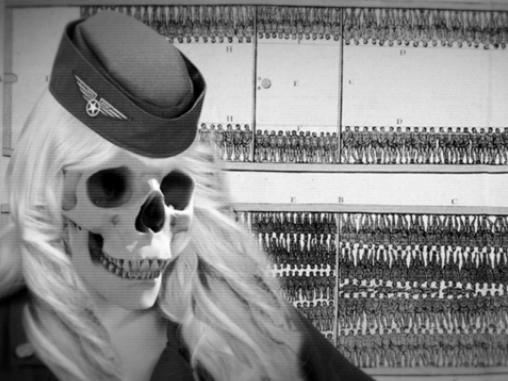
Ultimately, this is a video about extrajudicial rendition flights, the absence of law and the suspension of human rights. The screen grab above – which flashes by so quickly you’ll be forgiven for missing it – deals quite clearly with the involuntary movement of humans, only in this case that of slavery.
Just as the 9/11 plotters usurped commercial airliners for their ideology, the US military adopted commercial jets for its murky logistics. Salier doesn’t miss the opportunity to point out the hypocrisy in the visuals. 737’s get a mention in Atlas Air‘s lyrics.
Salier shows us the negation of order and, perversely, the power-distorted dominance and slick allure of disorder.
By strangling any reason out the compressed annihilation, the Atlas Air video is, for me, one of the finest visualisations of REAL terror. Massive Attack and Salier are not describing anything that relates to the rhetorical usage of the word ‘terror’ pushed on us by war-mongering politicians; they are dealing with pure destructive force as and when it is sent out against an equal force.
This is not a narrative of us against them or of us against them and their allies, or even us and our allies against them and their allies, it is about how fucked it all is … and about the terrifying, beyond-human-scale to which violence escalates. By relying on images of man made cities and theatres of war, Salier reminds us that these crushing vortexes are of our own creation and our own instigation.
I’ve admired Massive Attack’s intelligent use of video before.

 Prison Photography