
You are currently browsing the category archive for the ‘Non-Prison’ category.
I saw this TED talk by Ethan Zuckerman a couple of months ago and I’ve been meaning to post it since.
Zuckerman is a guy that is trying to work out how the web functions, more specifically how it is used. His research tests the claim that the web unites people from diverse communities.
In truth, the majority of us surround ourselves with like-minded people on line as we do in real life; in other words, the web isn’t used to develop wider world views – contrary to many folks’ lip service to the idea.
Zuckerman explains, “Much of my writing focuses on questions of whether the Internet is leading us to have a wider view of the world, or whether we’re becoming trapped in the “echo chambers” described by Cass Sunstein or the “filter bubbles” discussed by Eli Pariser. At Berkman, I’m running a number of small experiments that try to discover how parochial or cosmopolitan the use of the internet is in different communities – these questions are inspired in part by Pippa Norris’s work, especially her book Cosmopolitan Communications. I’ve been writing for the past several years on ways to make the internet work better for creating transnational connections, focusing on making translation transparent, engineering serendipity, monitoring what content we consume and leaning on bridge figures and xenophiles – I talk at length about these ideas in my TED talk, and am (slowly, painfully) working on a book on the subject.” (Source)
Twenty four pages of images here.


I really like Matthieu Gafsou‘s portfolio. This is from his CHAUX-DE-FONDS series.
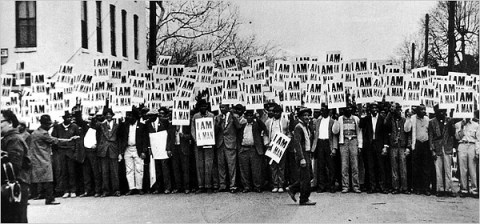
Two stories that broke this week demonstrate the levels to which everything is never as it seems.
The New York Observer describes links between Leslie Deak and funders of the controversial mosque, the CIA and U.S. military establishment have gone unacknowledged.
Meanwhile, The Commercial Appeal in Tennessee reports famed and revered Civil Rights Photographer Ernest Withers doubled as FBI informant to spy on civil rights movement.
Democracy now states, “Withers’s alleged involvement was revealed because the FBI forgot to redact his name in declassified records discussing his collaboration.”
Withers died in 2007.

Thanks to Stan for the tip off.
UPDATE: For more visuals go to:
http://www.flickr.com/photos/8883932@N02/4027649839/in/photostream/
http://www.speakingloudandsayingnothing.blogspot.com/
– – – –
If JR went to Navajo land, he’d hang out with James “Chip” Thomas.
Just love this guy.
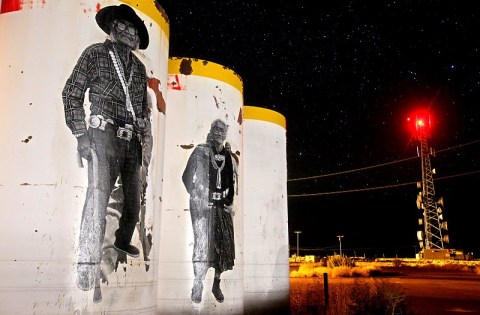
Grey Mountain, artwork by Chip Thomas © Erika Schultz
Just got in from the NW Photojournalism meet. Room chock full of talent including Matt Lutton (of Dvafoto fame) Theo Stroomer, Tim Matsui, Ken Lambert, David Ryder and John Malsbary.
Let me track back a week though.
SOME THOUGHTS AND CONTEXT ON NAVAJO GRAFFITI
A friend of mine who I’ve seen only twice in two years visited Seattle last weekend. He’s Native American … what white folks would call Navajo, but what he refers to as Dineh or Dine (pronounced d-Nay). We were talking about youth culture on the reservation and I mentioned passing through Window Rock (a junction with two gas stations, some vernacular murals and loose packs of dogs). He tells me I was in the wrong part of Navajo Reservation …
Anyway, the murals had me thinking. I saw graffiti on Navajo land – some of it good, some of it terrible; some of it lazy tags, some of it a bit more invested – and I wondered about the social context of these scrawls, paintings and artwork. I proposed to him that a long term photography project NAVAJO GRAFFITI could capture these temporary art interventions. The project would include interviews about the grafs and the social strata from which they emerge. It seemed like it could be a meaningful, novel photography project, a stellar book. Maybe?
In my mind (a place I often invent projects I’d like to see and promote) I envisioned image-making that could incorporate the narratives of a marginalised people without relying on cliches of documentary photography. The grafs could be photographed in the medium format stillness that is all too often wasted on garages, topiary and mall parking lots.
Just a thought.
Thinking on, my friend was as stumped as I to think of any photography work that the Navajo had been able to present, let alone self-represent.
BACK TO NW PHOTOJOURNALISM
The co-organiser of NW Photojournalism is Erika Schultz a PJ at the Seattle Times. When I got home, I checked out her blog. On which, I was blown away to find graffiti on Navajo land. I’d call it street art, except there’s only the open Black Mesa surrounding.

Grey Mountain, artwork by Chip Thomas © Erika Schultz
The work is by Chip Thomas an artist, self taught photographer and Health Services Physician who has lived on Navajo land for 16 years or more. He may not be Navajo by blood but I can be quite certain he has the rights of the Navajo/Dineh people close to his pounding heart.
I want to see more of this. I am not a photographer. Why aren’t photogs out on Native American lands finding more nuanced ways of telling the stories of the people?
The only Native American photographer I’ve identified is Tom Jones of the Ho Chunk Nation, and he is a long, long ways from the Western Deserts; of a different people.
So, two things: 1) Tell me about more Native American photographers (I want to stand corrected) and 2.) Somebody consider a project along the lines of NAVAJO GRAFFITI (I would if I could, but I don’t know cameras).
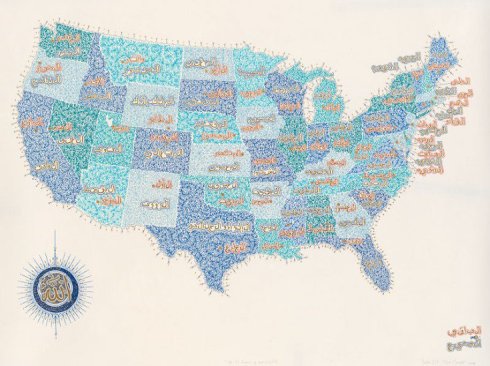
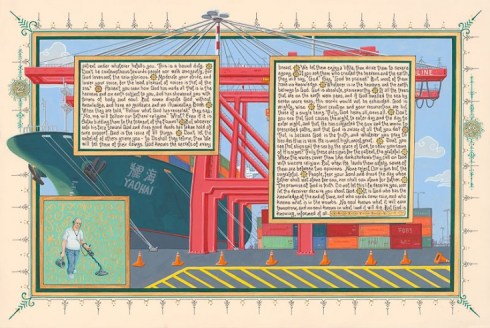
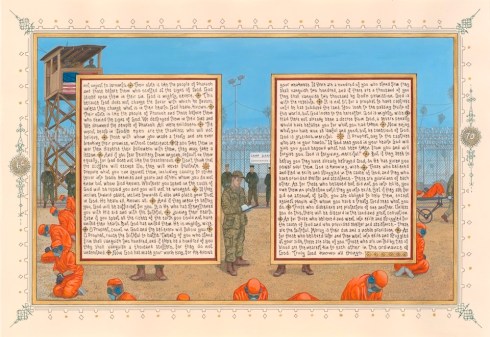
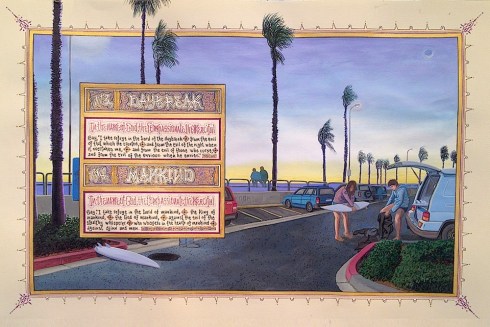
“Through the American Qur’an series, Birk presents a new version of this holy book that is more accessible and also shows how the teachings can be applied to the daily experiences of American life.” (Source)
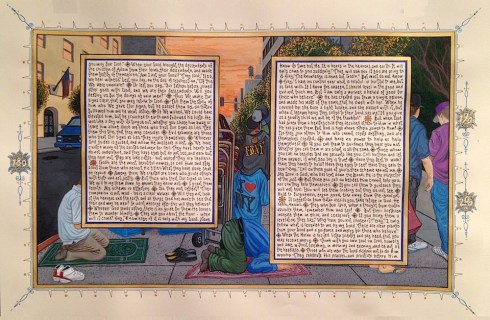
Not photography, not prisons, but very timely; Sandow Birk’s American Qur’an.
Since 2004 Birk has been transcribing the entire Qur’an into English, illustrating each sura (or chapter) with paintings evoking Persian miniatures, but depicting everyday scenes in America. According to the press release, the Detroit-born, California-based artist “hopes to reflect how consistent the similarities are in the teachings of Islam, Judaism and Christianity. To bring this to light enables more understanding and compassion, versus fear of the unknown … ” (Source)
This is the type of reflection that should be made in our current times, instead of this nutter and his offensive fetish for fire. Thankfully, the AP will not distribute images of idiots burning Qu’rans, during the so-called International Qu’ran Burning Day. Ugh.
– – – – –
To my mind, Sandow Birk is the greatest working political illustrator. His clever manipulation of the landscape genre for his Prisonation series was an intelligent, elegiac take on California’s 33 facility prison industrial complex. (I referenced his work reviewing the recent and excellent City Lights publication PRISON/CULTURE.)
– – – – –





… is the Gursky that got the Poster Boy treatment.

 Prison Photography