
You are currently browsing the category archive for the ‘Non-Prison’ category.

“The surveillance system, dubbed Sigard, has been installed in Dutch city centers, government offices and prisons, and a recent test-run of the technology in Coventry, England, has British civil rights experts worried that the right to privacy will disappear in efforts to fight street crime. The system’s manufacturer, Sound Intelligence, says it works by detecting aggression in speech patterns.” – Story
via Boogie
Image: Privacy And Control, by Michael Pickard, Creative Commons: Attribution 2.0.
Fonografia: “Money and press coverage started to arrive. Women organizers in Port-au-Prince camps spoke openly about the rapes and began raising money to move the victims into a new home, but as Bell says, “the visibility and funding have come with a price. Seeing all the ‘blan’ (human rights workers, gender advocates, journalists, delegations) troop to the women’s tents in Port-au-Prince, and knowing that ‘blan’ equals money, last week a man came to the KOFAVIV headquarters (a tarp in the middle of a camp) with a gun to kidnap one of the coordinators and to extract ransom from the coordinator. Fortunately, the plot failed. But (it) highlighted the utter danger that women and children face in the camps each day.”
Without apportioning blame, let’s all admit that we barely consider Haiti today. We all poured over the story, the ruin, the coverage – myself included. We took the opportunity to express our politics but we are too distant and too engaged elsewhere to sustain an informed, daily consciousness.
News media can be an empowering tool but it is also distorts our true commitment to its subjects. A flood soon becomes a trickle.
Last week, as part of that trickle, Deborah Sontag reported for the New York Times on the sexual violence threatening Haitian women.
Follow Beverly Bell’s writings on the issue of rape in Port-au-Prince since the earthquake, and consider supporting KOFAVIV’s efforts by making a donation and spreading the word.
Note: The Fonografia Collective have, as an exception to my point, been consistently committed to reporting on developments in Haiti.

I enjoy reading interviews, but I enjoy more listening to a photographer speak while their photographs scroll.
I also love being able to mount a knowledge of British photography of the second half of the 20th century; an activity that is not quite the fabrication of nostalgia, but I’ll admit it is close (I was born in the eighties … just).

Joerg has predicted this’ll be all over the photobioblogosphere, so I’ll oblige.
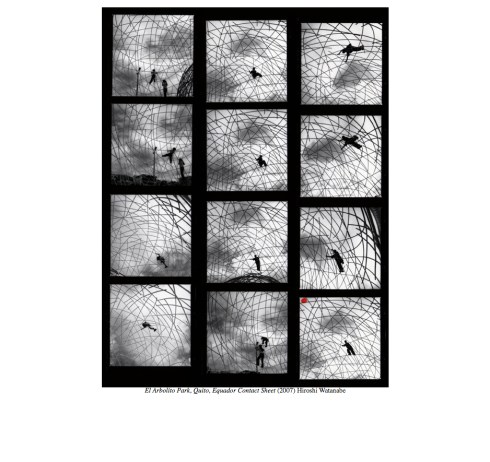
PROOF at the Edelman Gallery exhibits well known photographs with their original contact sheets.
Do I actually like the show or have I been instantly suckered by a seductive concept? I actually like the show; PROOF demystifies some of the lore about famous photography. We need to talk more about photography within the context of its manufacture.
My favourite? Hirshi Watanabe.

New Orleans. In the collection of the Peter Sekear Estate.
Actually, Jacob Holdt was the new Peter Sekaer … we just never knew about Sekaer. Until now.
Sekaer
The New York Times reported today on Signs of Life at the High Museum of Art in Atlanta, a major survey of Peter Sekaer’s life and of his works. Sekaer died prematurely in 1950 at the age of 49, leaving stacks of unsorted photographs.
Curator, Julian Cox said of his work, “We wanted to uncover this hidden gem. Sekaer was like the passage of a meteor, very bright but fairly brief.”
Sekaer often took photographic trips with friend Walker Evans. Sekaer photographed high streets, impoverished neighbourhoods, markets and games. He photographed signs and billboards. From 1936-43 he worked on assignment for various government agencies including the FSA, the USHA and the REA. His task was to document the depressed country and thus Seaker photographed a lot of poor Americans.
Excepting the New Deal agencies, this focus and unexpected coverage was repeated 40 years later by another Dane.
Jacob Holdt‘s ongoing life’s work American Pictures* is equally committed to describing the hardships of the American South. Holdt met many people suffering in a discriminatory culture with discriminatory laws. (I wrote about Holdt following his autobiographical presentation at the 2009 New York Photography Festival.
Holdt (b.1947) is the geist of Sekaer.
It should be noted Holdt doesn’t call himself a photographer, rather a man who uses the camera as a tool in his activism. Sekaer was professional from 1936 onward.
DANISH INQUISITION
It would be foolish to attribute their curiosity and achievements to their Danish heritage, or to suggest that foreign eyes can see with more clarity the shortcomings of their host nation. Sekaer and Holdt likely were/are simply good people with a belief in stories to be told.
Sekaer was an anomaly for his time; an outspoken, moody Dane, with a German camera, asking folk about their lives. Sekaer’s daughter, Christina explains that it wasn’t just his eyes that made his photographs, Sekaer’s voice did too, “His accent helped people want to talk to him.”
Sixty years on, it’s nice to meet you Mr. Sekaer.
More images here.
Peter Sekaer (American, born Denmark, 1901–1950)
Born in Copenhagen, Denmark, in 1901, Peter Sekaer immigrated to the United States in 1918 at the age of seventeen. After successfully operating a printing business in New York City producing posters, advertisements and window displays, he enrolled in the Art Students League in 1929 to study painting. He soon became involved in the New York art scene, befriending, among others, the artist Ben Shahn and the photographer Walker Evans.
By 1934 Sekaer had left painting behind to study photography with Berenice Abbott at the New School for Social Research. Through his friendship with Walker Evans he secured contracts from 1936 to 1943 to work on assignment as a photographer for various government agencies that were created as part of President Roosevelt’s New Deal program. In 1945 Sekaer started his own commercial photography business, shooting advertisements and human interest stories for magazines.
In 1950, at age forty-nine, Sekaer suffered a fatal heart attack. His life’s work has been preserved by his wife, Elisabeth Sekaer Rothschild, and their younger daughter, Christina Sekaer.

'Family Shelling Pecans, Austin, Texas', 1939. G Peter Sekaer. Collection of the High Art Museum, Atlanta. Purchased with funds from Robert Yellowlees.
Signs of Life: Photographs by Peter Sekaer is the first major exhibition dedicated to the work of the Danish-born American photographer Peter Sekaer. Organized by the High, the exhibition runs June 5, 2010 through January 11, 2011. High Museum of Art, 1280 Peachtree Street, N.E. Atlanta, Georgia 30309.
– – –
*Conflating Holdt and Sekaer further, a 1999 exhibition at the Addison Gallery of American Art was titled ‘Peter Sekaer: American Pictures’. I don’t know if the curators knew of Holdt’s body of work.

Photographing an American Marine with a malnourished boy during Operation Restore Hope, Mogadishu, Somalia (1991). © Paul Lowe/Panos
Victor Acquah has established AfricanLens to present African nations as “you” and “photojournalists who travel across the continent see it.” Hopefully, AfricanLens as a collaborative space for photographers contributing outside of their employers’ (agencies’) influence or editors’ decisions may dish up some novel, calmer stories.
AfricanLens also provides a platform for analysis. Early indications – and early contributors – are good. David Campbell, professor of cultural and political geography at Durham University, over the past couple of years has published (to academia AND blogs) excellent research and positions on media and photography; Campbell’s editorial for AfricanLens takes on the potential pitfalls of the debate about defining Africa:
“What is the visual story that needs to be told about Africa? … Would we even ask that question of the Americas, Asia or Europe? It is unlikely. Others are represented in ways designed to shore up the self and ‘Africa’ is central to the formation of European and North American identity.”
This is a familiar argument, and inasmuch as it still exists, I reckon it is as valid as ever; visual consumption is almost always simplifying and reductive. Would we be better with dozens of [Insert individual African nation names here]Lens instead of AfricanLens? Possibly, but let us not expect to run before we can walk. That Campbell’s position questions some tenets of AfricanLens itself would suggest this is to be an intellectually honest and open forum.
Campbell presented the above image from Somalia by Paul Lowe in 1991. Lowe’s image is an echo of Nathan Weber’s from Haiti (talked about here) and reminds me that discourse on the use and usefulness of photography outside our borders is as vital as ever.
Good luck to Victor and AfricanLens.

Photographers and Fabienne Cherisma, Port-au-Prince, Haiti, January 19th 2010. © Nathan Weber
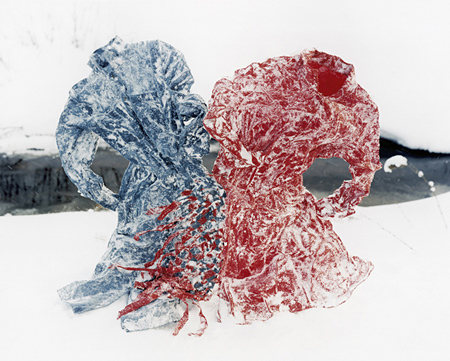
Relation, 2001 [from “Vestige”] © Riitta Päiväläinen
Anyone else notice Shane – over the weekend – spewing out content quicker than BPs worst nightmare?
And what quality. In two days we had:
Timothy Briner: Boonville
Thomas Bangsted: Pictures
Sasha Bezzubov: Wildfire
Céline Clanet: Máze
Ralph Shulz: Theater
Charles Fréger: Fantasias
Riitta Päiväläinen: Vestige
Cassander Eeftinck Schattenkerk: The Andromeda Strain
Good stuff.

Fantasias 9, 2008 [from “Fantasias”] © Charles Fréger
Hopper’s closing remark really stuck, “I am just a custodian. Hopefully, they’ll all end up in a museum”. I hope so too, Dennis.
Found via dvafoto and woostercollective.

 Prison Photography