
You are currently browsing the category archive for the ‘Opinion’ category.
I have a lot of reasons for opposing America’s prison industrial complex, but zealously guarding infirm, hospitalised prisoners (and the wasted money) seems like one we reason should all understand.
This, from the Los Angeles Times:
A degenerative nerve disease has left 57-year-old California inmate Edward Ortiz semi-paralyzed in a private Bay Area hospital for the last year. The breathing tube in his throat tethers him to a ventilator at one end of the bed; steel bracelets shackle his ankles to safety rails at the other.
Still, California taxpayers are shelling out roughly $800,000 a year to prevent his escape. The guards watching Ortiz one day last week said department policy requires one corrections officer at the foot of his bed around the clock and another guard at the door. A sergeant also has to be there, to supervise.
When I can find the time, Lebbeus Woods‘ blog is always a treat to dip into.

© Ross Racine
On Ross Racine‘s digital drawings, Woods says:
Artists and poets have struggled over the centuries to make works that startle us with their originality and, in effect, wake us up to depth of human feelings in our own uniqueness and individuality. The artist’s and the poet’s originality connects with our own, invoking the feeling that to be human is to be unique. The artist is a mirror of ourselves, inspiring us not to be artists but individuals […] But the raw fact is, most of us are not so unique. Our lives, except for the smallest details, pretty much resemble the lives of others, particularly those in our social group, whatever it might be, defined by economic class, race, educational background and many others. The truth is that we are intensely social creatures and our social context often overwhelms our individual traits and aspirations. This would seem to be the message imbedded in Ross Racine’s drawings of suburbs.
View Ross Racine’s work here.
– – – –
Woods’ post on Libya is also rather rousing. It discusses (not in any related way) the push for another type of individual recognition.
I include the map below, because despite my web-surfing it was new to me and it may be to you also.

(Click to view large)
Blake has compiled a great little piece about the final images of some of the best known photobooks.
Here’s what Blake has to say about Eggleston:
The final image in Eggleston’s Guide is typical Eggleston. It’s so banal it almost seems meaningless. Yet I’ve always found this picture loaded and menacing. Peaked hoods in the south creep me out. I wouldn’t make this my last image before bedtime.
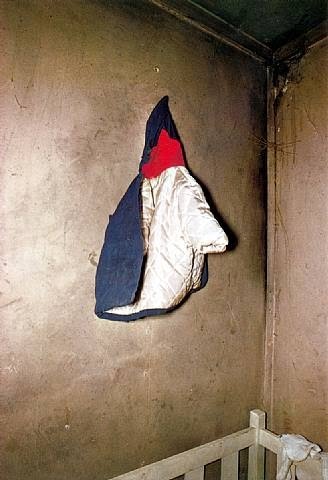
Near Jackson, Mississippi, 1970, William Eggleston
For all sorts of reasons, my life is a whirlwind right now.
With regard Prison Photography and what it all means, might mean, things are tabled for renegotiation. Rejigging.
The renegotiation is in thinking of more creative ways to share new content, but also leverage old content to make it available to interested parties.
A complete redesign of Prison Photography is on the cards; old interviews and criticism would resurface again. But overhaul is not scheduled within the next year. In the meantime, there exist novel means to share the archive of information on Prison Photography.
This week, I made the trip to Coventry University to guest lecture for the Picturing the Body (#PICBOD) course. Course leader Jonathan Worth is a lesson in enthusiasm. With the backing by Jonathan Shaw and the assistance of Matt Johnston along with a host of others within and beyond the photo deptartment’s walls, Jonathan Worth is creating something wholesome, giving and pioneering.
Worth and his collaborators are building a model for free, online photography curricular in criticism and practice for both BA and MA students; students in Coventry and across the globe.
My presentation ‘Tattoos, scars and tears, Robert Gumpert’s work in San Francisco jails’ (which you can listen to here) focused on Robert Gumpert‘s ever developing project ‘Take A Picture, Tell A Story‘. As an introduction and to provide context to Robert’s work, I summarised the work of photography within sites of incarceration throughout the history of the medium.
Following the lecture, Jonathan Worth suggested the introduction alone could constitute a lecture. I would venture farther and say it could warrant a full course in itself.
I’m writing a few syllabi presently and – in the spirit of #PICBOD – I realised I should be sharing my notes.
So, here they are … on a cachable page for perpetuity.
A BRIEF HISTORY OF PRISON PHOTOGRAPHY (IN LOOSE CATEGORIES)
Before the golden age of photojournalism, the photographing of prisoners was used for purposes of identification, order and discipline. The two part mugshot (front view and profile view) was standardised by Alphonse Bertillion. Police departments adopting the system had in-house technicians and photographers but they are anonymous in history.
Remarkable archives by anonymous police photographers exist the world over, but two noteworthy collections are in New Orleans and Sydney.
American prisons fell on to the radar of professional and committed photojournalists in the sixties and seventies, more and more. Three Magnum photographers (Eve Arnold, Bruno Barbey, Danny Lyon) went to Texas. Arnold returned to the subject again and again. The Lone Star state had a punitive prison culture with reform commonly taking the form of hard labor on the chain gang; images echoed those of slavery in the South.
The “exotic” prison (Late 70s, 80s, USA):
Morrie Camhi’s photographs of California prisoners remain some of the most authentic portraits made within US prisons. Douglas Hall Kent, spent years and published at least two books on prison tattoos. Garry Winogrand stopped by Huntsville for the prison rodeo. The much lesser known Ethan Hoffman produced a book titled Concrete Mama about Walla Walla Penitentiary in Washington State. The brutality and tenderness of interactions between prisoners as depicted by Hoffman are surprisingly frank.
Pioneers in prison documentary photography/photojournalism (1980s and 90s in USA):
Cornell Capa (Attica, NY, USA); Taro Yamasaki (Michigan), Ken Light (Texas), James Nachtwey (Texas and other Southern states), Bruce Jackson (Arkansas), Alan Pogue (Texas).
Contemporary to the Americans (above) was the anomalous Jean Gaumy. In 1976, Gaumy was the first photographer allowed access to a French Prison.
Contemporary prison photography (1990s, 2000s):
Lori Waselchuk (Angola, Louisiana), Ara Oshagan (California juveniles), Victor Blue (California), Andrew Lichtenstein (multiple states).
Collaborative/rehabilitative projects (2000s):
Casey Orr (Leeds, England), Mohamed Bourouissa (Paris, France); Deborah Luster (Louisiana, USA), Klavdij Sluban (France and Eastern Europe), Mikhael Subotzky (South Africa), Steve Davis (Washington State, USA); Robert Gumpert (San Francisco, USA); Leah Tepper Byrne (USA)
Eastern European and Former USSR (Late 90s, 2000s):
Much of the photography from the former Soviet bloc is characterised by the grey abandonment of it all. Into the new millenium, younger photographers took less documentary approach with more nuanced fine art engagement with the inmates of Russia and its satellites. Examine the work of Christian Als (Latvia), Carl de Keyzer (Siberia), Yana Payusova (Russia), Sasha Maslov (Ukraine); Delmi Alvarez (Latvia) and Jane Evelyn Atwood.
Western Europe:
Generally, a more tactical use of technique and viewing from photographers such as Nico Bick (Netherlands), Juergen Chill (Germany), Matthieu Pernot (France and Spain), David Moore (London, UK) Danilo Murru (Sicily and Sardinia); Lizzie Sadin (Multiple countries); and Melania Comoretto (Italy).
Guantanamo (2002 – ):
Many photographers have addressed Guantanamo including Paolo Pellegrin, Brennan Linsley, Tim Dirven, Chris Maluszynski, Bruce Gilden, Louie Palu and Christopher Sims. Above all others, Edmund Clark has made the best contribution with emotive images from former detainees’ homes, letters of the detainees and an extremely engaging essay from Dr. Julian Stallabrass.
Political memory (20th and 21st centuries):
Donovan Wylie (Northern Ireland), Paula Luttringer (Argentina), Dana Mueller (US POW camps), Phillip Lohoefener (East Berlin Stasi prisons) and Anna Schteynschleyger (Former USSR).
Archives of Atrocities:
Willhelm Brasse, known as the Photographer of Auschwitz during WWII; the photographers of Tuol Sleng in Cambodia during the Kymer Rouge regime (1975-1979); Victor Basterra, Naval Mechanics School (ESMA), Buenos Aires, Argentina during the Dirty War (1976-1983)
Conceptual:
Chris Jordan‘s large digital composites that stack 2.3million prison uniforms upon six floor-to-ceiling cnavases approach the depressing scale of US incarceration. Featured in ‘Invisivle’ a summary of his first ten years or so probing military and state secrets, Trevor Paglen “stalked” previously clandestine extrajudicial prisons used in the global war on terror. Broomberg and Chanarin, on a tour of Afghanistan rolled-out sheets of photographic paper on days of historical importance, in one case a jail-break.
Africa (21st Century):
Without exception the photographs of African prisons focus n the deplorable conditions, the mistreatment of children and usually both. Julie Remy (Guinea), Fernando Moleres (Sierra Leone), Lynsey Addario (Uganda & Sierra Leone), Nathalie Mohadjer (Burundi), Joao Silva (Malawi).
INQUIRY NOT GENRE
Given the breadth of photogs’ motives and the different uses of these images it is foolhardy to think of prison photography as a genre. I have taken to calling it a ‘non-existent’ genre.
The website Prison Photography is an inquiry, primarily into the uses and abuses, creation, consumption and distriubtion of images within highly politicised institutions. The photograph is only the beginning.
This time last year Laura Sullivan for NPR reported on the US broken Bail Bond System. I celebrated her work and later, upon it’s resurfacing called Sullivan “An American Hero”
NPR contacted me recently to let me know Sullivan’s series won an Excellence in Broadcast Journalism Award.
Bravo!
From NPR:
NPR News is being honored with a 2010 Alfred I. duPont-Columbia University Silver Baton Award for excellence in broadcast journalism for a three-part investigative series revealing deep and costly flaws in the U.S. justice system’s bail bond process, it was announced today. Reported by NPR Correspondent Laura Sullivan and edited by Senior National Editor Steven Drummond, “Bonding for Profit” exposed deep inequities in the treatment of rich and poor defendants, how the bail industry is vested in maintaining those inequities and the surprising cost to taxpayers. The series aired on the NPR newsmagazines All Things Considered and Morning Edition, and is available online at npr.org: www.npr.org/series/122954677/behind-the-bail-bond-system
After months-long research into the perpetual and expensive overcrowding problem in U.S. prisons, Sullivan discovered that the bond system may be a major factor in keeping jails stuffed. “Bonding for Profit” focused on the dilemma of more than a half million petty, nonviolent offenders stuck in jail for months due to the simple reason of not being able to make bail – which is sometimes as little as $50 – at a $9 billion a year cost to taxpayers. In three reports, Sullivan revealed how stark options often force inmates to take prosecutor deals in exchange for early release, and how the bondsman lobby fights pretrial release programs proven to save millions of dollars.
The “Bonding For Profit” series produced emotional feedback from listeners, and has been cited by The Justice Department, the American Bar Association and lawmakers in Virginia, North Carolina and Florida in initiatives to examine current bail practices. The Awards Jury also praised Sullivan’s writing, saying it “crackles with insight and storytelling based on hard facts.”
The duPont-Columbia Awards will be presented at a ceremony on January 20 at Columbia University in New York. Accepting the awards on behalf of the organization are Laura Sullivan and Steve Drummond. Information about all of the winners announced this year is available at: www.dupont.org
The Alfred I. duPont-Columbia University Awards honoring overall excellence in broadcast journalism were established in 1942 by Jessie Ball duPont in memory of her late husband. Administered since 1968 by Columbia University’s Graduate School of Journalism, the awards are considered the broadcast equivalent of the Pulitzer Prize, which the Journalism School also administers.
The LA Weekly has been following a story that questions the purpose and notion of “justice” in America. Zealous charges brought by the L.A. County District Attorney have destroyed Jeremy Marks’ life:
The first thing to understand is that Jeremy Marks touched no one during his “attempted lynching” of LAUSD campus police officer Erin Robles.
The second is that Marks’ weapon was the camera in his cell phone.
The third is that Officer Robles’ own actions helped turn an exceedingly minor wrongdoing — a student smoking at a bus stop — into a state prison case.
Marks, 18, has been sitting in Peter Pitchess Detention Center, a tough adult jail, since May 10. Bail was set at $155,000, which his working-class parents can’t pay.
The altercation was not pleasant and Robles and Marks (both fueled by adrenaline, I propose) are guilty of arrogance. But such involved inescapable legal proceedings? The juggernaut of procedure has pummeled common sense on this one.
Found via Discarted, who asks, “How does a situation where a campus police officer reprimands a high school kid for smoking escalate into a felony charge and a possible seven-year jail sentence for another?”
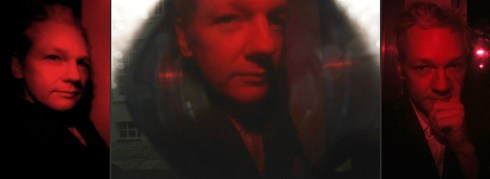
Carl Court / AFP – Getty Images; Dan Kitwood / Getty Images; Peter Macdiarmid / Getty Images
These photos of WikiLeaks founder Julian Assange arriving at Westminster Magistrates Court inside a prison van with red windows reminded me of Ben Graville’s past work, which I wrote about here.
Graville’s In & Out The Old Bailey caused some controversy drawing accusations of exploitation. Do we feel Assange is being exploited here? I don’t really think so. Assange is well aware of media praxis and photographer protocols for winning that shot. By his direct eye contact, it would seem he’s putting on a show for these photographers? Or maybe it’s just the edit?
BUT WHAT ABOUT THE RED?
You could run hog wild with reading the colour here, but I won’t. I’ll just mention, witch-hunts, the Hunt for Red October, Red Letter Day, the commies, the Reds, blood on “their” hands, whoever they are, the Scarlet Pimpernel, drive by night tactics, sex by surprise, red light districts and the red ink of Top Secret papers. All collapsing on top of this portrait of a man, still widely misrepresented.
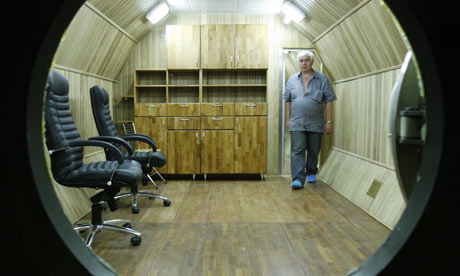
European Space Agency simulation module used to study the effects of long term confinement. Photo: Pavel Zelensky/AFP/Getty Images
In June 2010, as part of the Mars 500 research project, the European Space Agency (ESA) put six trainee astronauts into a space flight simulation. In a giant ” tin can” in a Moscow hangar with no sun, no fresh water and no alcohol for 520 days, the psychological tenacity of these six ground-bound astronauts will be under constant scrutiny. Mars 500 is the most ambitious space-simulator research to date. The ESA put away its trainees in similar conditions for 105 days in 2009.
As a spokesman for Mars 500, Dr. Christer Fuglesang, a Swedish astronaut with the human spaceflight directorate of the European Space Agency (ESA) emphasised the usefulness of the study:
“This isn’t a joke. It will give a lot of useful information, not just about Mars but also for Earth […] People are isolated in many places in the world. We have scientists in the south pole for a long time, or in submarines. Then there are all those in jail.”
Fuglesang is right. Solitary confinement is never a joke.
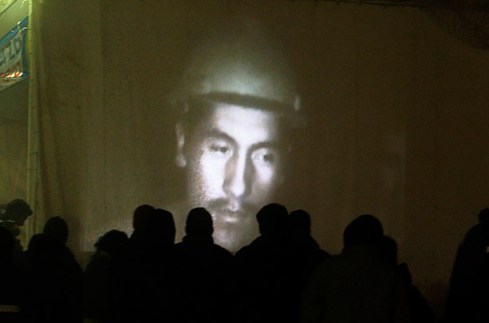
Well-wishers, family and friends watch a video of the miners projected onto a screen erected near the collapsed gold and copper mine near Copiapó, Chile. Photo: Ivan Alvarado / Reuters.
When the Chilean miners were trapped for 69 days experts from NASA were called in as experts on the psychological strains of long term confinement. A call to the management of any one of America’s hundreds Intense Management Units (IMUs) could have been as useful (except for the fact that prisoners are hardly cared for or monitored in the way necessary to improve their psychological state.) On any given day in the United States, 20,000 men, women and children are held in solitary confinement.
I have used this quote before, but it bears repeating:
First, after months or years of complete isolation, many prisoners “begin to lose the ability to initiate behavior of any kind—to organize their own lives around activity and purpose. Chronic apathy, lethargy, depression, and despair often result. . . . In extreme cases, prisoners may literally stop behaving” (Haney). [They] become essentially catatonic.
Source: Hellhole, The New Yorker, March 30, 2009, by Atul Gawande.
UNFATHOMABLE SCALE
Everyday in American prisons wallow the equivalent of 600 Chilean mining disasters … except prisoners can remain penned in for longer than 69 days.
“The [psychological and cognitive effects of long term isolation] is not something that’s easy to study,” says Craig Haney, psychology professor at the University of California at Santa Cruz, “and not something that prison systems are eager to have people look at.” Haney leads academic research on solitary confinement and notes that US prisons didn’t always resort to its current widespread use:
We have an overwhelmingly crowded prison system in which the mandate to rehabilitate and provide activities for prisoners was suspended at the same time as the prison system became overcrowded. Not surprisingly, prison systems faced with this influx of prisoners, and lacking the rewards they once had to manage and control prisoner behavior, turned to the use of punishment. And one big punishment is the threat of long-term solitary confinement. They’ve used it without a lot of forethought to its consequences. That policy needs to be rethought. (Source)
FIRST HAND TESTIMONY
Academics, studies and statistics may hook, inspire and lead some to direct action, but for others the voices of those who’ve suffered in solitary confinement may inform more effectively.
In a prison system that has lost its moral compass, in a system that uses solitary confinement cells as the new asylums, in a country which had made torture its own, it is the voices of the confined to which we should pay most attention.
I would like to recommend an excellent writer, who also happens to be a prisoner. Arthur Longworth was awarded First Place in memoir in the PEN American Center 2010 Prison Writing Contest. Longworth writes about the violence of the Walla Walla Intense Management Unit (IMU) in Washington State. Longworth’s second memoir piece is entitled The Hole.
You can buy The Prison Diary of Arthur Longworth #299180 ($7) by following the directions posted at Changing Lives, Changing Minds.

 Prison Photography