
You are currently browsing the category archive for the ‘Opinion’ category.
I have talked in the past about the politicisation of immigrants, their reduction to visual cliche and indeed there is a lot more to be said on Tent City, Maricopa, AZ particularly.
I even began this blog way-back-when with musings on physical & psychological borders and unseen landscapes that define flux, unknowns and action.
AIDING IMMIGRANT PASSAGE: The Transborder Immigrant Tool
I just received an email from Bryan Finoki about some unpleasant political muscling down in San Diego.
I am proud to support Ricardo Dominguez and to add my signature to the petition to save Professor Dominguez’s tenure:
Target: UC President Mark Yudof, UCSD Chancellor Marye Anne Fox, UCSD SVC Paul Drake
Sponsored by: UC Multi-Campus Research Group in Internationalism and Performance
Ricardo Dominguez (Associate Professor, Visual Arts, UCSD) is currently being threatened with criminal action and the revocation of his tenure by UCOP and several UCSD senior administrators. This is a long, rapidly-developing story. Time is of the essence. Please sign now!
UC Office of the President has reportedly been upset over Ricardo’s involvement in the Transborder Immigrant Tool – these are recycled cell phones loaded with software that points border-crossers to caches of fresh water in the desert, obviously saving lives. It’s a controversial project, to say the least; and Ricardo has received death threats from people in the SD community and beyond. The project was picked up by the national and international presses, and CNN named Ricardo one of its “Most Interesting People” of 2009 because of the project. Several Republican congressmen also recently sent a letter to UCSD demanding that the project be ceased and Ricardo be censured. In response to this, the university has been scrambling to find a way to shut it down. Importantly: the project has been included in every one of Ricardo’s professional reviews over the last few years, all of which have gone successfully (and have been signed off on by this very SVC); in addition, the project has been FUNDED by UCSD (and yet again, signed off on by this SVC). Now that the controversy has gotten attention in DC, they’re reversing course.
More recently, as part of the March 4 actions, Ricardo’s bang.lab created a virtual sit-in on the UCOP web site. A virtual sit-in works in this way: participants go to a specified web page, which continuously “refreshes” connections to the target web page (in this case, ucop.edu). This obviously increases traffic to that site — much like a live sit-in at a specified locale — with the potential effect of making it too busy to accept new incoming connections. It is similar, in form, to what’s called a “Distributed Denial of Service Attack” (DDOS). There are several critical difference between a virtual sit-in and a DDOS: a DDOS is prolonged and unending, used by various governmental groups to censor a wide variety of free speech groups, activist groups, etc, and non-transparent (the creators of the DDOS set up virtual robots to blast a given site with millions of hits, and hide the creators behind various firewalls and filters. A virtual sit-in is open, does not use such “robots,” and the creators are identified freely).
SIGN THE PETITION
Please sign the petition below to protect academic freedom and tenure from politically-motivated attacks.
http://www.thepetitionsite.com/1/stop-the-de-tenuring-of-ricardo-dominguez
THE RESEARCH
Click on the sheet below for a larger version.


Etching from Goya’s series “The Disasters of War:”
Lebbeus Woods posted some interesting thoughts today about Francisco Goya’s meditations on war.
My reading and interpretation of Woods’ words is based on the presumption that photography is the visual “raw material” of a war and art can be something distinctly different – as Woods argues something more transformative and powerful. I am knowingly playing devil’s advocate.
Woods:
“Instead of creating propagandistic art, extolling glorious military heroism, Goya focused on the atrocities of the armies, committed against ordinary people. He knew that when soldiers get into a killing craze, they murder and rape indiscriminately, often just for the hell of it.
If there were an Iraqi or Afghan Goya working today, he or she would not make journalistic photos of the slaughter of people who just happen to be there, but would draw and paint it, becoming selective, ‘aestheticizing’ the atrocities, in order to elevate them to a serious level of reflection.
The artist does not merely present us with raw material, which is always difficult to confront and understand—indeed, it is easier to dismiss it with only a shudder—but instead creates indelible images, which cannot be gotten out of the mind.”
It seems to me that Woods’ may have a point – that general publics may be turned off to the photojournalist product and more shocked when the depicted horror has come from the end of paint brush or lithography set, and thus by the way of a fellow human’s imagination.
What says you?

Jake and Dinos Chapman, 'Disasters of War' (1993)
Incidentally, a couple of friends and I went to see Goya’s Disasters of War etchings exhibited alongside Jake and Dinos Chapman’s sculptures of homage of the same title. It was simple … and singularly the best art exhibit I’ve seen in a long time.

Last week, I said that photographs from Guantanamo now teach us nothing. I should qualify that statement; photographs will tell us nothing new of the military operations, procedures and especially not future plans for the site.
It does not mean, however, that photographs are useless. Visual sources can be presented to refine existing positions of that illegal and politically foolish site.
Looking at the same set of photographs by Tim Dirven, Robert Hariman of NO CAPTION NEEDED has drafted a position that describes the growing and inevitable non-utility of Guantanamo as it relates to the discredited policy that originally led to its construction and use.
“An architecture of stupidity begins to emerge. For example, the extreme functionality of the space that actually inhibits any reasonable use, much less any use that might lead to resolution of the larger conflict. Also perhaps the over-design of the security apparatus: tables bolted to the floor within a cage will have their rationale, but there is something so excessive here that it has to be a sign of arbitrary rules, endless procedures, and near-complete inattention to anything else but the literal replication of the machinery of power. Nor is that a dynamic process, but one that depends on stasis, on the inactivity, boredom, and habitual resignation to routine evident in the guards’ postures.”
“[Guantanamo] prison is a monument to stupidity. It is not enough to reform the prison, however. My point is that the national security state produces stupidity because it depends upon stupidity. The national interest of a democratic people may be served well by reason, but the modern state, to the extent that it is a regime of coercive control, will rely on another mentality: stupidité d’état.”
(My bolding)
Plaut on racial tensions, sick politics, terrible stats and a worst case scenario:
For most South Africans, Eugene Terre’Blanche was a throwback to another era. But his death is a blow to the country’s image of racial tolerance, fostered so carefully by Nelson Mandela.
Some are likely to believe that the fact that his alleged attackers were arrested so rapidly smacks of a cover-up. Others, on the minority far-right fringe, will see his death as a vindication of their assertion that whites cannot live under black rule.
It is a tragic fact that more than 3,000 white farmers have been murdered since the end of apartheid in 1994. And it is possible that some people may seek retribution.
Mr Terreblanche’s funeral could become a rallying point for such sentiment.
Source: Terre’Blanche death brings Zuma appeal for calm, Sunday, 4 April 2010

The five boys who came to illustrate the class divide. Photograph: Jimmy Sime/Getty Images
Ian Jack wrote a glorious piece in today’s Guardian about Jimmy Sime‘s iconic image.
‘The photograph that defined the class divide’ describes 70 years of misreadings and its use as illustration for shallow assessments of Britain’s class disparities.
Jack is masterful in his analysis because he keeps it based in fact. The consequent lives of the five boys (which are not what you’d expect) are ultimately the critical blow to all the users and abusers of Sime’s image down the years.
“When a newspaper had asked the three men to get together to reconstruct the picture at Lord’s, one of them refused. I could see why: which of us would want to be remembered as a stereotype, especially in a class war where we’re given no choice of sides?”
Jack doesn’t dismiss the notion that Britain is still divided by class. To the contrary he says that Britain remains the European nation with the biggest gap between rich and poor. He (and I) can see that these arguments about UK inequality are better made with relevant illustration and not this nostalgic claptrap that does nothing to inform or elaborate.
” If a photographer wanted to re-create Sime’s picture, he might be faced with five boys dressed much the same, in jeans and brand names. Giving a superficial impression of equality, the picture would be even more of a lie than before.”
Just to prove the entrenched and idle use of Sime’s photo right up to present day, Jack finishes with this:
“What picture accompanied the Daily Telegraph’s report in January 2010? Sime’s, of course; the same as Picture Post had published in January 1941. There they were again: Wagner, Dyson, Salmon, Catlin and Young, doomed for ever to represent our continuing social tragedy.”
Brilliant stuff!
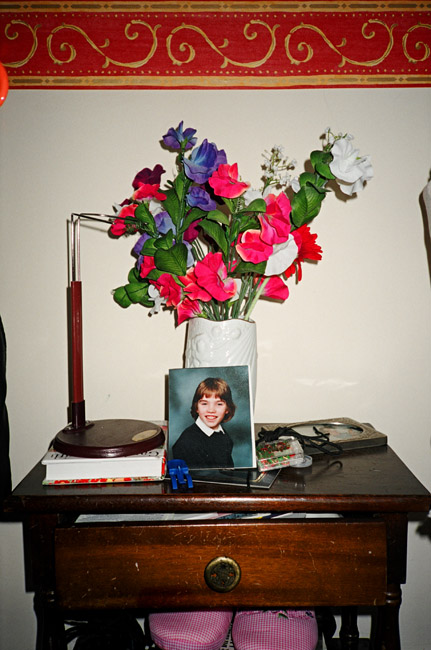
Anna Fox
Tomorrow, the 17th March, the Deutsche Borse Prize is announced.
Two artists up for this year’s prize can fill us with humour and optimism, two others serve the cold reality of human’s strategic antagonism and ability to destroy. It depends on which worldview you prefer.
THE COLOUR OF FOX AND LEONARD
Anna Fox’s bright works are full of love and wonder but they aren’t winners … not yet. Fox has too many ongoing projects that it would be counter intuitive to make her the Deutsche Boss.
The appeal of Fox’s work is obvious part Richard Billingham, part Cindy Sherman, large part Martin Parr. Fox observes congested cupboards, Mothers Day flowers, plastic dolls and emphatic interior details with awe but without irony. All her work is colourful and her later photography staged (Country Girls). Fox’s work is a celebration of that British penchant for chintz and pattern that is rarely brought into focus. While it is distancing, Fox’s work is not distant. Necessarily the ugly brocade of a parents’ generation is balanced by the crayons of the kids’ generation, Fox’s work is unifying. It’s a winner but a winner in its mid-development, so not a winner for now.
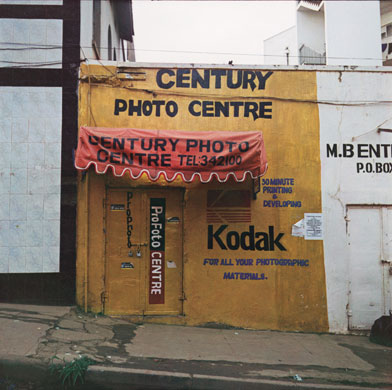
Zoe Leonard
Zoe Leonard has a keen omnicultural view that picks out the additions and modifications that humans make to their world. Surely, it is Leonard’s wandering eye which casts wonderment upon all nations that is the attraction of her work?
Like Fox, Leonard is interested in human ingenuity. Both artists are optimistic about the utility and purpose of things. For Fox and Leonard things, as curious and benign as they may be, are material objects that budded elements of creativity and graft.
Leonard’s worldly view is generous and progressive but is it a fair reflection of our world?
THE DARKNESS OF WYLIE AND RISTELHUEBER
On the other side of the equation, Wylie and Ristelhueber – with restrained palettes – throw down their documents of strife and its aftermath with dominating conscience.
The choice you must make between the two is simple. Do you go for Wylie’s final phase ‘Troubles’ of Northern Ireland or do you go for Ristelhueber’s sprawling and ongoing multinational survey of carnage?
Do you prefer your battles contained or dispersed? Can violence be enclosed, bright-burning and abated between walls, or is conflict slower – continually popping and maiming in every country and on any old road?

Donovan Wylie
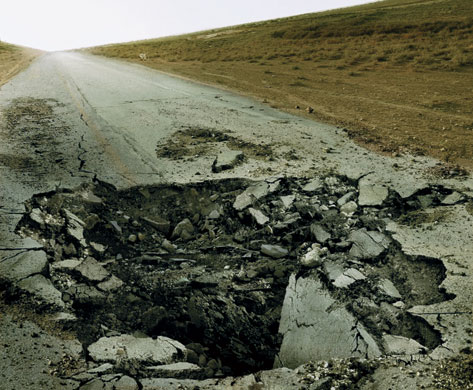
Sophie Ristelhueber
As Ristelhueber opens up space Wylie closes it down. As Wylie describes literal containment Ristelhueber prowls the unnerving territory of psychological containment. Ristelhueber’s Blowups series of craters after IED and car bomb explosions are chilling and very effective.
The ultimate difference between these two artists is that Wylie offers reprieve. Wylie recently declared his image of the Maze’s last wall to be demolished his “Best Shot”. Everyone is aware of Wylie’s Northern Irish heritage and H.M.P. Maze carries more meaning for him personally than it may for us. Wylie documented the prison’s decommission and demolition over a period of eight years. He hopes that the work be simultaneously a record of the site and a “metaphor for the peace process”.
Ristelheuber’s document of violence seemingly has no limits or borders, a notion of violence that is depressing but accurate for today’s globalised military engagement. Where do we find a peace process here? Which road or road-map do we follow here?
If Wylie’s work references the remnants of a political battle, Ristelhueber’s is record of ongoing skirmish. Ristelhueber’s photographs of blockades and bomb-craters are images not unlike those of the Northern Irish Troubles so we can identify a lineage there. However, hers are not photographs from 35 or even 15 years ago; Ristelhueber’s work shows us the violence of the 21st century.
Some might favour the distant and deadpan of Wylie’s aesthetic, but for me, for its immediacy and for its relevance, Ristelhueber should take the prize.
Last week Joerg linked to Sometimes the Photographer’s Name Simply Doesn’t Matter with the words “Great post”.
Today, I return the sentiment. Why We Must See. Great post.
Great, partly, because it is straightforward, “I know quoting Susan Sontag is the thing to do when writing these kinds of articles, but I’ll try without. I don’t think I’m smarter than her (that’s very unlikely), but I want to see where I will be getting without using intellectual crutches.”
A Miserable Old Git has launched CREEP with the following words
It’s been said before but, but Colin Jacobson‘s words carry a bit more weight because the WPP were, “foolhardy enough to invite [Colin] to be chair of the jury on two occasions back in the primordial mists of the 1980’s.”
And, because Jacobson is now the curmudgeon-in-residence over at Foto8.
Found via Peter Marshall.

 Prison Photography