
You are currently browsing the category archive for the ‘Opinion’ category.

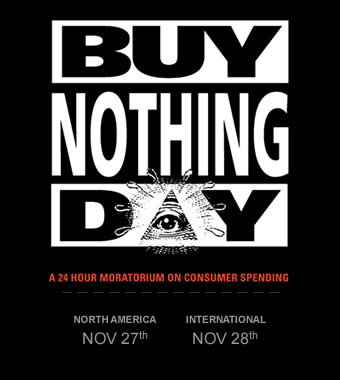
You have from November 29th until December 6th to submit your photos for this photo-community event/competition.
Picture Black Friday will feature the chosen images at Conscientious and Too Much Chocolate. Deets here and jurors here.
The results will be interesting. Personally, I can’t get enough of adults trampling one another to buy the latest piece of plastic. I see those moments as pure and unmasked moments of engagement with materials that are all on a common and inevitable course from factory to landfill.
But can we really expect more or of those cliches in the current economy? I expect mainstream media outlets will be divided; half searching other stories than the annual mall-scrum and the other half perpetuating them blindly because they are so invested in the consumer-as-hero narrative that dominates American hopes and ultimately props American jobs.
Photographer’s are going to have to work really hard to show something different because I suspect some arms of photojournalism are going to be trying new things too.
If you don’t want to document the madness, that’s all gravy but please just don’t shop:
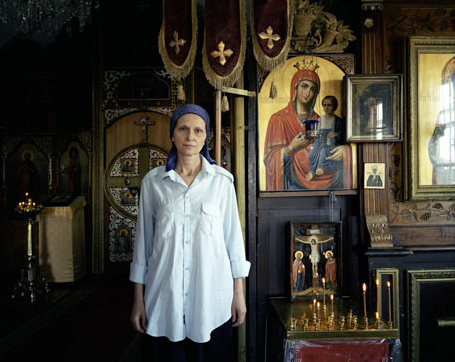
© Guia Besana
To the prison-nerds, I apologise for the move away from humanity’s failings, wastage and cages with this mild intrusion into things fine art, but I’ve got to say This Photo That consistently puts up great work.
Most recently Guia Besana, whose work reminded me of Melania Comoretto.
On Will Steacy’s blog this week:

Silverstein pulled a nearly foot-long knife from his conspirator’s waistband.“This is between me and Clutts,” Silverstein hollered as he rushed toward him. One of the other guards screamed, “He’s got a shank!” But Clutts was already cornered, without a weapon. He raised his hands while Silverstein stabbed him in the stomach. “He was just sticking Officer Clutts with that knife,” another guard later recalled. “He was just sticking and sticking and sticking.” By the time Silverstein relinquished the knife—“The man disrespected me,” he told the guards. “I had to get him”— Clutts had been stabbed forty times. He died shortly afterward.”
David Grann. ‘The Brand’, The New Yorker, February 23rd, 2004
It may be helpful for my readership if I state that I am not a prison abolitionist.
It occurred to me that I may not have shared that with you. There is a legitimate need for prisons when incorrigible and dangerous men or women must be controlled for the safety of all.
Unfortunately, over the past three decades, prisons in America have been used to test the “incapacitation theory” – which as Ruth Gilmore posits in Golden Gulag is not much of a theory, in fact it is not really a theory because it doesn’t propose to do or enact much at all [I paraphrase].
Prisons are many things; the parts of an expensive social experiment, the dumping-grounds for citizens caught up in the war on drugs; the accidental and damaging substitutions for mental health institutions; and in very few (and just as real) circumstances the necessary lock-ups for extremely violent offenders.
One problem I have in communicating the need for real prison reform is created by the fact that violent offenders are those that seize the public’s attention. Violent criminals are a tiny fraction of America’s prison population yet they’re the ones that trigger fear instincts and sway public opinion. I understand why this is the case and why it takes a lot to get past that.
Men like Silverstein, who’s actions are described above, should be behind bars for a long, long time. But the vast majority of the 2.3 million prisoners of the US are not like Silverstein. This same vast majority would also want Silverstein behind bars … and they’d make good argument as to why they shouldn’t be there with him.
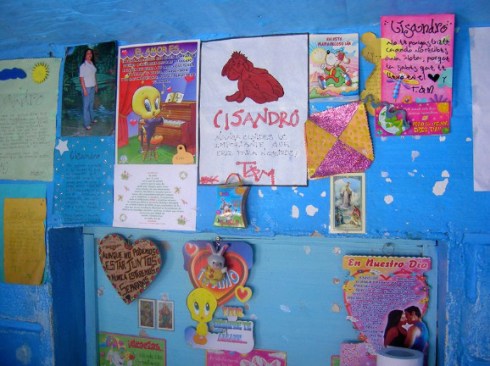
Often it seems photographs of South American prisons are presented in North American media only to emphasise the gulf that exists between the conditions of incarceration in the two regions.
I have posted before about prison beauty pageants in Bogota, Colombia; about the rise and fall of prison tourism at San Pedro in La Paz, Bolivia, and I have looked twice at Gary Knight‘s photography at Polinter prison in Rio de Janeiro – latterly featuring the conspicuous acts of a celebrity evangelical minister.
(Nearly) all photo essays I see coming out of prisons in South or Central America fall into one of two categories, or both:
1) A colourful contradiction to the dour, authoritarian environments depicted in US prison photojournalism.
2) A claustrophobic assault on our emotions as witnesses to desperate overcrowding and poor hygiene. The example par excellence of this is Marco Baroncini’s series from Guatemala.
What leads me to a narrow, ‘boxed’ categorisation of such documentary series is that I am convinced photographers know either the media or their editors well enough to know what flies with Western consumers and as such deliver an expected aesthetic.
I was therefore left without anchor when cyber-friend Nick Calcott sent over this latest offering by GOOD magazine on Medellin’s prison in Colombia. The images are by the inmates themselves:
On the invitation of the Centro Colombo Americano, an English language school for Colombians in Medellín, Vance Jacobs ventured to the Bellavista Prison with an inspired assignment: to teach documentary photography to eight inmates in one week.
“One of the things that gets the inmates’ attention is responsibility, that there is a stake in what they do. In this case, their ability to work together as a team, and to pull this together in a very short amount of time would determine whether other similar projects were done not only at this prison but at other prisons in Colombia,” says Jacobs. “Once they bought into the idea that there was a lot at stake, they really applied themselves.”
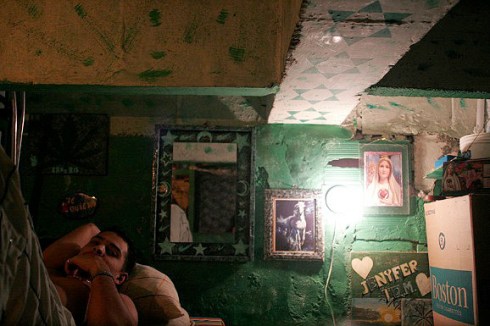
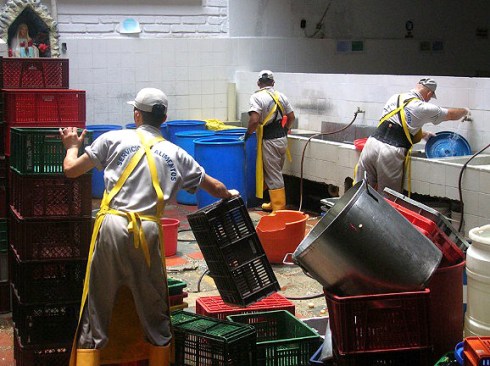
In the past, I have wondered how the camera can be used as a rehabilitative tool and it is a question that can be answered from different angles. In this case the responsibility given to the inmates is how we can derive worth. I have shown before that performance and team work in front of a camera can be good for exploring the self and ones own identity (and the results are of huge intrigue). The common denominator for any photography project is surely that it immediately relieves the boredom of incarceration.


Three months ago, I wrote about Silja Talvi‘s excellent book Women Behind Bars.
It turns out the Texas Department of Criminal Justice also noticed it. They banned it – along with another book, Perpetual Prison Machine by Joel Dyer. Both books are distributed by Prison Legal News – a phenomenal non-profit based here in Seattle that educates America’s incarcerated class on its human and legal rights.
Prison Legal News has launched a lawsuit against staff and senior officials of the TDCJ. Money is not as issue here, principle is. “PLN is seeking compensatory, punitive and nominal damages plus declaratory and injunctive relief for violation of its rights under the First and Fourteenth Amendments, as well as attorney fees and costs.”
WHAT TO DO
Visit Change.org and read my brief article.
Download the full PLN lawsuit (PDF).
Sign the petition to the TDCJ for reversal of their censorship policy.
Today, I read this wonderful article about community acting cooperatively to send a message to the highest authorities.
Ruth Hooke contributing in the Guardian’s Comment Is Free:
A step has been taken to right the injustices being done to the remaining detainees at the Guantánamo naval base. On 4 November the representative town meeting of Amherst, Massachusetts, overwhelmingly passed article 14 of its warrant, which urges Congress to repeal the ban on releasing cleared detainees into the US and welcomes such cleared detainees into our community as soon as the ban is lifted.
To Sarah Palin, I’d state that this is true America.

Past and present ruminations about what is and isn’t a photograph have been a source of frustration for me. For one, people can draw whatever lines they wish to determine the point at which manipulation tricks out a photograph and thus qualifies it as photo-illustration. And for another, as Errol Morris keeps banging on about, ALL photography is lies (and manipulation).
These debates are not about truth. Interventions – power relations, habit, photographic custom, complicity among subjects, props, political agendas (and framing), cropping, tweaking of exposure levels before and after development, digital alterations – mean that photography can never be, will never be truthful.
People forget that often it is the ingenious tricks that have spurred the largest wonder among viewing public – think Oscar Rejlander’s Two Ways of Life, Spirit Photography and – in a different sense – Ansel Adams’ Zone System.
It is therefore, with some relief that an artist like Azzarella comes along using photo-manipulation as the tactic and purpose for his work.
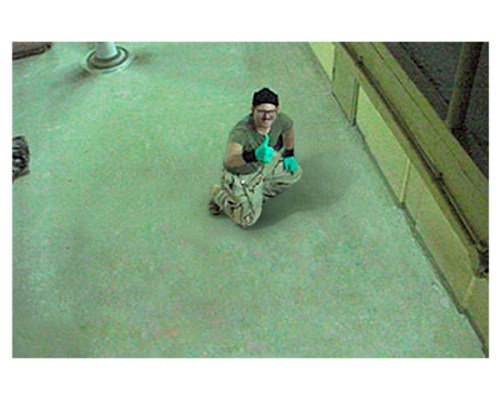

Last week, I questioned Anton Kratochvil’s Homage to Abu Ghraib, mainly because I think it makes little contribution to the discourse on the political aesthetics of Abu Ghraib. The blurry references to torture in Kratochvil’s images are in response only to a personal, conscious and willing point of view. I understand that Kratochvil’s work was an exercise in self-therapy but that shouldn’t stop me comparing it to Azzarella’s broader concerns about more general and unconscious reactions to well-circulated images.
If I w re to wr t th s sent nce wi h lette s m ss ng, you can still read it. The human brain is a wonderful instrument drawing on past experience to quickly filter out the non-possibilities. Just as the brain instantaneously deciphers gaps in text so it does with gaps in images.
With every passing hour the Spectacle suffuses itself further. It isn’t so much us reading images but images reading us. Our involuntary responses to images are predictable, predicted, precoded. The redacted action of violence in Azzarella’s pictures plays second fiddle to the original image, for it is the original image we drooled over and devoured.
The hooded detainee, dead student, wailing child or falling soldier needn’t even be present; our internal, emotional feedback spun by these images will forever be the same. We fill in the gaps and short circuit to prescribed disgust, sadness and politics, thus confirming our prevailing bias.
Azzarella’s works expose the fraud in us all … and our cheapened, robotic response to image.

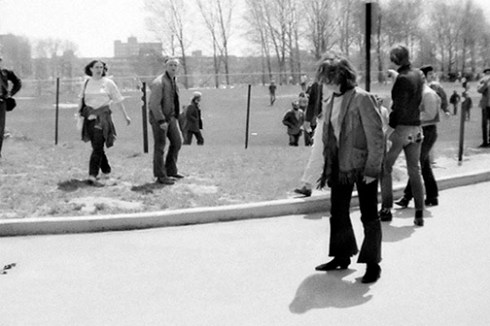
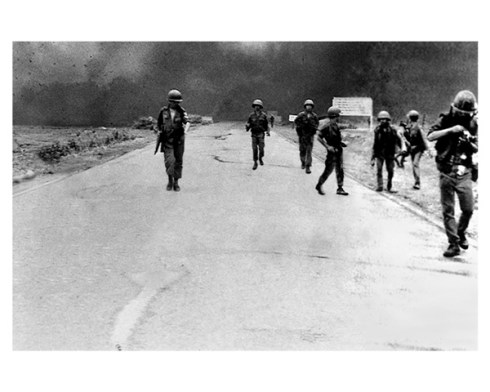
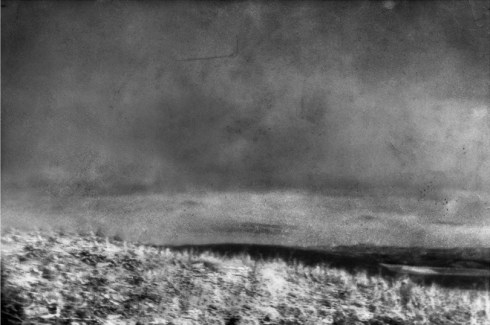
ALL IMAGES © JOSH AZZARELLA. FROM TOP TO BOTTOM: UNTITLED #13 (AHSF); UNTITLED (SSG FREDERICK); UNTITLED #24 (GREEN GLOVES); UNTITLED #35 (CAFETERIA); UNTITLED #39 (265); UNTITLED #20 TRANG BANG; UNTITLED #43 (PAR115311).
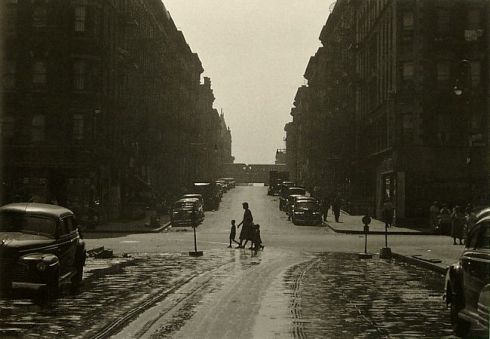
Roy DeCarava’s life and work has been noted by every source that should be seen to care following his recent passing.
There’s no doubt, DeCarava was a photographic great, a pioneer and a fine craftsman … but he had barely registered on my own personal radar. Until I found the story below courtesy of Dawoud Bey, I did not intend to comment upon DeCarava’s death. It would be inappropriate: I didn’t know about his work when he lived, why should I put on a show of knowing when he died?
Bey says:
Dawoud goes on:
I guess the lesson – for all things – is that one should only comment if the comment is vital, relevant and fair.
Thanks for sharing Dawoud.
___________________________________________________
Elsewhere, from a 1996 NPR interview, it was fascinating to hear DeCarava’s matter-of-fact memory and experience of serving in the US Army, “In those days there were two US Army’s. One Black, one White.”

 Prison Photography