
You are currently browsing the category archive for the ‘Photojournalism’ category.

Says Trolley Books:
The Arabic version of Alixandra Fazzina’s latest book A Million Shillings – Escape from Somalia (Trolley, 2010) was officially launched last Friday the 14th of January at the government buildings in Aden, Yemen, by António Guterres, the UN High Commissioner for Refugees.
Whilst the English version of the book keeps getting much attention and critical acclaim, both by the media and official institutions, it is hoped that the Arabic version will help it reach an even wider audience across the world, and to continue to advocate for the cause of these people who deserve a better treatment and better conditions, both at home and in the receiving countries.
The case for why this important book should be published in the language of the lands which it describes is as huge as my embarrassment that it had never, would never have, occurred to me.
My embarrassment is compounded by the fact that I rarely ever think about photobooks published outside of the English language.
FURTHER READING/VIEWING
Book review: A Million Shillings: Escape From Somalia by Alixandra Fazzina, Sean O’Hagan, the Guardian.
Gallery: A Million Shillings: Escape From Somalia, Alixandra Fazzina photographs of refugees and migrants from civil war-torn Somalia, the uprooted people who risk all to cross the Gulf of Aden in search of a better life.
Exodus, British Journal of Photography article on the work of photojournalists covering migration. Details extreme danger of Fazzina’s work in Somlalia.
Review: A Million Shillings: Escape from Somalia by Alixandra Fazzina, by Wayne Ford.
A Million Shillings also made it on to Sean O’Hagan and Colin Pantall‘s Best Books Lists for 2010.

© Alixandra Fazzina
“It was everything: kidnapping people, shelling civilian quarters, bombs, torturing, electrical shots, killing in the streets or killing in the prisons. And I did not think that what I was doing was bad.”
– Testimony of a perpetrator of crimes featured in ‘Lebanon’s Missing‘, a film by Dalia Khamissy
When Benjamin Chesterton of duckrabbit came across Dalia Khamissy‘s work from Lebanon, he was hooked and worked to present her work as a radio documentary combining Khamissy’s commentary with her photographs and film footage.
Ben hopes it will be the first of many such collaborations/presentations with the BBC World Service.
In my email inbox, from Ben:
Today, [Lebanon’s Missing] the first documentary and photofilm was published. It will be played worldwide seven times on the BBC World Service and BBC Radio 4.
It’s about the estimated 17,000 people kidnapped during the Lebanese civil war and never seen again. It’s a genuinely brilliant presentation by Dalia, with some great photos and video for the film (which is really meant as a teaser for the documentary).
Few know about the Missing in Lebanon, which is why I think it’s an important story to be heard. Not because the broadcast will change anything dramatically but because memory is resistance against the same atrocities being repeated.
Please take five minutes to watch the film and, if it moves you, download the podcast of the documentary. Dalia deserves enormous respect for this work. It was a brave story for her to take on.
Hopefully, the BBC will commission more programs of this nature, which would be great for photographers working on important stories who would like to reach a genuinely large audience.
I hope so too Ben, and I hope the duck magic becomes a permanent fixture on the World Service wires.
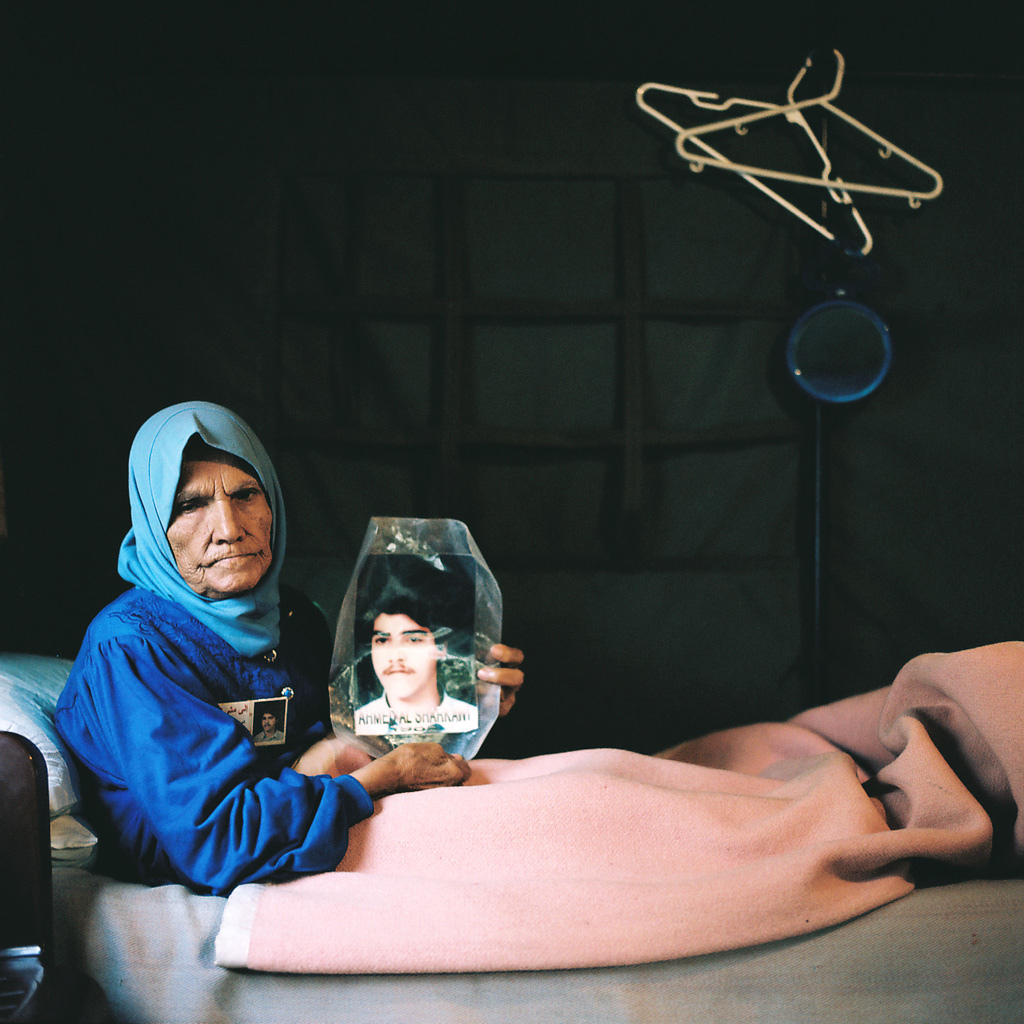
FURTHER READING
Conscientious: A Conversation with Dalia Khamissy
Lots of lists of photobooks cropping up for different reasons.
PHONAR
To close out the remarkable efforts of Jonathan Worth’s experimental open-sourced, web-based, free Photography and Narrative (#PHONAR) course offered through Coventry University, the #PHONAR course closed with a bevvy of recommended readings.
The following photographers, writers, teachers and journalists made picks:
Alec Soth; Andy Adams; Cory Doctorow; Daniel Meadows; David Campbell; Edmund Clark; Fred Ritchin; Geoff Dyer; Gilles Peress; Grant Scott; Harry Hardie; Jeff Brouws; Joel Meyerowitz; John Edwin Mason; Jonathan Shaw; Jonathan Worth; Ken Schles; Larissa Leclair; Ludwig Haskins; Matt Johnston; Michael Hallett; Miki Johnson; Mikko Takkunen; Nathalie Belayche; Peter Dench; Pete Brook; Sean O’Hagan; Simon Roberts; Stephen Mayes; Steve Pyke; Todd Hido
As a contributor, I picked out three titles. Predictably, each dealt with photography in sites of incarceration:

Too Much Time – Jane Evelyn Atwood


Chris Verene‘s Family was a later addition.

It was a privilege to be asked to guest lecture on this pioneering educational model. Thanks to Jonathan, Matt Johnston @mjohnstonmedia (Chief Engineer) and students for their encouragement and engagement.
WAYNE FORD
The #PHONAR list was spurred by Wayne Ford’s Photobooks and Narrative list.
JOHN EDWIN MASON
Following the #PHONAR list, contributor John Edwin Mason extended his selections. Mason’s Photobooks and Narrative: My (Slightly Flawed) Phonar List has an African and African American emphasis.
ALEC SOTH
Tonight, Soth put forward his Top 10+ Photobooks of 2010. As ever, Soth is thorough, thoughtful and generous in response.
JEFF LADD
Jeff at 5B4 has picked out his 15 choices for Best Books of 2010. The comments section is lively and I don’t think being to conceptual (as Jeff is accused of) is a problem, even if it were a fair allegation.
SEAN O’HAGAN
Sean at the Guardian has selected 2010’s best photography books that you should put in someones stocking.
NIALL MCDIARMID
Niall has put together his Photobooks and Magazines of the Year.

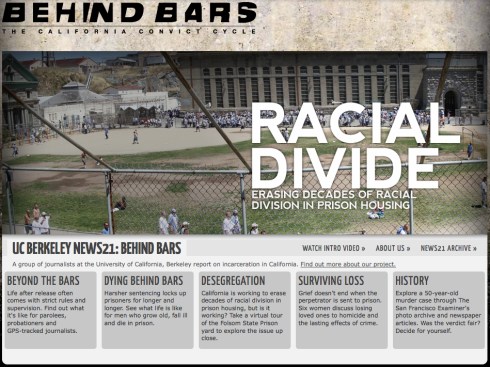
It took “eight tubs of candy and endless cups of coffee” and I presume a whole lot of talent for 14 journalists from the UC Berkeley Graduate School of Journalism, University of Nebraska and City University London to produce Behind Bars.
It is a multimedia project worth everybody’s time, thought and appreciation.
Behind Bars looks at man angles of the prison experience – Victims, Survivors, Parole Dept. Sweeps, Policing, Racial Segregation, Criminal Justice Law, Three Strikes, Geo-Tagging, Probation, Second Chances.
Behind Bars has 19 videos to view. I picked one out about lifer, Marvin Caldwell, in for 29 years to life for his third strike, a non-capital crime.
Behind Bars is a project of News 21, a national initiative led by 12 of America’s leading research universities with the support of two major foundations to advance the U.S. news business by helping revitalize schools of journalism. Universities integrate the schools of journalism more closely with the entire campus in an effort to better teach, challenge and prepare the next generation of news industry leaders for an increasingly complex world.
FOR A HANDLE ON THE US MILITARY’S COMPLICITY IN WIDESPREAD TORTURE IN SAMARRA, IRAQ, WATCH THIS.
FRAGO 242
FRAGO 242 is the US military’s abbreviation of a “fragmentary order” given to US military operatives.
When US military became aware of Iraqi torture of other Iraqis, to quote The Guardian‘s David Leigh, “FRAGO 242 meant that no further investigation was necessary.” When in the custody of Iraqi security forces, detainees were subjected to horrendous abuse. The US turned a blind-eye. The information about this is brilliantly presented in this seven minute video.

Iraqi commandos securing the area after a car chase resulted in the arrest of foreign terrorists. Gilles Peress/Magnum, for The New York Times. (Cropped from original)
Included in the seven minute video are Gilles Peress’ images from a New York Times assignment in 2005. (You can find 23 of Peress’ image from the assignment by searching “Peress Iraq Counterterrorism Commandos” on the Magnum website.)
The writer for that assignment was Peter Maass. He was reporting on the elite Iraq Ministry of Interior Commando Force, known as the Wolf Brigade. For the assignment, Maass shadowed Col. James Steele who he describes as “Petraeus’ man.”
At the invite of Steele, Maas visited a Samarra interrogation center. In this same video, Maass describes the sights and sounds of torture from within. During the interview incredibly loud screams of pain could be heard throughout the building. According to Maass, Steele left the room, the screams fell silent, Steele returned and Maass continued his interview with a Saudi prisoner.
Steele has not yet commented on Maass’ account of that day in Samarra.
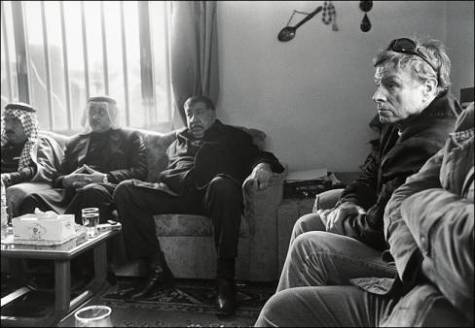
General Abul Waleed, Head of Command for the Wolf Brigade, and Col. James Steele, Samarra, Iraq. Gilles Peress/Magnum, for The New York Times.
WHAT JOHN MOORE DIDN’T PHOTOGRAPH
All of this is a very interesting counterpoint to John Moore’s In American Custody.
Moore’s compilation of images from embedded positions at Abu Ghraib and Camp Cropper (2003-2007) have been roundly celebrated since their publication on the 22nd Oct. I don’t see it. The collection is a politically safe edit of images from a war we are technically out of; they are the product of US military deceit. Moore was their pawn.
Moore’s images are benign in comparison to the descriptions set forth by Maass, the Wikileaks files and the thousands of Iraqis whose stories of torture have fallen on deaf ears for the past six plus years.

Inmates are taught how to grow mushrooms. The bottles contain fungus which is left to sprout in a dark and damp bamboo hut. Prisoners classed as a low security risk are entitled to participate in rehabilitation schemes. Prisoners can learn new skills and earn some money to smooth the transition back into society once released from prison. © Charles Fox
Often one presumes the prisons of a country have been put in place by the ruling party, coalition, dictator or whatever power base dominates.
Rarely does it occur that prisons and criminal justice systems could be established not by political forces per se, but by aid or reconstruction efforts.
(It’s worth noting, part of the responsibility of the allied occupiers in Afghanistan was to construct humane prisons that catered separately for men. women and children, which I have written about before).*
In Cambodia, $1 million dollars of the Australian government’s aid agency AusAid went toward the construction of Kandal Provincial Prison. It opened in 2006 and was designed to set the standard for humane incarceration in Cambodia. Sadly, overcrowding remains.
Photojournalist Charles Fox visited Kandal and I was interested in his images of culturally-appropriate rehabilitation. Seems to me that curd factories and mushroom cultivation are Cambodia’s equivalent to the US’ prison industries that press license plates and manufacture the executive suites for state attorney offices.
Fox:
“Kandal Provincial Prison houses 885 inmates including 38 women and 68 minors. Prisoners sleep in one of eight large buildings. The buildings are open dorm rooms, there are no cells at Kandal Provincial Prison. Prisoners classed as a low security risk are entitled to participate in rehabilitation schemes. Prisoners can learn new skills and earn some money to smooth the transition back into society once released from prison.
Overcrowding is a big concern across Cambodia’s prisons. Kandal Provincial Prison is no exception and is currently operating at around twice its capacity. The Cambodian Government has announced plans to build a new prison in Phnom Kravanh district to house an additional 2500 inmates to ease overcrowding.”
*No organisation is apolitical. All govt, non-govt, religious and social justice organisations are invested in politics – they just don’t sit in parliament or power-broker offices.

Inmates can work in a bean curd factory. The curd is left to dry in the sun and then used to feed both inmates and staff and also sold at market. © Charles Fox

Kandal Provincial Prison houses a garment factory as part of the rehabilitation scheme to give inmates a trade for when they leave prison. The factory has over 150 textile machines which produce plain cotton blend material. The garments are sold back to a Chinese garment factory which provided the machines to the prison. In mates can earn $10 dollars a month working in the factory. © Charles Fox
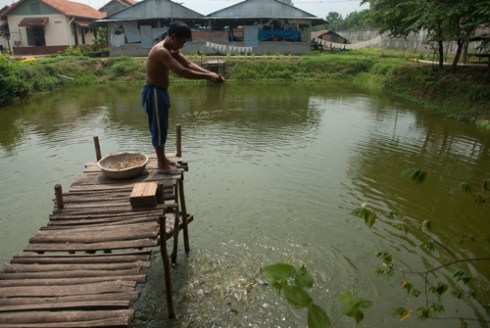
Inmate feeds fish which are farmed at Kandal Provincial Prison. The fish is used to feed the inmates and staff and also sold at market. © Charles Fox
Two photographers featured in the awards at Visa pour l’Image Perpignan for their work in Haiti. One of them photographed the aftermath of Fabienne Cherisma’s shooting.
DAMON
From Lens Blog:
“Damon Winter, a New York Times staff photographer, won the Visa d’Or news award for his photographs of Haiti. “Prayers in the Dark,” Jan. 15, 2010; “Where Is the Help?” Jan. 17, 2010; “Prison Break,” Jan. 19, 2010; and “Vignettes,” Feb. 3, 2010.”

Church Service, Haiti. © Damon Winter/The New York Times
Damon deserves the award. He succeeded where almost all other photojournalists failed and that was to dispatch thoughtful, emotionally affected work. He avoided some, not all, but some of the tropes of disaster photography.
Whether it was his or the New York Times’ decision to get him on the phone I don’t know, but the mix of audio and images was heartfelt. Michele McNally, director of photography at the Times backs this up.
Damon’s coverage of the broken Haiti prison was a story I followed (here, here and here). I interviewed Damon last year and I am sure he’ll take the honor with all the humility it demands.
Damon Winter was not witness to Fabienne’s death or its aftermath.
FABIENNE & FREDERIC
As many of you may know, I spent a lot of time looking at one particular incident in Haiti – the death of Fabienne Cherisma and the photographic activity about it.

Fabienne’s Father, Osama, and Fabienne’s sister mourn over the dead body of Fabienne Cherisma. Port-au-Prince, Haiti, January 19th, 2010
Frederic Sautereau, who was one of the last of the fifteen photographers I identified at Fabienne’s side.
Sautereau won the Visa d’Or daily press award for his work in Gaza for the French newspaper La Croix. He was also nominated this year for the Visa d’Or news award for his photos of Haiti after the earthquake.
In his Haiti portfolio, Sautereau has 7 or 8 images from around the time of Fabienne’s death. I am quite ambivalent about the work. Some of the images are as bloody as the ones I’ve chosen not to show previously on this blog.
ME
I must be wary of solipsism here. This isn’t about me. I want to convince you it shouldn’t be about Winter or Sautereau either. I want to bend your arm behind your back and tell you its all about Fabienne.
But, really, don’t I only care because I noted the story in January? And, despite all my efforts, I feel like I explained the circumstances of her death without actually improving her lot (in terms of justice) nor the lot of her family (in terms of healing or moving on or however you might measure that).
I guess I would just like to have handed out hard-copies of my inquiry and a CD of images to the Perpignan judges so that at least the possibility for remembrance could have carried with the awards.

© Kenneth Jarecke
Ken Jarecke (blogs at Mostly True) is a world-renowned photojournalist and founding member of Contact Press Images, an illustrious photo agency based in New York.
On Friday he poured his heart out at Tiffin Box:
No, I’m sad and ashamed to report that my lack of desire stemmed from nothing more than a lack of money. More specifically, the constant worry, and the ongoing struggle to pay the bills had taken its toll.
It’s sad, because I didn’t become a photojournalist to get rich (I was never that crazy or misguided). I’m ashamed because much of my money problems were the direct result of poor or stubborn decisions that are completely my fault.
He doesn’t hold back:
Pride and arrogance, a nasty couple of vices. As you can imagine, the only people to suffer from the choices I made was my family. Over the past few years, we’ve cut expenses, and eliminated most of the extras that come with family life, in my vain attempt to reinvent the editorial market and make things right (vanity, there’s another one).
Although I never stopped loving being a dad or a husband, the only thing I accomplished was to give my family a grouchy dad who hated making pictures.
Also recently, one of his daughters got serious ill, it gave him new perspective, Jarecke’s’s not proud anymore, he’s not too worried about bills, he’s taking portrait jobs, having a print sale and moving forward. He just wants more than ever to be a better dad and husband.
It seems to me that Jarecke has said what many are feeling. Bravo Kenneth for your honestly and vulnerability!

 Prison Photography