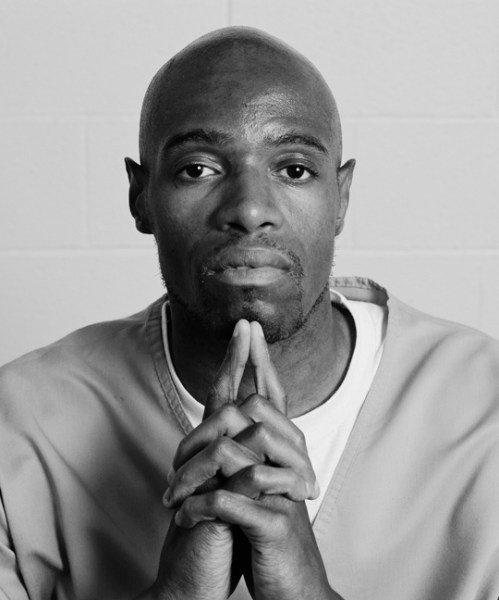
Untitled (from Lockdown)

Dread Scott‘s 2004 Lockdown pairs portraits with audio statements from the prisoners. The stories intend to represent the two million-plus inmates in American prisons. Dread’s belief is that America is defined by its criminal justice system and its incarcerated masses. This is not a position I would query.

Ostensibly, Lockdown is a less confrontational work than his renowned What is the Proper Way to Display the U.S. Flag? (1988) but the strength of the polemic, from which it stems, is no less.

Dread has drawn strong support as well as well-publicised contempt for his art and politics. Even the most respected progressive voices in politics, theory and photography have paused to question the coherence of his work. Dread, I trust, would expect no less than strong reaction to his work.

Among other identifiers, Dread is an avowed Maoist. He has stated, “This is a world where a tiny handful controls the great wealth and knowledge humanity as a whole has created.” In America more than any other ‘developed’ nation this statement applies. Dread’s political statement must be taken as delivered and used as the departure point for this work.

For our interview, I wanted to focus on Dread’s efforts and successes in accessing prisons, drawing testimony and mounting the piece. And to find out why these efforts were necessary.

Q & A

PP: How many prisons/jails did you visit while making Lockdown?
DS: I visited one prison and I went to another where I was turned away at the last minute.  I also worked with some youth who had been in the system, but were not locked up at the time I photographed and interviewed them.  This is also true of one adult ex-con I worked with.

PP: How many portraits are in the series?
DS: There are eleven that I show.  Obviously I took more, but there are eleven that are good. I also would like to expand the project but I have no plans to do this at the moment.

PP: Did you choose the sitters or did they choose you?
DS: In most cases the prison chose them and told them that a photographer wanted to do a project involving prisoners.  Then once I met with them I discussed more about the project and most of them wanted to be part of it.

PP: Were there prisoners who were simply not eligible for participation in Lockdown? If so, for what reasons?
DS: I wanted to get a somewhat broad sampling of the prison population. In many respects this was achieved, but because I was unable to work on the project as extensively as I would have liked, some types of prisoners aren’t in the project.  For example, I didn’t get to any women’s facilities, any jails and I was not to visit any prisoners on Death Row.

PP: Did you ever photograph a prisoner having had no prior contact or discussion?
DS: Generally this is how the project was done – I would be introduced to them and photograph them in the same day.

PP: Who controlled the length of time you had to introduce your project to, and work with, each of the sitters?
DS: Ultimately, it was the prison that controlled the hours of the visit and how many I would be allowed.  But once that was set, I could spend as much or as little time with any one prisoner.

Untitled (from Lockdown)

PP: How did you organize yourself and your subjects during the projects as a whole? What forms did the communication take before, during and after the sitting for the photograph?
DS: With rare exception, I wasn’t able to communicate with the prisoners before the photography/interview session. The sessions were very intensive.  I generally wasn’t able to spend more than an hour with each prisoner.  Often I only had about 40 minutes so the work was done quickly.  I would start by discussing what I was trying to do with the project and let them know that I wasn’t working with the prison and in fact that I was a revolutionary and I felt that the whole system was worthless.  Which is not what the project was about but I wanted them to know where I was coming from.  If after knowing more about me and the project they wanted to participate, we would move forward.

Generally, I would then photograph them and then I would interview them, which in many ways was just a conversation. As a preface to the interview I would say something like “It’s clear that the main requirement to get into jail today is that you be poor and Black or Latino. Who is in jail? I need to learn your story and want to tell it. Many people don’t know. And those that do know, people like you and your family aren’t talking about it enough. I need the truth. What happened? How did you end up here? I want to put faces on the slaves of these prisons, which are like modern day slave ships that don’t float.” Then we did the interview. As for more communication after the session, unfortunately the prison that I was working with made this impossible. I sent photographs of all the prisoners to them and I wrote again thanking them for participating. I never heard back from anyone. What I later learned when I met one of the prisoners when he was on the outside, he said that neither he nor anyone else ever got any photo or letter from me.

PP: How do you deal with impartiality?
DS: I am not impartial. I think that this is an unjust society and has exploitation woven into it’s very fabric – a society where a tiny handful control the wealth and knowledge that humanity as a whole has created. The imprisonment of two million+ people shines a lot of light on the society as a whole. I wanted to bring to light the people that are latterly hidden from society broadly and make a work that presented portraits of these hidden people and brought of out the insights they have about the society that imprisons them. Because these people and there ideas are written out of the popular discourse in society, I think that this project can reveal a lot about the society as a whole. The prisoners express their individual views and don’t necessarily share all of mine, but through the work as a whole, an audience has the opportunity to grapple with a lot about the foundations of this society and see and meet people who have a lot to say about it.

PP: What reasons did each of the inmates have for taking part? Were their reasons opinions that you also held or had previously held?
DS: Many of the prisoners initially met me because it was a break from their daily routine. Some were intrigued by the change and chance to work with some sort of photographer. Most didn’t know much about the project prior to meeting me. But once they met me they mostly decided to participate because they wanted to have both their individual story put out in the world, but also they saw this as a chance to be part of a broader conversation about a country that imprisons over two million people. There was also a small minority who were looking for some angle to shorten their time or hoped I was a vehicle to communicate with people outside.

PP: Did you take many pictures of the same sitter? Did the inmates of each portrait have a say in which print you chose for exhibition?
DS: Yes, I generally took about 20 pictures of each person. Sometimes a few more and occasionally less. Because the prison prevented me from communicating with them, they weren’t able to have any input into the portrait that I used.

Installation

PP: James Clifford has said, “Represented voices can be powerful indices of a living people – more so even than photographs, which, however realistic and contemporary, always evoke a certain irreducible past tense.” How important to this piece are the audio tracks; the ‘represented voices’ of the inmates?
The audio is essential. It is as much part of the project as the photographs and I will not exhibit the work without the audio.  One thing that I wanted to do with Lockdown is bring the faces, voices and ideas of those who are hidden behind bars in the gallery and museum setting. People throughout society need to see who is imprisoned and know what insights they have in the world.  So there is an important level of the ideas. But there is also a question of voice. It is very specific and allows the audience to encounter the prisoners in a much more real and complex way.

PP: Did each inmate prepare a statement or do you edit audio in post-production from single unrehearsed dialogues?
DS: The audio is carefully edited from much longer interviews. The interviews typically were about 30-40 minutes. And the audio in the work uses about 3-6 minute excerpts.

PP: How do you describe the relationship between the collected raw data (first-hand spoken testimony; photographic documentation; a unique name/identity) and the cultural frame you set it in (gallery, public space, political statement)?
DS: The portraits and interviews form the basis for the work but the art, once it is exhibited is just that – art. The art would be inconceivable without the photos and interviews, but they have been selected & edited and assembled to be a coherent work of art.

PP: Does your artistic voice compete with the oral testimonies/voices of the men you photograph?
DS: While the testimonies of the individuals are important as an individual expressions, Lockdown is the opinionated view of its author. I am not mischaracterizing any of the individual stories, but I have put them within the overall meditation on a society that imprisons over two million people that is Lockdown. So my voice dominates on a certain level.  The work is really the collective voices and photograph, not the individual stories. It is made up of individuals, but I think that the whole adds up to more than the sum of the parts.  It is because of this, the way the work is structured overall, that it is not a “documentary” where one person’s story is next to their photograph and it is about all of the individuals. It is about what they, through the work as a whole, address as a group.

PP: About your work, you have said, “the continuum of history is a recurring theme in many of my works” and therefore inviting comparisons between past and present events. Do you use artistic devices, photographic or otherwise, to assist the viewers with these comparisons?
DS: Yes, but I don’t see the continuum of history as being so foregrounded in this work. Some of my projects will have a lynching paired with police brutality or an electric chair. This isn’t so much the case with this work. Though I did decide to make the portraits black and white which roots somewhat in the past and situates the theme of the work as being tied to a longer history as well as roots the project in a certain photographic tradition.

PP: Are you following a photographic tradition? If so, which elements of past photographic works inform Lockdown. If not, where then should people find their visual cues for reading the photographs?
DS: In making this work, I really appreciated Danny Lyons’ Conversations with the Dead.  My project is different but it is on this continuum. Also, Avedon’s In the American West. Again, I’m doing something different. I think Avedon is exoticizing his subjects a bit, but they are really great portraits and he does reveal things about the people he shoots that many outside of the culture don’t know about.  Meat packers and guys on oil rigs aren’t often part of Chelsea conversations.  Also, Roy DeCarava’s influenced this work. Particularly how he respected many of the people he photographed.  As the project is not just a photo project, I drew on other artistic traditions. Actually the text and image work from the 80s has informed me on works like this. I just use audio text rather than written. What I am doing is new, but it wouldn’t exist without these influences.

_______________________________________________________________

Dread Scott works in a range of media including installation, photography, screen printing, video and performance. Dread first received national attention as a student at the School of the Art Institute of Chicago. In 1989, President Bush Sr. declared his installation What is the Proper Way to Display a U.S. Flag? “disgraceful,” and the entire US Senate denounced the work when they passed legislation to “protect the flag.” As part of the popular effort opposing compulsory patriotism, he, along with three other protesters, burned flags on the steps of the US Capitol. This resulted in a Supreme Court case and a landmark decision.

In 1992, Dread was a fellow at the Whitney Independent Study Program. In 1995, he was awarded a Mid Atlantic\National Endowment for the Arts Regional Fellowship in Photography. In 2000, he participated in the Institute on the Arts and Civic Dialogue directed by Anna Deavere Smith at Harvard University. He has been awarded a Mid Atlantic/NEA Regional Fellowship in Photography, a New York Foundation for the Arts Fellowship in Sculpture (2001) and Fellowship in Performance Art/Multi-disciplinary Art (2005), and a Creative Capital Foundation grant. In 2000 he participated in the Institute on the Arts and Civic Dialogue directed by Anna Deavere Smith at Harvard University. That year he also worked on a Special Edition Fellowship at the Lower East Side Printshop.

His work has been exhibited at the Whitney Museum of American Art, the New Museum of Contemporary Art, Robert Miller Gallery in New York, Brooklyn Museum, the Aldrich Contemporary Art Museum and the DeBeyerd Center for Contemporary Art in the Netherlands. His public sculptures have been installed at Socrates Sculpture Park in Queens, New York and Franconia Sculpture Park in Minnesota.

In 2008, the Museum of Contemporary African Disporan Art in Brooklyn, NY hosted Dread Scott: Welcome to America.

This interview provides more extensive coverage of Dread Scott’s oeuvre and politics.
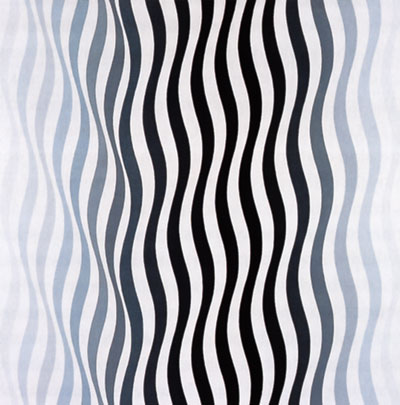
Arrest 1 (1965) by Bridget Riley

I’d like to propose an alternative method to discuss issues of race in visual culture and the photographic industry, but first some preliminaries.

HUGO AND THE CURRENT DEBATE

Necessary discussions about photography and its intersection with race are occurring once-more. Earlier this year, the criticisms were unambiguous – that the PDN failed to reflect the diversity of society on it’s jury panel. Now however, the discussions stem not from critique of the photographic industry, but off the back of Pieter Hugo’s work and all the readings viewers have heaped upon Nollywood and latterly The Hyena and Other Men.

The confusion between the two series doesn’t help as they have very different purposes; you won’t see Nigerian movie actors in zombie costumes on the street, but there is an outside chance you’ll see animal-handlers in Nigeria because they actually travel, actually perform and actually have large, wild animals as pets.

To borrow a term from M. Scott Brauer, the ‘blog echo-chamber’ has been rumbling – Jim Johnson (interestingly all the way back in July); Amy Stein; duckrabbit; Daniel Cuthbert; and Joshua Spees

I will be clear here. I like Hugo’s work. I don’t think he exploits his subjects. I disagree with Jim Johnson when he says that Hugo’s work is ‘unexceptional’. I didn’t know that Nigeria had a thriving movie industry nor that Hyenas could be ‘tamed’ and kept on chains. To deliver new information is the least we should expect of photography, and yet often not achieved.

Sebastian Boncy and Stan Banos are absolutely right in that Hugo’s work can be used by viewers to confirm their existing racism, but Daniel Cutbert is also right in that Hugo is making interesting photos of interesting people in Africa.

Any work can be misinterpreted and to criticise Hugo for the potential small-mindedness of his viewers is to cut of debate prematurely. If we took this logic to the extreme then we’d all stop making pictures. I am glad to see names as famous as Walker Evans mentioned in the cultural relativist argument – that being that we don’t all get up in arms when photographers aesthetisise the rural (white) poor of Appalachia or beyond.

John Edwin Mason emailed me. He focused on the photographic product as it is consumed, and drew parallels between Hugos’ fine art work and that of the idiots at French Vogue:

“If Hugo’s viewers are the sort of folks who hang out in downtown galleries and read Aperture, wouldn’t there be considerable overlap between them and Vogue readers? Aren’t Hugo’s photos high-end consumer goods – in the same league as a designer dress, a Rolex, or a Merc? And like them signs of wealth, taste, sophistication?  Even if we only aspire to own these kinds of [luxury] items and consume them via the magazines we read, the aspiration alone moves us away from ordinary people.”

The territory of art as commodity is perhaps where the richest investigations of inequalities can occur.

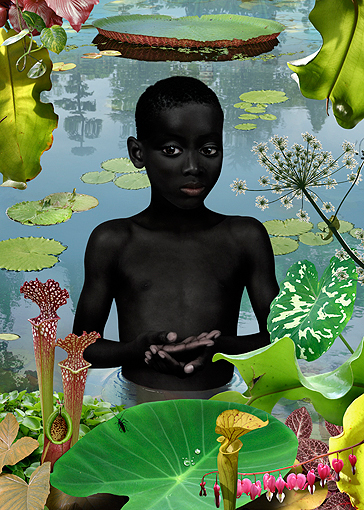
World #13 2006, BY Ruud Van Empel, Cibachrome, 33 x 36.5 inches

World #13 (2006) by Ruud Van Empel, Cibachrome, 33 x 36.5 inches

PHOTOGRAPHY AND RACE CONFERENCE

I wonder if this hotly debated topic were fleshed out elsewhere our results would be different? Instead of PDN answering to the inequalities of an industry, instead of comments being lost in wordpress/tyepad archives, instead of calls to extend the discussion being missed/ignored and instead of suspicion and frantic typing prevailing … could we try something different?

I am sure most photographers have a lot of common ground to stake. But unfortunately, the web (or at least typing on the web) is no substitute for discussion. It takes too long, the moments pass, emotions deflate and you’re not even sure if you’re being heard/read.

So could we not back up our convictions with a commitment to meet in person. I am not talking about a coffee and a quick chat. Could we the photoblogosphere-peeps not arrange among ourselves a “conference”? It doesn’t need to be a massive production but the invite could be open. If photo-collectives, companies, magazines want to join then all the better. The agenda is ours to set.

Don’t panic. It’s just a proposal. We could hold it anywhere; New York,  San Francisco, Santa Fe, New Orleans, Toronto, Chicago. We could do it next spring or summer … and plan.

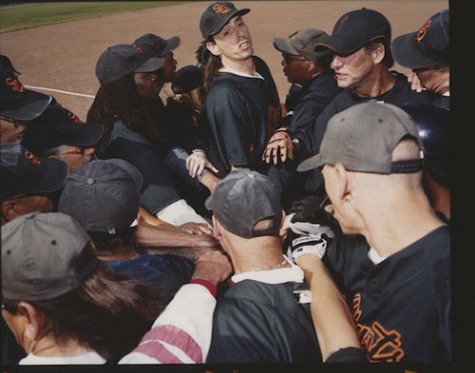
San Quentin Giants, by Emiliano Granado

San Quentin Giants, by Emiliano Granado

Obviously, discussion of race is impossible to ignore within the Prison Photography project.

The American prison system cages a disproportionate number of Black men. Other minorities are subjugated. Accusations of misogyny and gender prejudice can only gather traction given recent sentencing pollicy.

Issues change as one moves between domestic and foriegn sites of incarceration, but are no less important.

I’ve got much to say. Will you join me?

Found at the amazing Center for the Study of Political Graphics

Why bother wasting words when an effective graphic says it all?

Women in prison

Women in Prison Scott Boylston, Silkscreen, 2005

The production of this poster was donated to promote the work of Action Committee for Women in Prison.

NYC31738

NYC31758

NYC31751

NYC31737

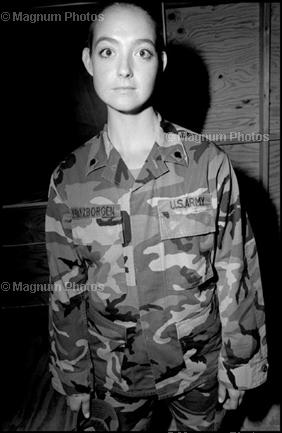
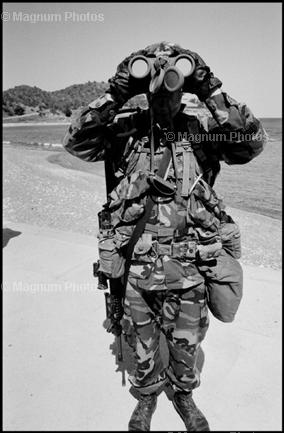
Go to Magnum and search “Gilden Guantanamo”. I’m not sure Gilden’s technique could really flourish at the illegal prison but he had a good go.

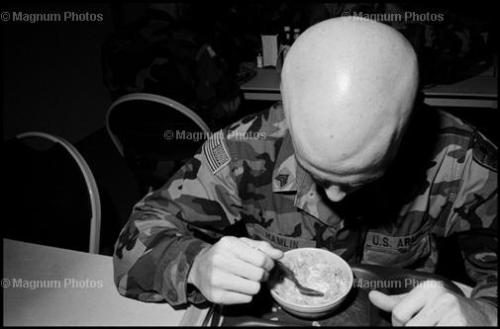
(From top left, clockwise) 1. Major-General Geoffrey Miller, Commander of Joint Task Force at Guantanamo Bay, is in charge of the 680 suspected enemy combatants in the camp. 2. Specialist Lily Allison Fitzborgen, a reservist who wants to become a police officer, is one of the guards who watches over the detainees. 3. Surveillance at Camp America. 4. Sergeant guard at a hospital for “enemy combatant” detainees. His name is blacked out so the detainees can’t see it. (Below) Before a prayer breakfast at Camp America.

NYC31746

All photos © Bruce Gilden/Magnum

If I’ve ever heard an interview which encapsulates the pride-cum-naivety of the military rank and file, the necessarily difficult (but largely unprofitable) questions of the media and the legal blackhole the Cheney administration established with Guantanamo … it is this.

I was surprised to hear that detainees threw excrement and threatened to kill the guards. Perhaps this brash antagonism is a relatively recent development at Guantanamo, now it’s population is reduced to the most fanatical 200 or so prisoners.

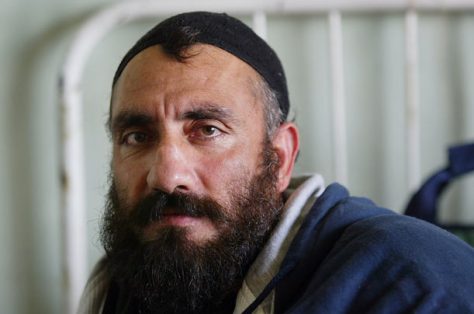
One of the first to be released in 2002, Mohammad, a farmer, says that he was forcibly conscripted into the Taliban, but tried to get away by surrendering himself to the enemy, the notorious warlord Abdul Rashid Dostum, who promptly served him up to the Americans. After less than a year, the Americans deemed him no threat and returned him to Afghanistan. He says that during his time in captivity, he was well treated by the U.S. military. © Paula Bronstein/Getty

One of the first to be released in 2002, Mohammad, a farmer, says that he was forcibly conscripted into the Taliban, but tried to get away by surrendering himself to the enemy, the notorious warlord Abdul Rashid Dostum, who promptly served him up to the Americans. After less than a year, the Americans deemed him no threat and returned him to Afghanistan. He says that during his time in captivity, he was well treated by the U.S. military. © Paula Bronstein/Getty

In my recent feature of Edmund Clark’s work on Guantanamo (that focuses on not only the fabric of the prison but also the environmental details of their homes post-release) I was reminded of Paula Bronstein‘s Guantanamo detainee portraits.

Whereas Clark focuses on detainees released into Western – I presume UK – society, Bronstein tracks former detainees down in their homeland, Afghanistan. She has photographed returning prisoners many times since 2002. All her work is collated at here at Getty Images. Time magazine ran Portraits of Gitmo Detainees earlier this year.

There are many stories to consider, and they are of course more vital than the photographs. The early releases, including Jan Mohammad (above), from 2002 came with favourable testimony in which detainees said they were treated fairly and allowed to practice their religion.

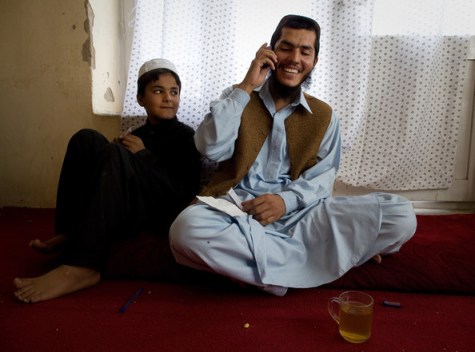
 Mohammed Jawad talks on the phone to a friend as a relative looks on in his family home on September 25, 2009 in Kabul, Afghanistan. He was the youngest Guantanamo Bay prisoner only 17 when he was arrested six years ago, but his lawyer says he was 14 and family members say he was 12. JawadÕs conviction was for throwing a hand grenade at two U.S. soldiers. The judge said his confession was obtained under torture. © Paula Bronstein/Getty

Mohammed Jawad talks on the phone to a friend as a relative looks on in his family home on September 25, 2009 in Kabul, Afghanistan. He was the youngest Guantanamo Bay prisoner only 17 when he was arrested six years ago, but his lawyer says he was 14 and family members say he was 12. Jawad's conviction was for throwing a hand grenade at two U.S. soldiers. The judge said his confession was obtained under torture. © Paula Bronstein/Getty

Mohammed Jawal, who could have been as young as 12 when he was detained was, according to a judge, tortured.

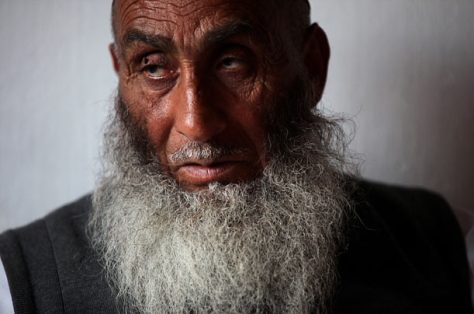
Haji Nasrat, 77 Released in 2006, the farmer was Guantanamo's oldest prisoner. Partially paralyzed for more than 15 years and illiterate, Nasrat says he does not know why the Americans detained him. Government documents relating to his case allege that he was a member of Hezb-e-Islami Gulbuddin, a former mujahadeen group said to be tied to Al Qaeda. © Paula Bronstein/Getty

Haji Nasrat, 77 Released in 2006, the farmer was Guantanamo's oldest prisoner. Partially paralyzed for more than 15 years and illiterate, Nasrat says he does not know why the Americans detained him. Government documents relating to his case allege that he was a member of Hezb-e-Islami Gulbuddin, a former mujahadeen group said to be tied to Al Qaeda. © Paula Bronstein/Getty

Haji Nasrat, Guantanamo’s oldest detainee, has spoken words which bear the experience of failed American policy in Afghanistan, “When (the Americans) came to Afghanistan everybody was waiting for America to help us build our country. We were looking for you guys and we were very happy that you would come to our country. The people who hated you were very few, but you just grabbed guys like me. Look at me. Our very happiness, you changed it to (bitterness).”

After eight years of war and too many attacks that have killed civilians, President Obama’s military and non-military personnel have a large task to improve security and win back the trust of the Afghanistan people. Is it even possible? If not, the biggest losers resulting from the lie that was the war on Iraq – and all the distractions it carried – may be the people of Afghanistan.

Found via Travel Photographer

clark1

I just keep coming back to Edmund Clark‘s work. And his book isn’t even out yet. It doesn’t help when venerable folk like Jim Casper and Colin Pantall are spending time and energy on his efforts – most recently from Guantanamo.

(BTW, Pantall has been posing some really good questions and posting some really good photography these past few weeks.)

Anyway, upon returning to Pantall’s site I picked up this quote by Clark:

“There is a lot of long lens imagery of Guantanamo showing the prisoners in their orange boiler suits, but I don’t know what that’s telling me.”

It seems to touch upon many of my frustrations with photography from Guantanamo. Many inventive photographers will find manouveurs to draw out a novel image at Camps Delta, X-Ray, Iguana and others. Of course it is worth remembering that the majority of photos coming out of Gitmo will be consumed by the masses through media served by newswire coverage relying on long lens images of faceless orange boiler suits.

Clark has widened the scope of Guantanamo imagery by following the detainees to their homes and picking up on the underwhelming details of their “free” lives. The sterility and parallels between incarceration and home are sometimes frightening.

clark3

With Pantall’s permission I reissue Clark’s words here. Pantall interviewed Clark for the British Journal of Photography. (Underlining for emphasis is mine)

My last book was called Still Life/Killing Time and was about a prison in Britain. I’m interested in the themes of confinement and entrapment. Guantanamo Bay stands out as a symbol of confinement and my imagery is about the symbolism of that confinement. The starting point was going out with detainees who had been released and seeing how they were surviving. These people had been in prison for years, had never been charged but still had this massive label of being the worst of the worst stuck on them. I was interested in what their personal spaces said about them and if they were any traces of what they had experienced in Guantanamo.

Access was very difficult but started with their lawyers and slowly progressed to the point where I could photograph their homes. Once this was done, the second part was getting into Guantanamo itself. I applied to the Pentagon and made it clear I wanted to photograph both the American Naval Base side and the prison side. It took me 6 months to get clearance and then it was another 2 months before I went. Once I was there I was fortunate enough to get paired up with Carol Rosenberg, a journalist from the Miami Herald who had been reporting on Guantanamo since it opened as a prison. She knew how to deal with the Guantanamo media team (who were new in their jobs) and how to get past their obstruction.

I spent 8 days there in total, including 4 days on the naval base. It was like so many expatriate places, more American than America itself. It was interesting to look at the schools, the shops, the restaurants. It was like a little bit of America in Cuba, with reflections both of America and of entrapment; models of old refugee camps, a shrine to the Virgin Mary where she almost seems to be imprisoned, A Ronald MacDonald statue surrounded by fencing and wire. It looks like he’s banged up.

I don’t have any images of the detainees except for one – which shows a guard reflected in the cell window. But that’s not what my work is about. There is a lot of long lens imagery of Guantanamo showing the prisoners in their orange boiler suits, but I don’t know what that’s telling me. My work is about the spaces and what they evoke and how they relate to the spaces people live in once they have been released.

The work is about memory and control and dragging the work out of Guantanamo into where people are living now. I’m doing that through the edit of the 3 different spaces I photographed: the homes, the American Naval Base and the prison. When I got back, I started to edit the pictures in sequence as a narrative, but then I began to mix them up so you’re never quite sure where you are. I juxtaposed images, put one things together so one image sets off ideas that enriches the idea of what it is both to have been in Guantanamo, but also to have that experience inside you.

There are also strange details that I’m not sure off, such as the picture of the Duress button. We were told this was in an exercise room but we think it was one of the interrogation rooms and this was a panic button for the guards. Another picture shows a row of Ensure jars with a plastic tube next to it. Ensure is an energy drink they used to force feed hunger striking prisoners and the Americans had it on display to show their ‘duty of care’.

The detainees brought home and kept the strangest of things, a red cross calendar with the days ticked off. Only the best behaved prisoners would get this because there was a strategy of total disorientation. When prisoners first arrived they had no idea of where they were, what day it was or what time it was.

Then I looked at other bits of people’s homes, especially windows because in Guantanamo they have no windows with a view. There are no views. Being released and being able to choose what to look at, to have a view, is quite a thing. Sometimes people chose not to have a view.

I’m working with Omar Deghayes on an edit of all the letters he received at Guantanamo. When people received letters, they didn’t get the original, they got photocopies or scans of every page, even blank pages, including the front and back of the envelope, each page bearing a document number and a Guantanamo stamp.

clark2

All Images © Edmund Clark

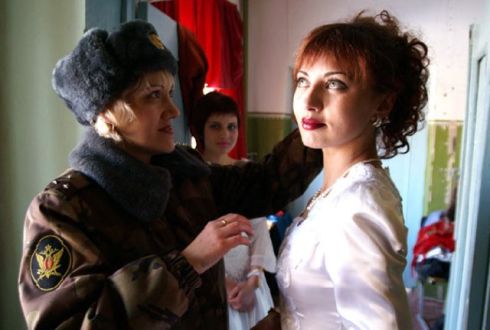
prison_girls_14

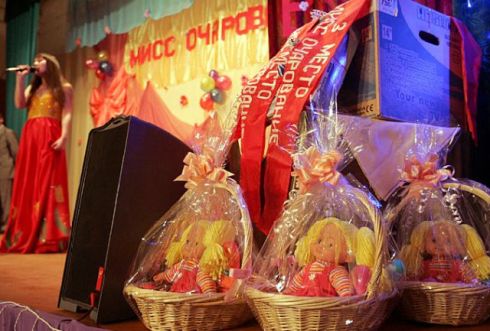
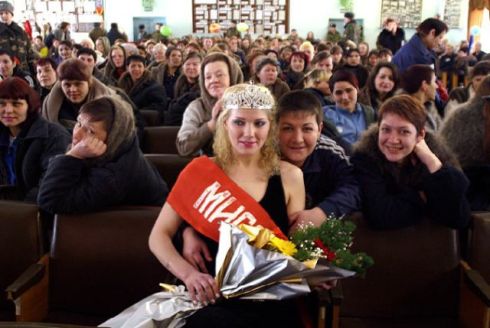
I realise things have been drab and monochromatic (and quite frankly depressing) on Prison Photography recently. My solution was to put up some prison beauty pageant images from Russia I found on a Russian website via BoingBoing.

I reckoned they’d stand in nice contrast to Jane Evelyn Atwood’s bleak images of the womens penal colony, Perm, Russia by directly testing Atwood’s view and undermining our preconceptions oncemore.

The photographs could also provide some much needed colour without much need for commentary, right? Wrong. The comments on BoingBoing suggest that not all, if any, are from Russian womens’ prisons.

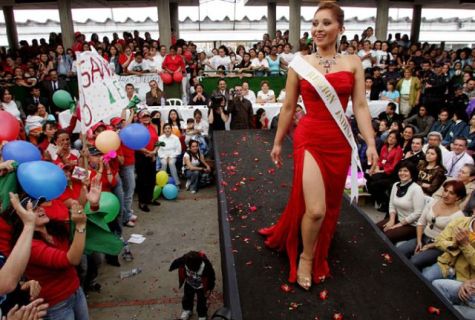
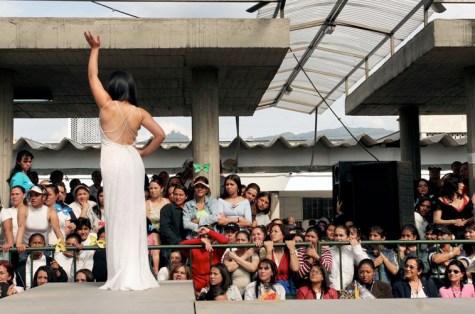
Comparison with Fabio Cuttica’s work here and here holds up this assertion. Compare the two images below:

PHOTOGRAPH CLAIMING TO BE FROM RUSSIAN PRISON. Source: http://www.webpark.ru/comment/52940

PHOTOGRAPH CLAIMING TO BE FROM RUSSIAN PRISON. Source: http://www.webpark.ru/comment/52940

PHOTOGRAPH KNOWN TO BE FROM BOLIVIA. Credit: Fabio Cuttica. Source: http://www.nerve.com/dispatches/prisonpageant/

PHOTOGRAPH KNOWN TO BE FROM COLOMBIA. Credit: Fabio Cuttica. Source: http://www.nerve.com/dispatches/prisonpageant/

I’d proffer that seven of the fifteen images in the original (Russian) web posting are from the same pageant Cuttica photographed in Columbia.

The image at the top and the three below I would guess are from Russia, but who can be sure if they are even from inside a prison?

I am left wondering how often I’ve read a caption or commentary ON ANY PHOTOGRAPH – and taken it as truth. Very often, I bet. Which leads me to wonder how often we’re dangerously misled by images. Who knows?

prison_girls_02

prison_girls_12

prison_girls_13

I suppose this only matters if you care if the images came from within a prison. Amputated from a true story, these images aren’t a malicious misrepresentation but probably a product of absent research. Although one wonders under what circumstances images from separate continents were sourced and paired.

So, beware the caption! Adam Broomberg and Oliver Chanarin have said “A photograph that relies on its caption to create meaning is impotent.” The reverse position holds sway too. Mustn’t captions be absolutely necessary at times to stave of the wild presumptions viewers bring to imagery?

EMAIL

prisonphotography [at] gmail [dot] com

Prison Photography Archives

Post Categories