Two stories from the British press this week mimicking to two pressing issues of the American justice system – care provision for mentally ill prison populations & exoneration after wrongful conviction.

First off. As the Beeb reports, The Lord Bradley Report has recommended moving mentally ill inmates out of prisons and into alternative care environments. That’s a significant victory for prison mental health reformers, and for the UK public.

The impressive thing Bradley’s report is that he ties the shortcomings of the prison system to provide appropriate mental-health care to wider problematic practices of policing; highlighting in particular the relatively new anti-social behaviour (ASBO) as inflexible and routinely applied. From the BBC,

It is expected to highlight how ASBO and penalty notices can accelerate the treatment of mentally ill people as criminals. Some estimates suggest 70% of inmates have two or more mental disorders

and

In February, Ministry of Justice (MoJ) figures revealed that a record 3,906 offenders with mental disorders were being held in secure hospitals in England and Wales at the end of 2007.

'I miss the prison crowds' ... Sean Hodgson. Photograph: David Levene/Guardian

'I miss the prison crowds' ... Sean Hodgson. Photograph: David Levene/Guardian

Secondly, The Guardian ran Sean Hodgson’s story about time served on a 27 year wrongful conviction. It also covered the first three days following release and the circumstances of Hodgson and reporter, Aina Edemariam, meeting. Edemariam picked Hodgson up off the street after he’d been clipped by the wing mirror of a passing taxi.

Sean Hodgson has been dealt a shitty hand. He suffers from a long list of serious health problems, his money has run out so he survives on coffee. He is lonely. On a ‘couple of times he has felt so depressed he has called a crisis line. But it was busy, he says. “So I just went to bed.”‘ He has also been stalked by a tabloid photographer.

In the US, The Innocence Project has led the way using DNA evidence to overturn wrongful convictions. I think Britain lawyers’ eyes were opened by the Innocence Project’s legal endeavours. The UK has been slower in it’s use of DNA testing for old cases. Sean Hodgson has served the second longest term for a wrongful conviction in the history of British law. And after doing that time? Well it was an abrupt transition:

Lifers who admit guilt go through a few years of preparation for their release: they are given parole, are able to work outside the prison, to put housing and income in place; they can retreat to the prison whenever the outside world gets too overwhelming. Those who have never admitted their guilt very rarely get parole, and thus receive none of this. So Hodgson was taken immediately to the housing and benefits offices – where it transpired that someone had stolen his identity and he no longer had a national insurance (social security) number, meaning that officially he did not exist. His MP had to intervene to sort that out.

With his brother he had his first pint and cigarette as a free man. Although they had spoken twice a week throughout his incarceration they hadn’t actually seen each other for over 10 years, because, he says, his brother couldn’t afford to travel to the prison. After their drink, his brother went back to his hotel, and the next morning, home, to work a night shift. And then Hodgson was on his own.

And then in some final insult, Hodgson’s compensation from the government, which will take at least a year and for which he must apply!, will pan out like this:

Then, when compensation is finally paid out, the government, unbelievably, docks room and board, or “saved living expenses” calculated on the basis of what a frugal person might have spent on their own upkeep if they were free. “As if you voluntarily popped into the local prison,” says Young, contemptuously. “Yes, it would have cost them something to live – but you’ve taken their liberty. If you can afford £50bn to bail out a bank you can afford to compensate someone for 27 years in prison.” McManus estimates that Hodgson will pay a minimum of £100,000 for the privilege. The appeal was paid for by legal aid, but it does not cover the process of applying for compensation. And so Hodgson will have to pay legal fees too.

______________________________________________________

I know it’s quote heavy. I tried to reduce the articles down to their essentials.

David Levene’s photographic work for the Guardian

Permanent for Sean Hodgson article, ‘Freedom? It’s lonely’

Continued Guardian coverage of Sean Hodgson
3030262852_13b64e79eb

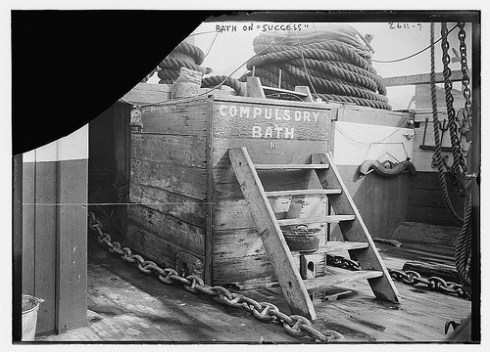
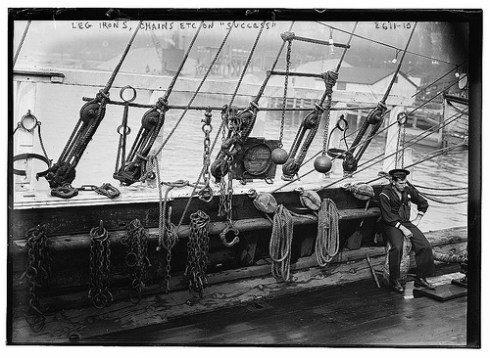
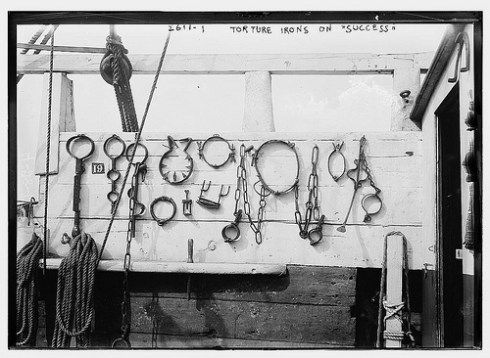
A couple of months ago, I wrote about the prison convict ship Success and its repurposing as a museum ship in the early 19th century. At that time, I featured a couple of images of the ship docked in Seattle and Tacoma. To continue from that visual anchor (pun intended), I’d like to share these few close up images of this unique and long-gone “Museum Ship of Colonial Horrors” (as I like to refer to it).

3030263666_f568014638

3029429307_4c6c2ec7d1The accoutrements of abuse on display are chilling. The international seafaring exhibit was an old British and latterly Australian ship used for deportation of ‘criminals’ during Victorian times and for non-human commodities thereafter.
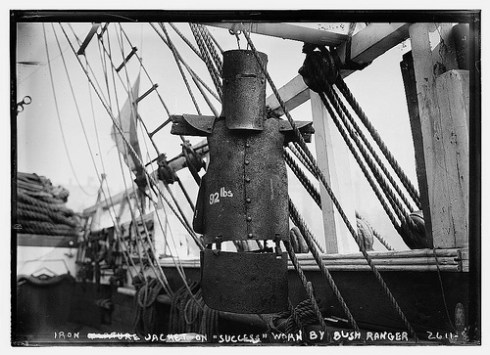
I wonder what sort of museological interpretation of Success was given to American audiences? Would this have been kept in a separate narrative to the slavery ships of the Atlantic or would all histories be foisted into one macabre reductive appreciation of the ‘Other’?

3029428883_df4e0a76ed

3029428449_3f46a11ca91When I saw the iron jacket I was terrified, but then I read Wystan‘s description of the Wooden Maiden:
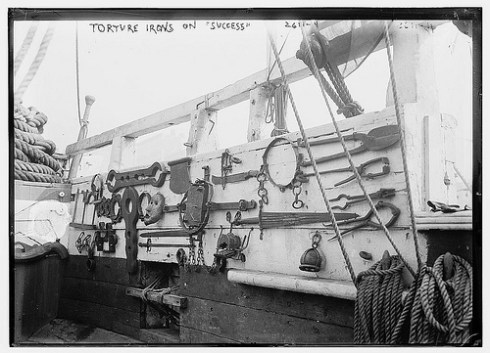
If you were very naughty, you might be asked to remove your clothing and climb inside this vertical coffin, where of course it was pitch dark, there was no water, and fresh air was scarce. Then the box (which was clad in sheet iron) would stand in the hot sun until you got nice and warm. But you wouldn’t want to slump or faint, because then your bare flesh might get snagged on the ends of the long nails that had been pounded into it from random directions . . .

3029428277_531721dec6

All images from the Library of Congress on Flickr,

and searched out through Flickr Commons.

US Soldiers in a Mosul Internet Cafe. Photo Credit: Andy HoboTraveler.com World Travels. http://www.hobotraveler.com/120mosul03.shtml

US Soldiers in a Mosul Internet Cafe. Photo Credit: Andy HoboTraveler.com World Travels. http://www.hobotraveler.com/120mosul03.shtml

Last week, BLDGBLOG published How The Other Half Writes: In Defence of Twitter. It slammed Margaret Dowd’s “brain-dead editorial” in which she pouted like an adolescent instead of actually interviewing Twitter founders, Stone and Williams.

In Defense of Twitter was vitriolic and robust in its argument. Geoff usually sticks to urban-tectonics, mobile architecture and Los Angeles, so it was unusual to see him drop down to the base debate over whether Twitter is good or not. Alas, he dropped in and closed the debate.

Geoff’s argument was that Twitter is essentially a note taking application, and we shouldn’t crap ourselves just because the post-its are seen by the world.

Paul Carr’s article in the Guardian today suggested Twitter can take care of itself anyway. Twitter and other webomediasphere-folk have been brought in to consult on the loose ends and cable ends of a frayed Iraq. Carr exhorts

“I am not making this up. The department has just airlifted Twitter’s Jack Dorsey along with representatives from WordPress, Meetup.com, YouTube and Google into Baghdad to discuss how social media can help build Iraq 2.0″

Carr’s article runs at the same time the New York Times picks up on the story.

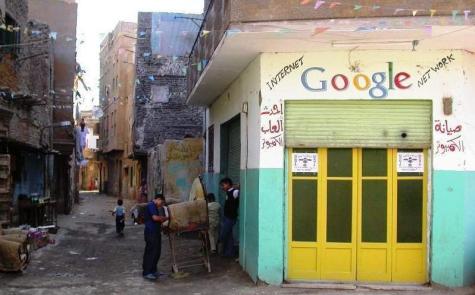
Internet Cafe in Baghdad. Phot Credit: BlogIraq (died April 2008). http://www.blogiraq.info/2007/02/22/at-last-google-opens-and-office-in-baghdad/

Internet Cafe in Baghdad. Photo Credit: BlogIraq (died April 2008). http://www.blogiraq.info/2007/02/22/at-last-google-opens-and-office-in-baghdad/

The US military’s partnership with non-military groups/corporations takes me back to a presentation made in 2005 (the pre-Obama era). Thomas Barnett bleated about the failings of the Iraq (mainly the “six months of dicking around” after Saddam was toppled). He relates all of this to the US military’s ongoing deficiencies since the end of the cold war. The American army can annihilate any chosen subject but it has not paid much attention to post-major-operations rebuilding. Iraq is a sorry testament to that fact. Barnett suggested a flood of 250,000 “administrators” into Iraq in April 2003 would have stabilised the country a lot quicker.

It seems the US military is now calling upon Twitter and others as “post-war administrators” infrastructure builders, vacuum fillers – whatever you want to call them – as described by Barnett. What should one make of this? Why shouldn’t Twitter et al. be working to improve the long term prospects of Iraq? The US military is great at shock, awe, power and might, but not building community. Barnett prefers his soldiers “young, male, unmarried and slightly pissed off”. But he insists the military personnel be followed up by a flood of partners who facilitate the the rebuilding of infrastructure. A 19 year old marine cannot carry out both distinct functions/philosophies of war.

I don’t like Barnett’s tone. I like his honesty about the realities of military combat, but not his pompous humour. Barnett takes on many groups; multiple government agencies, the UN, TSA, and not least liberals who squirm uncomfortably to pussy jokes. But just because he takes on the military – just because we share opposition to the Iraq war – does not makes us allies in thought. Barnett wants to make military better and ultimately a more efficient killing machine.

militaryicons

Military Icons for PC

It is perhaps this quote by Barnett describing the relationship of military and non-military responsibilities through hypothetical steps of entering, winning and closing warfare, that positions Twitter best. Twitter is part of the second group.

“The first group takes down networks, the second group puts them up. You’ve got to wage war here, in such a way to facilitate that [second group reconstruction activities]. “

Again, what should one make of this? Everyone knows about Halliburton, because of Cheney’s associations. Are Twitter and its do-no-evil web 2.0 pioneers any different to the tens of thousands of other corporate interests in Iraq?

twitter

Screenshot of "Iraq" Search on Twitter. April 28th 2009

On Thursday, 28th May, photographs of prison conditions and detainee custody from six facilities other than Abu Ghraib will be released to the public.

Reports over the weekend suggested a figure of 44, but the Guardian has stated over 2,000 photographs are to be made public. Images of Bagram Air base in Afghanistan are included in the cache. Critics will surely scan for similarities in detention/torture methods used in Afghanistan as in Iraq to argue against the ‘few bad apples’ logic that railroaded earlier attempts to bring military and government commanding authorities to full-accountability.

boarding

ACLU’s advocacy deserves international acclaim. Not only have they forced the release of photographic evidence they won a ruling to prevent the destruction of audio tapes that record torture scenarios.

This is an interesting counterpoint. I presume we all assume we’ll see the images in the printed press. Would we expect the tapes to play on our televisions and radios? That scenario makes me uncomfortable.

Continuing with issues of format, it will be interesting to see how the media presents the-soon-to-be-released photographic documents in contrast to the recent torture memo’s. WoWoWoW set the bar low with the tabloid inquiry “How Bad Will They Be?” and the Los Angeles Times allays fears with a dead-pan assessment, “examined by Air Force and Army criminal investigators, are apparently not as shocking as those taken at Abu Ghraib.

No doubt these images will be contested and a ‘Meaning-War’ over the images will ensue, but I think people for and against the Bush administration’s interrogation policies are not going to change their position now – whatever the evidence.”

But, I guess it depends who’s looking.

bush_rorschach_test

Lefties want more weaponry in the push for prosecution of Bush and his cronies for war crimes. The right is debilitated and otherwise occupied by the economy, stocking guns before the “Obama-ban” and the latest Meghan McCain slur.

Politicians from both parties seem to want this to go away, snarking on about how the release of yet more Un-American activities will only fuel the burning hate toward the US. This position is an insult.

Did Bush care what Iraqi’s would think when he bombed them out of house and home? Did Bush care to think how American’s would react in the face of diminished civil liberties? Yet here, politicians of both parties are scrambling to avoid the negative reactions of entrenched, fundamental opponents INSTEAD of anticipating the beneficial good-will and return to mutual trust provided by honest disclosures of a transparent and constitutional government. Why cover-up a cover-up?

Maybe, the Democrats are shy to see these documents because they may implicate their top brass?

torture

One concern I will air, is that all this could move toward some bizarre show-trial scenario, where lawyers bargain, Bush is spared, the American public settle for a conviction of Cheney, and careers and reputations lie in waste on both sides of the aisle!?!

I certainly didn’t expect the incriminating documents to flood as they have in recent weeks. I have no idea how all this is going to shake down. Obama doesn’t seem to have control of this. That doesn’t bother me. No-one can hold back the truth.

So, as wise at it’d be to remember the date, 28th May, you should bear in mind the photographs of abuse could well leak earlier…

________________________________________________

First Image lifted from Gerry May. http://www.gerrymay.com/?p=1426

Cartoon courtesy of the Nation. http://www.thenation.com/doc/20050307/duzyj

Final Image by Takomabibelot. http://www.flickr.com/photos/takomabibelot/2090273618/

© Stephan Sahm, from the series 'My Cage is My Castle'

© Stephan Sahm, from the series 'My Cage is My Castle'

It takes something special to jolt me from my ‘prison-photo-myopia’.

The European Prize of Architectural Photography has the most cohesive group of fine art photography winners and honorable mentions I’ve seen in the past five years. The theme was “New Homeland”. Each photographer has four prints as representative works and each mini-set is a treat!

Outstanding quality.

© Jacky Longstaff

© Jacky Longstaff

You can browse the links provided below, but first see the 2009 Prize Winners Gallery.

Photographers formally recognised are Stephan Sahm, Tim Griffith, Jacky Longstaff, Freudenberger & Bachmeier, Kai-Uwe Gundlach, Frank Meyl, Szymon Necki, Menno Aden, Johanna Ahlert, Nicolas Briffod, Judith Buss, Walter Fogel, Andreas Fragel, Matthieu Gafsou, Benjamin Gerull, Juri Gottschall, Hanna Kohl, Shimizu Ken, Meike Hansen, Jonas Holthaus, Werner Huthmacher, Christian Kain, Sally-Ann Norman, Florian Profitlich, Andrew Phelps, Martin Richter, Martin Roemers, Michael Schnabel, Marcus Schwier, Michael van den Bogaard.

I was only aware of Fragel, Gafsou and Phelps previously.

© Frank Meyl

© Frank Meyl

© Matthieu Gafsou

© Matthieu Gafsou

© Marcus Schwier

© Marcus Schwier

© Kal Uwe Gundlach

© Kal Uwe Gundlach

I suppose if I were to push for a relation of any of these works to ‘Photography Within Sites of Incarceration’ I would want to begin a dialogue on Sahm’s Hamster-Pop representations of confinement. Sahm was the grand prize winner.

With Jurgen Chill winning two years ago, and the presumed associations of borders and immigration within the theme of “New Homeland”, the European Prize of Architectural Photography apparently rewards photography that emphasises the psychological impact of architectural forms on its users/subjects – in which, notions of containment and non-containment are central.

________________________________________________________

I am aware Prison Photography has been preoccupied with fine art depictions of prison space recently and I intend to redress this genre imbalance in the coming weeks with more documentary works.

chill-jurgen-zellen3

In 2007, Jürgen Chill‘s Zellen series won him the European Architectural Photography Prize in the “Favorite Places” category. Awarded every two years since 1995, the international prize is now organized by the nonprofit architekturbild.eV (since 2005). The 2007 jury – chaired by Hans Eberhard Hess, chief editor of Photo International magazine – was impressed by Chill’s strict central overhead perspective and chose four images.

Today, the 2009 prize winners are announced, so it seems like a good time to recall Chill’s intriguing images.

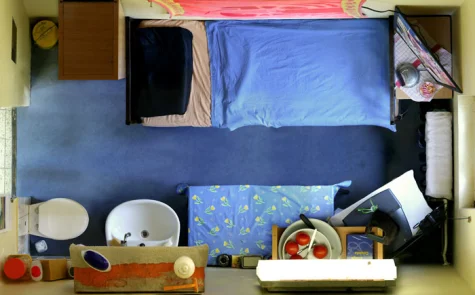
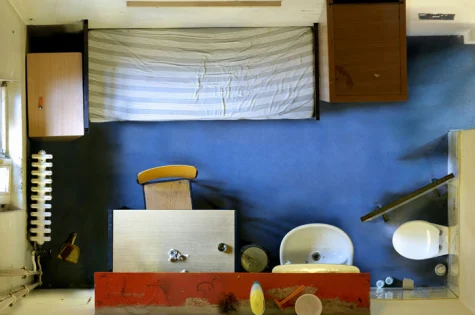
Jürgen Chill’s Zellen photographs are a unique perspective upon prison space. Of all the positions in the cell, this floating light-fixture-eye-view should be the least claustrophobic, and yet, the central (physically impossible) high vantage point is dizzying. How does the camera (let alone cameraman) take up such a position? From here, what is there left to do but fall?

Has Chill has pioneered a new photographic typology? I was fascinated by the order of each work; the order of each cell. I must presume this order is the inmates doing and not the photographers. Chill’s work is labour intensive. The reason he nor the camera falls is because each image is a stitch of over one hundred photographs, captured by a digital SLR mounted on a boom, pressed – facing downward – against the ceiling surface.

chill-jurgen-zellen2

chill-jurgen-zellen5

chill-jurgen-zellen7

Chill is aware that entering his work in the category ‘Favourite Places’ may seem careless or even cynical, especially as the inmates are not pictured. On the other hand, as he notes on his website, “the barren rooms of the inmates are highly individualized and at least temporary qualify as de facto ‘Favorite Places’.” In 2006 he stated:

A person’s favourite place is a place which can be chosen at will. The person’s freedom is presupposed. Freedom, however, is not granted to all. Those that do not have it must adjust to whatever opportunities exist and strive to create their own place. A cell is perhaps the smallest possible space for habitation that a person can have. Personal and functional items are all accommodated in the tightest space. The spaces are represented as they are found. The Spaces are represented as they are found. The proportions of the photographs mach those of the rooms. All details in the rooms are shown orthogonally from above, nothing has been altered.

________________________________________________________________

I contacted Jürgen via email to ask about the practicalities of making Zellen, and to secure his comments on the series concept.

Jürgen, please introduce your work.
My photographs are most like a map of the prison cells; like a Google Earth view of a landscape.  I try to communicate information about the individuals that have to live in perhaps the smallest possible space for habitation that a person can have – without showing this person himself. Personal and functional items are all accommodated in the tightest space.

I’m interested in how a person arranges personal and functional items in their small cell. And what kind of person can it be [based upon the visible evidence]? Is it possible to get a “picture” of a person by having a view of his private space? It’s a view and perspective that you normally would never get of these cells. So it is not really “real”, more a scenery set or something similar.

chill-jurgen-zellen6

chill-jurgen-zellen9

chill-jurgen-zellen1

Where are the cells?
The are all in Germany in big cities in the area of Nordrhein Westfalen.

Are the photographs made in the same institution?
I made 16 photographs in 6 different prisons in the cities of Bochum, Hagen, Duisburg, Gelsenkirchen, Essen and Geldern

Where were the prisoners when you took the photographs?
I had a short conversation with the prisoners in their cells; explained my project, my concept and my motivation. Some of them were really interested in my work and my kind of photography. The prisoners allowed me to spend about 45 minutes alone in their cells, while they are waited outside, in the alleyway, guarded by one or two persons from the prison.

After my work, for their permission to photograph and publish their private things and space, I gave them a small gift; a packet of coffee or cigarettes. Later I sent them all the photograph of their rooms. Some of them asked for it to have as a kind of souvenir for when they are released from prison.

How long did set up take and what equipment did you use?
Just to photograph takes about 30 minutes. With the test shoots and everything it takes about 75 minutes in one cell. The main work, the montage to one photo takes about one week. So it took a long time to make the photo series. You can see how the images were made in the youtube clip of this German television show from October, 2007.

Does the collection and order of all worldly possessions in a single space fascinate you?
It’s the combination of personal and functional items in a small space. First, the cell must contain all the functions of a house in one room: bedroom, toilet, living-room, store-room and sometimes a kitchen. Then the prisoner combines it with his personal possessions and create his private space in about 8 square metres. How does a person arrange such a small space with personal items so that it [also] keeps its basic functions ? And that arrangement exists for years. So my photographs try to draw a picture of an individual person.

chill-jurgen-zellen4

Americans, in particular, are starting to realise that they must use/waste less petrol, possessions, energy, space and give up personal largess for the benefit of community. Does the modesty of the prison cell appeal to you? Do future modes of living relate to the cell?

For me, as the artist and maker of these photographs, my intention is not to call out [to people] to give up personal largess for the benefit of community or for other kinds of social and political attitudes or activities. I just want to show the state of things in the visual of photography and try to show these things in an unusual perspective or context. Just to ask questions about it and not to give answers. That’s the viewers job.

Would you put your images into a history of visual culture that represents humans under duress and finding humanity in the smallest places/between the cracks? Or, is the Zellen series a totally modern piece, completely divided from historical context?

About historical context: I think every art work (the good ones) can not be divided from cultural and historical contexts. The Zellen series, and the new photographic series of whorehouse rooms, which I’m now working on, tells us about situations and the state of things now.

But the contemporary associations of now ( the “Zeitgeist” ) result from the past. The series Zellen was shown in a large exposition about prisons, CUSTODY/SPACES OF SURVEILLANCE in the Summer of 2008 in Frankfurt, Germany. The photographs were shown there in the historical context of humanity under surveillance; within imprisonment and [in the context of] prison architectures.

chill-jurgen-zellen8

________________________________________________

Thanks to Jürgen for his kind help and time in piecing this article together.

All Images ©  Jürgen Chill.

wsp_8x10

Yesterday, the internets celebrated Earth Day. The irony in this is that our grandparents’ generation would or could find nothing more incongruous than screen-sucked individuals posting pixels about the earth instead of actually being in its woods, lakes, deserts and mountains. I am not exempt from scorn.

Within the blogophotosphere the general tactic was to post aerial photographies. 100 eyes went to town with a series of Where Am I Now quizettes. NPR went with the easy but stunning option of Geo-Eye’s aerial images. On the aerial theme, i heart photograph posted an unintended but fitting selection of Eva-Fiore Kovacovsky’s photography. The Big Picture did not disappoint with a medley of seriously good environmental issues, opening with a shot of earth from space and Indicommons presented photochroms, albumen & photomechanical prints of nature from earth’s best collecting institutions. And, all of this buttressed by PhotoInduced‘s assertion that digital photography is the green option.

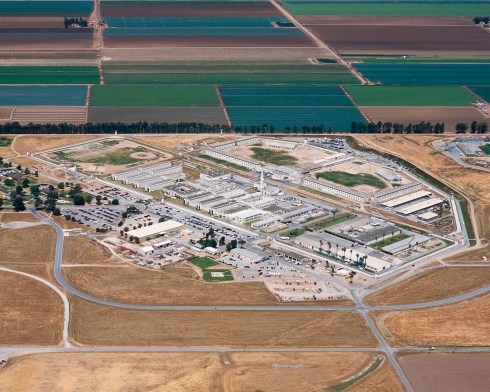
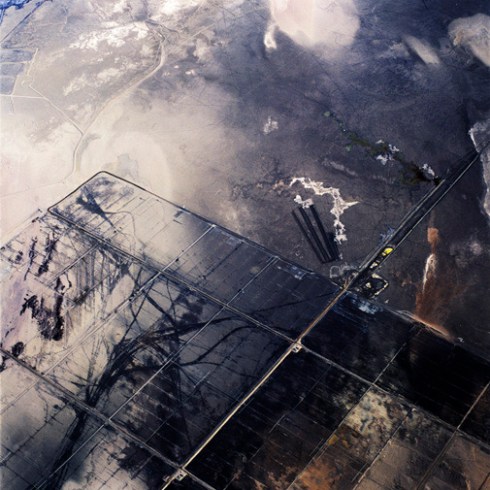
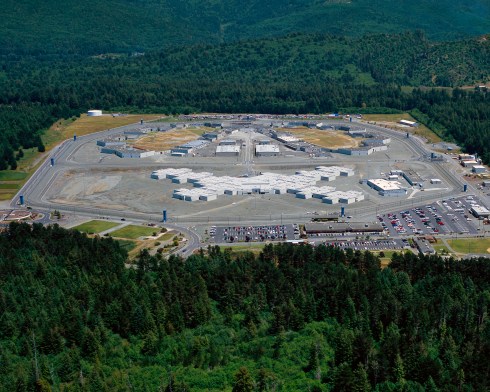
I began to think how aerial photography could tie in with prison photography. Last month, I used some official California Department of Corrections & Rehabilitation (CDCR) images for a post, and in doing so noted the fleeting resemblance of some patterns in the prison-adjacent fields to the salt-pan and tilled earthscapes of David Maisel.

Disclaimer: David, if you are reading, I respect your craft, fine art and politic. In March I camped at Owens Lake and your project formed the basis for much of our camp fire discussion. I hope you don’t think it inappropriate to juxtapose your work with standard state-sanctioned aerial photography.

Salinas Valley State Prison. Courtesy CDCR

lak_m_13

pleasant-valley

lak_m_09

California Training Facility

lak_m_18

Substance Abuse Treatment Facility at Corcoran. Courtesy CDCR

lak_m_03

vspw_8x10

lak_m_05

A CDCR image appears before the text. After the text, images are arranged alternatively beginning with a CDCR image. Any image without a prison is a David Maisel.

___________________________________________________________

David Maisel’s oeuvre is dedicated to altered environmental landscapes. Maisel’s images featured in this article are from The Lake Project which, along with Terminal Mirage, makes up his ongoing ‘Black Maps’  project recording “the impact on the land from industrial efforts such as mining, logging, water reclamation, and military testing.” Maisel’s official bio continues, “Because these sites are often remote and inaccessible, Maisel frequently works from an aerial perspective, thereby permitting images and photographic evidence that would be otherwise unattainable.” Prisons are often remote and inaccessible in California.

In all our justified concern for the environment and its invisible, gradual damages, I also want us to also to consider the invisible, gradual damages done to our social landscape. Men and women are wasted in America’s prisons.

___________________________________________________________

Prison Photography recommends Geoff Manaugh’s extended interview with Maisel at Archinect, audio interview at Lens Culture, Joerg Colberg’s interview at Seesaw Magazine and a full environmentally friendly CV from the Green Museum.

David Maisel was born in New York City in 1961. He received his BA from Princeton University, and his MFA from California College of the Arts, in addition to study at Harvard’s Graduate School of Design. Maisel was a Scholar in Residence at the Getty Research Institute in 2007 and an Artist in Residence at the Headlands Center for the Arts in 2008. He has been the recipient of an Individual Artist’s Grant from the National Endowment for the Arts, and was short-listed for the Prix Pictet in 2008. Maisel lives and works in the San Francisco area, where he has been based since 1993.

Like most other people, I can’t get enough of Roger Ballen at the moment.

Doug McClermont has treated us to a great interview with Roger Ballen. It crescendos in a battery of ‘Ballenisms’ on the evolution of man, the rejection of political correctness and the common id of all great portraits.

Sergeant F. de Bruin, Department of Prisons employee, Orange Free State, 1992 © Roger Ballen

Sergeant F. de Bruin, Department of Prisons employee, Orange Free State, 1992 © Roger Ballen

RB: But what is the most important thing in that picture?

DM: His stare?

RB: The wire. Before I saw him I found the wire. And then when I turned the corner there he was … but I associate that picture with the wire. Without the wire there’s no photograph. That’s what the picture is about, not necessarily him. The wire looks like his lips.

DM: I know there’s a formal aspect to the images, but that face has seen so much.

RB: Form makes the content! Without your ribs you’re just a deflated nothing. The forms bring out the content and create meaning in themselves. So it’s very important to see the images as formal instruments as well as the content in and of itself.

DM: But it’s also narrative.

RB: It is, you can’t separate the two.

DM: This guy has seen so much and It’s all reflected right there in his mug. There are so many stories behind those eyes… what we bring to it.

RB: You have to find your own world in that picture. A lot of what you find you can’t explain. You can’t put into words. But you have an emotional relationship. Like life.

DM: If you could have put it into words, you would have written him as a character in a book.

RB: Basically, some people see him as a monkey. The character of a buffoon and a monkey in a prison guard, whatever. There are all those masks you see in the face. The face reveals the human condition in all sorts of ways. He’s funny, he’s tragic.

DM: Like the masks of theater…

RB: He’s vicious. He’s a monkey. He’s a pompous prison guard.

DM: He seems simultaneously weak and evil to me.

RB: Behind the face is always the monkey. Remember that. I’ve been living in Africa a long time. I’ve really seen a lot about the human condition. Behind the face is the monkey. You won’t get me to change that point. I don’t care if every PC person wants to shoot me for it.

DM: In terms of evolution, you mean?

RB: It’s Freudian…

DM: The id.

RB: Yes, the monkey is the id. Each image is like someone’ s id… and then I bring mine and put it on top of it. If it’s good artwork, it’s everybody id in some way. They’re heroes of the human id. Jess and Tessie, [the drooling twins] you see who you were a million years ago…a monkey…and you were that monkey. Subconsciously, genetically in the back your mind it’s the monkey. You’re a monkey. You see it our ancestors, that’s why the picture is so strong. Simple as that, because people relate to it. They’re brutal, they’re simple, they’re drooling but we relate to them. We see ourselves as humans deep inside them. It’s Neanderthal. Half man, half monkey.

DM: Chromosomes definitely come to mind when you see that image.

RB: No, it’s not about chromosomes – that’s PC thinking – the only thing that crosses your mind is: there’s my face. There’s my id. That’s what I come from. I come from a monkey. That’s your cousin in that picture.

__________________________________________

Doug McClemont is the former Editor-in-Chief of HONCHO, Torso, Mandate, Inches and Playguy. His writing regularly appears in publications such as Publishers’ Weekly, Library Journal and Screw. He has written introductory essays for several monographs on contemporary art and is currently at work on a book of short stories entitled Little Morticians.

EMAIL

prisonphotography [at] gmail [dot] com

Prison Photography Archives

Post Categories