
You are currently browsing the tag archive for the ‘Haiti’ tag.
PART FOUR IN A SERIES OF POSTS DISCUSSING PHOTOGRAPHERS’ ACTIONS AND RESPONSES TO THE KILLING OF FABIENNE CHERISMA IN PORT-AU-PRINCE, HAITI ON THE 19TH JANUARY 2010.
On the 3rd February, Adjustment Layer posted an account by photographer Edward Linsmier. It is the fullest eye-witness account by a photographer of events surrounding Fabienne’s death that I have read.
The account doesn’t name the girl as Fabienne. Her name has been available from different sources for some time.
Also worth noting, Linsmier talks of Nathan Weber, another photographer present. I was not aware Weber was at the scene.

Fabienne Cherisma lies dead after being shot in the head by police. January 19th, 2010. © Edward Linsmier
LINSMIER’S ACCOUNT
Read the full account on Adjustment Layer.
Linsmier opens with the excess necessary to hook the reader, “We heard gunshots and knew we needed to be closer. We processed the thought for a split second and we took off running with our fixer not far behind.” and, “Emboldened by the electricity of the chaos, we advanced further and saw people laying on the ground with police yelling and waving guns in the air and shouting commands.”
Linsmier goes on, “We retreated several steps and waited behind a truck for several seconds until the police were distracted. I saw another photographer up the road and decided that we needed to make a move closer to him so we could make some pictures.”
(One presumes this other photographer is Weber?)
“We followed … onto a downed roof top that led to the exposed insides of several shops filled with the scavenging and excited crowd. We were making pictures.”
“The fixer motioned for me to come because the police had caught a man and had him down on the ground. I, in turn, motioned for my friend and fellow photographer, Nathan Weber, who was still on the slanting concrete rooftop to follow me to the commotion down the road. I yelled his name and he looked at me with a blank stare. Nathan is someone who is on point in a situation such as this. He communicates quickly, clearly and with authority when needed. He is no stranger to photographing in similar situations but something of this magnitude was new to both of us. I knew he heard me and figured he would be right behind me as I headed down to the commotion.”
Linsmier returns to see Fabienne’s body, “[I] climbed back up on the roof to see Nathan in almost the exact same spot where I last saw him, except he was looking at a girl who was lying face down on the slanting concrete roof. As best as I can recall, Nathan spoke in short sentences, “I saw her fall. I thought she tripped and knocked herself out. She’s dead. Fuck. She got shot. I was right here.”
“The decision to continue making photographs was instinctual. More photographers showed up and we were all making pictures, composing the dead girl in the foreground as the looters continued to walk past her, almost over her, carrying whatever they could. Several men stopped to turn her over, seemingly to identify the body. They gently took her arms and almost had to twist her just a little to face her upward. They looked at her with little emotion and left.”
This record of events is interesting because it doesn’t report the bypassers going through Fabienne’s pockets as the Guardian did here.
“She had been shot in the head. From what I could tell, the bullet entered her cheek and exited from the back of her head. The blood had been pooling in some picture frames she was carrying when she fell. After the men moved her, the blood began to run down the slanting concrete roof towards us. We all were still making pictures. To anybody else, it must have looked sick, a crowd of photographers vying for the best position to tell the story of the death of a girl.”
“Just about the time that I figured the pictures were over and we should leave, a frantic man and several others emerged from the crowd. It was the family of the girl. The father hoisted her onto his shoulders and began the journey of bringing his daughter home. The photographers followed. Ordinarily, this would be a scene that hardly anyone could bare to photograph. They were experiencing probably some of the most painful moments of their lives but they knew why we were there. Not once did anyone give a mean look; not once did I hear anyone question why all the photographers were following this family’s grief so intently and so closely. It was part of the story.”
THOUGHTS
The underlining above is mine. It highlights the photographers’ conscious activities. I make no judgments here. Linsmier is aware of the sensitivity of the situation. Like, Mullady, yesterday, Linsmier’s candour should be appreciated.
Photographs are deceiving. I should know that by now. When I began my inquiry into Fabienne’s death, I assumed there was a scarcity of images. I presumed only Grarup and Garcia Rawlins had witnessed and recorded the incident.
It is clear, now, that there was more photography and activity. On the scene, at various points, were six photographers – Jan Grarup, Olivier Laban-Mattei, Edward Linsmier, Michael Mullady, Carlos Garcia Rawlins and Nathan Weber.
I’d like to state that I have no agenda here, I am simply interested in constructing the scene in a wider context. Photographers don’t work in a vacuum and we must demand to turn their images inside out to understand the context in which the images were created.
Mining the conditions of production is a position I have held consistently throughout my writing on Prison Photography. I am a great admirer of Errol Morris’ writings that demystify photography; it is in that spirit I am pursuing this inquiry.
Thanks to Melissa Lyttle for the note on Edward’s interview.
– – –
ALSO IN THE ‘PHOTOGRAPHING FABIENNE’ SERIES
Part One: Fabienne Cherisma (Initial inquiries, Jan Grarup, Olivier Laban Mattei)
Part Two: More on Fabienne Cherisma (Carlos Garcia Rawlins)
Part Three: Furthermore on Fabienne Cherisma (Michael Mullady)
Part Five: Interview with Edward Linsmier
Part Six: Interview with Jan Grarup
Part Seven: Interview with Paul Hansen
Part Eight: Interview with Michael Winiarski
Part Nine: Interview with Nathan Weber
Part Ten: Interview with James Oatway
Part Eleven: Interview with Nick Kozak
Part Twelve: Two Months On (Winiarski/Hansen)
Reporter Rory Carroll Clarifies Some Details
Part Fourteen: Interview with Alon Skuy
Part Fifteen: Conclusions
PART THREE IN A SERIES OF POSTS DISCUSSING PHOTOGRAPHERS’ ACTIONS AND RESPONSES TO THE KILLING OF FABIENNE CHERISMA IN PORT-AU-PRINCE, HAITI ON THE 19TH JANUARY 2010.
Michael Mullady just gave an interview to CALIBER SF, the second half of which reflects upon his recent experience in Haiti.
The image atop the interview is of Fabienne Cherisma, the 15 year old girl shot dead by police in Port-au-Prince. I have talked about the circumstances and the photographing of her death here and here before.
In addition to Garcia-Rawlins, Grarup and Laban-Mattei, I did not know that Mullady had also followed her corpse down the street.
Warning: The image is graphic. It is so close in. I should’ve offered the same caveat in my earlier posts. The more I deconstruct the images of – and pass on information surrounding Fabienne’s death – the more I feel like an intruder into a scene that should never have been.
WORDS
Read Mullady’s interview
Mullady talks generally about his career and then moves on to talk frankly about why he went to Haiti (last minute), how he wasn’t prepared for it, and how he now has a commitment to telling the stories of Haitians in the “immediate future”. He offers observations on the social/security fabric of Port-au-Prince.
On Fabienne:
“One day while covering the situation, a young girl was shot just a few feet from where I was standing. People had jumped onto a collapsed building and were running over roofs to get inside stores were merchandise was buried. It was a split decision, but I decided to follow the people to get more intimate images. Putting myself into that situation was possibly something I should have thought more about. In the moment, getting the photograph was all I was thinking about, not my life. That bullet could have been in my head. It was that serious. The cops were not looking at who was in the crowd, they were just shooting. To think I could have lost my life in an instant is terrifying. That day I realized the dangers of working in hostile situations as a journalist and that any day could be your last. When I saw that girl laying on the ground and the agony on her families face, I thought about my own family and the agony I put them through every time I leave the country to work. I never want my parents to have to go through losing there only son. That situation impacted me very deeply and I have yet to speak to anyone in detail about it, you guys are the first. I will share one of my images from that day with you guys.”
On Jim Nachtwey?!:
“I always admired James Nachtwey. Believe it or not, I actually got to meet him in Haiti. It was surreal to look over one-day and see him working next to me. Wow. I couldn’t believe it was really him. Everything I had dreamed about and strived towards became real in that moment. He was no longer a golden god in my eyes but a colleague, working to illustrate the same situation I was.”
On the day-to-day situation:
“The way I see things in Haiti is very different then I imagine you guys to see it through the news. Aid is here, but there are so many people in need and not everyone is receiving proper attention. Things have definitely positively progressed, but it’s going to take more time to help everyone in need.”
“Haiti is plagued by corruption. I have witnessed it first-hand, police stealing aid supplies and keeping them for themselves or selling them to wealthy people. This type of thing is a reality in Haiti. I’ve seen it on many occasions.”
“Before the earthquake, Haiti was in a bad situation so after this I fear for their future. Many Haitians whom I’ve spoken with express they want to become and American colony, such as Puerto Rico. Being an American, it’s been difficult to answer those questions for people and even more difficult knowing that if I told them what I really thought, it would not be what they wanted to hear.”
CLOSING THOUGHTS
Mullady’s candour is to be acknowledged. He could do to turn-down the Nachtwey-worship, though.
After reading the article and seeing the picture, however, I cannot shake his earlier quote:
“Many people believe photojournalists to not be artists and consider other genres of photography to be “art.” What I strive to do is bleed these lines. First and foremost, I would consider myself an artist, a visual artist whose subject matter is humanity. I live for light, obsess over sophisticated compositions and spend as much time as needed to make the exact frame I’m envisioning. A large distinction is that I intend to make images for the world to see, via publications, not images just to hang on a wall.”
Is to “bleed the lines” an incontestable perspective on one’s photojournalism? What happens when one is framing a composition of a murdered teenager? Has this perspective been more common than we’d like to acknowledge in recent images of Haiti?
– – –
ALSO IN THE ‘PHOTOGRAPHING FABIENNE’ SERIES
Part One: Fabienne Cherisma (Initial inquiries, Jan Grarup, Olivier Laban Mattei)
Part Two: More on Fabienne Cherisma (Carlos Garcia Rawlins)
Part Four: Yet more on Fabienne Cherisma (Linsmier, Nathan Weber)
Part Five: Interview with Edward Linsmier
Part Six: Interview with Jan Grarup
Part Seven: Interview with Paul Hansen
Part Eight: Interview with Michael Winiarski
Part Nine: Interview with Nathan Weber
Part Ten: Interview with James Oatway
Part Eleven: Interview with Nick Kozak
Part Twelve: Two Months On (Winiarski/Hansen)
Reporter Rory Carroll Clarifies Some Details
Part Fourteen: Interview with Alon Skuy
Part Fifteen: Conclusions

© Daniel Morel / Corbis
Amidst the all the coverage of Haiti, I have found the interviews and words of photojournalists (eg. Damon Winter; Melissa Lyttle) FAR more interesting and informing than the images.
What an essential privilege to hear Haitian photographer Daniel Morel speak about not only his placement during the earthquake, but also the behaviour of the media, the complaints of Haitians toward said media and where he and Haiti go from here.
If I am going to put weight on any opinion it is Morel‘s.
PART ONE OF A SERIES OF POSTS DISCUSSING PHOTOGRAPHERS’ ACTIONS AND RESPONSES TO THE KILLING OF FABIENNE CHERISMA IN PORT-AU-PRINCE, HAITI ON THE 19TH JANUARY 2010.
“The question is not whether Fabienne will be remembered as a victim of the earthquake but whether, outside her family, she will be remembered at all.”
Rory Carroll, The Guardian, January 26th, 2010
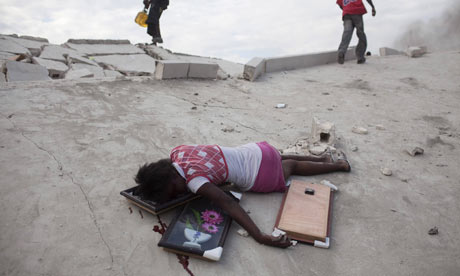
15-year-old Fabienne Cherisma lies dead after being shot in the head in Port-au-Prince. Photograph: Carlos Garcia Rawlins/Reuters.
Fifteen year-old Fabienne Cherisma was shot dead by police at approximately 4pm, January 19th, 2010.
On the 26th of January, the Guardian published an account of Fabienne’s life – her schooling, her sales acumen and her aspirations to be a nurse. The piece is not long, but it needn’t be. It is a modest effort – hopefully the first of a few – to remind us that Fabienne was a daughter, a sister, a source of love and pride for her family and, in the end, an innocent victim.
THE IMAGE THAT REMAINS, THE SYMBOL THAT EMERGES
There is a chance that Fabienne Cherisma could become a symbol of the Haitian earthquake and the problematic aftermath; that she become a tragic silhouette extending meaning far beyond the facts of her abrupt and unjust death.
This notion can be at once offensive and inevitable. If the visual rhetoric is going to play out as such, then if it is not Fabienne, it will be another victim.
What purpose could the emergence of a such a symbol serve?
Thus far Fabienne’s death is a story that has caught wide attention. It came without warning, it was unexpected. Her death – resulting not from nature’s violence but from human action – stands out from other deaths as a particular injustice; Fabienne’s killing is salt in the wounds. While tens of thousands lay obscured beneath rubble, she lay limp and exposed on a bare roof-top. The image itself is an affront.
If one believes that images fuel public awareness, thus securing donations and aid, and thus helping Haiti’s immediate future, then certain images and stories will carry that awareness and emotion.
All the accusations of media exploitation in Haiti do not discredit the positive effects a single image can – without any manipulation – have in the minds of millions. I wouldn’t call this the magic or the power of photography, I’d call it the mysterious perversion of photography. I don’t, and can’t, explain it. I merely observe it.
THE RESPONSIBLE USES OF PHOTOGRAPHY
Fears amongst those who care about media and its conduct hope that the focus can remain on Haiti and its long-term recovery. If the media deserts Haiti after a few short weeks then all accusations of disaster pornography will be upheld.
Photo-editors are now searching for the images that will maintain the humanitarian momentum on Hispanola. These images will be from committed photojournalists who stick around once press photographers have left.
It would be worthwhile to see and hear journalists’ reporting that follows up on the experiences of victims who may or may not have already appeared in coverage. I actually expect journos will follow up on the stories of the child born amid the rubble, the elderly woman rescued after 10 days and the man rescued after search and rescue was called off.
The Haitian recovery must be reported more than the initial chaos.
In the scenario of mass reproduction and circulation, the image of Fabienne’s dead body needn’t be one of mere exploitation. Nothing is so one-dimensional. Of course, this is very sensitive territory and above all the wishes of her family should prevail … in an ideal world.
That said, the history of photojournalism is replete with globally-recognised subjects whose visage was appropriated without their knowledge and/or consent. There’s no model release form in war and disaster.
Fabienne may become a symbol for the innocent victims of this disaster as Kim Phúc did for those in Vietnam. The politics of the two crises are a planet apart, but our modes of consumption are not.


Images are highly manipulable; Errol Morris asserts a caption will turn can turn the reading of a photograph 180 degrees.
The inconvenience of captions often results in the creation of symbol.
I don’t think it will be long before a symbol, a brand for Haitian plight, will rest upon a single image. Western thought demands a visual book-end to the visual dialogue.
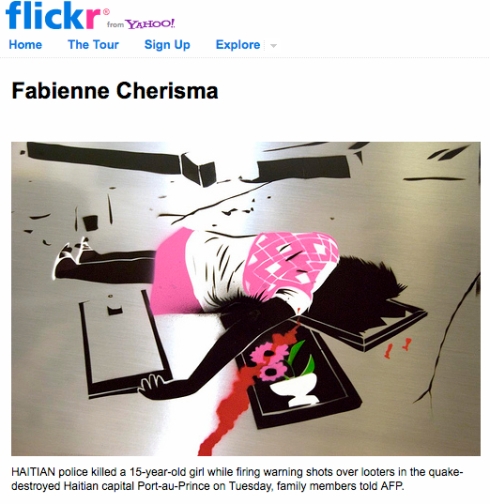
Pureevilbunny has already documented a graphic (in both senses of the word) stencil rendering of of Fabiennie’s corpse (artist not stated). The incongruous pink clothing, argyle sweater, flowers and blood are elements that shock.
THE PHOTOGRAPHIC EVIDENCES AVAILABLE
I do not want to prescribe a means of viewing images of Fabienne’s death. I am interested in informing the public about the photographers who witnessed and recorded the event.
The most widely circulated image is that atop this article by Carlos Garcia Rawlins and distributed by Reuters. It was used in the Daily Mail among others and in the Guardian’s original reporting of the killing:
Jan Grarup of Noor images was also present. Grarup’s dispatch for the 19th and 20th January contains 136 images, nine of which include Fabienne.
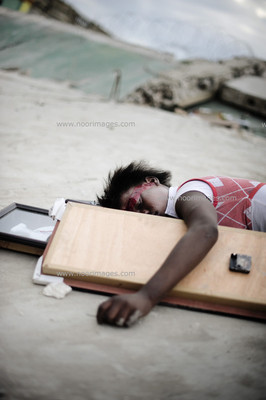
© Jan Grarup / Noor Images
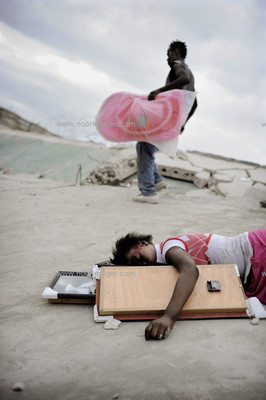
© Jan Grarup / Noor Images
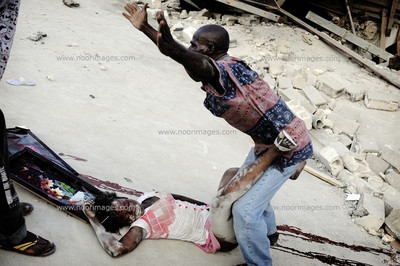
© Jan Grarup / Noor Images
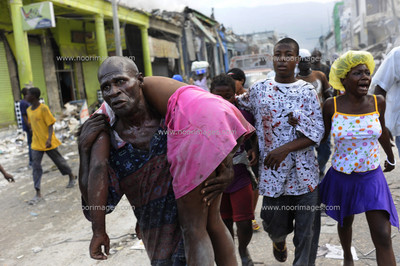
© Jan Grarup / Noor Images
Fabienne’s body is in a distinctly different position between the photographs of Garcia-Rawlins and Grarup:
© Carlos Garcia Rawlins/Reuters.
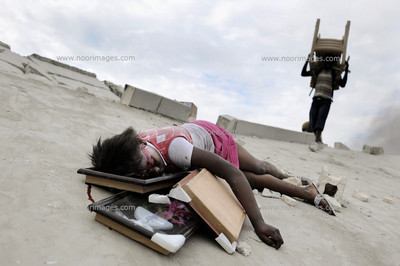
© Jan Grarup / Noor Images
Grarup was present at the scene before Garcia-Rawlins. Between their photographings, the framed pictures slid, Fabienne’s hips turned and her body rolled.
How much time was there between Fabienne’s slaying and the two photographers at the side of her body? How much time was there between the two of them photographing Fabienne? Were Grarup and Garcia-Rawlins on the roof at the same time? Did they see each other work?
Both photographers were obviously present before Osam, Fabienne’s father, carried her body away.
In the immediate aftermath, Grarup documented with a few frames a distraught Osam and family.
Olivier Laban Mattei continued documenting events. Laban Mattei’s dispatch of 28 images, is in fact only five images repeated.
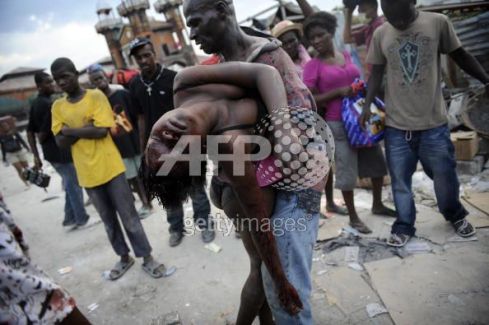
Osam Cherisma carries the body of his daughter Fabienne killed by a policeman during lootings in the Marthely Seiee street January 19, 2010 in Port-au-Prince. © Olivier Laban Mattei/AFP/Getty Images.
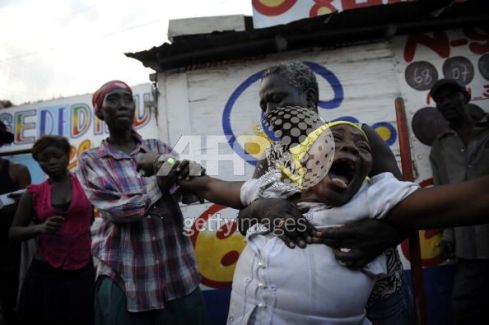
Armante Cherisma cries in front of the body of her daughter, Fabienne, 15 years old, killed by a policeman during lootings in the Marthely Seiee street January 19, 2010 in Port-au-Prince. © Olivier Laban Mattei/AFP/Getty Images.
Despite the amateurish piecing together of evidences, presented here is a basic timeline to Fabienne’s death. These images placed in sequence describe more fully her tragic death and take Fabienne’s memory beyond that (Garcia-Rawlins’) single image.
Fabienne was an innocent. Whether misdirected warning shots or deliberate targeting, her shooting was needless.
If Fabienne’s death does come to symbolise something larger, I hope it does so to benefit the survivors in Haiti; that the injustice brought upon her will only distill our resolve to avoid injustices to others.
If the shocking form of her body, face down in the broken frame, becomes symbolic it cannot be for reductive consumption, disaster cliche or political gain.
AFTER THE PHOTOGRAPHS
‘With morgues overflowing, and earthquake fatalities being bulldozed into mass graves, the Cherismas took their daughter’s body out of the city. With a borrowed $70 they rented a private bus, and drove for four hours to relatives in Zorange. They buried her in a Catholic ceremony and placed a white cross over the grave.’ (Source)
– – –
ALSO IN THE ‘PHOTOGRAPHING FABIENNE’ SERIES
Part Two: More on Fabienne Cherisma (Carlos Garcia Rawlins)
Part Three: Furthermore on Fabienne Cherisma (Michael Mullady)
Part Four: Yet more on Fabienne Cherisma (Linsmier, Nathan Weber)
Part Five: Interview with Edward Linsmier
Part Six: Interview with Jan Grarup
Part Seven: Interview with Paul Hansen
Part Eight: Interview with Michael Winiarski
Part Nine: Interview with Nathan Weber
Part Ten: Interview with James Oatway
Part Eleven: Interview with Nick Kozak
Part Twelve: Two Months On (Winiarski/Hansen)
Reporter Rory Carroll Clarifies Some Details
Part Fourteen: Interview with Alon Skuy
Part Fifteen: Conclusions

Magnum has produced a three minute In Motion piece on Haiti:
The multimedia piece as a whole is disappointing. It features the photographs of Abbas, Christopher Anderson, Eve Arnold, Jonas Bendiksen, Bruce Gilden, Cristina Garcia Rodero and Alex Webb – all incredible photographers, but bundled together they compete against (and detract from) one another.
Abbas’ silvery images of Hounsis, ladies dressed in white (2000) … mix with his images of Saut D’eau (2000) … mix with his images of the Pentecostal Protestants of Jacmel … mix with Gilden’s hard-flash from Plaine du Nord (1985) … mix with Gilden’s street photography in Port-au-Prince (1990 & 1994) … mix with Eve Arnold’s quiet compositions (1956) … mix with Christopher Anderson’s menace … mix with Jonas Bendiksen’s beautiful retreated studies of Haitians in agrarian landscapes and activities … mix with Rodero‘s image of the rituals of Soukri, photos of the Carnival at Jacmel and Souvenance …
The slideshow concludes with a vertiginous volley of portraits of Restavek child servants/slaves by Paolo Pellegrin (who strangely has no credit line).
It’s all too busy and without context and frankly does nothing to describe the country of Haiti. It is in some ways just a limp, late addition to the flurry of visuals we’ve been served these past eleven days.
Magnum would have been much better promoting the recent traveling exhibition Disposable People – Contemporary Global Slavery, and making ‘In Motion’ pieces for contributors Webb and Pellegrin.
ALEX WEBB INTERVIEW
Fototapeta‘s interview with Webb is well worth reading. He talks about the cultural differences between the US and countries of Central and Southern America (with repeated references to to Haiti); about open energy and discrete action; about shooting in colour and in B&W; and about reconciling photojournalism with an inevitable personal reaction.
Webb notes his ongoing balancing act,
“I always felt to some extent that I am out one fringe of Magnum, but I was brought into Magnum particularly by Charles Harbutt, and Charles was really oriented not towards traditional photojournalism at that point. I mean at that point Marc Riboud was doing a lot of rather traditional photojournalism. Charles was encouraging a much more personal kind of vision of the world, and that influenced me much more. I have taken elements of that, which is a very personal approach, but taken them into situations that people do not associate with a totally personal approach like going somewhere else, like Haiti, where political violence takes place, therefore it is photojournalism, but I am actually taking a very personal approach inside places like Haiti.”
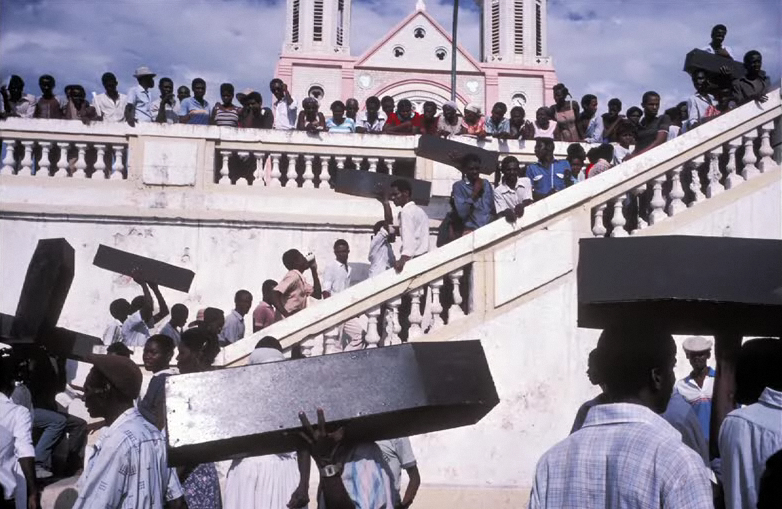
HAITI. Port-au-Prince. 1987. A memorial for victims of army violence. © Alex Webb
I picked out the image by Alex Webb (above) as my preferred image because, while it’s subject is death, it is – as a single image – actually about the bonds of a Haitian community and the composition of Webb’s craft. And they equalise one another perfectly.
I don’t wish to be misunderstood, Magnum: In Motion is a phenomenal service to the global photographic community. I can’t imagine a world nor web without it. The archive is a treasure. I guess when I believe a slideshow has fallen short I want to state it as such. I only criticise because I care.
Andy Kershaw‘s view is a welcome counter to the presumptions of an unknown scenario I and others had considered:
“Most journalists were reporting breathlessly that Port-au-Prince’s main prison had collapsed. Good story. But not for the reasons we were told. The inexperience – and indeed arrogance – of every single reporter who drew our attention to the jail, missed the real significance of its destruction.
It was not that “violent criminals”, “murderers”, “gang bosses” “notorious killers” or “drug dealers” had “simply walked out the front gates”. (And just how did these escapees miraculously avoid being crushed to death in their cells?) Even if true, that was a minor detail to the people of Port-au-Prince, who had more urgent concerns.
The true significance of the prison’s implosion was that it represented for ordinary Haitians, like the wreckage of the presidential palace and the city’s former central army barracks, exquisite revenge upon the prime symbols of decades of state cruelty and oppression.
And many of the prison’s inmates were surely not the dangerous stereotypes of these lurid reports. Haiti’s jails were, notoriously, full of petty thieves and other unfortunates who shouldn’t have been in there anyway. I once had to go into that Penitentiaire Nationale, where I saw hundreds of men kept in cages, without room to lie down, shuffling around literally ankle deep in their own shit, to get out of there the son of a Haitian friend who’d been arrested so that the local police could extort money from his father for the release of his boy.”
via Colin
Currently, truth is also a large casualty in Haiti.
Kershaw’s version is as politically self-serving as most accounts coming out of Haiti, in the confusion following the earthquake citizens, aid-workers and journos are making fast assertions based on their own observations. We should expect that most of these assertions will need modifying in time.
Nevertheless, Kershaw’s is the only commentary that has countered the immediate furor and conjecture surrounding the vacated national prison.
Indeed, Kerhsaw makes it clear that the obfuscations of fact are the direct result of the typical blend of fear and uninformed judgement; judgement applied to prison populations of every nation.
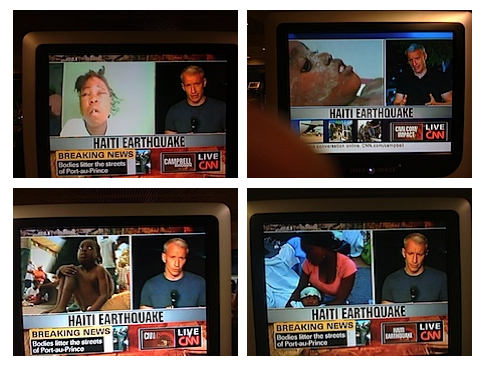
It one thing having foolish and clumsy media commentary of flash-in-the-pan (US) regional stories. It is another when CNN and Anderson Cooper use that same approach covering a humanitarian disaster.
As folk interested in media we should speak out when we see offensive framing and “reporting”.
Anderson Cooper’s bravado is only slightly more insulting than other major networks, but if we picket Cooper and his CNN editors maybe we’ll make a dent large enough that other major networks will also take note.
Michael Shaw just emailed this to concerned social media types. I am behind his sentiment:
I’m writing because I’ve just done a post at BAGnewsNotes that I think is extremely important.
It’s an appeal to readers to contact CNN, or tweet them (@andersoncooper @CNN – PLEASE STOP visually exploiting the Haitians! http://bit.ly/8R1DGc) about the way Anderson Cooper/CNN is visually exploiting the Haitians.
What Cooper has been doing is a complete affront, and it’s time we pushed back in a more systematic way. Haiti is going through a completely sub-human experience as it is, and the humanitarian effort, and dignity for its people, should absolutely extend to the media sphere.
Thanks so much for putting your eyes on this, and being part of the response.
Here’s hoping.

A crowd of people look at two men who were caught stealing and were bound and shot on Delmas Road in Port au Prince, Haiti 17 January 2010. The man in the yellow shirt was still alive after being shot through the head but neither the Haitian national Police nor the general public expressed any concern. EPA / Shawn Thew
Chay soti sout tet, tonbe sou zepol.
The load goes from the head to the shoulder.
(Problems go from bad to worse.)
Haitian Proverb.
DISCLAIMER: THERE ARE MANY LINKS HERE, BUT I HAVE CHOSEN THEM CAREFULLY AND ASSEMBLED SOME ORDER
First things first …
100Eyes
My early enthusiasm for Andy Levin’s proposed wider view of Haiti is now thoroughly tempered. In 100Eyes first statement, Andy made no mention of money. I presumed he was redirecting already committed attendees and resources, but he has extended the venture to new takers and at $1,500, the issue of money-flows (not to mention the obvious dangers and liabilities) makes it seem and sound like a bad idea … for reasons mentioned here and here.
And, I didn’t think Andy’s response was adequate.
GIVE MONEY!
Immediately, let’s us not confuse our value. We know it sits in our wallets and purses. GIVE.
Here is a list of organizations which have been highly rated by the American Institute of Philanthropy through which you can aid those in need in Haiti:
Source
UPDATE:
I also want to add that Paul Farmer’s Partner’s in Health has been doing increible work in Haiti for more than two decades. Money donated to his organization will be very well spent. http://www.standwithhaiti.org/haiti (Thanks Chris)
Possibly the most important and startling initiatives I have found all week …
The Young Haitian Documentary Photographers Group of the St.Marc region of Haiti in March of 2006. “This was the first time these young photographers had used cameras. Their work is ongoing. For more information about this unique group please visit the Haiti page.” (found via Manchester Photography)
Zanmi Lakay is an NGO that offers among its many educational opportunities, photography workshop for Haitian Street Children.
Zanmi Lakay is also Andy Levin/100Eye’s partner in Haiti, which complicates judgement on 100Eyes workshop, no? Maybe, maybe not.

© The Young Haitian Documentary Photographers Group
If you want to contribute while consuming art …
Haiti Benefit Sale was brought to my attention via the The 20×200 Blog.
William Greiner is auctioning an exhibition print & monograph book.
Aline brought to our attention a new Flickr Charity Print Auction. It isn’t exclusively for Haiti, but no doubt, Haiti will dominate current donations.
And, of course there is the Onè Respe Magazine at MagCloud with photos by Chet Gordon, Kari Hartmann, Mary Ellen Mark, Peter Pereira, Lindsay Stark.
@jeffantebi has made limited editions from Haiti available stolen space to benefit Oxfam and MSF.
Singular pieces of photography coming out of Haiti
American Red Cross Flickr Photostream.
Jonathon Torgovnik photos Anderson Cooper picking up a bloodied boy off the street.
Two photo essays from the Prospekt collective.
Flickr: Catherine Laine photographs for the Appropriate Infrastructure Development Group.
David Levene for the Guardian.
Jan Grarup and once again for Noor
Panos by Jeroen Oerlemans and Moises Saman.
Redux showcases Emiliano Larizza.
Not photography, possibly more important than photography, worth reading
“Stop treating these people like savages” by Andy Kershaw of The Independent, “An unbelievable 10,000 charities were already working in Haiti when the earthquake rocked the island, most of them tiny independent organisations. Humanitarian aid is, almost by definition, never where it is needed when natural disasters strike. But, in Haiti, what’s needed has been flown in with impressive speed. Yet the combined concern of all those organisations – many of them regarding fellow charities as professional rivals – has so far been unable to get that assistance a ride from the airport. Too much energy in the last week has been expended on bickering about procedure and the fetish about “security”.”
Interactive map of Haiti to report incidents.
From the BBC –Haiti earthquake: Aid workers’ diaries.
Bizarre turn of events when an American cruise company chose to find a Haitian berth only 100 miles from Port-au-Prince but then to soften the blow offered to donate sun loungers to a Haiti makeshift hospital.
Poynter Online offers welcome perspective on photography in Haiti by focusing on Patrick Farrell’s Pulitzer winning work from last year.
Colin Pantall‘s Junot Diaz, Trujillo and The Dominican Republic looks obliquely at Haiti’s historical relationship with its neighbour.
Philip Gourevitch makes a modest proposal; “Goldman Sachs and JPMorgan Chase should give a billion dollars apiece to Haiti relief and reconstruction efforts—and they should do it swiftly and without hesitation.”
Also, from the New Yorker, Earthquakes and Journalism Steve Coll offers some insight, “I learned something about journalism while covering my first earthquake, in northwest Iran, in June, 1990.”
Saturated in the Image
LENSblog (Maggie Steber, Damon Winter, James Estrin) have been leading the way with classy and sensitive coverage diluting images with interviews .. and even dipping into the Archive: Haiti, Alive.
The Boston Globe started the trend for newspaper’s to post them large. It has had three monster galleries thus far: Earthquake in Haiti, 48 Hours Later and Haiti Six Days Later.
Plethora of disaster from the NJ Star-Ledger.
The Denver Post has two offerings: One Week Later Photos and Earthquake in Haiti Photos.
The Los Angeles Times goes Hi-Res with Carolyn Cole, Rick Loomis and Brian Vander Brug.
The Wall Street Journal has led the charge with mammoth galleries daily, ominously titled WSJ Photographers Document Chaos. Here’s the last three days, they go back further:
WSJ Photographers Document Chaos in Haiti: January 17, 2010.
WSJ Photographers Document Chaos in Haiti: January 18, 2010.
WSJ Photographers Document Chaos in Haiti: January 19, 2010.
The Sacramento Bee has also been offering the large scrolling wide web galleries. They used images by Logan Abassi and The Red Cross to take an aerial view. Here’s the SacBee’s latest, Haiti One Week Later.
Interview with Melissa Lyttle & gallery of Melissa’s images from St. Petersburg Times.
NPR Picture Show has been offering constant Haiti coverage from the ground.
Photographers in Haiti
Here’s the scoop from Lightstalkers: Is anyone on the ground in Haiti?
And finally, PDN ran this: Photographers in Haiti Face Shortages of Fuel, Water, Housing, and Food, which may be true but the headline is hardly tactful.
How many photographers does it take to photograph a humanitarian disaster?
Juan Barreto / AFP / Getty Images
Bruno Stevens / Cosmos
John W. Poole / NPR
David Gilkey / NPR
Ramon Espinosa / AP
Luis Acosta / AFP / Getty Images
Jae C. Hong / AP
Minustah / Logan Abassi / AP
Julie Jacobson / AP
Francois Mori / AP
Chris Hondros / Getty Images
Win McNamee / Getty Images
Ariana Cubillos / AP
Ricardo Arduengo / AP
Olivier Laban Mattei / AFP / Getty Images
Sophia Paris / Getty Images / UN / Minustah
Gerald Herbert / AP
Uriel Sinai / Getty Images
Patrick Farrell / AP / The Miami Herald
Peter Andrew Bosch / Miami Herald / MCT
Carl Juste / AP / The Miami Herald
Melissa Lyttle / St. Petersburg Times
Dominic Nahr / The Wall Street Journal
Julie Platner / The Wall Street Journal
Ron Haviv / New York Times / VII
Heather L Rohan / NJ Star & Ledger
Nicholas Kamm / Getty Images
Gregory Bull / AP
Michael S. Wirtz / Philadelphia Inquirer
Federico Gambarini / EPA
Orlando Barria / EPA
David Fernandez / EPA
Juan Barreto / AFP Getty Images
Shawn Thew / EPA
Thomas Coex / AFP / Getty
Thony Belizaire / AFP / Getty
Julie Remy / AP / MSF
Julien Tack / AFP / Getty
Michael Laughlin, Sun-Sentinel / AP
Francois Mori / AP
Julie Jacobson / AP
Jewel Samad / Getty Images
Paul J. Richards / Getty Images
Joe Raedle / Getty Images
Mario Tama / Getty Images
Martin Oeser / Getty Images
Jody Amiet / AFP / Getty
Logan Abassi / AFP / Getty
Marco Dormino / AP / United Nations
Frederic Dupoux / Getty Images
Eduardo Munoz / Reuters
Cris Bierrenbach / AP
Jorge Cruz / AP
Maggie Steber / The New York Times
Tequila Minsky / The New York Times
Damon Winter / New York Times
Michael Appleton / The New York Times
Erika Santelices / Getty Images
Jonathan Torgovnik
Boots Levinson
Alvaro Ybarra Zavala / Getty
Jan Grarup / Time
Jeroen Oerlemans / Panos
Moises Saman / Panos
Zoriah
Carolyn Cole / LA Times
Rick Loomis / LA Times
Brian Vander Brug / LA Times
Nick Kozak
Jason Henry / Wall Street Journal
David Levene / Guardian
Francesco Giusti / prospekt
Samuele Pellecchia / prospekt
Emiliano Larizza / Contrasto / Redux
Carol Guzy / Washington Post
Lisandro Suero / AFP / Getty
Clarens Renois / AFP / Getty Images
Kena Betancur / Reuters
Ivanoh Demers / AP / Montreal La Presse
Sam Yeh / AFP / Getty
Gus Ruelas / Reuters
Carlos Barria / Reuters
Jess Hurd
Axel Oberg
Jorge Silva / Reuters
Carlos Garcia-Rawlins
Andy Levin
Robert Larson
(List not exhaustive)
AND LAST BUT NOT LEAST
Special mention must go to Daniel Morel (AFP / Getty Images) who has photographed Haiti all his working life and holds the nation and its people close to his heart.
See a slideshow of his work here at The New York Times Lensblog

 Prison Photography