
You are currently browsing the tag archive for the ‘Monday Convergence’ tag.
In October, I posted an image of Orleans Parish Prison inmates guarded on a New Orleans Bridge following a problematic evacuation. It was within a meandering article charting a chain of discoveries beginning with Arnold Genthe and ending with Pay-As-You-Stay jails in Los Angeles.
My conclusion then remains the same now: Katrina dealt with the poor in the same way a American society and markets have for the past 30 years; it picked them up, took them wherever it was heading on its disastrous path and spewed them out the back with nothing … and likely closer to death.

O.P.P. Inmates guarded on New Orleans overpass following Hurricane Katrina. Credit: David A. Phillip/AP
In February, an assistant producer working on David Simon’s new project Treme got in touch with me to source the above image. (So, expect some Orleans Parish Prison related plot line!)
In response, I spent hours trying to hunt down my original source. FAIL. I found other images like it belonging to David A Phillip/A.P. and so, it is he I credit. I am 99% certain.
I have talked before about prisoners as waste, and this image is a convergence on that thought. Both people and trash have been herded into their corner; trash checked by freeway wall and current, people by armed guard.
This image bristled for some time during which I read reports on rivers full of trash and Charles Moore’s TEDtalk about the Great Pacific Garbage Patch.
Then, add hero David Simon telling Bill Moyers that the reason America has never solved the chronic poverty in cities because America’s economy (no longer manufacturing based) does not need 10-15% of it’s population and labour pool. America has turned people into excess.
It begins to get depressing and heavy.

© Megan Martin 2009 http://www.meganmartinphoto.com
Add to this the fact I f*#kin’ hate those stupid-pearlescent-pearly-plastic-pearls-destined-to-choke-a-fish and it was all starting to get back to a dirty, sad, wasted and wasteful place.
Collapse.
I’ve never been to New Orleans’ Mardi Gras. Large celebrations unnerve me and the party – as legendary as it is – remains on my “to avoid list”.
I searched for the image that had bedded like sediment at the foot of my brain stem. Any trash image of the Mardi Gras aftermath was to serve the purpose, but when Flickr presented Megan Martin’s photo it was like string of predetermined conscience came home to fester.
The compositional mirror of these two images just polished my obsession with the unsustainability of most things. Processes have products and by-products. By-products are shipped to Asia to pollute its children or trampled into our unsustainable soils.
Louisiana has the largest number of prisoners per capita in the United States. Fiscally, Louisiana prisons must be feeling the pinch as much as any other state?
It appears a society’s self-made problems – when they are big – won’t even be washed away by a 100year storm. Let’s stop filling prisons like we fill landfill. Prisoners and their rights cannot be ignored. Prisons are unsustainable.
For a full account of the disastrous evacuation of New Orleans prisoners during Katrina watch Prisoners of Katrina by the BBC.
See Megan Martin’s photos here.
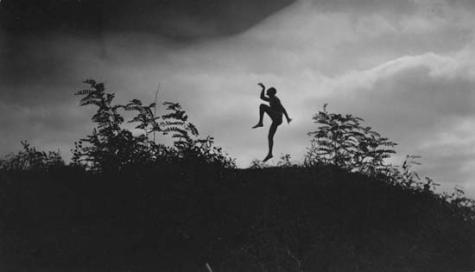
The Dancing Faun. 1919. AFP Photo/Andre Kertesz/National Gallery of Art
A few weeks ago I promoted a David Bauman slideshow documenting the San Quentin Giants. The anchor image to Bauman’s multimedia project was an image of a silhouetted pitcher mid-throw (below). Photographer David Simonton pointed out the image’s likeness to André Kertész’s well-known Dancing Faun.
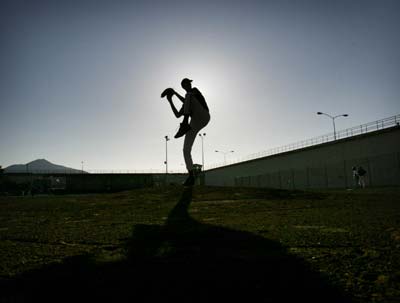
Pitcher for San Quentin Giants. Credit: David Bauman/PE.com

Germany; Indoor Pool "Tropical Islands" in Berlin Brandenburg; Tourist watching the evening show. © Reiner Riedler / Anzenberger
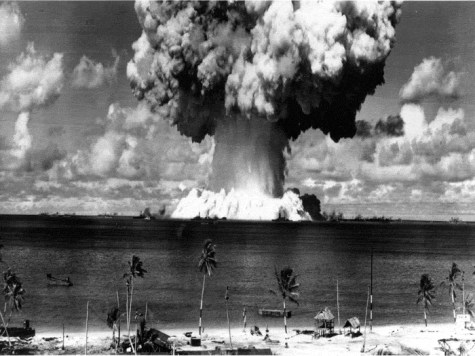
Nuclear Test on Bikini Atoll
Lenscratch was right to single out the work of Reiner Riedler from the 50 chosen artists of Critical Mass at Photolucida, Portland, Oregon.
The search for the authentic undertaken by the tourists of Fake Holidays creates paradoxically inauthentic (“anti-authentic”) spaces. Invariably, engagement with these theatre-sets of leisure is as spectator. Of the audience, the spectacle requires passive acceptance and, to some degree, a surrendering of their self identities as agents of change.
Many of Riedler’s images are caustic in their humour but others are flat out depressing. “Tropical Islands” reminded me of the images of 50’s movie-goers in 3-D glasses; fun at the time but now cut into apocalyptic montages of human division, destruction and powerlessness.
Riedler’s image suggest little progression since the late colonial exploitations of Europe in the South Pacific. It is as if he turned the camera 180 degrees on its tripod, eradicated half a century, added colour and caught the masses still gawping.
Furthermore, “Tropical Islands” can be read as a simulation of the defacement of human existence. The fake plastic trees, sealed dome architectural skin and industrial spotlights have me imagining these people kicking back on their loungers as a nuclear winter takes hold outside their chlorinated, hemispherical world. It is as if the only method of survival in this radioactive-proof conch is to relive (in full surround-sound) the astounding beauty of the awesome act that drove them to their hermetically sealed lives.
Also, while we are on the topic of nuclear holocaust, you should listen to Nitin Sawhney’s Beyond Skin.
Mikhael Subotzky is an infrequent contributor for the Magnum blog. In fact, it happened only once; in response to the Magnum blog competition, for which, members of the public drew visual similarities between the works of Magnum photographers and the works of art historical cannon.
If a convergence is presented by the artist himself does it make it indisputable? Or at least 50% indisputable?
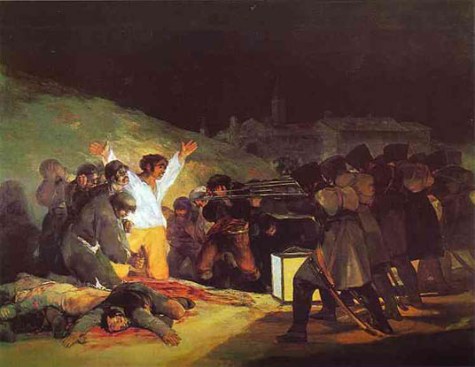
"May 3, 1808: Shooting at Montana del Principe Pio", 1814. Francisco Jose de Goya (1745-1828) Collection of the Prado, Museum, Mardid.

Beaufort West Police Station, South Africa, 2006. © Michael Subotzky
Subotzky warns against referencing for referencing’s sake. (I’ll be vigilant). And, I’ll leave you with the most succinct of Subotzky’s comments:
I don’t think anybody [in photography] has more intelligently related to philosophy or the history of painting then Jeff Wall.
The Subotzky Trajectory has been steep. His photographic conscience and works warrant the worldwide attention they have. He is with Magnum. See his website. And read this and this. Book here. There is an interview over at Conscientious.
Oh, and by the way, no wikipedia page on Mikhael Subotzky, which surprises me.

 Prison Photography