
You are currently browsing the tag archive for the ‘Oregon’ tag.

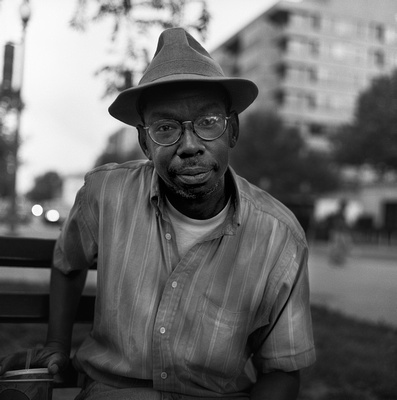
Ward Shortridge makes portraits in Portland and other cities, but mainly in Portland, Oregon where he lives. Ward used to work as a psychiatric social worker. Good portraits often come from the same place as good counselling.
“The best photographs, like the best therapy, occur when I don’t talk too much, when I engage my subjects with unconditional acceptance and love, when I let go of my desire for a particular result and take my direction from the life that is presented to me,” says Ward.
This post is the second in a new series called Eye on PDX. Once a week, I’ll post some images and words by a different photographer working in Portland, the town I now call home. Think global, shoot local.
Ward Shortridge’s website and blog.

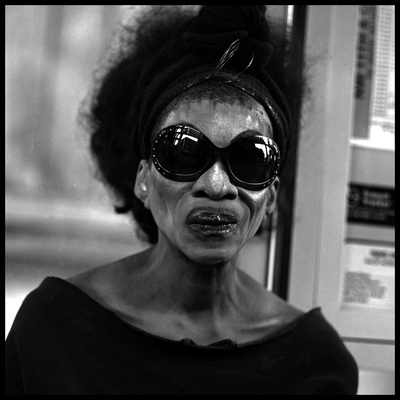



Alabama & Gracen © 2011-12 Bobby Abrahamson
North Portland Polaroids, Bobby Abrahamson
St. John’s is one of the more interesting neighbourhoods in Portland. Geographically isolated from the rest of the city, many people in St. John’s – for the longest time – considered themselves distinct from the rest of the city. That sentiment still remains, but throughout the nineties and early noughties there was an influx of youngsters looking to make home and St. Johns in the historically more blue-collar North Portland afforded the cheapest homes. This isn’t to say that gentrification has taken place – by the standards of other cities, the curious and lovable outpost of St. Johns cradles as much of it’s original modesty and allure to outsiders (me and others like me) than ever before.
Photographer, Bobby Abrahamson, bought a house in St. Johns just over a year ago, but his making of portraits using 5×7 Polaroid film preceded his move into the neighbourhood. North Portland Polaroids is a gentle homage to the photographer’s immediate surroundings and supports the theory that one needn’t travel the earth to make interesting photography.
As well as being acquainted with Bobby and really liking the work, another winning factor is the Portland-based collaborative championing of North Portland Polaroids. It is currently being shown at two stalwarts of the PDX photo-scene – Blue Sky Gallery (downtown) and Ampersand (Alberta Arts District, NE).
Abrahamson was in discussions with Myles Haselhorst at Ampersand about producing a book before a show at Blue Sky was confirmed. When Blue Sky said ‘Yes’, instead of the two venues competing against one another they coordinated their ventures. Ampersand is a bookstore with gallery space and finely curated photobooks and ephemera, whereas Blue Sky is a more traditional gallery space with programming and workshops. In terms of international exposure, Blue Sky is the place in this city, but in terms of making books with local binderies and a keen curatorial eye, Ampersand fits the bill.
Just as Weegee “took over” New York last Fall, now is Abrahamson’s moment in Portland. North Portland Polaroids is of and for this town.
I’d like to hear readers’ suggestions of other keenly local projects that have been embraced by the locals, the subjects. [Comment below, please]
I should take this opportunity to say that living in Portland has worked out very well for me; the photography community here is active but relaxed; intelligent and open. Ampersand, The Grid Project, Lightleak, NewSpace, Blue Sky and Critical Mass/Photolucida are all PDX businesses, non-profits and ragtag bunches of friends with capital in the culture of photography. I digress but perhaps those observations speak to my own fondness for photography in Portland … and as to why I write this post.
LISTEN
Bobby Abrahamson, Julia Dolan (Minor White Curator of Photography curator at the Portland Art Museum) and Myles Haselhorst (Owner, Ampersand) on KBOO Portland Community Radio. Here.
LOOK
BOOK: NORTH PORTLAND POLAROIDS
Buy the book at the Ampersand website.
5 x 7 in.
Perfect bound soft cover
100 pages
46 photographs
Printed on Mohawk Superfine paper
Foreword by Julia Dolan, The Minor White Curator of Photography, Portland Art Museum
Designed & published by Ampersand
Printed & bound in Portland, Oregon
Edition of 150
As you may know, I’ve recently relocated to Portland, Oregon. The Portlandia TV comedy narrative would have you believe this is a town full of loveable counter-culture stereotypes; under-employed dreamers, kombucha-swilling hippies, and coffee-obsessed yoga-rock-climbers, to name a few.
But …
PORTLAND IS NOT PORTLANDIA
It is fair to say that on the West Coast, the tech boom of the nineties – centred on Seattle, San Francisco and Silicon Valley – bypassed Portland. And the joke is that people pursued fire-eating, tattoos and weed instead of HTML and Java-code.
But Portland is not a harmless bubble populated only by self-aware, contented contrarians. Portland has the same problems with failing schools, violence and inequality as many large U.S. cities. Furthermore, the State of Oregon as a whole has seen dwindling public funds for education as measured against its burgeoning law enforcement and corrections budgets.
As a reality check, I’d like to recommend two articles.
Firstly, Our preoccupation with incarceration costs us in education, by Naivasha Dean in Street Roots:
Oregon is one of only a handful of states in the nation that spends more money on prisons than on higher education, a statistic that is often met with dropped jaws by students struggling for financial aid. The Department of Corrections has been one of the fastest growing state agency budgets that is eating up an ever-increasing percentage of the state’s General Fund. This does not bode well for Oregon’s future and represents a deeply misplaced set of priorities and an archaic approach to addressing crime and public safety.
Why is Oregon’s prison spending so out of control? Oregon can trace the trend directly back to 1994, when voters approved Ballot Measure 11. Measure 11 established mandatory minimum sentences for approximately 20 “person-to-person” crimes, and it automatically sends youth charged with any of those crimes, aged 15 and over, directly to adult court. Mandatory minimums are a one-size-fits-all approach to criminal sentencing that prevent judges from using their discretion and prevents Oregon from using smarter approaches to accountability and crime prevention.
Shortly after the passage of Measure 11, Oregon’s governor and legislature approved plans for more than 8,000 new prison beds, including siting for six new prisons. Since then, the legislature has authorized more than $1 billion for prison construction. As anticipated, Oregon’s prison population exploded — from 6,000 inmates in 1995 to more than 14,000 today, and the Department of Corrections budget more than tripled.

Secondly, Portland, the US capital of alternative cool, takes TV parody in good humor, by Paul Harris. This Guardian article, partly, dispels the temptation to get carried away with TV’s version of PDX life:
Portlandia is not the whole picture of life in Portland. Not everyone is white, urbane, child-free and in their 20s, or acting as if they are. In fact the city is 8% black and 9% Hispanic– communities that often live in poorer neighbourhoods that are gentrifying with newcomers who push out long-established families who can no longer afford rents.
Portland also has a problem with gang violence. […] One man who sees this side of Portland close-up is John Canda, founder of gang outreach group Connected. “I personally have been to 358 funerals,” he said of two decades working in the field. Connected, formed last year after a series of shootings, seeks to lessen violence by having volunteers walk the troubled streets, reaching out to Portland’s youth.
“Our message is talk with us. It starts with a greeting,” he said. For Canda, as a native black Portlander, the world of Portlandia and its concerns over recycling and organic food seem unreal. “It is like a parallel universe,” he said.
Graph courtesy of the Prison Policy Initiative.

Cutting a chair and stool. © Gary Walrath. Taken with Pentax ME super.
Two years ago, I found Gary Walrath‘s set of photos from a 1970s Logging Show at Oregon State Prison. They are so unique they don’t really fit into any recognisable discussion … still.
I have also repeatedly tried to contact Gary about the background to the series. No luck. So, I simply provide a couple of images, a link and some bemusement at the spectacle of axes and chainsaws within prison walls.
Gary is a busy amateur photographer and a seven times chainsaw World Champion, in the Un-limited Hotsaw Class. His weapon? The Iron Horse.
‘The Iron Horse – 90 hp 500cc Husqvarna Motorcycle Engine. Running Oregon 1/2 pitch chain on a 36″ custom made guide bar. The drive sprocket is 16 tooth. Over 8,000 RPM in the cut.’ (Source)
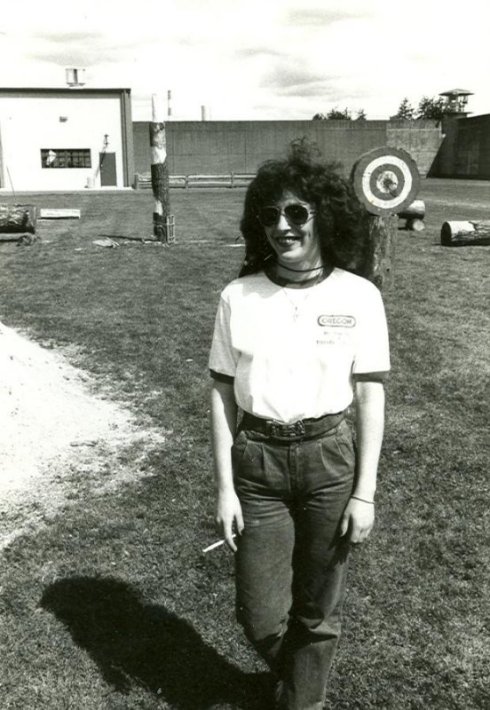
Ronda (she drove the prisoners nuts). © Gary Walrath. Taken with Pentax ME super.

 Prison Photography