
You are currently browsing the tag archive for the ‘Prison’ tag.
Prison populations around the world have much in common. They are virtually always dominated by poor, uneducated, unemployed young men, often from minority groups. Indigenous groups are also over-represented. For example, in New Zealand 45% of inmates are Maori, although they comprise only 14% of the national population (Stern 1998:32-33). In Australia, aborigines are more than nine times more likely to be arrested, more than six times more likely to be imprisoned, and 23 times more likely to be imprisoned as juveniles (Broadhurst 1997: 410).
In the US, African Americans form 12.7% of the population but make up 48.2% of adults in prison. Hispanics constitute 11.1% of the national population but form 18.6% of the prison population. Native Americans are less than 1.0% of the population, but 4.0% of adults in this group are incarcerated. This holds true for Canada, where indigenous women make up only 3% of females in the country, but comprise 29% of the female prison population.
Source: Human Rights in African Prisons, Sarkin, Jeremy (ed.) Page 8
If you ever needed a reason to question America’s prison system, the Daily Kos gives you dozens …
… and then some.

© 1989 A.G. Reinhold, 14 Fresh Pond Place, Cambridge, MA 02138. K2PNK "May be freely distributed with attribution."
Recently, I’ve been floored by the quality of writing and fresh analysis springing forth from the biospheroblog:
PRISONS
Sara Mayeux, a relative newbie over at the Prison Law Blog has been busy her first two months. Lots of serious stuff but it was Sara’s reminder that Lil Wayne goes to Rikers in two weeks that held my attention.
“Lil Wayne was supposed to head to Rikers earlier this month, but got his sentencing postponed to accommodate an oral surgery appointment; his new court date is March 2. I’m always curious about what, if any, effect celebrity prison stints such as this will have upon the national dialogue about mass incarceration.”
I think the circus surrounding Lil Wayne’s stint will further obscure the facts of a broken system. If it gets millions of Americans talking, I suspect it’ll be the wrong talk.
Everybody should have Grits For Breakfast in their RSS reader.
Radley Balko on the significance of a milestone exoneration for the Innocence Project:
“These 250 DNA exonerations aren’t proof that the system is working. They’re a wake-up call that it isn’t. Instead of falling back on groups like the Innocence Project to serve as unofficial checks against wrongful convictions, lawmakers, judges, and law enforcement officials should be looking at why there’s so much work for these organizations in the first place.”
PHOTOGRAPHY
The Spinning Head, pulls no punches, especially when talking about photography in Haiti. Rafiqui’s long-form posts are worth their weight in word-count.
I don’t know where Peter Marshall gets the energy to photograph seemingly every protest in the Greater London area, post the images and then offer an editorial for each event! Over at >Re:PHOTO
I found Simon Sticker‘s writing first via A Developing Story swiftly followed by his photography and Ugandan workshops WITH OUR OWN EYES via his site Flow Media
The Visual Student, courtesy of the NPPA, doesn’t waste anyone’s time. The site has filled a much-needed niche offering students advice and most importantly encouragement from other students/recent grads. None of it is patronising and the interviews and showcases are quality. For proof see: Scott Brauer, Dominic Nahr, Kathryn Cook and Alex Welsh. They also announce important stuff like the recent NPPF $16,500 worth of scholarships.
Of course, we are all intrigued by the Hulin’s new aggregation-toy The Photography Post.
JOURNALISM
Charlie Beckett has been coaxing us back to the hard questions about the nature of photojournalism and media coverage. Necessarily, he’s looking at Haiti (Part one & part two).

Chris Jordan. Prison Uniforms, 2007. Installed at the Von Lintel Gallery, NY, June 2007.
Chris Jordan‘s populist brand of socio-enviro-photography deserves our respect. The skills necessary to direct (what I presume) is a team to composite his images, is small fries compared to his ability to sell his brand. He brings to surface issues as varied as breast augmentation for teenagers, deaths by smoking, prescription drug overdoses and airline plastic cup wastage.
Jordan argues that all these issues are tied together by our collective denial and connected by our search for a global view obscured by the massive numbers (billions, trillions) which we cannot realistically fathom. Jordan reckons his illustrations help us feel, and thus have us consider and alter own behaviours.
Critics would say that Jordan plucks issues at will, and given their variance, he might just be a fraud. Aren’t we supposed to specialise in our advocacy? Don’t we pick one topic?
I’d be sympathetic to this view if I thought Jordan was picking the latest cause célèbre, but he isn’t. Jordan represented the 2.3million US prisoners with 2.3million prison uniforms (I discussed this before).
Prison reform has never been sexy. Prisoners rights are rarely considered and that is because many of us suspend our emotions toward those put behind bars. Heck, even rape is considered humorous when it is put in a prison setting.
Whatever your take on Jordan’s craft and motives, his research and discussion of issues is passionately informed. For me, most of the time Jordan trumps my cynical view that he’s just selling a cute visual idea.

The closing two minutes of this well-circulated TEDtalk is convincing enough. Yet, I’d forgive people who thought of him as a sellout.
Jordan’s assertion that US citizens are in denial about their prison system is dead on.
Thanks to Stephen Sidlo for the reminder of Jordan’s work.


There are prisons and there are jails. The two differ.
Prisons are where sentenced offenders get sent after trial, and they are run by the state.
Jails are where offenders go before trial, and they are run by the county. All offenders, at least for a short while, will go to jail and get booked. If they can post bail they’re out until court date. If they can’t afford it, they remain until their day in court … which can sometimes be many, many months. (It should be said, some short-term sentences are served in local jails).

Across the street from the county jail in Lubbock, Texas, is a row of one-story offices housing Lubbock's bond companies. There are about a dozen bail bond companies in this city of 250,000. © Katie Hayes for NPR
THE BAIL BOND INDUSTRY
Last week, Laura Sullivan‘s sterling three-part report on the US’ broken bail system ran on NPR. Sullivan writes it LARGE: Money rules; the bond system is simple market capitalism. It favours the rich and punishes the poor.
Research shows that those who post bail serve less time post-trial. This is for many reasons, but mainly because once released, the accused can prove to the court (between arrest and trial) that they can stay straight; hold down a job; and publicly respond to their transgression in a socially-agreeable manner, in other words, attempt whatever is necessary to please the court.
However, there are half-a-million people locked-up in US jails either waiting or unable to pay bail. This is more criminal than any act these half-a-million may have committed. REMEMBER: Bail is not granted to violent or dangerous suspects, and the majority of those jailed are non-violent criminals usually for a small-victimless crimes (minor traffic infraction, petty theft).
Amounts differ to post bail differ, sometimes being as low as $50 (that’s a $10 down-payment to a bondsmen on a $500 bail).
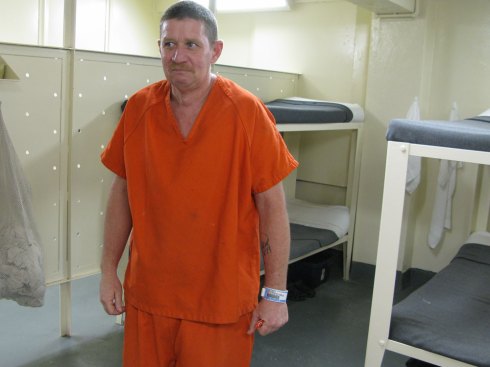
Leslie Chew, in Lubbock County Jail for theft, said his $3,500 bail was "like a million dollars to me." © Laura Sullivan for NPR
The result is that cases such as Leslie Chew’s cost the tax payer over $7,000 for 185 days of incarceration … all because he couldn’t afford the $350 down-payment for bail. His crime? Stealing $120 worth of blankets because he was suffering the cold sleeping in the back of his station wagon.
Chew is typical of many stuck in the system. But the system has alternatives. Offenders could be released on trust (a practice that used to be common) and expected to show up for court OR they could be part of pre-trial release programs using probation officers and tagging technology.
Pre-tirla release programs cost only between $2-$7/day. Compare that to $38-$115/day to house an inmate. Statistics have shown pre-trial release programs effective and offenders show up for court as regularly as those on bail.
In total the broken bail bond system costs US tax-payers $9billion/year!
WHY DOES A BROKEN SYSTEM PERSIST? WHAT ABOUT THE ALTERNATIVES?
NPR describes, ‘Ken Herzog, manager of Trammel’s Lubbock Bail Bond for over 25 years, sees an average of six people a day who need to be bonded out of jail. His bonding company currently has between 2,500 and 3,000 active accounts.’ Because they cannot secure new accounts, the bail bond industry sees pre-trial release programs as direct completion. Bail-bondsmen have organised strong lobbying groups in counties where alternative pre-trial release programs were in use.
As an example, Sullivan points to Broward County, Florida:
Bail bonding became political in Broward [and] sent shock waves through pretrial programs across the country. Here in Broward, bondsmen pushed hard for a new county ordinance that now limits the pretrial program. Now industry experts say powerful bail lobbying groups have begun using Broward as a road map of how to squash similar programs elsewhere, even though public records show the programs have saved taxpayers millions of dollars.
This gutting was all the more catastrophic because the pre-trial release program was so successful. It alleviated jail overcrowding that was deemed by a judge as unconstitutional.
Instead of building a new $70 million jail as they had proposed, county commissioners voted to expand pre-trial release, letting more inmates out on supervised release. Within a year, the jail population plunged, so much so that the sheriff closed an entire wing. It saved taxpayers $20 million a year.
And, according to court records, the defendants were still showing up for court.
“DON’T PISS ON ME AND TELL ME IT’S RAINING”
The Broward ordinance passed and, in so doing, slashed the number of defendants eligible for the pre-trial release program by hundreds.
Who, they wondered, could possibly be against a demonstrably successful program? Follow the money:
In Broward County, 135 bail bondsmen amassed and hired a lobbyist, Rob Book:
“To be perfectly arrogant about it, I’m considered if not the best, [then] one of the best in the state,” says Book. He has been lobbying for bondsmen in Florida for more than a decade.
According to campaign records, Book and the rest of Broward’s bondsmen spread almost $23,000 across the council in the year before the bill was passed. Fifteen bondsmen cut checks worth more than $5,000 to commissioner and now-county Mayor Ken Keechl just five days before the vote.
EDITORIAL: THE UNITED STATES OF CORRUPTION
Sometimes, I am carefully worded. I work with prisoners, correctional officers, DoC administrative staff and activists weekly – I must be diplomatic.
But I have no care for the bail-bond business nor the corrupt bondsmen and bought politicians of Broward County, Florida.
Their system is self-serving. It does nothing to protect NOR serve. It is overly punitive. The bondsmen are hacks and the politicians they bought are contemptible.
I hope that the backhanded decision-making in Broward is not typical, but I fear it is not isolated. Selfish, zealous systems such as those Laura Sullivan exposed are ruled by revenge, fear-emotion and profit.
The bail-bond system of America is on this evidence devoid of progressive policy. And, when a small light of common sense policy rears its head based on solid figures and a reduced bottom-line, still well-heeled and big-footed buffoons can kick it all to shit.
DISPICABLE.
THE FULL ROSTER
Part One: Bail Burden Keeps U.S. Jails Stuffed With Inmates
Part Two: Inmates Who Can’t Make Bail Face Stark Options
Part Three: Bondsman Lobby Targets Pretrial Release Programs
All brought to you by Laura Sullivan
Thanks to Jim Johnson for alerting me on this.

 Prison Photography