
You are currently browsing the monthly archive for March 2009.

Woman in cell, playing solitaire. ca. 1950. Nickolas Muray. Transparency, chromogenic development (Kodachrome) process. George Eastman House Collection - Accession # 1983:0567:0151
I was blown away last month when the indicommons feed landed Nickolas Muray’s colour commercial photography on my desktop. Muray’s commercial work is fresh, witty, a sock in the eye and an all round feast of fun. The fact I haven’t any knowledge ofi the advertised products makes my enjoyment all the more visuocentric and naive. And that’s okay … every so often.
Pop music sprouted in the fifties, right about when this image was taken. I have Alma Cogan playing in my mind as I browse Muray’s commercial kodachrome prints. Visually, Woman in Cell, Playing Solitaire is an alterworld mash-up of Jehad Nga and Edward Hopper. Don’t you just dig those colours? None of the psychological edge though; the lady, despite being locked up, hardly looks harassed or without hope. Rather, she looks bored.
To continue the fest of technicolour, let me include the image below. Admittedly, it stretches the theoretical parameters of this blog but I would argue the subject is relevant. Depicted is the harsh subjugation of fowl to sites of incarceration – evidenced by the chicken wire and possibly even the girl’s well-disguised, maniacal grasp of the hat!

American Cyanamid Girl with Straw Hat Full of Chicks, 1947. Nickolas Muray. Color print, Assembly (Carbro) Process. George Eastman House. Accession # 1971:0048:0017.
To end on a serious note, I knew of the exceptional George Eastman House collection, but was frequently frustrated by the archaic platform of its website. Browsing was not fun. To GEH’s credit they recognised this enfeeblement and avidly committed important works to the Flickr Commons project. Kudos to them. We are all the better for it! I am just happy an image came along with vaguely carceral imagery, providing me an excuse to share.
_________________________________________
Nickolas Muray (American, b. Hungary, 1892-1965) immigrated to the United States in 1913, working first as a printer and then opening a photographic portrait studio in Greenwich Village in 1920. He became well known for his celebrity portraits, publishing them regularly in Harper’s Bazaar, Vanity Fair, Vogue, Ladies’ Home Journal, and The New York Times. After 1930, Muray turned away from celebrity and theatrical portraiture, and became a pioneering commercial photographer, famous for establishing many of the conventions of color advertising. He is considered the master of the three-color carbro process. Muray’s portraits of Frida Kahlo are well known and well-loved.
While not related to the work of a single photographer or project, the lines of argument proffered by Subtopia are so resonant that Prison Photograph Blog feels the diversion justified. Through summary of the four chosen articles, we can gaze upon the complexity and omnipotence of incarceration in our frantic, contested global society. Subtopia’s images will knock you on your arse!
The analysis of Bryan Finoki at Subtopia consistently join the dots between geopolitics & biopolitics; movement & paralysis; spatial theory and spatial reality. Unsurprisingly, for a writer in the 21st century, his interest in the production of structures & networks, often leads him to theories of militarised space.
I am in awe of Subtopia’s output. From lengthy and comprehensive issue-based summaries; to purposed surveys; from fine image-editing; to diverse links and sources in each post. Finoki serves up rigorous analysis, or entertainment, but usually both.

© 2009 Subtopia/Brian Finoki
Over the past couple of years Finoki has submitted a few pieces on “The Prison”. Subtopia’s preoccupation with power and spatial production means carceral sites/archipelagos are referenced frequently. Finoki has been keen to unravel the mysteries of the Global War on Terror (GWOT), its structures and its legacies – this always means dealing with detention, rendition, and construction (that can be visible, but more often invisible.)
Article One – Fantasy Prison is a meditation on potential prison architectures spurred by the 2007 Creative Prison project a collaboration between architect Will Alsop prisoners at HMP Gartree to redesign corrective and rehabilitative space. Two things struck me about the suggestions made by prisoners. 1) They were most afraid of attack from other inmates, and therefore an option to lock themselves IN was a shared high priority, and 2) They wanted to include a designated photo-room within the visitors center to allow for photography and variant backgrounds. I have posted before about manifestly curious prison-polaroid aesthetic. This article also threw up the crucial social responsibilities of architects & designers in a time of prison expansion, most notably the Prison Design Boycott launched in 2004 by the group Architects/Designers/Planners for Social Responsibility (ADPSR).
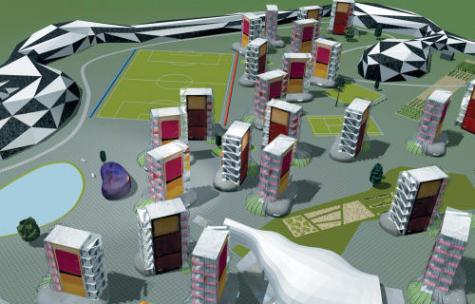
A rendering of Will Alsop’s new corrections landscape, developed in collaboration with prisoners, resembles a cross between Communist-era housing blocs and a series of South Beach condos. Courtesy Alsop Architects
I have been a fan of Alsop’s work since his 2005 hypothetical SuperCity project which would subsume my hometown in the North.
Article Two – Floating Prisons is a historical survey of sea-faring, carceral solutions by warring and colonising nations. Finoki maps the use of prison ships from 18th & 19th century economic necessity to transport human cargo to contemporary manoeuvrings in avoidance of international law. He makes reference to the convenience use of islands as sites of detention, the use of ships as temporary housing in leiu of land locked sites, and the dubious experiments in swapping refugees held in off-shore camps. The summary was to say that new legal definitions and controls are creeping in giving one the sense, “refugees and migrants are just an excess of biomass to be herded around on prison islands or in prison vessels, traded like geo-economic commodities, removed and disposed of like capitalist human waste, reinforcing the state of exception that goes on re-organizing the architectural spheres of global migration.” Phenomenal.

The Vernon C. Bain is a prison barge operated by the City of New York, housing 800 prisoners in a medium and maximum security facility. Built in 1992 at a cost of $ 161 Million means it would have been cheaper to send the inmates to Harvard instead. (Source)
Article Three – “Block D” enters the Pantheon of GWOT Space is a meditation on the totality of restricted space across the globe – in multiple nations – in order to sustain military operations. The point of the survey (which includes previously known sites such as Guantanamo, Baghdad’s ‘Green Zone’, Bagram Theater Internment Facility, US homeland immigrant detention facilities, and Taxi networks for rendition) is to add another site to the list: “Block D” in Pul-e-Charki Prison just east of Kabul, Afghanistan.
With persistent references to journalists’ work for the BBC, New York Times and Washington Post, Finoki summarises, ” ‘Block D’ or ‘Block 4’ as it is also apparently known: a newly built detention facility [is] quickly becoming understood as the Asian corollary of Guantánamo Bay. No matter, it is another utterly disturbing black hole in the universe of legally suspect and secret space.” Finoki doesn’t focus on the conditions of detention but rather America’s self-created legal imbroglio.
Nearly a year after writing, this analysis seems prophetic now, as the American public is slowly coming to realise that Obama’s closure of Gitmo doesn’t necessarily magic away the human rights issues … only shifts them somewhere slightly more obscured. As with Gitmo, one expects Block D to focus the new rounds of jousting between the same ideological stakeholders.
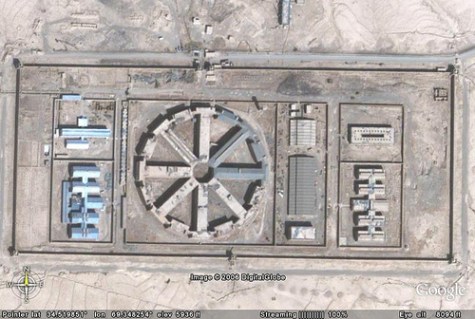
Pul-e-Charkhi prison, Kabul, Afghanistan. Construction began in the 1970s by order of then-president Mohammed Daoud Khan and was completed during the Soviet invasion (1979-89). The prison was notorious for torture and abuses under the control of Afghanistan's communist government following the invasion by the Soviet Union. (Source)
Article Four – The Spatial Instrumentality of Torture is a stomach-pounding dose of reality in the form of an interview with Tom Hilde, Research Professor in the School of Public Policy at the University of Maryland. I will not offer a synopsis, just encourage you to read through it. The interview is illustrated in part by Prison Photography‘s favourite Richard Ross.
Hilde ends with the sobering words, “The secrecy of much of the US torture program, its physical spaces, and its extent has certainly kept public debate rather subdued. But I think the dualistic moral framework has been even more corrosive of a public understanding of torture in general and the consequences of American torture in particular. When a majority of Americans say that torture is acceptable for some purposes, I think they have the fantasy of the ticking timebomb, and likely racism in many cases, in the backs of their minds.”

Camp X-Ray, Guantánamo, Cuba. The facility has not been used since early 2002, and recent heavy rains at Guantánamo Bay have brought about overgrowth. Credit: Kathleen T. Rhem
Kevin Van Aelst for The New York Times
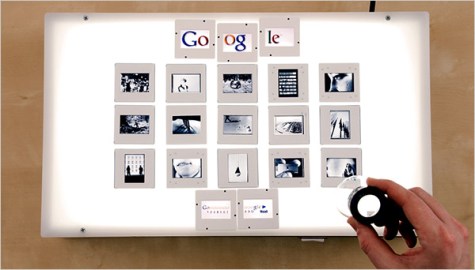
I posted about Google’s collaboration with LIFE Magazine a few months ago. I – like many folk – were excited to dig in, ferret about and generally enjoy the visual culture of decades past. It seems the novelty has worn off for some. An excellent diatribe, Photo Negative, in the New York Times last week made the point succinctly.
“When Google first announced on its blog that the Life archive was up, it seemed like another Google good deed: rescuing the name of Life magazine and the glorious 20th-century tradition of still photojournalism. But Google has failed to recognize that it can’t publish content under its imprint without also creating content of some kind: smart, reported captions; new and good-looking slide-show software; interstitial material that connects disparate photos; robust thematic and topical organization. All this stuff is content, and it requires writers, reporters, designers and curators. Instead, the company’s curatorial imperative, as usual, is merely ‘make it available’.”
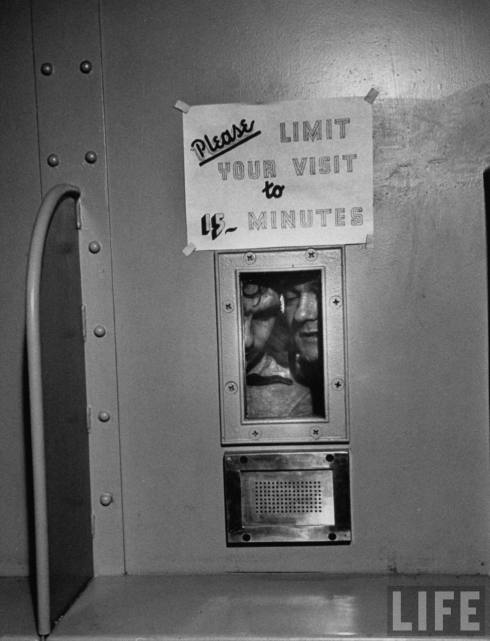
Prisoners watching baptism of repentant killer, in Harris County jail, TX, US. March 1954. Credit: John Dominis. ©2008 Google
With little in the platform or functionality to inspire users, Google could find visitors’ perusal time shrinking. Users might face unavoidable limits to their search time and patience. 15 minutes?
I don’t want to get into the habit of posting on cases of police corruption, police brutality, or correctional officer misconduct.
I don’t want to do this for three reasons:
1. It distracts me, and you the reader, from digesting content directly related to photography and its praxis.
2. Many other regional, national and international newsrooms will cover these stories – as a matter of course – more thoroughly than I.
And 3. Despite their shared “peace officer” status, cops and screws are cut from a different cloth. It would be wrong of me to carelessly blur the activities of one disciplinary group with another. Police and correctional officers share minimal operational relation to one another.
So, I don’t wish to obfuscate the reader/viewer. However, the video below leaves no confusion in anyone’s mind.
The spokesperson in the video relayed the official words of an authority under investigation, but one feels even he could barely stomach the truth here. Where some videos are subject to interpretation – and consequently endless courtroom debate – there can be no doubt here. The officer lost his head and unleashed upon this young girl. He’s a thug, just like a guy fist fighting on the street is a thug.
As some of you may know, I have recently transplanted to Seattle. Occasionally, one witnesses acts of rote police procedure in place of common sense, but by and large, the cops on the streets here (as in my former home of San Francisco) are a friendly bunch on bikes and skates.
I am saddened such a horrendous beating should take place in my new hometown … which is why I have made an exception to my rule here.
Unfortunately, this brutal lashing occurred in the same month that Seattle police chief Gil Kerlikowske was selected by Obama to be America’s next Drug Czar. Seattleites have voiced varied opinions regarding this appointment, but secretly they are all really chuffed. It is a proud moment for Seattle residents, not least, because Kerlikowske – even as a police chief – shares some majority views of the citizenry. Kerlikowske adopted a common sense approach to urban policing by making marijuana infractions the lowest priority of his force in order to redirect resources to more serious matters … matters of violence. The Stranger, Seattle’s favourite free rag offers four wildly different but well-informed opinions on Kerlikowske’s appointment.
_______________________________________
Seattle lost an age-old institution recently. The Seattle Post Intelligencer, like the Rocky Mountain News and San Francisco Chronicle has had its day. I am not sad because I believe newspapers have unending rights or high position in urban comunities because I don’t – I am excited by new media and its different forms of creation and distribution. I am upset because it was the liberal leaning paper in this two paper town. That leaves the Seattle Times, which is very mediocre. If you are intent on getting good journalism in print pick up the San Jose Mercury Times. Crap city, great newspaper!

 Prison Photography