
You are currently browsing the monthly archive for March 2009.
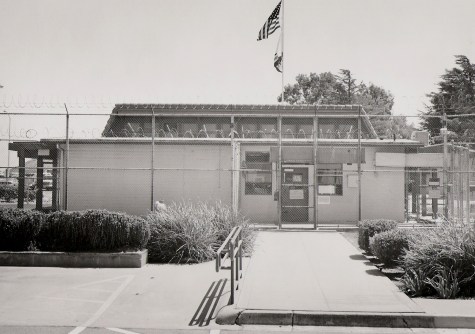
Deuel Vocational Institution, California. © 2009 Robert Walsh
Predictably, my partner is my first critic and supporter. Often distilling my whirling thoughts, she’ll draw some coherence from my arguments. I asked her to look over the photography of Robert Walsh. He had submitted his work via email. She pointed out that three of his images bore striking resemblance to school environments. I can only agree.
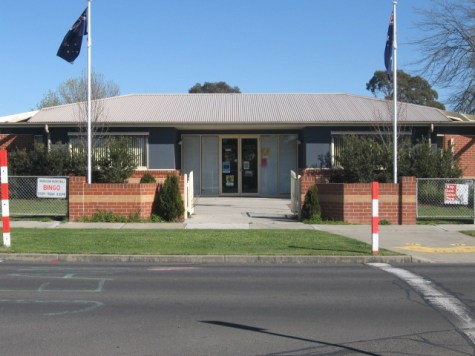
School
Of course, this is not a novel notion and philosophers have, for decades, had a field day dissecting and bisecting institutional architectural forms. I’ll add this quick post to the heap of rhetoric and swagger.
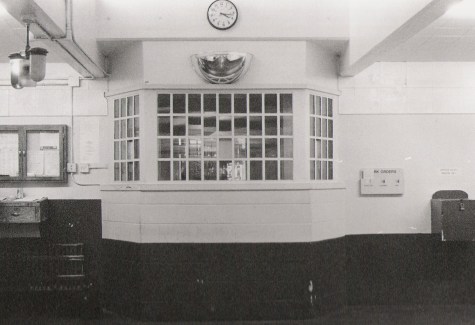
Deuel Vocational Institution, California. © 2009 Robert Walsh

Mill Creek Middle School secretary Jane Crum works beside the new buzz-in system that was installed for safety purposes at the school. Press Photo/Emily Zoladz
Maybe worth returning to would be Richard Ross‘ work. He pin-pointed the many shared criteria in institutional architectures of authority. His prints are pristine and his visual evidence compelling.

Deuel Vocational Institution, California. © 2009 Robert Walsh

School Buses in Yard
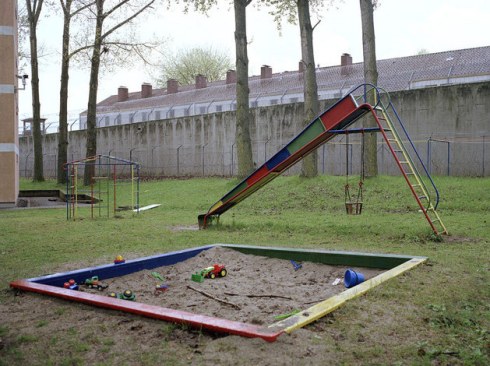
In Germany, as in most European nations, prisons often lie within towns and cities; European prisons & jails are older than the housing estates and urban developments that, ultimately, came to surround them.
In Britain, castle-like Victorian-era prisons were the dominant type until the seventies when they were replaced by draft-proof, medium-sized institutions in rural locations. Bricks and mortar made way for concrete & razor wire. That said, a few town-centre “citadels” such as Preston Prison and Lancaster Castle still operate within Her Majesty’s Prison Service, the latter dating back to the 14th century!

In the American penal landscape, a high proportion of prisons (and all new builds) are outside of conurbations – sometimes isolated in the mountains or desert, sometimes just within grasp of a rural town to prop or establish a local economy.
Christiane Feser‘s photographs could not be mistaken as American, just as the New Topographics couldn’t be mistaken for anything but American. I don’t want to say Feser’s series Prisons is typically German, because I don’t know what that means. Instead, I will say it is typically Northern European. Feser’s photographs embody the spirit of pedantic spatial ordering which I have observed not only in Britain and Germany, but also Austria and the Netherlands.
We don’t know the specific locations of these prisons so we can not know the construction dates. Given the carceral/residential interplay we can say that if Feser’s images aren’t about the zoning of space, they are about a time before zoning dominated civic-planning.

“When I photographed the prisons I was interested in how these prison walls are embedded in the neighbourhoods,” said Ms. Feser via email. “How the neighbours live with the walls. There are different strategies. Its a little bit complicated for me to write about it in English …” Feser’s images do the talking.
Feser’s world is one of silence, order and manicured nature. Her images evince a harmony between the prison, its neighbours and vice-versa. We witness no trauma here.

Feser has obviously decided to omit humans from her compositions. The neighbourhoods are well tended and so presumably inhabited. One presumes the neighbourhoods are occupied daily, and yet we see no cars in driveways nor bikes on the street. Feser almost suspends belief. Are these actual places? Is this a toy-town?
Why does Feser rely on manicured topiary and brick pointing of the absent inhabitants to illustrate the “different strategies”? Is Feser suggesting a common psychology between prisoners and residents?
Have the neighbours adopted psychologies of seclusion and discipline as exist in the prison next door? Can penal strategies of control transfer by osmosis through prison walls and throughout a community? Or are certain personalities attracted to these new build estates? Are a portion of these homes reserved for prison staff? Or has Feser’s clever framing and omissions just led the viewer along these lines of inquiry?
Many would think in this peculiar carceral/residential inter-relationship the prison dominates, overbears. I doubt it. I contend those who live in such locales influence the institution also. The two agents in this relationship aren’t separate; they are drawn to one another and they overlap.
Feser uses visual devices to point toward this overlap. Angles of the oblique walls, dead ends, tended verges and brown-toned brickwork repeat through the series; sometimes these elements are part of prison fabric, sometimes part of a house.
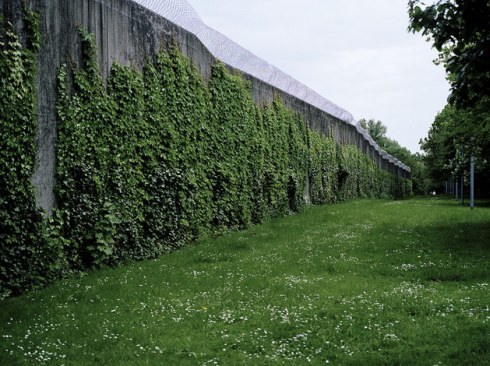
There exists no hierarchical coda in Feser’s images as all the surfaces are equal. One has to pay attention to figure out which architecture is carceral, and which is not. Even the barbed wire doesn’t confirm it totally as (in England at least) one commonly sees barbed wire and glass shards lining the walls of merchant-yards and back alleys.
Feser’s photographs cradle a palette of grey concrete & skies; dense greens and the browns of brick & mortar. This is Germany, but it could as easily be Lancashire housing estates, Merseyside new towns or the reclaimed industrial sites of Scottish cities.

So how about it America? You are the land of the suburb and subdivision. You may not be familiar with a socio-spatial history that favours the awkward in-fill of urban and semi-urban space over the encroachment on to undeveloped land. It’s alright. Prisons needn’t be invisible and we needn’t be afraid. Locks and keys work as well on your street as they do in up-state, high-pain, back-water seclusion!
The location of prisons matters because when prisoners are sent to facilities on the other side of the state, families are likely to visit less. The commitment of time and money required to make such a lengthy trip usually precludes the poorest families from the essential and simple act of visiting a loved one. Research has shown the largest single factor in a prisoner successfully reentering society and not re-offending is the maintenance of family ties and the continued support it provides.


All images © Christiane Feser. Used with permission.

Capt. H.D. Smith of SUCCESS, Date Unknown. Glass negative. George Grantham Bain Collection (Library of Congress). Call Number: LC-B2- 2611-3
A couple of weeks ago I gave a nod to subtopia’s article on Floating Prisons. This is a topic that gets more meaty the more contemporary the examples become. The intrigue levels reach new heights when the 21st century, nautico-military gun-vessels are spear shaped, warp radar detection and travel quicker than your average barracuda. Concomitantly, the further back one ventures, prison ships are mired in the shameful times of slavery and the dirty deeds of colonial conquest.
There is a period between these two paradigms, when American authority locked up American pioneers on prison hulks. When the western expansion became western settlement, predominantly centered about San Francisco, the authority of the time needed a “bulk” solution to the settling and incorrigible population. The quickest solution to the quickest lawlessness on the continent was the prison ship.
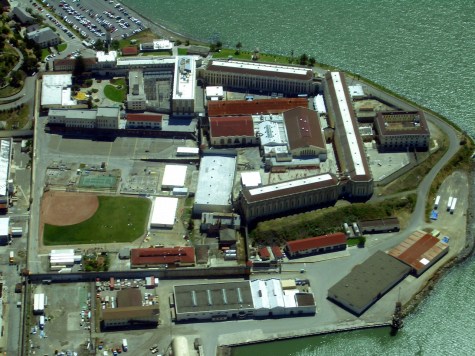
San Quentin Prison. Image: Telstar Logistics (Source)
In 1851, the first prison on the west coast of America was established at Point San Quentin, but when it was established it was not bricks and mortar but beams and gulleys. The Waban, a 268-ton wooden ship, anchored in San Francisco Bay, was outfitted to hold 30 inmates. Subsequently, inmates who were housed on The Waban constructed San Quentin which opened in 1852 with 68 inmates. Unfortunately, I could find no images of The Waban.
I think it is interesting that a “prison-as-terminal” was immediately necessary when humans reached the edge of a continent. San Quentin prison replaced the archipelago of local jails across America as a permanent and expanding facility – the final stopping point for California’s early lawless contingent.
It is poetic that the first penological-structure chosen (based on practical needs) was one that straddled land and water; permanently moored, but temporary in its utility. Carceral use demotes the ship to ‘container’ and The Waban, like its inhabitants, entered its demise.
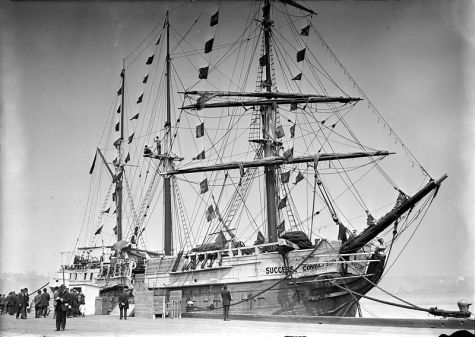
Success convict ship, no date recorded. Image: Library of Congress
Anyway, just to prove its not all bad news for prison ships, above is one of the most famous. Success was reincarnated as a global museum traveling the world purportedly as a museum demonstrating the transportation horrors of the British Empire.
Here’s the skinny, “Constructed in built in Natmoo, Tenasserim, Burma in 1840. sold to London owners and made three voyages with emigrants to Australia during the 1840s. On 31 May 1852 the Success arrived at Melbourne with emigrants, and the crew deserted to the gold-fields, this being the height of the Victorian gold rush. Due to an increase in crime, prisons were overflowing and the Government of Victoria purchased large sailing ships to be employed as prison hulks. These included the Success, Deborah, Sacramento and President.
“When no longer needed as a prison ship as such, the Success was used as a detention vessel for runaway seamen and later as an explosives hulk.
“When the Victorian Government decided to sell the last of its redundant hulks, Success was purchased by a group of entrepreneurs to be refitted as a museum ship to travel the world advertising the perceived horrors of the convict era. Although never a convict ship, the Success was billed as one, her earlier history being amalgamated with those other ships of the same name including HMS Success that had been used in the original European settlement of Western Australia.
“A former prisoner, bushranger Harry Power, was employed as a guide. The initial display in Sydney was not a commercial success, and the vessel was laid up and sank at her moorings in 1892. She was then sold to a second group with more ambitious plans.
“After a thorough refit the Success toured Australian ports and then headed for England, arriving at Dungeness on 12 September 1895 and was exhibited in many ports over several years. In 1912 she crossed the Atlantic and spent more than two decades doing the same thing around the eastern seaboard of the United States of America and later in ports on the Great Lakes.
“The Success fell into disrepair during the late 1930s and was destroyed by fire at Lake Erie Cove, Cleveland, Ohio, while being dismantled for her teak on 4 July 1946. (Source)
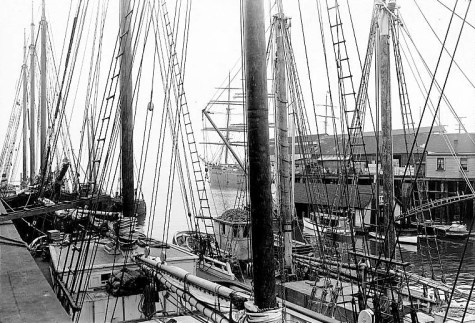
Prison ship SUCCESS, Seattle, 1915. Photographer Unknown. Image: University of Washington Digital Archives
The Success passed through the Panama Canal and spent 1915/1916 on the Pacific Coast. She drew huge crowds in Seattle. I found the image above at the University of Washington Archives, which was my main reason for constructing this post. Success also docked in Tacoma in 1916.
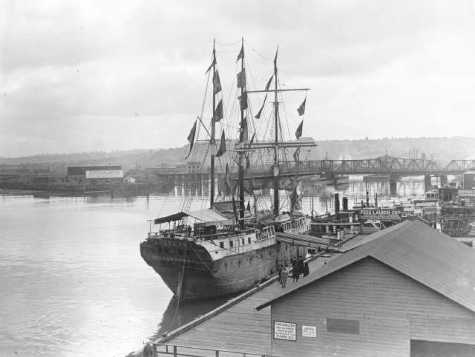
Around 1916, the exhibition prison ship "Success," from Melbourne Australia, was docked at the Tacoma Municipal Dock Landing and open for tours. Marvin D. Boland Collection, Tacoma Public Library. Series: G50.1-103 (Unique: 31555) (Source)
I guess I just like the fact the Success was repurposed so many times and for a long period of time was a museum to the macabre. Some commentators were bothered by Roger Cremers recent World Press Photo win in the “Arts & Entertainment” category for his photographs of Auschwitz tourists. I guess ‘Dark Tourism’, or Thanatourism, has always existed. 21st century generations may not be as perverse as we perceive.
__________________________________________
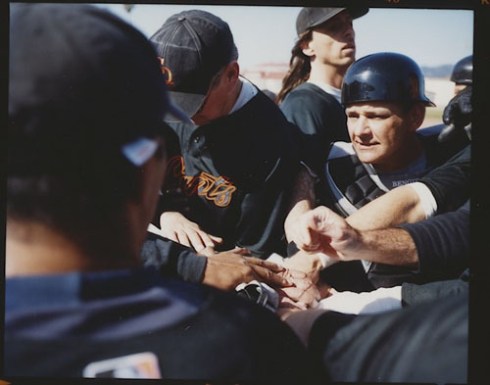
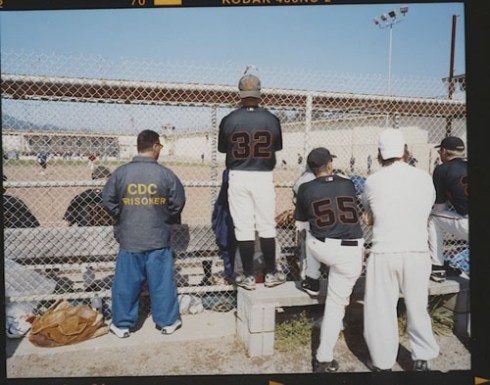
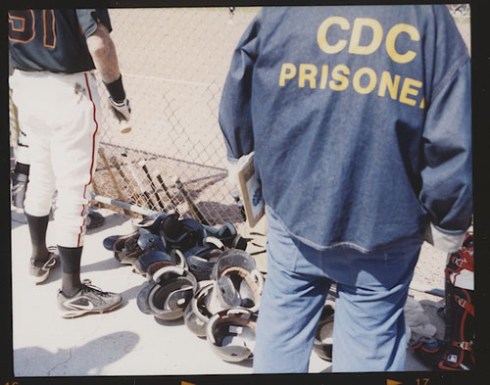
Last week, I threw up a quick post featuring Emiliano Granado’s website images of his photographs of the San Quentin Giants. Here, Granado shares previously unpublished contact sheet images, his experiences and lasting thoughts from working within one of America’s most notorious prisons.


What compelled you to travel across the US to photograph the story at San Quentin?
This was actually a magazine assignment for Mass Appeal Magazine. However, the TOTAL budget was $300, so it really turns out to be a personal project after the film, travel expenses, etc. So, the simple answer to the question is that I’m a photographer. I’m curious by nature. Part of the reason I’m a photographer is to study the world around me. I like to think of myself as a social scientist, except I don’t have any scientific method of measuring things, just a photograph as a document.
With that in mind, it would be crazy of me to NOT go to San Quentin! I’d never been in a correctional institution but I’ve always been fascinated by them. If you look through my Tivo, you’ll see shows like COPS, Locked Up, Gangland, etc. I was also a Psychology major in college and remember being blown away by Zimbardo’s prison experiment and other studies. Basically, it was an opportunity to see in real life a lot of what I’d seen on TV or read in books. And as a bonus, I was allowed to photograph.

What procedures did you need to go through in order to gain access?
I was amazed at the lack of procedure. The writer for the story had been in touch with the San Quentin public relations people, but that was it. There was plenty of other media there that day. It was opening day of the season, so I guess it made for a minor local news story.
I’m pretty sure SQ prides itself in being so open and showcasing what a different approach to “reform” looks like.
It is my opinion that San Quentin is one of the best-equipped prisons in California to deal with a variety of visitors. Did you find this the case?
Definitely. Access was very easy. They barely searched my equipment! Parking was easy. I was really surprised at how easy and smooth the process was. Not to mention there were many other visitors that day (an entire baseball team, more media, local residents playing tennis with inmates, etc).

Did your preparation or process differ due to the unique location?
Definitely. I usually work with a photo assistant and that couldn’t be coordinated, so I was by myself. I packed as lightly as I could and prepared myself for a fast, chaotic shoot. Some shoots are slow and methodical, and others are pure chaos. I knew this would be the latter.
One thing I didn’t think about was my outfit. SQ inmates dress in denim, so visitors aren’t allowed to wear denim. Of course, I was wearing jeans. The officers gave me a pair of green pajama pants. I’m glad they are ready for that kind of situation.
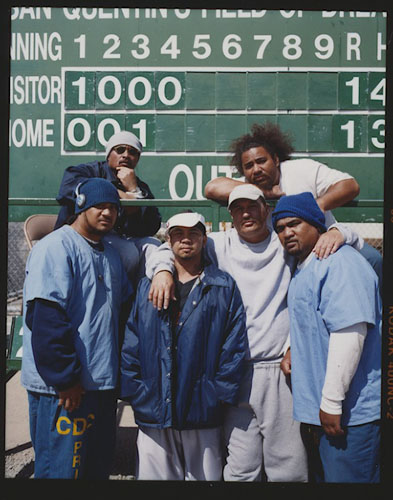
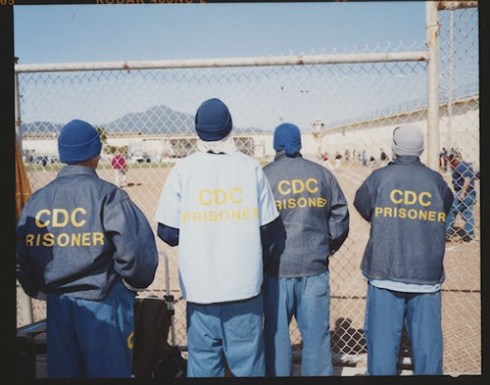
You are not a sports shooter per se. You took portraits of the players and spectators of inmate-spectators. How did you choose when to frame a shot and release the shutter?
Correct. I’m definitely not what most people would consider a sports photographer. I don’t own any of those huge, long lenses. However, I photograph lots of sporting events. I think of them as a microcosm of our society. There are lots of very interesting things happening at events like this. Fanaticism, idolatry, community, etc. Not to mention lots of alcohol and partying – see my Nascar images!
Hitting the shutter isn’t entirely a conscious decision. That decision is informed by years of looking at successful and unsuccessful images. It’s basically a gut instinct. There are times that I search for a particular image in my head, but mostly, it’s about having the camera ready and pointed in the right direction. When something interesting happens you snap.
There are photographers that come to a shoot with the shots in their head already. They produce the images – set people up, set up lighting, etc. Then there are photographers that are working with certain themes or ideas and they come to the location ready to find something that informs those ideas. I’m definitely the latter. There is a looseness and discovery process that I really enjoy when photographing like this. It’s like the scientist crunching numbers and coming to some new discovery.


A lot of photo editors say the story makes the story, not the images. Finding the story is key. Do you think there are many more stories within sites of incarceration waiting to be told?
I’m not sure I agree with that. I always say that a photograph can be made anywhere. Even if there is no story, per se. I definitely agree that a powerful image along with a powerful story is better, but a photograph can be devoid of a story, but be powerful anyway.
Every person, every place, everything has a story. So yes, there are millions of untold stories within sites of incarceration. Hopefully, I’ll be able to tell some of them.
Having had your experience at San Quentin, what other photo essays would you like to see produced that would confirm or extend your impressions of America’s prisons?
Man, there are millions of photos waiting to be made! I’m currently trying to gain access to a local NYC prison to continue my work and discover a bit more about what “Prison” means. Personally, I’d love to see long-term projects about inmates. Something like portraits as new inmates are processed, images while incarcerated, and then see what their life is like after prison. Their families, their victims, etc. And of course, if any photo editor wants to assign something like that, I’d love to shoot it!

Anything you’d like to add to help the reader as they view your San Quentin Baseball photographs?
Yes. When I walked in to the yard, I didn’t know what reaction I would get from the inmates. Everyone was super friendly and willing to be photographed. Everyone wanted to tell me their story. I’m not sure how different their reaction would have been to me if I didn’t have a camera, but I was pleasantly surprised. At first, I felt like an outsider and fearful, but after an hour or so, I felt comfortable and welcome. It was a weird experience to think the guy next to me could be a murderer (and there were, in fact, murderers on the baseball team), and not be afraid. There was this moral relativism thing going on in my head. These people were “bad,” yet they were just normal guys that had made very big mistakes. I left SQ thinking that pretty much any one of us could have ended up like them. Given a different set of circumstances or lack of access to social resources (e.g. education, money, parenting, etc) I could very easily see how my own life could have mirrored their life.
And finally, can you remember the opposition?
I don’t remember who they were playing, but I do remember that their pitcher had played in the Majors and even pitched in a World Series. I believe the article that finally ran in Death + Taxes magazine mentions the opposition.
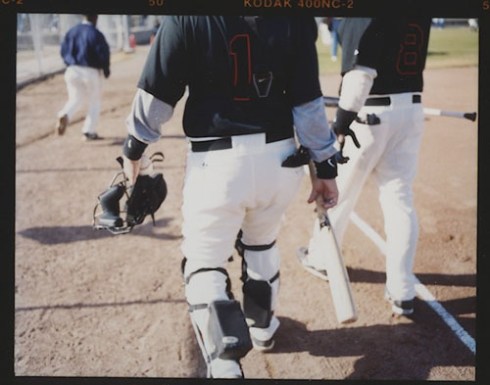
ALL IMAGES © 2009 EMILIANO GRANADO
Authors note: Huge thanks to Emiliano Granado for his thoughtful responses and honest reflections. It was a pleasure working with you E!
Housekeeping. At the end of my previous post on Emiliano’s work, I postured when San Quentin would get more sports teams for the integration of prisoners and civilians. Emiliano has answered that for me in this interview. He observed locals playing tennis and also states San Quentin also has a basketball team.

Ettore Scalambra © 2009 Luca Ferrari
Luca Ferrari is a young documentary photographer who graduated recently from The University of Wales, Newport. In 2001, he gained a scholarship in Rome and chose to document the lives of inmates in his native Italy at Rebibbia Prison.
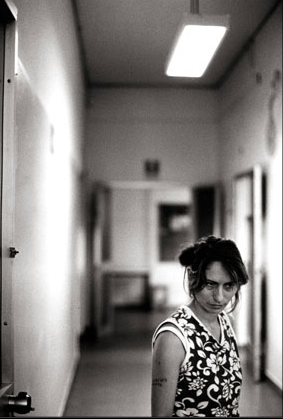
© 2009 Luca Ferrari
I have chosen seven of his most striking works. Ferrari’s portraits are accompanied by words spoken by the prisoners. I have only included a single testimony here and I encourage you all to take the time to visit his site to understand the subjects more. Ferrari offers the caveat, “I apologise if some of the text is long for internet reading, but they are an essential part of my work.” No apology needed. The necessity for the text is obvious; I would argue crucial.
I have included the words of one inmate discussing the experience of another at the end of this post. The words are hard to read. I jostled with the decision to include them or not. In the end, I decided if anything should come from an analysis of Ferrari’s work it should be to convey the real gravity of his subjects’ lives.
I also firmly believe that in the work of any documentary photographer, if the sitters and subjects stories stay in the audience’s mind longer than the photographer’s name then the photographer has succeeded.

Pierluigi Concutelli © 2009 Luca Ferrari

The Mass © 2009 Luca Ferrari
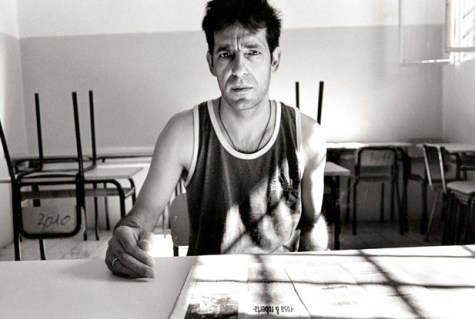
Giovanni Iacone © 2009 Luca Ferrari
______________________________________________
Alessia and Lucia
Ferrari interviewed inmate Alessia on September 10th 2003. She spoke of Lucia’s traumatic experiences and suffered injustice.

Alessia © 2009 Luca Ferrari
She is 42 years old. She comes from Ethiopia. She lives on the street – in the park at Piazza Indipendenza. She says she will go [be released] on the 22nd. She has a father and mother. They live her in Rome. Her parents have tried to help her but she cannot see a male person because five Italian guys have raped her. She was in the boarding school of Villa Pamphili and during the weekend she would go home. While she was at the bus stop waiting for the bus to go home, a car arrived and kidnapped her. They probably took her to a secluded place. It happened in the cell as well.
In fact, when they lock us up, she opens the water tap and fill sup the buckets, then she empties them on the floor. She then takes the toilet paper and puts it on the television screen. She does this to have the cell unlocked.
She has not been sane since she was raped. They did not only rape her they gave her a good thrashing. One of the guys made her pregnant and nobody knows the whereabouts of the kid. The social services gave him to another family.
Her parents took her to the hospital. She escaped and has never gone back. They attempted many times to help her, but nothing. She has been in a psychiatric hospital, where they bombarded her with electroshock. After this she was worse.

Lucia © 2009 Luca Ferrari
______________________________________________
Brief Q & A
When did you photograph the Rebibbia series and how many times did you visit?
I did the series during August 2001 and the summer of 2003. I can’t count the times, but almost every day for a month in 2001 and daily for one month in 2003.
Describe Rebibbia prison.
Rebibbia is a prison in Rome which holds 352 women and 1927 men. Within the womens’ ward there is also a special section for mothers with children under 5 years old.
What first got you interested in the subject of prisons?
I won a scholarship in Rome in 2001 to produce a exhibition on the theme of “Memory”. From that I showed my pictures to a publisher who was interested in making a book on Rebibbia. In 2003 I continued the work.
Why Rebibbia prison?
At that time I was living in Rome. Moreover, Rebibbia is one of the biggest and most important prisons in Italy.
What arrangements did you need to make to gain access to the prison (phone calls, letters, recommendations)?
I needed a letter of commission from the scholarship/publisher and also the permission of the prison authority.
Describe your interactions with the prison inmates/subjects and also the prison staff.
The permission I had was very restricted. I could not going everywhere, so I decided to add text to my pictures. The texts are not official interviews but chats I recorded in my notebooks. Sometimes the inmates gave me letters from their relatives or text written by themselves.
I tried to be as informal as possible with the texts. The prison institution is already very formal; As Erving Goffman described in Asylums it is a total institution. The status of a prisoner “is backed by the solid buildings of the world, while our sense of personal identity often resides in the cracks.”
I just tried to be a crack.
Today, March 11th 2009, marks the twentieth anniversary of the first COPS episode. Producer, John Langley, and his cohorts celebrated the when the first show of the twentieth season aired at the back end of last year. Allow me to reflect also.

At overcrowded jails, like this one in Marion County, IN, inmates must sleep in portable containers. Credit: Inside American Jail
This is not really a day of celebration. Personally, I loathe the show. It is lazy, cheap and exploitative. In that regard, it paved the way for all the reality TV on the box today. Off my soap box.
It is worth noting that the 1988 television writers strike gave rise to COPS airing on screens. A desperate Fox Channel signed up after Langley had tried and failed pedaling the format for over six years. Lucky for him. But he was no slouch and worked the opportunity when it arose. Langley struggled early in his career. My guess is his PhD in Aesthetics took his thinking outside of the rote and predictable circles of Hollywoodthink. But TVland came round eventually and Langley has since distinguished himself as a true pioneer of America’s most-loved lowbrow art form.

Inmates in this Utah jail aren't digging an escape tunnel. They're learning to garden. Credit: Inside American Jail
Three years ago, Langley Productions introduced a spin off show that went off the streets and into the jails. Inside American Jail has ventured into sites of incarceration across the nation including the circus-like Maricopa County Tent City. The show won high ratings when the Las Vegas County Sheriff detained O.J.Simpson.

A sign at a Maricopa County jail reads "Vacancy." The rates are good but the atmosphere is lacking. Credit: Inside American Jail
In many cases the TV cameras show the true harsh realities of institution after institution with stretched resources warehousing troubled folk with few opportunities for rehabilitation. This doesn’t stop them from hamming up the quirks of jail time as evidenced by the promotional images and campy captions (shown within this article) drawn from the show’s website.
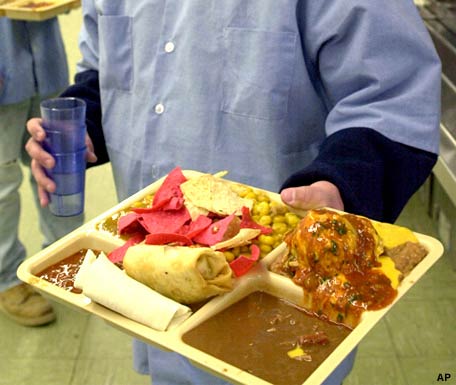
Mmm-mmm-good. An Iowa State Penitentiary inmate shows us what lunch in jail looks like. Credit: Inside American Jail
With most debates, nothing is cut and dried and an insightful article in the New York Times shows a vaguely compassionate point of view from Langley – who, let’s be honest has made his fortune of the back of America’s criminal justice exploits.
Having seen America’s prison population soar to more than 2.2 million, and with widespread prison overcrowding in California, Mr. Langley says he now believes the nation should be reconsidering which crimes should be punishable by imprisonment. “A lot of our attention is dedicated to arresting people who have drug problems,” he said, “when the real solution may be to rehabilitate them.”
And for your viewing pleasure here’s the ridiculous promo for Inside American Jail
This interview allows Langley to describe where Inside American Jail fits into the larger television ecosystem.
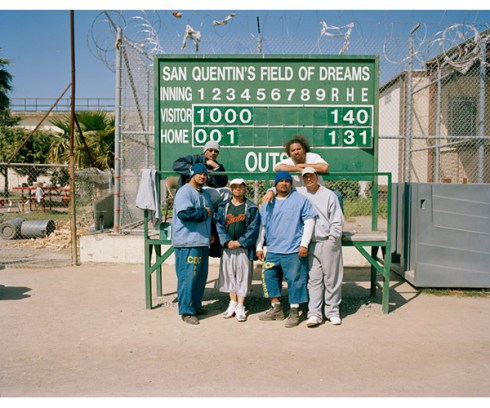
With Emiliano‘s permission I have lifted these images straight from his website. We are working together on an interview for a second post on his work (scheduled for next week). It will include previously unpublished and untouched images from his contact sheets. Please stay tuned for that. Meanwhile enjoy my personal selection of six preferred prints.

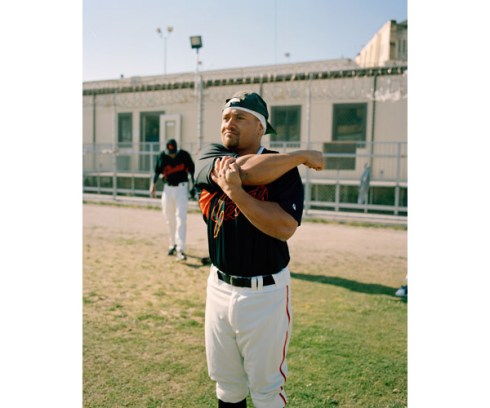


ALL IMAGES © 2009 EMILIANO GRANADO
_____________________________________________
The San Quentin Giants are well known in the San Francisco Bay Area. I have met a couple of guys in the past who’ve played inside the walls during regular season – it is not unusual.
In an ideal world, the to and fro of public in and out of prison would be without restriction, threat or security protocol. This way, society could fear inmates less and inmates would not be institutionalised to the extent they are today.
I realise this is pie-in-the-sky thinking as the minority of seriously dangerous prisoners necessarily dictate the need for stringent controls. Still it doesn’t mean that increasingly trusted and regular contact between inmate and no-inmate populations cannot be our ideal to shoot for. Smaller and purposefully designed institutions would certainly be the first step in this sea change.
The scheduled games for the San Quentin Giants baseball team are the closest approximation to genuine & normalised interaction between inmate and non-inmate populations. When will San Quentin get a basketball team? Or any other teams for that matter?
____________________________________________
Check out these sources for further information on the San Quentin Giants. Press Enterprise – Long Article and Audio, Mother Jones article – Featuring Granado’s photography, California Connected – Video, Christian Science Monitor – Long article and video, NPR Feature – Audio.
And, if you are really engrossed you can always purchase Bad Boys of Summer, a recent documentary from Loren Mendell and Tiller Russell.

Inmate Jeff Curbow, 40, says he improved a watering system for the moss after others built a special hut for it at Cedar Creek Corrections Center in Littlerock, Thurston County. Credit: Ken Lambert / The Seattle Times.
Prison Photography always looks to visual sources that represent incarcerated peoples from a different perspective. Some of the best opportunities to do this is with images of prisoners employing their time in job placements, self-growth programmes and/or restorative justice & community education projects.
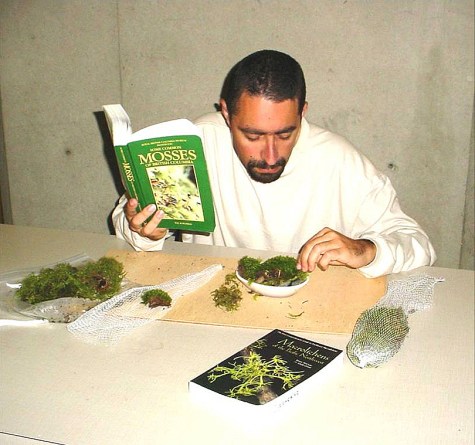
A Cedar Creek inmate and researcher in the Prison Moss Project studies mosses. Credit: Nalini Nadkarni of Evergreen State College
The Prison Moss Project, part of the Washington Department of Corrections‘ sustainability efforts uses prisoners time for the benefit of multiple causes. The project studies the growth of different mosses, cultivates the fastest growing species and sells them commercially as an alternative to mosses stripped from America’s temperate rain forests. Harvested mosses constitute a $265 million/year business. 90% of mosses come from Pacific Northwest forests. The majority of mosses are used for short lived floral-arrangement. Moss can take between 20 to 40 years to regrow even a small patch of a few square feet.
The beauty of this model based on simple scientific observation and applied methods is that it is replicable the world over. And, the business that results makes sense too.
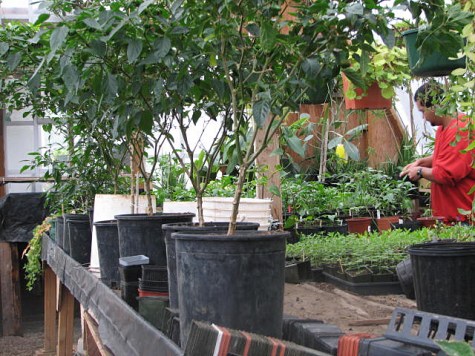
A Cedar Creek inmate and researcher in the Moss-in-Prisons project tends the garden. Credit: Nalini Nadkarni
So, the benefits? First and foremost, the inmates at Cedar Creek, a minimum security facility in the rural southwest of Washington enjoy daily active learning. Prison staff have described the facility as one without idle time among its inmate population. Engaging the bodies and minds of frequently docile populations is the first step in combating recidivism.
Concurrently, tax-payers (economically-efficient prisons), tourists (untouched old growth forests) and global citizens (robust ecological legacies) all benefit too. Finally, all this pales in comparison to the rewards for the Pacific Northwest old growth forests, which in future will not suffer unsustainable tree-stripping and moss harvesting.

A Cedar Creek inmate and researcher in the Prison Moss Project in the purpose built greenhouses. Credit: Nalini Nadkarni
How did all this start? Two convergent forces came together. The first was a general move by the Washington Department of Corrections to improve its carbon footprint, sustainability and opportunities for its inmates. This involved composting, recycling, organic farming, beekeeping at selected facilities. This green awakening fell into step with Nalini Nadkarni‘s need for extended and immediate research into moss varietal growth patterns.
Nadkarni has been called the “Queen of the Forest Canopies”. I am not one for personality worship, but let’s just say her work is socially – as well as environmentally – responsible, she knows how to work media channels, her message is imperative and the Evergreen State College in Olympia is very lucky to have her on faculty. She co-founded the Research Ambassador Program at Evergreen, which seeks to combine academic and non-academic practitioners to widen the reach of environmental dialogue and deliver relevant forms of communication to different groups; from inner city youth, to business CEOs.
It’s all about respectful communication, and it’s all for the benefit of our environmental futures.

Daniel Travatte, 36, suits up to check on the Italian honey bees he cares for at the Cedar Creek Corrections Center in rural southwest, Wash. on Friday, Oct. 17, 2008. The bees are part of a program to help the prison be more environmentally green. Credit: John Froschauer/AP
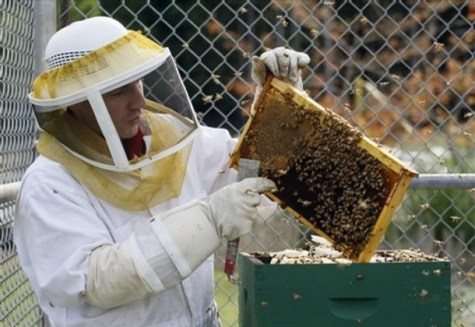
Inmate, Daniel Travatte, tends the Italian honey bees he cares for at the Cedar Creek Corrections Center in rural southwest, WA. Credit: John Froschauer/AP
The media coverage of this programme has often focused on the story of a young inmate who, since release, secured a biochemistry PhD full ride scholarship at the University of Nevada, Reno. He was imprisoned after accidentally killing his friend with his sports rifle in his student apartment. Four years later, he has continued the exceptional academic track he seemed destined to follow. It is a testament to the Washington Department of Corrections and Nalini Nadkarni (his mentor during time served) that his life has been delayed rather than destroyed.
But, he surely is an atypical case and it is a case that obscures the facts about the sustainable projects in operation at Cedar Creek. Not every inmate is a PhD candidate, but every inmate is a willing recipient of education – especially environmental education which, in many cases, is totally novel. Environmental education carries an almost redemptive message in that your actions can directly benefit everyone in modest but crucial ways. Actions based upon this new learning can be very therapeutic. Responsibility for oneself and other human beings is not separate from responsibility for our shared environment.

Inmates Robert Day (left) and Brian Deboer (right) check on plants in one of the organic gardens at the Cedar Creek Corrections Center in rural southwest, Washington, on Friday. The minimum-security prison has adopted many environmental and cost saving practices. Credit: John Froschauer/AP
I have discussed sustainability efforts in California’s prison system before. In closing I’d like to repeat the sentiments of Cedar Creek superintendents who, in attempts to convince the public of the utility of this program, talk of the direct reduction in operating costs at the facility. If commentators such as myself want to espouse the rehabilitative value also then so be it. Doubters now have firm fiscal, quantitative evidence – in addition to qualitative inmate testimonies – to shape their support for sustainability programmes in prisons. WDC senior staff are adamant Cedar Creek is the correctional model to follow in the 21st century.

Inmate Robert Knowles pitches plant stalks into a compost pile Oct. 17 at the Cedar Creek Corrections Center in rural southwest Washington. The minimum-security prison has adopted many environmental and cost-saving practices. Credit: John Froschauer/AP
There are many resources out there on the Prison Moss Project and Nalini Nadkarni‘s ongoing evangelism. I personally would recommend in this order … Nalini Nadkarni’s recent TED presentation about the opportunities for academic & non-academic communities to unite for greater good; this extended video from KCTS (9 minutes); this interview with Nadkarni; a recent Mother Jones summary of her projects and two media reports (1), (2).

 Prison Photography