
You are currently browsing the monthly archive for September 2010.

Photo: Chris Mottalini
Quilting as a form of rehabilitation for prisoners may seem unorthodox, even beyond the pale, but really it doesn’t surprise me. It’s been put in place at Jefferson City Correctional Center, Missouri.
I was intrigued impressed by how the practice was described by this UTNE Reader article:
Restorative justice, which focuses on the victims needs, is potentially the sharp-end of a positive trend that deals with the emotional repercussions of crime, beyond simple notions of retribution … and its widespread implementation might just drive down US prison populations.
– – –
Photographer, Chris Mottalini‘s other work can be viewed at http://www.mottalini.com/

Photograph: David Levene
I have been aware of Shaun Attwood‘s blog for a while, but never a regular reader. He’s just released a book about the filthy six years he spent in Arizona prisons.
Attwood, formerly a stockbroker and rave organiser was imprisoned in Arizona for drug dealing and money laundering. He was the first person to blog from inside a US prison. He now campaigns against Sheriff Joe Arpaio and Maricopa County Jail’s human rights abuses.
Erwin James (also a former-prisoner) wrote about Attwood and Joe Arpaio in today’s Guardian:
and
Shaun Attwood blogs at jonsjailjournal.blogspot.com. Hard Time: A Brit in America’s Toughest Jail is published by Mainstream.
… is the Gursky that got the Poster Boy treatment.
Sometimes the simplest ideas are the best. With the aid of inmate Renata Abramson (pictured in sceengrab below), Detective Kim Bogucki and Photographer/Film Director Kathlyn Horan co-founded The IF Project and asked ladies at the Washington Corrections Center for Women a single simple question:
“If there was something someone could have said or done that would have changed the path that led you here, what would it have been?”
Simply, the filmed testimonies (also here) and over 300 essays give the public an open line on the difficult lives these ladies have lived.
The lazy definition of ‘choice’ that everybody falls back on to justify punishments meted out upon the disadvantaged in our society – “they chose to do their crime, they do the time” – is exposed by these ladies’ stories. Many of them had no choice, at least not choice that would be obvious to an unloved teenager without any support, example or love.
I also know that The IF Project has expanded into men’s prisons in Washington State. Wonderful news.
IF you wouldn’t have noticed, the lady in the top image is cutting out the Washington Department of Corrections uniform badge.
IF you do anything today, spare 13 minutes for The IF Project trailer.
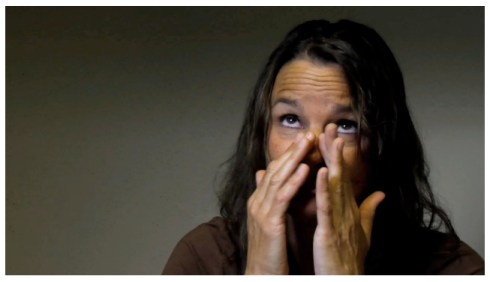
The IF Project Trailer, Screengrab
Okay, okay, I know DAH is a good photographer and a greater promoter of work.
Seriously, what he does for youngsters in the industry is incredible and he was doing it a long time before the internets allowed him to share his support and passion via burn.
So, I’ll probably take a lot of heat for what I am about to say … like that time I was invited around to a friends house and ended up pissing on the kids’ Christmas presents.
It’s just that, this seems like quite an essay for a time of emergency.
“This calls for immediate action!”

After publishing a few posts about prison tattoos (here, here and here) Klaus Pichler emailed me to tell me about his project ‘Inked for Life: The World of Prison Tattoos‘:
I am a landscape architect and I am currently researching the exercise yards of Austrian prisons, in both spatial and sociological approaches. I am also a photographer.
‘Inked for Life: The World of Prison Tattoos‘ deals with the art of tattooing in the prisons of Central Europe, from the 1950s through to the 1980s.
I am surely not the first one who has done a project about this topic, but the Central European tradition of prison tattooing is genuinely different from the North American, the Latin American and also the Russian/Eastern European style of tattooing.
I have worked more than seven years on this project, and it will be published as a book in late 2010. The project consists of pictures and excerpts of interviews with (mostly) ex-inmates, about tattooing, prison life and prison culture.
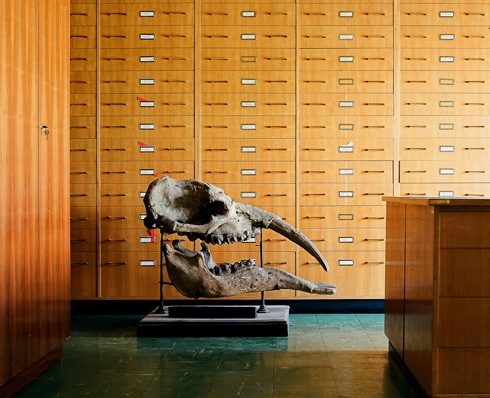
I am assuming it is because the book is imminent that Klaus did not provide me jpegs from the Inked for Life series. Klaus did, however, send over these four images from Skeletons in the Closet.
Skeletons in the Closet goes into the long list of photo-projects adopting a distancing view of stores/archives/displays/dioramas of natural history museums, albeit one of the better projects of that ilk … of that trend.
Klaus Pichler‘s entire portfolio is worth a look but I think his studies of people, nay characters, in his Odessa series are particularly good … very good.
So please look at those people shortly after looking at these dead animals!



 Prison Photography