
You are currently browsing the monthly archive for September 2013.

Brandon Tauszik moved to Oakland from San Diego three years ago. He’s got a day job. Some of his images are a little raw — check his Instagram feed @BE_DIZZLE. Tauszik was for a while assistant to the legendary Jim Goldberg. He’s also a big fan of TBW Books the small publisher just down the road run by Paul Schiek. I haven’t asked Tauszik but I reckon he’s probably a fan of the Hamburger Eyes folks too.
Tauszik is making the Bay Area his home and the aesthetic of his work makes obvious sense amid the prevalent scratched-up, banged-up, gritty, kids-street-realism typical of California. Less obvious though are the motives, goals and choices within Tauszik’s latest body of work White Wax.
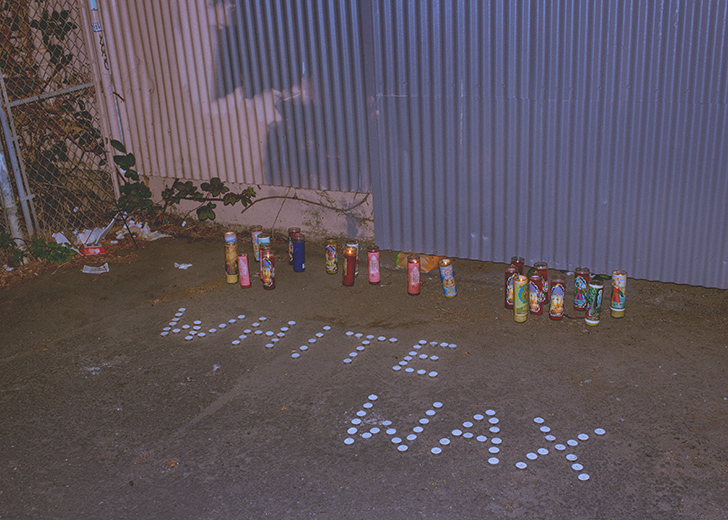
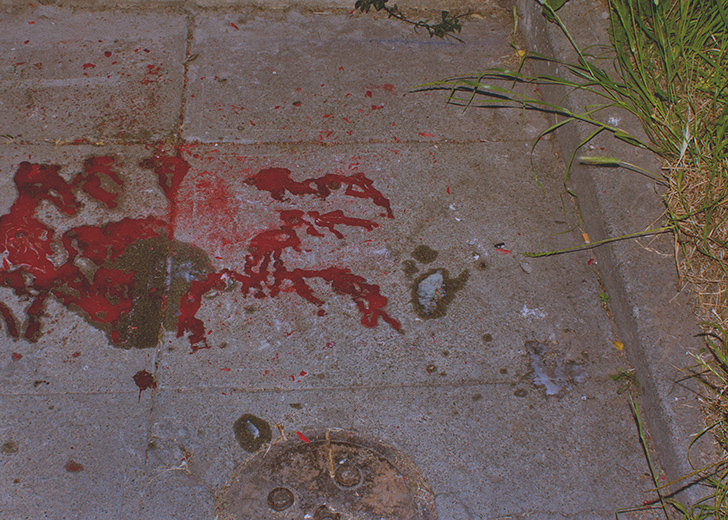
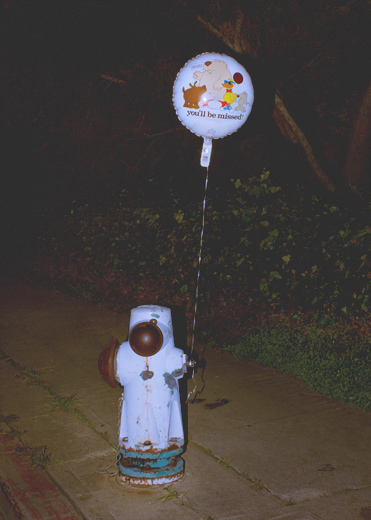
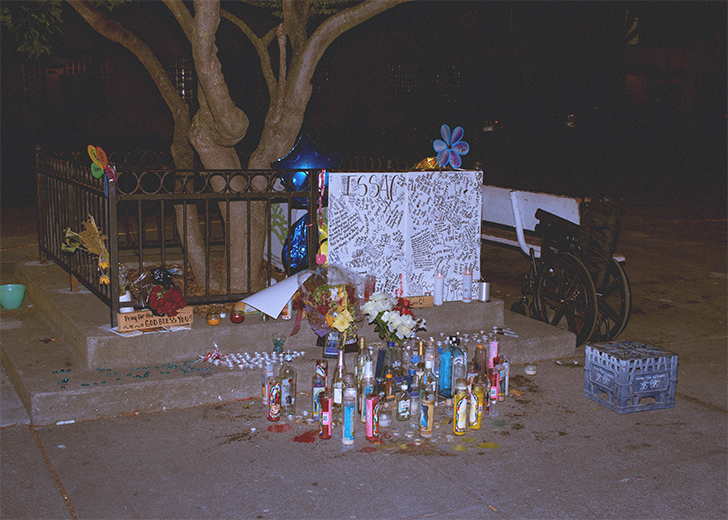
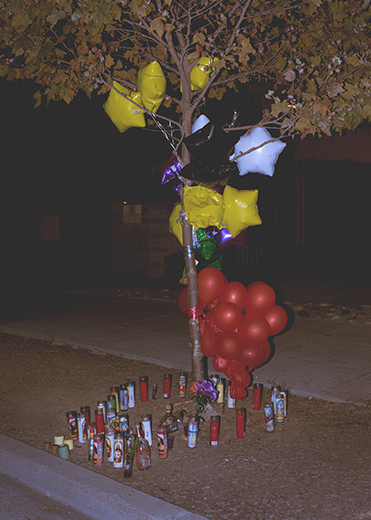
White Wax is a year-long visual document of memorials to homicide victims on the streets of Oakland. Tauszik says in his artist statement that his photos are to serve as a medium for self-examination. He thinks America is in the middle of a collective re-examination of its criminal justice policy, gun culture and post-racial credo.
White Wax is also,I suspect, a means by which Tauszik can remain connected to the place he lives. Unfortunately, for most people, murders are pretty easy to ignore; they just have to stay off the wrong streets. Some Oaklanders don’t have that luxury though.
“Why has the ecology of the American inner city long enabled it’s own self-destruction?” asks Tauszik. “Is it possible to shift our tired narrative of another young black man memorialized with white wax?”
SCROLL DOWN FOR OUR Q&A


Q&A
Prison Photography (PP): Why take on this project?
Brandon Tauszik (BT): Oakland is a violent city, but America is a violent country. Its inner cities particularly so. There is already a great deal of photography approaching this subject with a kind of coarse imagery. We’ve all seen it over and over. I asked myself, ‘How can I photograph gun violence without showing any guns? How can I create an emotional project without showing victims or mourners? How can I approach a politically charged subject, yet leave cops and politicians out of it?’ I hope that with these images I am able to communicate something beyond just melted wax on the sidewalk.
PP: I used to live in San Francisco and there was a bizarre media obsession about the annual homicide rate, as if people were waiting for it to meet or surpass the previous year’s figure. Oakland was always the depressing counterpoint to SF figures as it suffered 2 to 3 times the number of murders. Briefly, can you describe your experience of information, conversation, attitudes about murder? Surely, beyond figures there’s talk of interventions and solutions? Basically, what should Oaklanders do?
BT: That’s a loaded question! There is a lot of social inequality in the Bay Area and particularly here in Oakland. Having been largely de-industrialized over the past few decades, Oakland is currently in the midst of a strong wave of gentrification. Despite this new influx of higher income residents, the crime rate has barely shifted in the past decade. It’s currently the most dangerous city on the west coast and has the highest robbery rate in the whole country. People blame this on the understaffed police department, the economy, the gangs, the guns, whatever.
It’s uncomfortable to address, but ultimately this isn’t about “What should Oakland do?” but instead “What should America do?” In New York City, Memphis, Chicago, Baltimore, Los Angeles (the list goes on and on) young men of color kill and are killed more than any other demographic. We’ve ignored violence in our country because the victims don’t look like us. As one African American mother told me at a memorial, “We have been living a daily Sandy Hook and it’s time for the nation to know.”
There are some very strong local organizations (SAVE, Khadafy Foundation, RJOY) that do amazingly important work, but ultimately this is about a flawed national mindset in regards to prisons, guns and race relations.
SCROLL DOWN TO CONTINUE Q&A



PP: Is White Wax a memorial? A study of vernacular action? Other? Both?
BT: It’s more a study in the unique and visually distinct way that my neighbors mourn the loss of their loved ones. Or in your words, a study of vernacular action.
PP: Was it important to commit to this for one year?
BT: Every big city has their yearly homicide count which is obsessed over and analyzed as strictly data. I wanted to see what that data would look like in context of the shrines, which are a direct result of that count.
PP: White Wax images are taken at night. Was this a deliberate choice? If so, why?
BT: I wanted to capture these scenes as naturalistically as possible. The majority of these murders take place under the cover of darkness, so while this makes my work more difficult and dangerous, nighttime is one of the threads I use to tie the images together.
PP: I know you use Shine In Peace, Google Alerts and word of mouth to discover homicides. Do you fear White Wax has omitted some homicides just as the local news often misses/overlooks these murders? If you have missed some what does that mean?
BT: I’ve definitely missed some, due to a few reasons:
1. These memorials are, by nature, ephemeral and are displayed for anywhere from one day to many weeks. Sometimes I find a site I’ve missed where there are still traces of wax, but the shrine has been removed.
2. The given victim’s family and friends sometimes don’t erect a shrine. If the murder took place in a particular neighborhood where the victim was not welcome, that will usually apply to the victim’s family and acquaintances as well.
3. Many of these murders get little to no media exposure. For example, here is an example of a web-only murder story from last year. I rely on Oakland’s news outlets to report on (or at least tweet on) each murder. However there is low motivation to do so due to the very limited readership on these stories.
There are usually a few murders a week here, so unfortunately it can be hard for me to keep up.
SCROLL DOWN TO CONTINUE Q&A


PP: What about captions? Is there a need (from you or audience) to include information about the homicide?
BT: I have the name/age/race/sex/location information for most of these murders. However, captions have a didactic manner of reducing a photograph down to data and information, which is what I am trying to avoid. A recent study showed that Americans assume black people feel less pain than white people. This is deeply frightening. I want the viewer to ponder these images and wonder, ‘Was this person someone who looked like me?’
PP: What’s been the reaction from folks in Oakland to White Wax?
BT: I have been sitting on this project until very recently. I wanted to give it time to fill in and for the thesis to take shape. The local people I’ve showed it to so far seem to think it’s strong and thoughtful. I would love to arrange an exhibition towards the end of the year in Oakland.
PP: Which photographers are working in ways that you admire and value?
BT: When I first moved to the Bay Area, I assisted Jim Goldberg for a while. That was a pivotal time for me which pulled me away from strict photojournalism toward longer, in-depth projects. Lately though I’ve been into Harry Griffin, Yoshi Kametani, and Viviane Sassen.
PP: What’s the purpose of photography? What should we be trying to do?
BT: We have ears to hear, but also eyes to see. The spoken word can only accomplish so much. You can sometimes say so much without using your mouth … a gesture, a glance.
For me, photography acts as a medium to illuminate ideas and questions on all aspects life.
END


Biography
Brandon Tauszik is a photographer and filmmaker based in Oakland, California. He creates visual media at Sprinkle Lab while pursuing personal photography projects.


At Photoville this year, you’ll find me and a team of pen-pushers in a container amassing The Depository Of Unwanted Photographs a crowdsourced archive of images and stories. We need your help and we need your submissions.
What is The Depository Of Unwanted Photographs?
The Depository Of Unwanted Photographs (TDOUP) is a few things: part social engagement, part fun, part an investigation of quality but mostly an opportunity to share our thoughts on how and what we think about our own photographs.
CURATORIAL STATEMENT
My explanation lifted straight from the The Depository Of Unwanted Photographs sparkly website of why I have conceived of TDOUP:
When asked to pick out a single image they absolutely treasure, people generally don’t hesitate. A snap of their children, a Polaroid of their parents, a formal pose from precious life event, or perhaps even a photograph with the prescribed artistic balance of composition, contrast and exposure. Whether the choice is dictated by emotional memory or technical concerns, the question “What is your best photo?” is not an unusual one.
But what about the question, “What is your worst photo?” To put it another way, what photograph of yours is obsolete, worthless, old news or just plain bad? Which single photograph of yours would you like to officially state on the record as unwanted?
During Photoville, submissions will be rotated in and out of display for public viewing. When the festival ends, the Photoville team will compile the images and create a reference book of “Unwanted Photographs”. The debate about what is good and bad in photography is as old as the medium itself, but what are the debate’s current touchstones? If we’re looking for good photography, we’ll find plenty of suitors in photobooks, galleries and publication, but where do we find a legitimate and well-researched presentation of bad photography? Does our discussion of what is good not also rely on a shared knowledge of what is bad, unwanted and unloved? Images do not exist in a vacuum, but emerge from contexts and histories. We think that your photos and stories are as relevant as the stories in news-photo exclusives and famous documentary images — your stories are central to discussions about how we consume and use photography. Therefore, we ask that each submitted image is accompanied by 50+ words on why it is not wanted by you, and not needed in the world.
We create and circulate millions of images every week. Many of these never exist beyond digital formats; stuck in our phones or transferred to computers on their way to social media sites. We are constantly employing choices, consciously and subconsciously, to share or overlook images. If we accept the mantra that ‘we are all photographers’ then aren’t we all photo-editors too?
There might be many of your images that you could trash, but by asking you to choose only one, we hope you’ll take the opportunity to think about the proliferation of images in society and your relationship to the ever-increasing number. Photoville will officially recognize your image as Unwanted with a numbered certificate and unique catalogue code. One-by-one, as the images interrelate and build the Depository, new meanings will emerge. The arbitrary definitions brought to the project by you the public will amount to a unique view. The Depository Of Unwanted Photographs is an unpredictable interrogation of quality that crucially is made by the public, not by the dominant voices of those in the media or culture industries.
HOW TO SUBMIT YOUR UNWANTED PHOTOGRAPH
During Photoville, you may make walk-in submissions at the TDOUP container which will be equipped with a scanner and computer to download, copy and catalogue your printed photographs and digital files.
For those of you who are unable to attend the event:
– Download the form (PDF)
– Attach a photograph and fill out the form
– Return the form for processing. You may either:
A. Scan the form and email it to receivables@unwantedphotographs.org
B. Place it in an envelope and mail it to 111 Front Street, Suite 204 – Brooklyn, NY 11201, USA
SHARING IS GOOD: #TDOUP
Please share the project and the www.unwantedphotographs.org URL far and wide. Please send us your jpeg and share your story.
Please use Facebook, Twitter and Instagram to hashtag your thoughts, observations and photos. We are #TDOUP
See you in NYC on Thursday!


Prison guards in Norway train for two-years in a special program which includes seminars on human rights, ethics and law. Warden Heidal oversees between 250 and 340 prisoners.
This week the University of Oslo admitted mass-murderer Anders Breivik into their Political Science program. It caused astonishment and chagrin for people across the globe. Understandably so. But, equally understandable is the decision, as explained by Ole Petter Ottersen, rector University of Oslo:
The fact that his application is dealt with in accordance with extant rules and regulations does not imply that Norwegians lack passion or that anger and vengefulness are absent. What it demonstrates is that our values are fundamentally different from his. […]
Having been admitted to study political science, Breivik will have to read about democracy and justice, and about how pluralism and respect for individual human rights, protection of minorities and fundamental freedoms have been instrumental for the historical development of modern Europe. Under no circumstances will Breivik be admitted to campus. But in his cell he will be given ample possibilities to reflect on his atrocities and misconceptions.
I have written before about Halden Prison — in which Breivik is held — that time leaning on the photographs of Fin Serck-Hanssen. I still hold that a prison should never alter or lower its operations to equal the depraved levels of its most infamous and criminal prisoners. As institutions, Halden Prison and the University of Oslo are both conducting themselves in ways fitting for a resolute and lawful society.
Gughi Fassino‘s photographs from Halden show us the very contemporary facilities and programs available to prisoners.
I am not interested in famous prisoners; they are famous because their crimes were extraordinary. The disproportionate amount of press coverage they get distorts the debate and distorts our impressions of what a prisoner is. I am more interested in the non-violent prisoners (a category that is proportionally much higher in the U.S.) that wallow in overcrowded prisons and don’t have access to meaningful programs.
Rehabilitation, education and vocational activities REDUCE recidivism and in turn REDUCE the financial burden to society. Men released from Halden Prison succeed at a much higher rate as compared to those released from other prisons in Norway, released from other prisons in Europe and by a distance compared to those released from U.S. prisons. Only 20% of Halden prisoners reoffend in the three years after release. The figure in the U.S. is 65-70%.
Roughly 90% of U.S. prisoners will eventually be released; they need help readjusting after years looked up and they need reason to buy into our society. We don’t need cycles of crime to persist and to pretend prison conditions aren’t the largest factor in that equation is a refusal to deal with the issue. WE deserve better prisons.
So as we look over Fassino’s photographs, let us not think about what these facilities mean for Breivik but what similar facilities could mean for the 2.3 million American prisoners and society as a whole.
View more of Fassino’s photographs here.

Prisoners are allowed to shop in the prison supermarket once a week. Beef tenderloin is $60/kg.
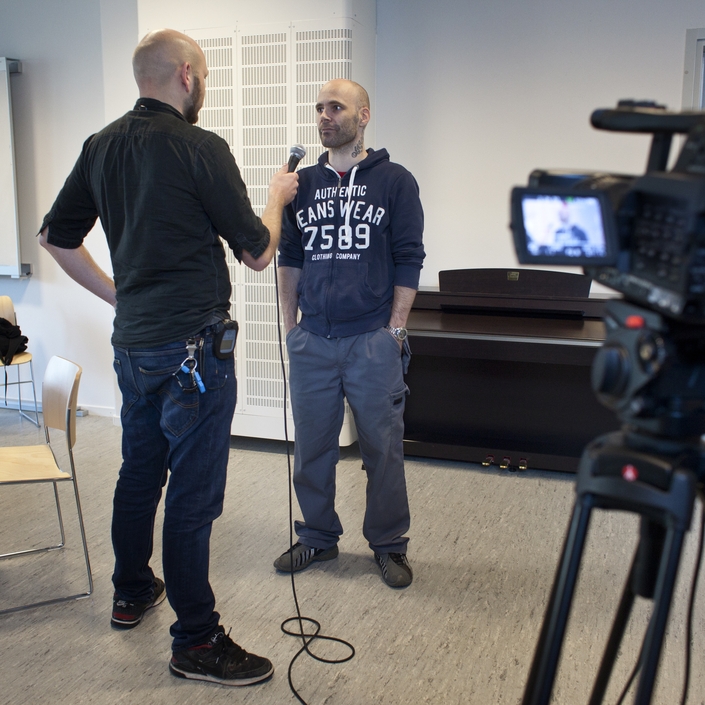
Communication with the outside world is limited. The prisoners are permitted three conversations a week with their family and weekly visits from their families. Here they produce a radio show for broadcast within the prison.
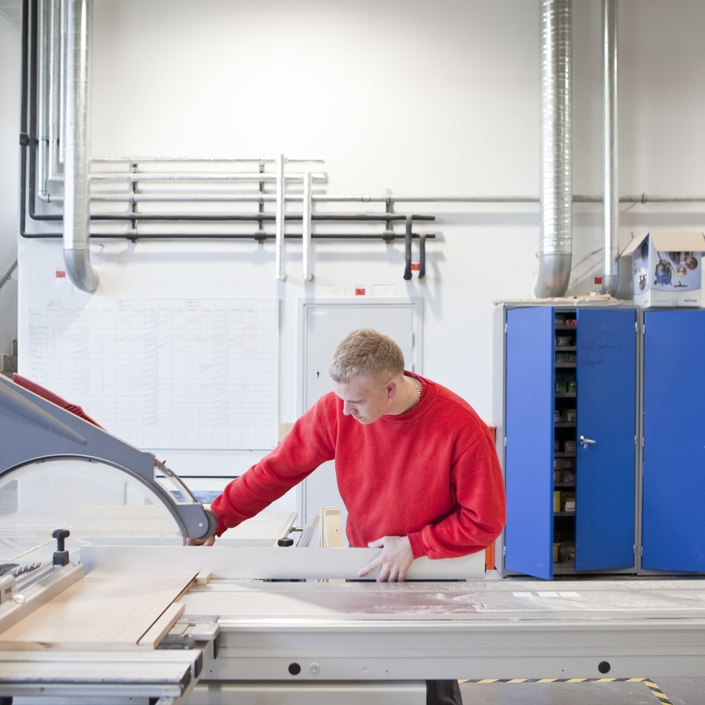
Prisoners are paid $9/day for their work.
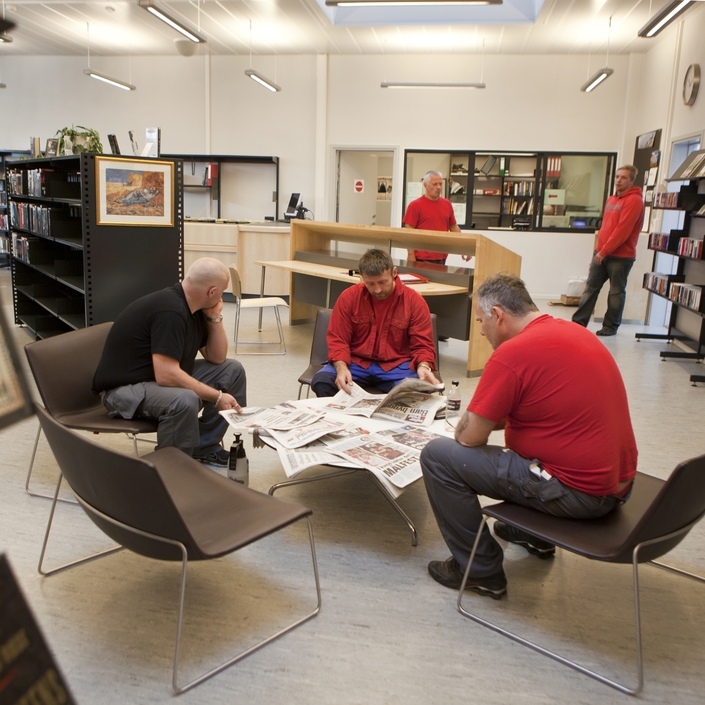
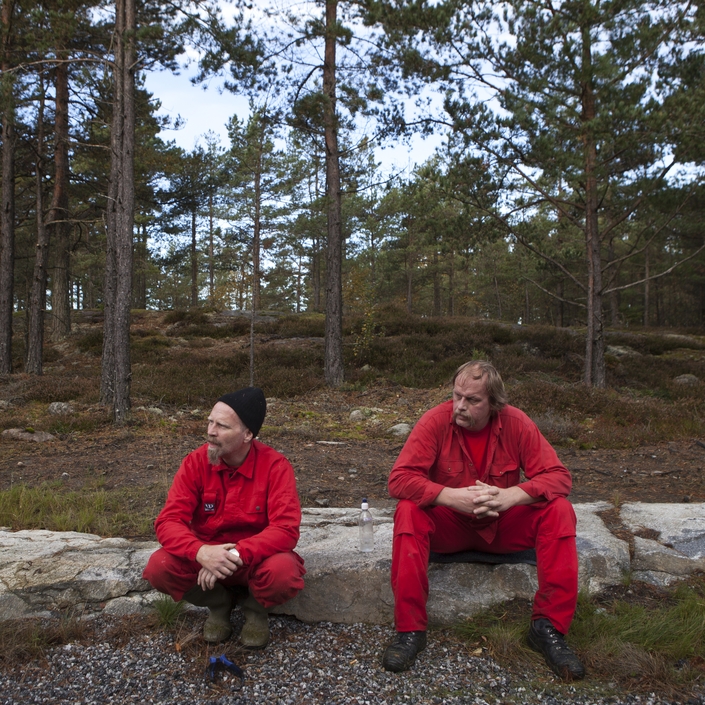
Halden Prison is located on 30 acres of open woodland on which prisoners are allowed to roam. According to the director, there have been no attacks on guards, no fights and no escape attempts.

With the express intent to shine a light on the lives of women imprisoned in Oklahoma for non-violent crimes, Yousef Khanfar‘s project and book Invisible Eve should be an excellent contribution to the visual resources we can use to inform ourselves about mass incarceration. It is, but it doesn’t go far enough.
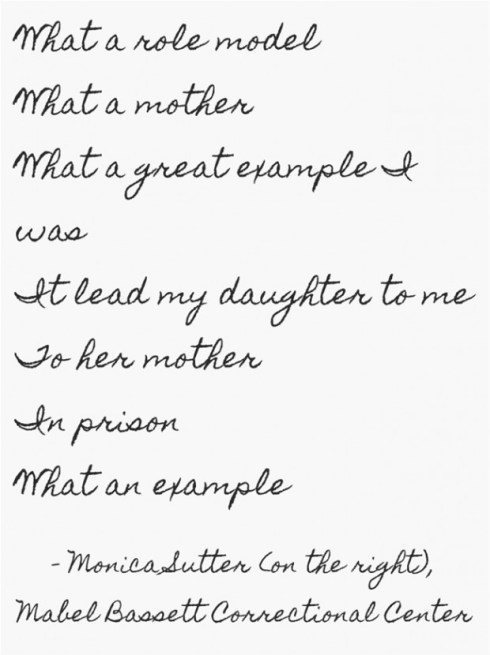
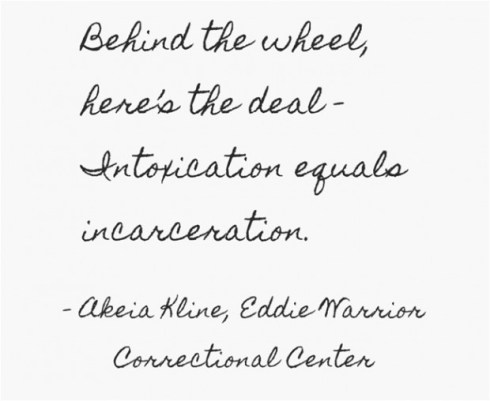
Invisible Eve has a couple of inherent problems that I think are worth pointing out. The first, to be fair, might just be a snag of language and a misinterpretation on my part, however, when I read that Khanfar asked the women to write statements of advice to younger generations so that “the fault of one being might be the salvation of another” it raised alarm bells. In the phrasing, there is a presumption of guilt that falls solely on the individual. Nothing is as simple as that and, for me, the way we warehouse non-violent offenders is as criminal as the act for which the individual is condemned and controlled.
If one accepts that the prison industrial complex is the problem, not the solution, any language that verges on the moralistic is troublesome.
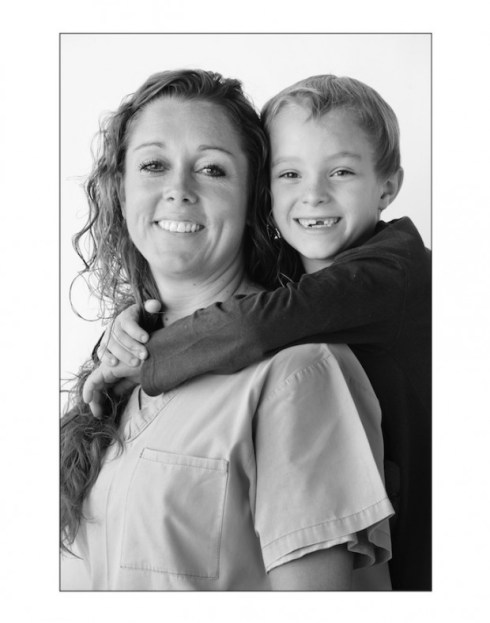
As for the portraits, they are fine. They’re straightforward, maybe a bit sugary, but probably exactly what the women would want (it is safe to presume Khanfar gave them multiple copies). For women with children, the portraits are a particular gift.
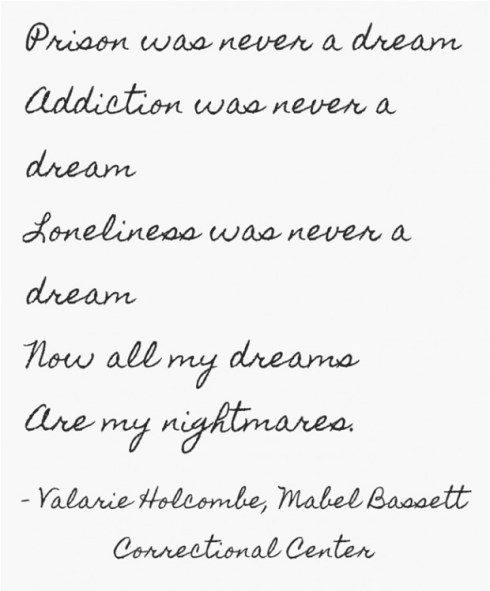
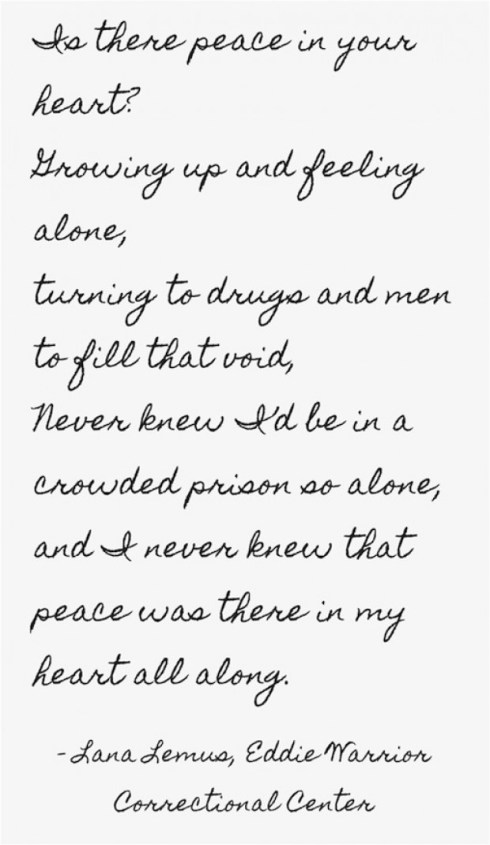
The second, and most glaring, issue for me are the “handwritten” notes. Bear with me.
Khanfar has said that his realisation that he couldn’t change the women’s circumstances and was his motivation to ask them to help others. Oklahoma has the ignoble distinction of being the U.S. state with the highest per capita rate of female incarceration. Khanfar notes that the women are “cast away and forgotten” and that his photographs are “not to condemn or commiserate, but to serve as bridges of understanding.”
Why then, did Khanfar choose to transcribe their words and publish them in a faux-handwritten font? The notes are all in the same handwriting! By choosing to do this, Khanfar has completely erased one of the few evidences that each of these women are individuals; one of the essential bridges to understanding.
The personal touch of individuals’ hand(writing) would have been a powerful element that has been overlooked in the project.
Take a look at the texts below and let me know what do you think. Am I being to precious or is the exclusion of the women’s own scripts a sizable mistake on Khanfar’s part?
Just a quick heads up to let you know that my Instagram handle has changed to my actual name. Find me at @petebrook from now on.
All those past mentions for @p3t3brook are confined to history and will only guide you to a non-existent account. Such is the price to be paid.
Also, remember that time I laid out my Instagram rules? I’ve had a couple of slips, but generally I think I’ve done an okay job sticking to them.

 Prison Photography