
You are currently browsing the monthly archive for October 2014.
I’ve wondered before where all the photographs of solitary are. This question presupposes that the American public’s exposure to the inside of these modern dungeons will spur a degree of enlightenment, consternation and protest.
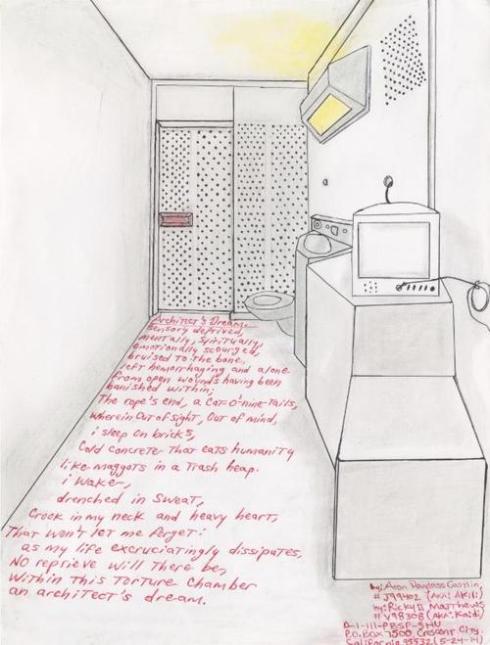
Putting the veracity of that string of causality aside for a moment, it might be worth saying that photographs are perhaps not necessary to stir emotional and political response. Maybe sketches can do these things as well, or better?
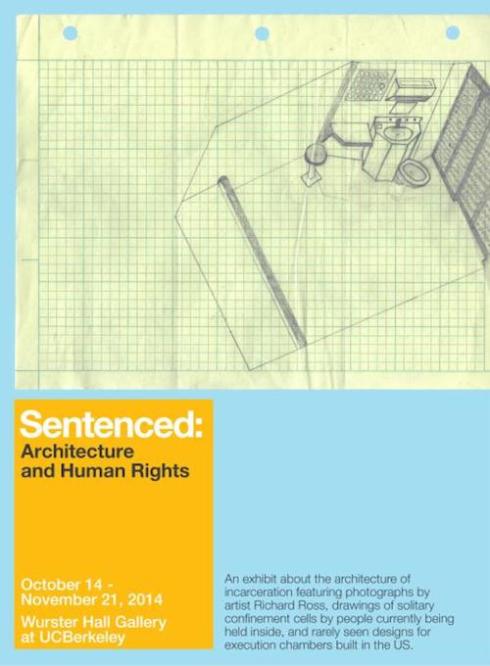
An opportunity to discuss this will arise in the next few weeks at the UC Berkeley’s Wurster Hall Gallery, in the College of Environmental Design.
Architects/Designers/Planners for Social Responsibility (ADPSR) present “Sentenced: Architecture and Human Rights,” an exhibit about the architecture of incarceration featuring drawings of solitary confinement cells by people currently being held inside.
In addition, rarely seen designs for execution chambers built in the U.S. and photographs by Richard Ross will be on show.
“Sentenced: Architecture and Human Rights,” highlights problematic and little-known spaces within United States prisons and detention centers that house activities deemed to violate human rights. What do these spaces have to teach us about the state of freedom in America?
The exhibit is free and open to the public M-F 10-5 until Nov. 21st, and the opening reception is this Tuesday, October 14th from 6-8pm, at which author Sarah Shourd, Professor Jill Stoner, and architect John MacAllister will be in attendance.
Here’s the announcement and here’s the Facebook event page.

“Tex Johnson, 60” by Ron Levine, courtesy of the artist.
Later this week, I’ll be attending the inaugural prison arts and activism conference, Marking Time.
Hosted by the Institute for Research on Women at Rutgers, and across multiple venues, the event brings together an incredibly committed and skilled cohort of practitioners throughout many disciplines — from dance to yoga, from occupational health to sculpture, and from film making to social work.
I’ll be moderating a panel discussion Imagery and Prisons: Engaging and Persuading Audiences, with Gregory Sale, Lorenzo Steele, Jr., and Mark Strandquist on Wednesday afternoon. In addition, a version of Prison Obscura will be on show at the Alfa Art Gallery in downtown New Brunswick.
To emphasise the breadth and depth of expertise I’ve copied out the schedule below. I have made bold and linked the names of artists, activists and academics’ names with whose work I am already familiar … and admire.
I pepper the post with artworks made by photographic artists attending Marking Time.
Marking Time runs 8th-10th Oct. Registration for the conferecne is free.
See you in New Brunswick this Wednesday?!?!

“Allen and Tanasha, 1998.” Family album. Courtesy of the Fleetwood family.
WEDNESDAY 8TH OCT.
Session 1: 9: 30 – 10:45 am
PANEL: Creative Arts and Occupational Health (ZLD)
Susan Connor and Susanne Pitak Davis (Rutgers University Correctional Healthcare) “Finding Meaning Thru Art”
Karen Anne Melendez (Rutgers University Correctional Healthcare) “The Concert Performance with Adult Females in Correctional Health Care”
Moderator: Michael Rockland (Rutgers-New Brunswick)
WORKSHOP: Steps Taken: Footprints in the Cell (NBL)
Rachel Hoppenstein (Temple University)
Ann Marie Mantey (Temple University)
Session 2: 11:00 – 12:15 pm
PANEL: Law, News, and Art (ZLD)
Regina Austin (Penn Law School)
Ann Schwartzman (Pennsylvania Prison Society)
Tom Isler (Journalist/Filmaker)
Moderator: Tehama Lopez
WORKSHOP: Utilizing Dance as a Social Tool: Dance Making with Women in Prison (NBL)
Meredith-Lyn Avey (Avodah Dance)
Julie Gayer Kris (Avodah Dance)
LUNCH: 12:15 – 1:15 pm
Session 3: 1:15 – 2:30 pm
PANEL: Imagery and Prisons: Engaging and Persuading Audiences (ZLD)
Gregory Sale (Artist)
Lorenzo Steele, Jr. (Founder, Behind these Prison Walls)
Mark Strandquist (Artist)
Moderator: Pete Brook (Freelance Writer/Curator)
PRESENTATION: The Political and Educational Possibilities of Exhibitions (NBL)
David Adler (Independent Curator)
Sean Kelley (Eastern State Penitentiary)
Rickie Solinger (Independent Curator)
Session 4 2:45 – 4:00 pm
PANEL: About Time (ZLD)
Damon Locks (Prison and Neighborhood Arts Project)
Erica R. Meiners (Northeastern Illinois University/Prison and Neighborhood Arts Project)
Sarah Ross (School of the Art Institute of Chicago/ Prison + Neighborhood Arts Project)
Fereshteh Toosi (Columbia College Chicago)
Moderator: Donna Gustafson (Rutgers-New Brunswick)
PANEL: Best Practices: Arts, Prisons and Community Engagement (NBL)
Robyn Buseman (City of Philadelphia Mural Arts Program)
Shani Jamila (Artist, Cultural Worker, Human Rights Advocate)
Kyes Stevens (Alabama Prison Arts and Education Project)
EVENING EVENTS
4:00 – 5:00 pm Artist Talk: Jesse Krimes (ZLD)
5:00– 5:45 pm Welcome Reception (ZL)
7:30 – 9:00 pm Opening Keynote: Reginald Dwayne Betts (KC)
Welcome Remarks: IRW Director Nicole Fleetwood
Introduction of Keynote: Dean Shadd Maruna, School of Criminal Justice – Rutgers, Newark

“Exercise Cages, New Mexico” by Dana Greene, courtesy of the artist.

“That Renown New Mexico Light” by Dana Greene, courtesy of the artist.
THURSDAY OCTOBER 9TH
Session 1: 9: 30 – 10:45 am
PANEL: Theater in Prisons (ZLD)
Wende Ballew (Reforming Arts Incorporated, Georgia) “Theatre of the Oppressed in Women’s Prisons: Highly Beneficial, Yet Hated”
Lisa Biggs (Michigan State University) “Demeter’s Daughters: Reconsidering the Role of the Performing Arts in Incarcerated Women’s Rehabilitation”
Karen Davis (Texas A&M) “Rituals that Rehabilitate: Learning Community from Shakespeare Behind Bars”
Bruce Levitt and Nicholas Fesette (Cornell University) “Where the Walls Contain Everything: The Birth and Growth of a Prison Theatre Group”
Moderator: Elin Diamond (Rutgers-New Brunswick)
PANEL: Prison Architecture, Space and Place (NBL)
Svetlana Djuric (Activist) and Nevena Dutina (Independent Scholar) “Living Prison”
Maria Gaspar (Artist) “The 96 Acres Project”
Vanessa Massaro, (Bucknell) “It’s a revolving door”: Rethinking the Borders of Carceral Spaces”
Moderator: Matthew B. Ferguson (Rutgers-New Brunswick)
Session 2 11:00 – 12:15 pm
PRESENTATION: Sustaining Engagement through Art: The US and Mexico (ZLD)
Phyllis Kornfeld (Independent Art Teacher, Author, Activist, Curator) “Thirty Years Teaching Art in Prison: Into the Unknown and Why We Need to Go There”
Marisa Belausteguigoitia (UNAM) “Mural Painting in Mexican Carceral Institutions”
WORKSHOP: The Arts: Essential Tools for Working with Women and Families impacted by Incarceration (NBL)
Kathy Borteck-Gersten (The Judy Dworin Performance Project)
Judy Dworin (The Judy Dworin Performance Project)
Joseph Lea (The Judy Dworin Performance Project)
Kathy Wyatt (The Judy Dworin Performance Project)
LUNCH: 12:15 pm – 1:15 pm
Session 3 1:15 – 2:30 pm
PRESENTATION: Visualizing Bodies/Space: A Performative Picture of Justice System-Involved Girls & Women in Miami, FL (ZLD)
Nereida Garcia Ferraz (Artist/Women on the Rise!)
Jillian Hernandez (University of California-San Diego/Women on the Rise!)
Anya Wallace (Penn State University/Women on the Rise!)
Moderator: Ferris Olin (Rutgers-New Brunswick)
PANEL: 25 Years of the Creative Prison Arts Project: Connecting Incarcerated Artists with the University of Michigan Community (NBL)
Reuben Kenyatta (Independent Artist)
Ashley Lucas (University of Michigan)
Janie Paul (University of Michigan)
PRESENTATION: The Art of Surviving in Solitary Confinement (RAL)
Bonnie Kerness (American Friends Service Committee Prison Watch Program)
Ojore Lutalo (American Friends Service Committee Prison Watch Program)

“Theda Rice, 77” by Ron Levine, courtesy of the artist.
Session 4 2:45 – 4:00 pm
PANEL: Restorative Arts and Aging in Prison (ZLD)
Aileen Hongo (Educator/Activist)
Anne Katz (University of Southern California)
Ron Levine (Artist)
WORKSHOP: The SwallowTale Project: Creative Writing for Incarcerated Women (NBL)
Angel Clark (Photographer/Filmmaker)
Bianca Spriggs (Artist/Poet)
Session 5 4:15 – 5:30 pm
PANEL: Resisting Guantanamo through Art and Law (ZLD)
Aliya Hana Hussain (Center for Constitutional Rights)
Matthew Daloisio (Witness against Torture)
Aaron Hughes (Independent Artist)
Moderator: Joshua Colangelo-Bryan (Dorsey & Whitney LLP)
WORKSHOP: Bar None: The Possibilities and Limitations of Theater Arts in Prison (NBL)
Max Forman-Mullin (Bar None Theater Company)
Julia Taylor (Bar None Theater Company)
EVENING EVENTS
5:45 – 6:45 pm Reception (NBL)
7:00 – 9:00 pm: Artist Talks: Russell Craig, Deborah Luster, Dean Gillispie, Jared Owen (AAG)

“Self Portrait” by Russell Craig, acrylic on cloth, 2014, courtesy of the artist.

“LCIW, St. Gabriel, Louisiana, Zelphea Adams” from One Big Self: Prisoners of Louisiana, by Deborah Luster, courtesy of the artist.
FRIDAY OCTOBER 10TH
Session 1: 9: 30 – 10:45 am
PANEL: Prison Lit (ZLD)
Helen Lee (University of North Carolina at Chapel Hill) “Eldridge Cleaver’s SOUL ON ICE: A Rhetoric of Confrontation in Prison Writing”
Suzanne Uzzilia (CUNY Graduate Center) “Lolita’s Legacy: The Mutual Imprisonment of Lolita Lebrón and Irene Vilar”
Carolina Villalba (University of Miami) “Radical Motherhood: Redressing the Imprisoned Body in Assata Shakur’s Assata: An Autobiography”
Moderator: Monica Ríos (Rutgers-New Brunswick)
PANEL: Photographic Education Program at Penitentiary Centers in Venezuela: From the Lleca to the Cohue (ZMM)
Helena Acosta (Independent Curator)
Violette Bule (Photographer)
Moderator: Katie Mccollough (Rutgers-New Brunswick)
PANEL: Narrating Injustice: Youth and Mass Incarceration (BSF)
Sean Saifa M. Wall (Independent Artist) “Letters to an Unborn Son”
Richard Mora and Mary Christianakis (Occidental College) “(Re)writing Identities: Past, Present, and Future Narratives of Young People in Juvenile Detention Facilities”
Beth Ohlsson (Independent Educator) “Reaching through the Cracks: Connecting Incarcerated Parents with their Children through Story”
Moderator: Annie Fukushima (Rutgers-New Brunswick)
Session 2 11:00 – 12:15 pm
PANEL: Gender, Sexuality, and Systemic Injustices (ZLD)
Michelle Handelman (Filmmaker, Fashion Institute of Technology) “Beware the Lily Law: Tales of Transgender Inmates”
Tracy Huling (Prison Public Memory Project) “‘She was incorrigible…’ Building Public Memory About A Girl’s Prison”
Carol Jacobsen (University of Michigan) “For Dear Life: Visual and Political Strategies for Freedom and Human Rights of Incarcerated Women”
Moderator: Simone A. James Alexander (Seton Hall University)

“Beware the Lily Law” by Michelle Handelman, high-definition video, sound, Installation at Eastern State Penitentiary, Philadelphia. Photo credit: Laure Leber, 2014.
PANEL: Life Sentences: Memoir-Writing as Arts and Activism in a Maximum Security Women’s Prison (ZMM)
Courtney Polidori (Rowan University)
Michele Lise Tarter (The College of New Jersey)
Samantha Zimbler (Oxford University Press)
Moderator: Fakhri Haghani (Rutgers-New Brunswick)
PANEL: The Politics of Imprisonment (BSF)
Dana Greene (New Mexico State University) “Carceral Frontier: The Borderlands of New Mexico’s Prisons”
Marge Parsons (Prisoners Revolutionary Literature Fund) “Free the Spirit from Its Cell”
Jackie Sumell (Independent Artist) “The House That Herman Built”
Treacy Ziegler (Independent Artist) “Light and Shadow in a Prison Cell”
Moderator: Angus Gillespie (Rutgers-New Brunswick)
LUNCH: 12:15 pm – 1:15 pm
Session 3 1:15 – 2:30 pm
PRESENTATION: Shakespeare in Prison (ZLD)
Tom Magill (Educational Shakespeare Company Ltd)
Curt Tofteland (Shakespeare Behind Bars)
PANEL: Building Effective Prison Arts Programs (ZMM)
Laurie Brooks (William James Association) “California Prison Arts: A Quantitative Evaluation”
Jeff Greene (Prison Arts Program at Community Partners in Action) “Beyond Stereotype: Building & Supporting Extraordinary Arts Programs in Prison”
Becky Mer (California Appellate Project/Prison Arts Coalition) “National Prison Arts Networking in the US: Lessons from the Prison Arts Coalition”
Moderator: Lee Bernstein
PANEL: Genre and Aesthetics in Prisons (BSF)
T.J. Desch Obi (Baruch College, CUNY) “Honor and the Aesthetics of Agon in Jailhouse Rock”
Anoop Mirpuri (Portland State University) “Genre and the Aesthetics of Prison Abolition”
Jon-Christian Suggs (John Jay College, CUNY) “Behind the Red Door: Real and Fictional Communism in Prison”
Ronak K. Kapadia (University of Illinois at Chicago) “US Military Imprisonment and the Sensorial Life of Empire”
Moderator: Jed Murr
Session 4 2:45 – 4:00 pm
PANEL: Twenty Years of Teaching Visual and Literary Arts in a Maximum-Security Prison (ZLD)
Rachel M. Simon (Marymount Manhattan College in Bedford Hills Correctional Facility)
Duston Spear (Marymount Manhattan College in Bedford Hills Correctional Facility)
WORKSHOP: Alternatives to Violence Workshops in Prison: Liminal Performances of Community and/as Activism (ZMM)
Chad Dell (Monmouth University)
Johanna Foster (Monmouth University)
Eleanor Novek (Monmouth University)
Deanna Shoemaker (Monmouth University)
WORKSHOP: More Than a Rap Sheet: The Real Stories of Incarcerated Women (BSF)
Amanda Edgar (Family Crisis Services)
Jen LaChance Sibley (Family Crisis Services)
Jenny Stasio (Family Crisis Services)
CLOSING REMARKS (ZLD): 4:00 – 4:30 pm
OPENING RECEPTION FOR PRISON OBSCURA (AAG):4:30 – 6:30 pm
EVENING EVENTS: 7:00 – 9:30 pm (SH)
Tales from the Cell, Mountainview Program
The Peculiar Patriot, Liza Jessie Peterson
Women on Our Own, acapella group of formerly incarcerated musicians
Films to be shown all day on October 9 & 10 at the Ruth Dill Johnson Crockett Building, 162 Ryders Lane (Douglass Campus), schedule to be determined.
—————————————————-
Key for venue codes:
AAG: ALFA ART GALLERY
BSF: BLOUSTEIN SCHOOL FORUM
KC: KIRKPATRICK CHAPEL
NBL: NEW BRUNSWICK PUBLIC LIBRARY COMMUNITY ROOM
RAL: RUTGERS ART LIBRARY
SH: SCOTT HALL
ZL: ZIMMERLI MUSEUM LOBBY
ZLD: ZIMMERLI MUSEUM LOWER DODGE GALLERY
ZMM: ZIMMERLI MUSEUM MULTIMAX ROOM
——————————————————-
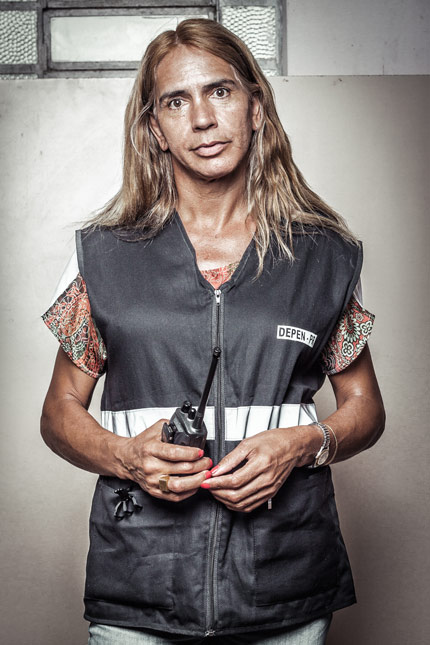
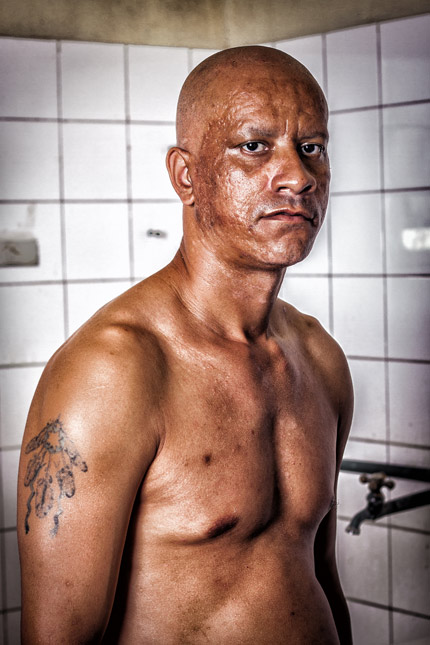
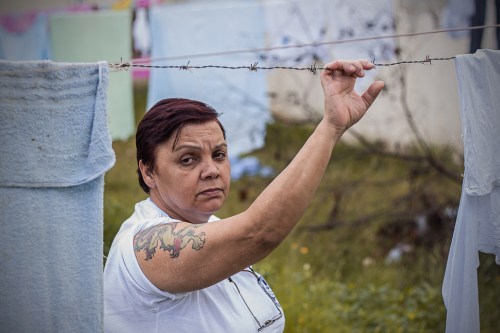
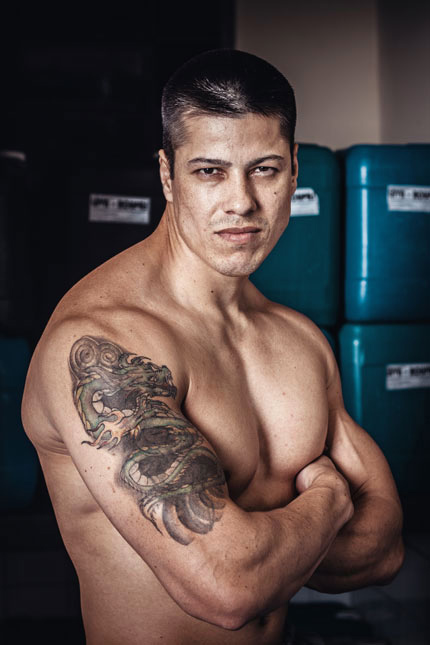
Photographer Milcho Pipin went into the Central Penitentiary of the State of Paraná, in Curitiba, Brazil. It’s a fairly sizable prison with nearly 1,500 prisoners.”Despite frequent overcrowding problems and precarious infrastructural condition, this penitentiary is by no means the worst in Brazil,” says Pipin.
From within this tough institution, Pipin wanted primarily to “capture expressions of male and female prisoners and to understand and share their feelings,” he says.
In collaboration with Dr. Maurício Stegemann Dieter, a criminology specialist, Pipin produced the series Locked Up. Both answered a few short questions I had.
Scroll down for Q&A.
Q & A
Prison Photography (PP): Why did you want to photograph in Central Penitentiary of the State of Paraná?
Milcho Pipin (MP): It all started because of my father. He was a police inspector of foreign crime / border control in Macedonia for 30 years. He went through a lot of cases. His sense of comprehensibility to all social classes inspired me to photograph in prison.
PP: What are attitudes toward prisons and prisoners in Brazil?
Dr. Maurício Stegemann Dieter (MSD): Hostile and cynical.
PP: What do Brazilians think of incarceration in the U.S.?
MSD: Except for some researchers (criminology and criminal law professors, mostly), they don’t have a clue.
PP: What did the staff think of you and your camera?
MP: As the director of the prison informed us, it had been over 40 years since media had access inside, it was pretty shocking to me. That’s why when we entered, the staff was not really sure who we were, how we got there and what was our purpose being inside with a photo equipment.
I explained that there was nothing to do with any political purpose and that it was an artistic project only — to photograph the lives behind those concertina wires. Later, the staff mood changed and they were really helpful showing around the prison and introducing us to the prisoners.
PP: How long can babies stay with their mothers? Until what age?
MSD: From birth up to 6-months. After that, they meet daily for up to 4 hours.


PP: Of the 1480 prisoners, how many are men and how many are women?
Maurício Dieter (MD): 1116 men and 364 women, each in a separate penitentiary.
PP: What did the prisoners think about your photography?
MP: The first day was the hardest. We had a short briefing with the prisoners about the project and I felt their lack of interest as they were not yet sure that we were not there for political purpose.
I explained [to a large group] that the only thing I wanted to do was to take their portraits as they expressed their feelings, and then to show the outside world. Most of them left the briefing, just 7 or so stayed.
I showed my print portfolio to those who stayed and I heard one prisoner saying: “Oh good, ok, let’s do this!” As I started photographing one by one, they spread the news and the interest to have their photo taken became viral in the next days. Almost all of them were friendly with us, with a few exceptions.
PP: Did the prisoners see your photos and/or receive prints?
MP: They saw the photos on the camera display a few moments afterwards. I gave them my website link, so the family could see them online. I did promise prints though, and for sure they will soon receive them. There are still a lot of photos in a finalizing phase so I can start printing and delivering them with pleasure to all the prisoners that collaborated in this project.
PP: Milcho, how do you hope your photographs might alter attitudes?
MP: Hmm, through my photographs I hope people will be able to visualize, feel and understand that we are all at the risk of committing a crime, purposely or not, at any moment of our lives, and of being convicted and facing a sentence. That’s why we should appreciate our freedom, because it’s just one of those big things we usually don’t appreciate until we lose it.
We never know, our future is a dice.
FIN

BIOGRAPHY
Milcho Pipin was born in Bitola, Macedonia. Based in Curitiba, Brazil, Pipin started photography in 2001 as he journeyed across five continents. He focuses on editorial, commercial, documentary and fine art photography. Pipin is founder and creative director of VRV, international creative agency.
All images: Milcho Pipin, and used with permission. Use, manipulate or alteration of any photo without written permission of Milcho Pipin is prohibited.

 Prison Photography