
You are currently browsing the monthly archive for January 2015.

Claudia Cass with her children, Matthew, Kaylee, left, and Courtney in 2006. Credit: Alysia Santo/The Marshall Project
The lives of prison officers, as I have said before, are rarely represented by means of photography. I don’t know if that is the case for other mediums. Regardless, Alysia Santo‘s profile of Claudia Cass, a prison officer in New Hampshire, is essential reading.
“Her work in the prison had become so overwhelming that Matthew, her 11-year old son, was often alone, cooking his own dinner and seeing himself off to school,” writes Santo.
Cass, 42, is so stretched by the long hours of her job she feels unable to care adequately for her son. She made the toughest decision of her life and transferred legal custody of Matthew to her mother.
Imagine that? Having to give up legal custody of your child because you’re spending all your waking hours working in a prison? Crazy and depressing.
Santo writes:
Prison guards are often characterized, whether in news accounts or movies, as living under some constant threat of mayhem. But for Cass and her fellow officers, the recurring nightmare is not a prison riot. It is falling asleep at the wheel after a series of 16-hour shifts. Or nodding off with your sidearm exposed while escorting a sick inmate to the hospital. Or even having to tell your child that you don’t have time to be a mother.
Read 16-Hour Shifts, 300 Prisoners to Watch and 1 Lonely Son

ACTIVIST-SHAREHOLDERING
I love the term “activist-shareholder.” I envision a person wearing protest t-shirts at the AGM, or the organisation of a silent bloc that suddenly bursts into action and derails the agenda of a meeting. Activist-shareholders are moles in the system. Granted they are very visible roles, and it is soon very obvious as to why they have bought shares in a corporation whose practices they oppose, but still. yay for the little man.
Alex Friedmann, associate director of the Human Rights Defense Center and managing editor of Prison Legal News is one such activist shareholder. He made the reasonable proposal that private prisons make attempts to rehabilitate prisoners. Shock horror! And, guess what? The private prison company refused.
I just adore these tactics. If the prison industrial complex is to be dismantled it’ll take an untold amount of imagination and the combination of many tactics. Friedmann’s colleague at Prison Legal News Paul Wright was on hand this week to remind us that talking about the problem is not always doing something about the problem. Wright spoke with Alysia Santo for The Marshall Project, in a provocatively titled interview piece Sure, People Are Talking About Prison Reform, but They Aren’t Actually Doing Anything.
Go forth, let your imagination run wild.
Below, the Human Rights Defense Center press release:
Nation’s Largest Private Prison Firm Objects to Resolution to Fund Rehabilitative, Reentry Programs
Nashville, TN – Last Friday, Corrections Corporation of America (NYSE: CXW), the nation’s largest for-profit prison firm, formally objected to a shareholder resolution that would require the company to spend just 5% of its net income “on programs and services designed to reduce recidivism rates for offenders.”
The resolution was submitted by Alex Friedmann, associate director of the Human Rights Defense Center and managing editor of Prison Legal News. An activist shareholder, Friedmann owns a small amount of CCA stock; in the 1990s he served six years at a CCA-operated prison in Clifton, Tennessee prior to his release in 1999.
“As a former prisoner, I know firsthand the importance of providing rehabilitative programs and reentry services,” Friedmann stated. “I also know firsthand the incentive of private prisons to cut costs – including expenses associated with rehabilitative programs – in order to increase their profit margins.”
Citing data from the Bureau of Justice Statistics, the resolution notes that “Recidivism rates for prisoners released from correctional facilities are extremely high, with almost 77% of offenders being re-arrested within five years of release.” Further, “[t]he need to reduce recidivism rates for offenders held in [CCA’s] facilities is of particular importance, as two recent studies concluded that prisoners housed at privately-operated facilities have higher average recidivism rates.”
The shareholder resolution states that it “provides an opportunity for CCA to do more to reduce the recidivism rates of offenders released from the Company’s facilities, and thus reduce crime and victimization in our communities.”
CCA filed a formal objection with the Securities and Exchange Commission (SEC), seeking to exclude the resolution from its 2015 proxy materials distributed to shareholders. In its objection, CCA argued that the resolution relates to “ordinary business operations,” comparing it to other shareholder resolutions that have, for example, sought to require companies to “test and install showerheads that use limited amounts of water.”
In a press release issued by CCA last year, the company announced “a series of commitments” to rehabilitative programming, stating it would “play a larger role in helping reduce the nation’s high recidivism rate.” At the time, CCA CEO Damon Hininger claimed that “Reentry programs and reducing recidivism are 100 percent aligned with our business model.”
“CCA’s objection to a shareholder resolution that would require the company to spend just 5% of its net income on rehabilitative and reentry programs demonstrates the lack of the company’s sincerity when it claims to care about reducing recidivism,” stated HRDC executive director Paul Wright. “Evidently, retaining 95% of its profits isn’t enough for CCA – which isn’t surprising, because as a for-profit company CCA is only concerned about its bottom line, not what is best for members of the public, including those victimized by crime.”
“If CCA was serious about investing in rehabilitation and reentry programs for prisoners who will be released from the company’s for-profit facilities, then it would not have objected to this resolution,” Friedmann added. “But it did, so we can draw our own conclusions.”
–
The Human Rights Defense Center, founded in 1990 and based in Lake Worth, Florida, is a non-profit organization dedicated to protecting human rights in U.S. detention facilities. HRDC publishes Prison Legal News (PLN), a monthly magazine that includes reports, reviews and analysis of court rulings and news related to prisoners’ rights and criminal justice issues. PLN has around 9,000 subscribers nationwide and operates a website (www.prisonlegalnews.org) that includes a comprehensive database of prison and jail-related articles, news reports, court rulings, verdicts, settlements and related documents.
For further information:
Alex Friedmann
Associate Director
Human Rights Defense Center
(615) 495-6568
afriedmann@prisonlegalnews.org
Paul Wright
Executive Director
Human Rights Defense Center
(561) 360-2523
pwright@prisonlegalnews.org

Image source: ACLU

‘TRIUMPH’
For the Winter Issue of Actually People Quarterly (APQ), I interviewed college professor Nigel Boyle who played the beautiful game in circumstances that most would consider unlikely. Nigel explains, however, that football is a way of life among the Ugandan prison population who welcomed he and other educators with untold warmth.
The theme for the Winter APQ Issue was ‘Triumph.’ Nigel had a good game.
It’s great to publish the APQ article, in full, here on the blog. Thanks to my friends over at San Francisco’s Carville Annex for ongoing collaborations.
FOOTIE
Nigel Boyle is a bit like me. He’s English, he’s quite white, he can’t control his bigger smiles, and he’s a mad football fan. Earlier this year, before I visited Nigel’s hometown of Claremont, California, I contacted him because he had been teaching in his local prison. I wanted to know more about that.
I did not know he had taught in a prison in Uganda this summer, too. Nigel invited me to a soiree at his house. It was a reunion of the faculty, students and administrators involved in the Uganda prison teaching program as well as directors of partner organizations. I was made to feel very welcome.
Nigel supports Aston Villa, who play in claret and blue. They’re based in Birmingham, have existed since 1874, and were one of the 12 founding teams of the English Football League. I support Liverpool who play in red and, down the years, have won more trophies than Villa. Neither team haven’t won many titles in recent decades.
Nigel is one of those lucky people that has managed to merge his passion for a particular sport with his professional pursuits. He has taught seminars on the history and political economy of football and once delivered a conference paper titled “What World Cup and Champions League Soccer Teaches Us about Contemporary Europe.” Before he moved to California to teach at Pitzer College, Nigel taught at Duke and Oxford universities.
During his party, Nigel entered the kitchen clasping a photograph. In it, he was pictured with teeth and fists clenched, in mid-sprint in front of a crowd of onlookers. It looked like he had just kicked a ball. He explained that the onlookers were prisoners in the Luzira Upper Prison, in Uganda. Naturally, I had questions.
Q & A
Prison Photography (PP): Why were you in a Ugandan prison?
Nigel Boyle (NB): I was there as a volunteer with the Prison Education Project (PEP), a California program founded by my colleague Professor Renford Reese. PEP had been invited by a Ugandan academic, Arthur Sserwanga, who has been doing third-level education in Ugandan prisons.
PP: So football in prison?
NB: There are 10 “clubs” at the prison and they are all named after renowned European teams — Man United, Liverpool, Aston Villa, Leeds, Chelsea, Arsenal, Newcastle, Everton, Barcelona and Juventus.
PP: Really?
NB: Really. A league structure is an organizing principle inside. They all have long histories and fan clubs. They adhere to league codes of ethics and conduct. They have transfer windows!
PP: Why were you playing?
NB: I watched several games at the prison – tournaments between a game between the Luzira Upper Prison Team and another prison team (Murcheson Bay Prison) and one between the Luzira Upper Prison Team and the prison staff team. I got antsy as a spectator and put together a team of U.S. students and students from Makerere University. Games are the primary entertainment at the prison, 3,000 spectators. I was not sure when the game was going to happen which is why I was wearing my “teaching kit” not my Villa kit. We were playing the Arsenal club team.
PP: How did the game go?
NB: Arsenal started off by scoring early and then went easy on us as we had some inexperienced players on the team. But then we started to play a bit, got an equalizer and the crowd really got into it. They were supporting us mostly (apart from the Arsenal fans, of course). The crowd was most delighted with the “the girl” on our team, a U.S. student called Ashley. That she could actually play well led to roars of approval. As the old Muzungu* on the field I also drew some cheers when I showed I knew how to kick a ball.
PP: Was it tense?
NB: It was the friendliest “friendly” game I have ever played in. In fact all games at Luzira are played in a very gentlemanly fashion – the prison soccer association constitution demands it and sets explicit standards for player and fan behavior, above anything FIFA* can manage.
PP: What are your strengths and weaknesses as a player?
NB: I’m your basic Brummie* parks player. Good in the air, poor control, good passer, slow. I played at the back most of the game, with 10 minutes to go it was 3-3 and I moved up front.
PP: That’s when your moment of glory came?
NB: I scored with a sidefooted shot from 15 yards out, with only 8 minutes of the game to go. The crowd which was about 3,000 roared.
PP: A crowd of 3,000!?!?
NB: My childhood fantasy came true. Then I scored again. I was through on keeper, chasing down a clearance. We won the game. Being “interviewed” about my performance in this game only adds to the sense of my childhood dream coming true at the age of 53! After the game there were speeches (there always are after Luzira UP games). I thanked the Upper Prison Football Association, and it’s president-prisoner Opio Moses, whom I’m proud to call a friend.
PP: Will you ever play in front of a crowd that big again?
NB: Only if I get back to Luzira again, and I would love to do that.
PP: Are you at all tempted to retire on a high?
NB: I know guys in their 60s still playing pick-up soccer and I intend continuing as long as my knees hold out. But this is the story I will be telling my grandchildren.
PP: What’s football got to do with education?
NB: I’ve taught a course on comparative political economy through football (or soccer/futbol/fussball) eight times, at three institutions: Pitzer College, the University of Landau in Germany, and at California Rehabilitation Center, which is a prison in Norco. Is there a better lens for understanding contemporary globalization out there? Certainly not one that engages students the way the beautiful game does.
PP: How do Uganda prisons differ from those in the U.S.?
NB: U.S. prisons use vast human and financial resources to dehumanize prisoners and deny them the ability to function as social beings. I’m only familiar with Level 2, medium-security prisons in the U.S., but these are militarized holding pens.
Luzira Upper Prison is the top maximum security prison in Uganda, but staff carry no weapons, look prisoners in the eye, and treat prisoners as potential co-managers of the prison, not as human refuse. Resource starved Ugandan prisons allow prisoners to organize themselves into a civil society behind walls, and it’s through the football clubs and the Prison Football Association that prisoners have organized and bargained with prison staff.
Upper Prison Luzira was a colonial prison designed to incarcerate and punish men who threatened British law and order. In the last 20 years, this colonial shell has been allowed to sprout prisoner-led education (literacy through degree levels), and sports and cultural organization that provide a training in how to be a productive citizen. U.S. prisons talk about “rehabilitation” but appear to be designed to induce PTSD.
PP: Thanks Nigel.
NB: Thank you, Pete.
A GLOSSARY OF TERMS
Brummie = a person born in Birmingham, England.
Muzungu = Swahili word for white man.
FIFA = The International Federation of Football Associations, known most recently for its bloated coffers, back room deals, golden handshakes and rampant corruption.
Photographer, friend and fellow San Franciscoer Robert Gumpert will be exhibiting at St. Mary’s College in Moraga, California from January 25th to March 15th.
On show will be photographs from two projects — Gumpert’s ongoing Take A Picture, Tell A Story, and images from “I Need Some Deodorant. My Skin Is Getting Restless” which were made between 1996 and 2002 at the Alameda County’s Psychiatric Emergency Services at John George, Oakland. In both bodies of work, Gumpert uses oral history (audio and text interviews) to add description, depth and context to the experiences of his subjects.
If you’re in the Bay Area, I strongly recommend a trip through the Caldecott Tunnel out to Moraga.I’ve long been an admirer of Gumpert’s work, specifically Take A Picture, Tell A Story which is part of my curated effort Prison Obscura.
Prior to the public reception on January 25th, will be an hour long panel discussion with Gumpert; architect/activist Raphael Sperry; and psychologist/authority on solitary confinement Terry Kupers.
Click on the flier below to see it larger and glean all the critical information.


Tameika Smith, San Francisco, CA. SF CJ2. 9 July 2012.

Deborah Lee Worledge, San Francisco, CA. CJ1 Men’s jail. 4 April 2008.

Michael Johnson, San Bruno, CA. CJ5.

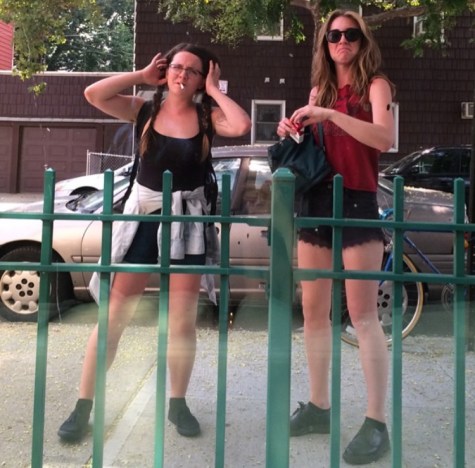
I wrote about the Greenpoint Glass Selfie Window for Vantage, on Medium — All Of Us, Looking at You, Looking at You.
“Molly’s living room window — Greenpoint’s own ‘Selfie Window’—is a local landmark. Over the past year, a small patch of Brooklyn pavement has become a haven for impromptu portraits, in-jokes among friends and street performances.”
Follow @greenpointglass on Instagram — they’re one of my favourites.








Photographer unknown. Group holding cages, C-Yard, Building 13, Administrative Segregation Unit, Mule Creek State Prison, August 1, 2008
The coalition activist groups Californians United for a Responsible Budget (CURB) are doing tremendous work at tracking was is said as compared to what is done by the Golden State’s politicians. Governor Jerry Brown has been particularly adept at appeasing the centrist and liberal leaning electorate without ever taking bold action to reduce California’s reliance on incarceration.
This morning, Gov. Brown announced an increase in spending on corrections at the state level. Not acceptable.
You may wonder why I focus on California so much. Well, aside of the fact it is my home state, California is often a bellwether for actions in other states. California was the first to enact Three-Strikes-And-You’re-Out Laws in the mid-nineties and it was the first to repeal them at the ballot in 2014.
California is a massive economy — bigger than most nations — and yet inequality in the Golden State has never been more stark. California tells itself it is a global leader. However, if that were true it would be spending less money on cages and more money on education, rehabilitation, and initiatives to build healthy communities.
Today’s announcement from the Governor’s office simply is not good enough. Here’s CURB’s response:
CURB PRESS RELEASE
California Governor Jerry Brown Backslides on Corrections Budget, No Substantial Reductions to the Prison Population Except Costly Expansion
Gov. Brown’s 2015-16 Budget, released this morning, defies comments earlier this week that the administration is committed to shrinking California’s over-sized prisons by increasing prison spending by 1.7%, bringing the total Corrections budget up to $12.676 billion.
“If the Governor believes that ‘we can’t pour more and more dollars down the rat hole of incarceration’ and has actively attributed the voice of the voters in this decision, then why is he increasing spending on corrections, planning for more prisoners rather than fewer and defying the demands of the Federal Court to further shrink the prison system?” asked Christina Tsao of Critical Resistance. The proposed increase of funding for corrections is partially due to 13 new reentry hubs.
California’s overwhelming passage of Prop. 47 was widely recognized as a mandate from voters to further reduce the prison population. County officials in Los Angeles have estimated an annual reduction of 2,500 in their jail population, however today’s budget predicts that in 2015-16 only 1,900 people will be released from state prison under the proposition. The budget highlights the release of people from prison as a result of the expansion of good-time credits (4,418) and elder parole (115). The budget does not outline any further plans to expand these efforts.
“Today’s budget shows the success of parole and sentencing reform measures in beginning to reduce crowding in California’s bloated prisons,” said Diana Zuñiga, Statewide Organizer for Californians United for a Responsible Budget. “Then why is Governor Brown still spending millions of dollars to open thousands of new prison beds, instead of implementing even more aggressive population reduction reforms?” asks Zuñiga. The budget anticipates that 2,376 new state prison beds will open in Feb. 2016 at 3 different locations.
“Today’s budget maintains California as #1 in poverty and #1 in prison spending. This is not an accident, “ said Vanessa Perez from Time for Change Foundation. “This morning Brown applauded the legislature on a balanced budget but we need to tear down the wall of poverty and invest more into vital programs and services that will lift the most vulnerable in our community out of poverty and stop wasting money on building new prisons walls. That is something that will be worthy of an applause”.
After years of cuts, today’s budget includes an increase in spending on K-12 and higher education. Education advocates, particularly in the UC system would like to see even further increases to prevent tuition hikes. “Higher educations in California has needed more funding for years. As we see tuition hikes happening for UC students across the state, here in San Diego they are building new prison beds at Donovan State Prison,” says Allyson Osorio a student working in External Affairs at UC San Diego. “We should support the students in California and stop wasting precious funding to increase incarceration.”
——
CURB Press Contact
Emily Harris, Statewide Coordinator, Californians United for a Responsible Budget
1322 Webster St. #210
Oakland, CA 94612
510-435-1176
emily@curbprisonspending.org

I was invited by WIRED to write about Josh Begley‘s work Prison Map. The article is Aerial Photos Expose the American Prison System’s Staggering Scale:
There are some 2.2 million people behind bars in the United States. That’s more people than there are in all of New Mexico. And there are more jails and prisons than colleges and universities in this country. Still, it can be difficult to grasp the scale of incarceration in America, in part because so many of these facilities are tucked away far from view in rural areas.
Prison Map provides a sense of the enormity of it all by giving us a fascinating vantage point from which to view the architecture of incarceration. Begley’s created a vast visual compendium of the nation’s jails and prisons, comprising more than 5,300 aerial images that offer a compelling metaphor for the rapid expansion of the American prison system.
“Prison Map is about visualizing carceral space,” says Begley. “We have terms like the ‘prison industrial complex’ but what does that actually look like? If you were to stitch together all these spaces of exception, how might they appear from above?”
Read more at WIRED.








The Abolitionist Law Center is doing wonderful things to hold morally-bankrupt and cowardly Pennsylvanian politicians to account.

 Prison Photography