
You are currently browsing petebrook’s articles.
Ken Light won Round One in the small claims division of the Superior Court of California in San Francisco on December 23. He claimed unfair business practices under state law because Current TV used his 1994 image of Texas death row inmate Cameron Todd Willingham without permission. Light won and Current TV was ordered to pay a retroactive licensing fee and damages to the tune of $588.
Well, Gore survived the count and is up for Round Two. Current TV are claiming their use was “fair use”. Conor Risch of PDN Pulse:
Current TV has appealed to San Francisco Superior Court, where its lawyers will be able to mount a more vigorous defense against Light’s claim.
That will cost Current Media a lot more than simply paying the small claims judgment. But the media company has a self-interested principle to defend: the right to use news photos at will without permission, and without payment. A trial date has been set for April 14.
Again, stay tuned folks …

Inmates in Discussion © 2009 Ged Murray
It might be that the anniversary of the most famous riot in the history of the British prison system will become an annual feature on Prison Photography?
Last year, I noted the 19th anniversary of the Strangeways Riot with looks at the work of Ged Murray and Don McPhee. This year for the big 20, I’ll point you in the direction of Ciara Leeming, fellow blogger, Northerner and Thatcher-basher. (Why is it that we children of the late seventies/early eighties can’t get out from under the iron lady’s shadow?)
Ciara:
Ciara’s just written a piece for Big Issue in the North, the UK’s magazine sold by homeless vendors in cities up and down the Isle. Download Ciara’s Big Issue feature here.

Armed police barricaded the gates of Drik Gallery to prevent the exhibition Crossfire, organisers opened the exhibition on the streets outside of the Drik Gallery. March 22, 2010. © Saikat Majumder/DrikNews/Majority World
Since the March 23rd censure and closure of Shahidul Alam’s exhibition at the Drik Gallery by Bangladeshi police, events have been well reported and BLOGGED!
Robert Godden who writes the The Rights Exposure Project blog looked forward to the exhibition but warned it may face closure. David Campbell noted Rob’s foresight with his post ‘Crossfire’ censored – the power of documentary photography (cross-posted on A Developing Story blog)
LENS Blog followed up its preview by catching a soundbite of Alam‘s and reflecting his pride in the mobilisation of protestors:
“It really has galvanized public opinion. People were angry and ready — they just needed a catalyst. The exhibit has become in a sense iconic of the resistance.”
Peter Marshall has been as diligent as ever with two posts – Crossfire and More on Crossfire
100Eyes also had the scoop with a large image of the human chains an d protestors. Robert Godden returned to the issue highlighting the very serious issue of Death threats issued to organisers. Eyeteeth (a new favourite of mine) also followed the shut-down.
Of course, if you only have time for one source it should be Shahidul Alam’s own blog, to which two posts have been posted – firstly, Siege of Drik Gallery and secondly Drik: Photo power.
– – –
What’s my point? My point is that if we bloggers are to be be labelled prairie dogs (here and here), perhaps we should be noted for our hard work, solidarity and a long gaze that goes further than the end of a trustee’s vault?
Sometimes the name of this weblog-journal means that I simply cannot overlook certain stories or acts of publishing.

@ Tim Dirven / Panos Pictures
In the past couple of hours, the Guardian website ran a nine image Guantanamo photo-gallery. The gallery launches from the largest and most prominent rectangle of the new Guardian redesign, i.e. it is the top story on the home page.
I can only assume that this is an editorial decision to keep Guantanamo in people’s minds? After all. we’ve been distracted by healthcare reform in the US, the chancellor’s TV debate in the UK, Israeli obstinacy in the Middle East and a new guise of terrorism in Russia for which our numbed minds must recalibrate.
I can only assume this is the Guardian’s decision because the essay is totally non-descriptive – in that it is nothing new. We know there are Uighurs, Chinese separatists, who shouldn’t be there; we know they play soccer in cages, we know there are well-cushioned shackles bolted to pristine concrete floors; and we know detainees on hunger strike are force-fed Ensure by tube.
All I want to say is that you should look elsewhere for Guantanamo imagery. My Guantanamo: Directory of Photographic and Visual Resources is a good place to start.
I’ve also provided the previous insights which go beyond Dirven’s nine illustrative images:
Suicide at Guantanamo?
Justice Denied: Voices of Guantanamo
Bruce Gilden once went to Guantanamo
Interview: “Jane Smith” Former Gitmo Guard
Paula Bronstein: Guantanamo Detainees Young and Old
“There is a lot of long lens imagery of Guantanamo prisoners in their orange boiler suits, but I don’t know what that’s telling me.”
A Dozen Visits to Guantanamo
‘Guantanamo’ by Paolo Pellegrin
Guantanamo Photo Essay
– – –
None of this reflects on Tim Dirven. Dirven is a good photographer and photojournalist (check out his work on Orthodox Christians in Ethiopia).
It’s simply impossible to produce a novel photo-essay when the Joint Task Force of Guantanamo walks you around the camp … and they do it every week … with different journalists.
The US military’s media detail is as well-drilled as any other detail at Guantanamo. In fact, I’d go as far to say that the media-liaisons are, at this point, the most critical employees on the base.

As a foil to the non-committal position of my last post, Jim Johnson has posted a very important statement about the label – and according judgement – that should fall upon America’s homegrown terrorists.
What’s the difference between a terrorist and an “apocalyptic Christian militant”? A must read.

© Pavel Maria Smejkal. From the 'Stars' series
For some, my deliberations about Bruce Gilden/Haitians might seem tepid compared to Pavel Maria Smejkal‘s use of people-as-props for his photographic art.
Smejkal’s Stars series is potentially about the reversal of fates, wasted potential, chance events and turns of fortune. It is also potentially insulting.
The question for me is whether digital composites of Auschwitz inmates and the faces of silver-screen stars is a good way to communicate an actually important philosophical position. Mrs. Deane (Beierle or Keijser) can’t say that Smejkal’s work is a success or not because they stumble at its first requirement to recognise the faces of inserted celebrities! Which is a nice side-step.
I too intend to hang up my judgement on this and simply pass on notice of the project for you to decide. My editor said a few months ago that Western culture – and photography in particular – had no sacred cows left to slaughter. In the manner in which sentiment and controversy whirl past without touching the sides these days, right now, I am inclined to agree.
– – –
Just as a footnote, Smejkal’s Stars series reminds me of Agan Harahap’s work Super Hero.
“We never sat down, as far as I know, and came up with a grand strategy. Everything was very reactive. That’s how you get to a situation where you pick people up, send them into a netherworld and don’t say, ‘What are we going to do with them afterwards?’ “
Former senior US intelligence officer. (Source)

Mihail Kogalniceanu air base. Romania. @ 44.36043300, 28.49149700
Since 2001, the US has operated a program of rendition, illegal torture and operated a network of secret prisons and CIA “Black Sites”.
Men captured as part of the Bush and Obama administrations’ program were are interrogated, physically & psychologically beaten and denied human rights.
Images of these secret prisons are not common, but I’ve peppered this piece with a few just for the sake of the exercise.
At the top of this article is Mihail Kogalniceanu air base, Romania. It was used for “high-level” detainees from as early as 2005. Beneath is Kiejkuty Stare an illegal CIA prison just 20 miles away from Szymany airport, Poland. (source) It was used as early as 2005 and its function was confirmed in 2007. (source)
Khalid Sheikh Mohammed, “the mastermind of 9/11”, claims he was submitted to waterboarding 183 times over a one-month period. New evidence suggests he was interrogated in Poland. (More from Der Spiegel here and here).

Kiejkuty Stare
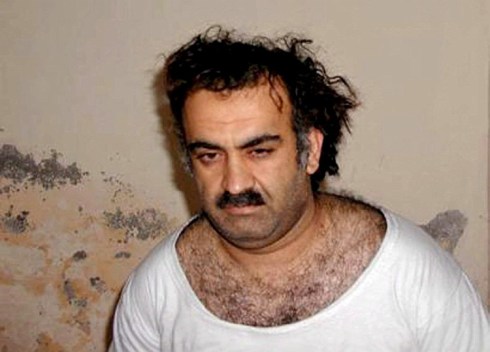
Khalid Shiekh Mohammed
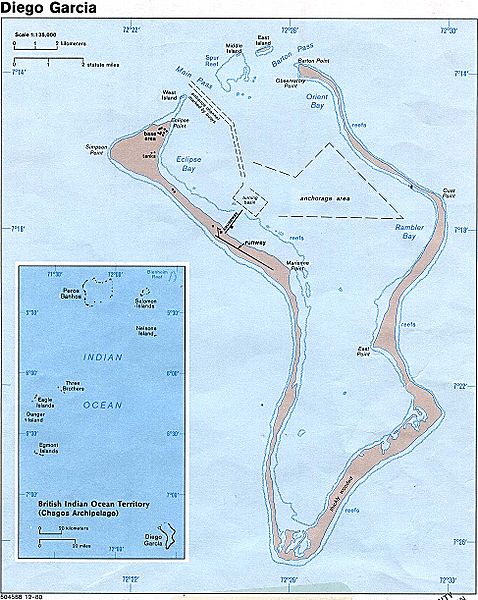
Diego Garcia Island, Indian Ocean, United Kingdom Territory. Rendition Flights Refuelled on the Island in 2002.
The UK Government provided infrastructural support for America’s extraordinary rendition program allowing rendition flights to refuel on Diego Garcia (above), a British territory in the Indian Ocean. (More here and here).
– – –
Below is the plan of a cell used during the 19 month illegal detention of Mohamed Farag Ahmad Bashmilah, a Yemeni national. Salon reports:
Bashmilah’s story also appears to show in clear terms that he was an innocent man. After 19 months of imprisonment and torment at the hands of the CIA, the agency released him with no explanation, just as he had been imprisoned in the first place. He faced no terrorism charges. He was given no lawyer. He saw no judge. He was simply released, his life shattered.
In 2007, Salon did a thorough job in describing his detention and its aftermath, even presenting plans based on Bashmilah’s descriptions of torture and interrogation rooms. No-one knows for certain where these cells were, but it is suspected they were within Afghanistan.
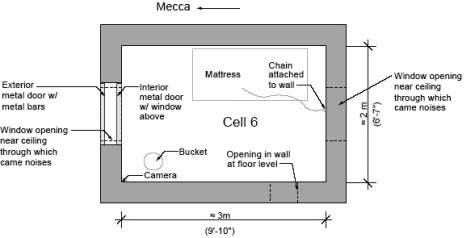
Exhibit I: Rendering of Mohamed Farag Ahmad Bashmilah's first cell in Afghanistan (based on Bashmilah's own drawings). Source: Salon.com
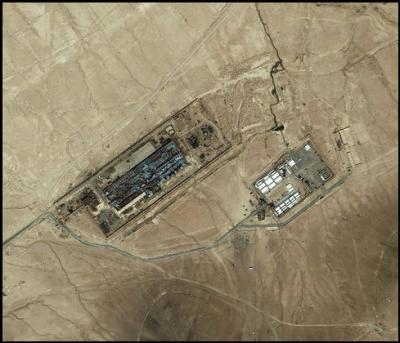
In Afghanistan, the largest CIA covert prison was code-named the Salt Pit, at center left above. (Space Imaging Middle East). Source: Washington Post
The most notorious Black Site in Afghanistan is referred to as ‘The Salt Pit’.
The Salt Pit brings us to Trevor Paglen‘s geography, photography and investigative academics, but first let me point out a couple more excellent resources.
When the details of rendition broke in 2007, Jane Mayer led the exposé with her book The Dark Side. Read a book review here and her extended New Yorker essay here.
FRONTLINE produced this astonishing interactive graphic showing all the illegal prisons and all the US aviation front-companies used for the rendition flights. That map is part of a larger presentation with interviews, time-lines and further resources.
More recently, Anand Gopal has revealed the US military’s still recent tactic against the Taliban in Afghanistan of by-night kidnappings. The result? The US has lost the support of the Afghan people toward the American project. Read America’s Secret Afghan Prisons here.
Just this month, Stephen Lendman summarised the January 26th UN Human Rights Council (HRC) report ‘Joint study on global practices in relation to secret detention in the context of countering terrorism’ which details practices by various countries “including America, by far the world’s worst offender in its war on terror.” The full report is here (Word) or here (pdf).
Lendman’s words The truth is shocking:
“Besides Guantanamo, Afghanistan and Iraq, HRC said the CIA runs scores of offshore secret prisons in over 66 countries worldwide for dissidents and alleged terrorists – in Egypt, Algeria, Jordan, Morocco, Syria, Libya, Tunisia, India, Pakistan, Russia, Uzbekistan, Sudan, Zimbabwe, Ethopia, Djibouti, Kenya, Poland, Romania, Bosnia, Kosovo, Thailand, Diego Garcia, and elsewhere.” (Source)
Onward. Now, Paglen …
TREVOR PAGLEN
The two images below are by Trevor Paglen. The first is the Salt Pit and the second is a military jail in Kabul. They are also his most ordinary of images … the only images he could capture in the circumstances.
Paglen isn’t primarily concerned with prisons; he is concerned with all the unseen activity of the military industrial complex – aviation companies, air strips, covert ops, air bases, Pentagon annual budget projections, spy satellites, shadow NASA reconnaissance agencies … the list goes on.
After meeting Emiliano Granado last Summer, he posted a good one-stop description of Paglen’s work. Granado also posted some good examples of Paglen’s Limit Telephotography and The Other Night Sky series. Check those out and then skip to Paglen’s lecture at the foot of this post.
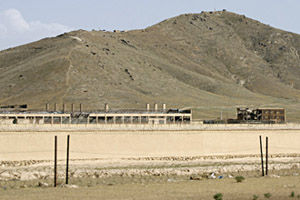
The Salt Pit, Shomali Plains Northeast of Kabul, Afghanistan. Trevor Paglen: The Salt Pit is located in an old brick factory a few miles northeast of Kabul, along an isolated back-road connecting Kabul to Bagram.

Black Site, Kabul, Afghanistan. Trevor Paglen: This site was brought to my attention by Afghan journalists and human rights activists in Kabul. The code name of this site remains unknown.
LECTURE
I have waited for a long time for an online presentation of Paglen’s oeuvre to which I could refer PP readers. (Thanks Alejandro!)
It’s quite the thrill to be brought in on Paglen’s sleuth work, as he walks us through the various public records used to piece together the rendition program. If you can spare an hour this weekend, you’ll be thankful for the education!
FORTHCOMING BOOK
Paglen’s work is to be published by Aperture in a book titled INVISIBLE. You can see Paglen and publisher Lesley Martin discussing the project here.

NYC103226 © Bruce Gilden / MAGNUM Photos
Gilden makes no bones about his style. He’s brash and in-yer-face. It’s his visual brand.
He doesn’t change his brand. With his surprise tactics, Gilden makes fun of New Yorkers as much as Texan millionaires as much as Guantanamo soldiers. (Might he also employ subtler approaches than the video below suggests?)
And why should he change his visual brand? He’s worked hard at it and we have supported it his whole career.
On the front page of magnumphotos.com today are a few of his shots from the Haiti earthquake aftermath. Should Gilden have changed his approach for his 2010 Haiti portfolio?
No, I don’t think Gilden should change his style; I think Gilden should’ve just stayed away.
This is my own personal opinion and I am not interested in any crusade against Gilden’s assumed approach or ethics. I just didn’t want to let his work pass without saying that I find it quite uncomfortable. This project isn’t the sort of thing I want to look at.
GILDEN REPEATS TOWELL’S MISTAKE?
A couple of weeks ago John Sevigny had a serious pop at Larry Towell (also of Magnum) for “gratuitous, racist and disgusting” work. I posted it, the Click picked it up and there was a short discussion at Lightstalkers.
I see where Sevigny’s coming from but I also appreciate comments which add a bit more subtlety to the debate – namely that exposed breasts are not always to be sexualised or considered part of an unequal power dynamic. This is just imposing ones own sensitivity upon another culture. More problematic is the fact the bare-chested woman is unable to move from the hospital bed away from Towell’s directed lens. Anyway, I digress, Gilden’s Haiti work is the topic at issue.
The situation with Gilden is slightly different. I must pause here and state that Gilden has photographed Haiti many times before (1988, 1989, 1990, 1992, 1995); he has perhaps been as many as a dozen times? And yet, I feel as though Gilden’s images of victims (many amputees) in the MSF hospital are feeding the same distant disdain we reserve for drunk and bloodied hipsters in our faux-fashion magazines (Vice). Isn’t Gilden’s work going to get caught up in a visual culture that often replaces even slightly careful representation with the thrill of gore and body fluids?
I take issue with Gilden’s style as used in Haiti, now. To me personally, Gilden’s style mocks its subjects. I can’t get away from that. I would fully anticipate Gilden arguing (very well) just the opposite – that he cares deeply about different shapes, colours, countenances and circumstances of all the people at whom he launches his lens and flash.

NYC103269 © Bruce Gilden / MAGNUM Photos
After the MSF hospital Gilden goes on to make a typology of survivors’ structures and portraits of beggars, tent city dwellers and the mentally ill.
So, I want to ask. Do I have a point? Do you share my aversion to Gilden’s work in the aftermath of this natural disaster of a quarter-million fatalities?
Magnum has made a public commitment to funding work in Haiti, but should we maybe have hoped that the members had encouraged Gilden to perhaps sit this one out?

 Prison Photography